The Telehealth MVP Playbook for US Founders: State Licensure, ePrescribe, Eligibility, and the UX That Actually Works


Create engaging, high-performance mobile applications tailored to your business needs. We craft future-ready apps that offer smooth user experiences on all devices.
Build robust and scalable websites and CMS platforms that help you manage content effortlessly. Our development ensures a seamless digital presence.
Launch secure, feature-rich online stores with intuitive shopping experiences. We build tailored eCommerce platforms designed for growth.
Design captivating games with immersive gameplay and stunning graphics. From concept to launch, we build engaging experiences that players love.
Enhance your customer relationships with customized Salesforce implementations. Drive growth and efficiency with smarter CRM solutions.
Harness artificial intelligence and machine learning to automate workflows and gain actionable insights. Our AI transforms data into smart decisions.
Accelerate your software delivery lifecycle with continuous integration, delivery, and infrastructure automation to boost efficiency.
In March 2023, a women’s health founder in Los Angeles came to us with a product that had been live for four months. $4.2M raised. A beautifully designed telehealth platform connecting patients with OB-GYNs for virtual consultations. Her NPS from patients was 71. Her provider retention was strong. Her board was happy.
Then her healthcare attorney sent a memo.
Three of her seventeen contracted providers were seeing patients in states where those providers were not licensed. The platform had no licensure verification logic, it matched patients to available providers by specialty and time slot, not by the provider’s active state licenses. A provider licensed in California and Nevada had seen patients in Arizona, Oregon, and Colorado through the platform. The platform had facilitated unlicensed medical practice in three states.
The financial exposure was significant. The reputational exposure was worse. She pulled those providers from interstate consultations immediately, refunded the affected patients, and engaged a healthcare attorney at $650/hour to assess the liability. She has not told me the final number. What she told me was that the licensure verification logic would have cost $18,000 to build correctly from the start.
Every telehealth product is, at its core, a licensure management problem wrapped in a video call. The founders who understand this build it right. The founders who think telehealth is a video call with a medical form attached pay for that misunderstanding eventually.
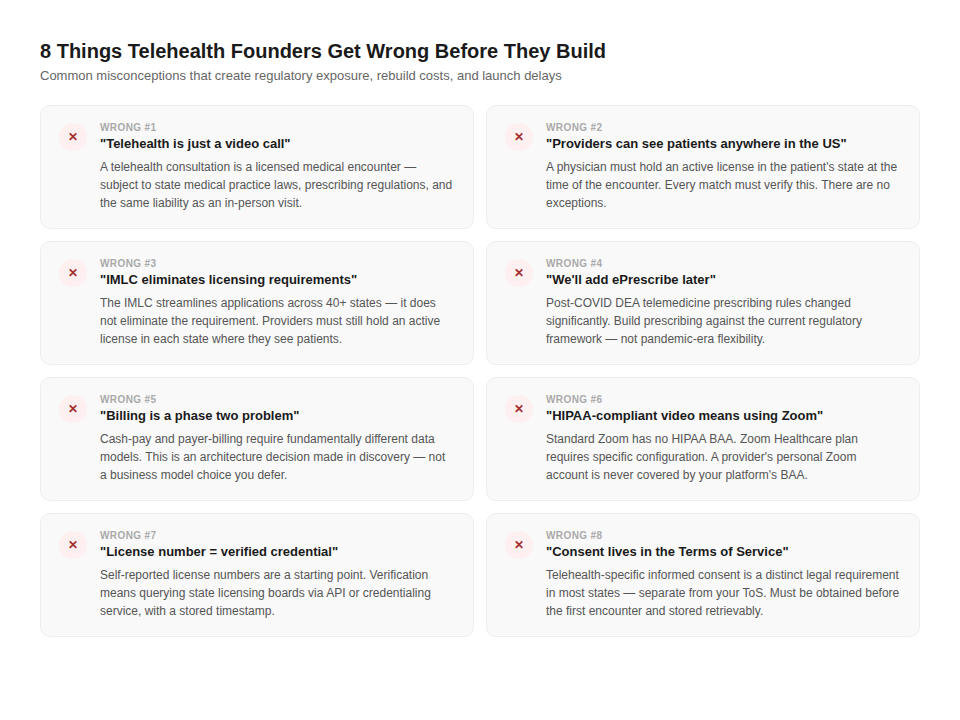
A telehealth consultation is a medical encounter. It is subject to the same state medical practice laws, the same prescribing regulations, the same documentation requirements, and the same liability exposure as an in-person visit. The video call is the delivery mechanism. The regulated product is the medical encounter that happens through it.
No. A physician is licensed to practice medicine in specific states. Seeing a patient located in a state where the physician is not licensed, even via video, is the unlicensed practice of medicine in that state, regardless of where the physician is physically located. Your platform must enforce this. Every patient-provider match must verify that the provider holds an active license in the patient’s state.
The IMLC covers 40+ states and makes it faster for physicians to obtain licenses in additional IMLC member states. It does not eliminate the licensing requirement, it streamlines the application process. A physician must still hold an active license in each IMLC member state where they see patients. PSYPACT covers psychologists across 42 states. The Counseling Compact covers licensed professional counselors. Nurse practitioners, physician assistants, and therapists have their own compact frameworks, each with different member states and different requirements.
If your clinical use case involves prescribing, and most telehealth use cases eventually do, ePrescribe is not a feature you add later. The DEA’s telemedicine prescribing rules changed significantly in 2025 following the COVID-19 public health emergency expiration. The current framework for controlled substance prescribing via telehealth requires an in-person evaluation in most circumstances unless specific exceptions apply. Build prescribing capability with the current regulatory framework in mind, not the pandemic-era rules.
Maybe. But the decision of whether you are a cash-pay platform or a payer-billing platform is an architecture decision, not a business model decision you can defer to phase two without engineering consequences. A cash-pay telehealth platform and a payer-billing telehealth platform have fundamentally different data models, compliance requirements, and integration needs. Decide in discovery. Architect accordingly.
Standard Zoom does not include a HIPAA BAA. Zoom’s Healthcare plan does, but it requires specific configuration and the BAA covers only specific Zoom services. The consumer Zoom your provider is already using on their laptop is not covered. Your telehealth platform must use a video infrastructure provider that offers a HIPAA BAA and must ensure that providers use the platform-provided video interface, not their personal consumer video accounts.
A provider providing their license number is not the same as your platform verifying that the license is active, unrestricted, and valid in the patient’s state at the time of the encounter. Credential verification means querying state licensing boards, either directly via API or through a credentialing service like Medallion, Verifiable, or MD Verify, and storing the verification result with a timestamp. Self-reported license numbers are a starting point for verification, not verification itself.
Telehealth-specific informed consent is a distinct legal requirement in most US states, separate from your platform’s general terms of service. Many states require that patients explicitly consent to the telehealth modality, acknowledging that they understand they are receiving care via video rather than in person, that they have the right to refuse telehealth, and that the provider is licensed in their state. This consent must be obtained before the first encounter and documented in a way that can be retrieved if a licensing board or attorney requests it.
Before you build, define exactly what category of telehealth product you are building. The regulatory requirements, the data architecture, and the integration needs differ significantly across these categories.
The provider and patient interact in real time via video. This is the most common telehealth model. Requirements: HIPAA-compliant video infrastructure, real-time licensure verification, encounter documentation, ePrescribe if prescribing is in scope, consent workflow, provider scheduling and availability management.
The patient submits information, photos, questionnaire responses, medical history, and the provider reviews and responds asynchronously. Common in dermatology, ophthalmology, and certain primary care use cases. No live video required. Requirements: HIPAA-compliant file storage, structured intake forms with clinical data collection, provider review queue and response workflow, documentation of the asynchronous encounter, and, importantly, the same licensure requirements as synchronous telehealth. The provider must be licensed in the patient’s state even if they never speak to the patient in real time.
Covered in Guide 5. The provider monitors patient-generated health data from connected devices over time. Different reimbursement model (CPT codes 99453/99454/99457), different data architecture (time-series device data rather than encounter records), different provider workflow.
Many modern telehealth products combine both models, an initial asynchronous intake followed by a synchronous video consultation for complex cases, or ongoing asynchronous monitoring between synchronous check-ins. The engineering complexity is additive. Plan for it in discovery.
Carries additional regulatory considerations: 42 CFR Part 2 for substance use disorder, state-specific mental health parity laws, crisis intervention protocol requirements, and PSYPACT licensure compact for psychologists.
Dermatology, cardiology, neurology, endocrinology, and other specialty telehealth products have specialty-specific workflows, documentation requirements, and in some cases specialty-specific regulatory frameworks (e.g., FDA requirements for AI-assisted diagnostic tools in dermatology or cardiology).
From a US founder call: “I spent three months scoping a telehealth platform before I realized I hadn’t decided whether it was synchronous or asynchronous. My engineer had built half of a live video infrastructure before we figured out that our dermatology use case was almost entirely asynchronous, photos and questionnaires, reviewed by dermatologists within 24 hours.
We rebuilt. It cost us eight weeks and $40,000. The question ‘synchronous, asynchronous, or hybrid?’ is the first question you answer in discovery, not the third month of build.”, Seed-stage specialty telehealth founder, Chicago.
State licensure is the most underestimated engineering problem in telehealth. Here is the full picture.
Medical practice is regulated at the state level in the United States. A physician, nurse practitioner, physician assistant, therapist, or any other licensed healthcare provider is licensed to practice in specific states. Practicing medicine, including via telehealth, in a state where the provider is not licensed is the unlicensed practice of medicine, a criminal offense in most states.
The patient’s location at the time of the encounter determines which state’s medical practice laws apply, not the provider’s location, not the platform’s headquarters. A provider in Texas seeing a patient in New York via video is practicing medicine in New York and must hold a New York license.
Your platform must enforce licensure compliance at every patient-provider match. This means:
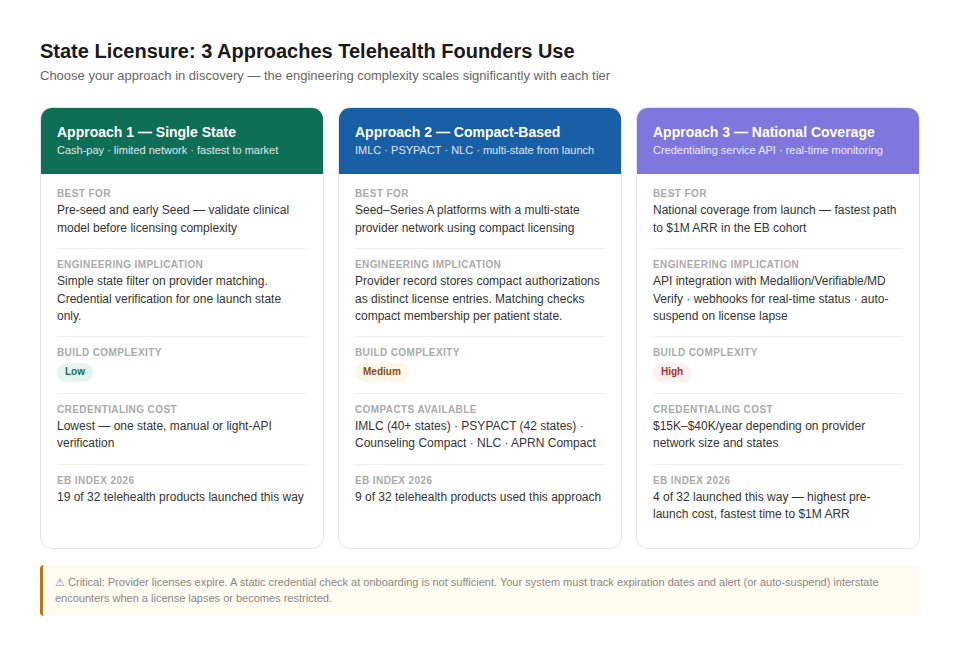
Approach 1: Cash-pay, single-state, limited provider network Launch in one state with a small, fully credentialed provider network. Every provider holds a license in that state. No interstate matching logic needed in v1. Expand to additional states as the provider network grows and licenses are obtained. This is the right approach for pre-seed and early Seed founders who want to validate the clinical model before scaling the licensing complexity.
Engineering implication: simple state filter on provider matching. Credential verification for the single launch state. Fast to build, easy to maintain. The right v1 architecture for most early-stage telehealth startups.
Approach 2: Compact-based multi-state coverage Use provider licensing compacts to enable interstate coverage from launch. The IMLC allows physicians who hold a license in their principal state of practice to obtain licenses in other IMLC member states (40+) through an expedited process. PSYPACT allows licensed psychologists to see patients in 42 member states under a single authorization. The Counseling Compact, the Nurse Licensure Compact (NLC for RNs), and others cover additional provider types.
Engineering implication: the provider record stores each active compact authorization as a distinct license entry. The patient-provider matching logic checks compact membership for the patient’s state. You still need verification logic, compact membership does not eliminate the licensing requirement, it streamlines obtaining licenses in compact member states.
Approach 3: National coverage via credentialing service integration For platforms targeting national coverage from launch, integrate a credentialing service, Medallion, Verifiable, MD Verify, or Nursys for nurses, that performs primary source verification of provider credentials across all US states and provides ongoing monitoring for license status changes, disciplinary actions, and expirations.
Engineering implication: API integration with the credentialing service, webhook handling for real-time license status updates, automated suspension of interstate encounters when a provider’s license in a given state lapses or is restricted. The most robust approach. Also the most expensive, credentialing services charge per provider per state per verification, with ongoing monitoring fees.
EB Index 2026: Across 32 telehealth products we have shipped for US founders since 2020, 19 launched with Approach 1 (single-state), 9 launched with Approach 2 (compact-based), and 4 launched with Approach 3 (national credentialing service). The 4 that launched with Approach 3 had the most complex builds and the highest pre-launch cost. They also had the fastest time to $1M ARR after launch, because national coverage was a selling point their competitors couldn’t match.
Red flag: Any telehealth product that matches patients to providers without a licensure verification step, even in a beta or “soft launch”, is facilitating potential unlicensed medical practice from Day 1. There is no beta exception to medical practice law. Build the licensure verification before you onboard your first real patient.
Compliance trap: Provider licenses expire. A provider who was licensed in 12 states when they onboarded may be licensed in only 9 states six months later if they let some licenses lapse.
Your system must track license expiration dates and alert, or automatically suspend, interstate encounters when a license expires. A static credential verification at onboarding is not sufficient. You need ongoing monitoring.
Before your engineering team writes a line of code, work through these fourteen questions. Each one is an architecture decision or a compliance decision that is cheaper to make explicitly in discovery than to discover implicitly post-launch.
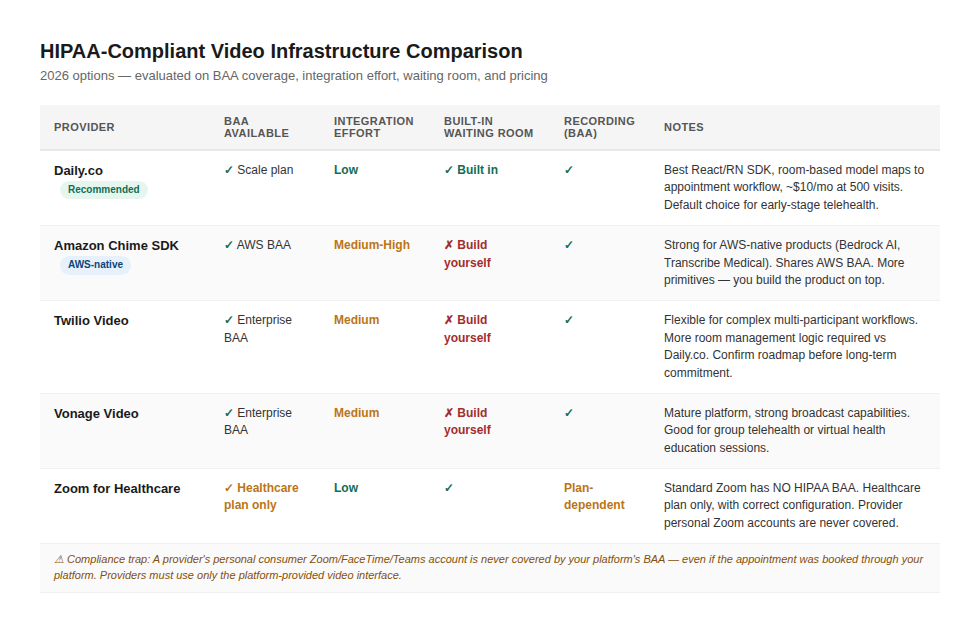
The video infrastructure decision is the most visible architecture decision in a telehealth product. It is also the one most founders make based on the wrong criteria, familiarity and price, rather than the right criteriHIPAA BAA coverage, reliability, clinical workflow fit, and scalability economics.
The non-negotiable requirement: Your video infrastructure provider must offer a HIPAA BAA and that BAA must cover the specific services you use for clinical encounters. A BAA that covers the provider’s general API but excludes recorded sessions is insufficient if you record encounters.
The options in 2026 and what we actually think about each:
Our most common recommendation for early-stage telehealth products. BAA available on the Scale plan. Strong HIPAA posture, well-documented. Excellent React and React Native SDKs, fast to integrate. Room-based model maps cleanly to the appointment-based telehealth workflow. The waiting room concept is built in. Recording available with BAA. Pricing: starts at $0.00099/participant-minute for video, scales with volume. For a platform doing 500 telehealth visits per month at an average of 20 minutes per visit, that is approximately $9.90/month in infrastructure, before you add recording, transcription, or AI features.
Honest limitation: Daily.co’s maximum room size (for group telehealth) caps at lower participant counts than enterprise video infrastructure. For individual or small-group telehealth, this is not a constraint. For platforms doing large virtual care groups or community health sessions, evaluate participant limits carefully.
BAA available under the Twilio HIPAA BAA (enterprise agreement required). More flexible than Daily.co for complex multi-participant workflows. Slightly more engineering effort to implement, you build more of the room management logic yourself. Strong for platforms where the video workflow is deeply embedded in a custom clinical interface.
Honest limitation: Twilio Video’s roadmap has been subject to changes. Confirm current development trajectory and support commitment before a long-term architecture decision.
BAA available under enterprise agreement. Mature platform, strong broadcast capabilities for one-to-many telehealth scenarios (provider speaking to a group of patients). Solid for platforms where group sessions or virtual health education events are core to the product.
Covered under the AWS BAA for HIPAA-eligible services. Strong choice for products already deeply integrated into the AWS ecosystem, AWS Bedrock for clinical AI, Amazon Transcribe Medical for session transcription. The video infrastructure and the AI layer share the same BAA and the same compliance posture.
Honest limitation: More engineering effort than Daily.co or Twilio to implement basic telehealth video workflow. The Chime SDK gives you primitives, you build the product.
BAA available under the Zoom for Healthcare plan specifically. The standard Zoom Business plan does not include the HIPAA BAA. If you are considering Zoom, you must use the Healthcare plan and configure it correctly per Zoom’s HIPAA guidance. Providers who use their personal Zoom accounts for telehealth sessions facilitated by your platform, even if the appointment is booked through your platform, are not covered by your platform’s BAA.
Honest recommendation: Zoom for Healthcare is a reasonable choice for provider-facing scheduling and communication workflows. For a telehealth product where the video interface is embedded in your patient-facing app, Daily.co or Amazon Chime SDK give you more control over the patient experience.
What we’d cut: For a HIPAA-ready Lean Telehealth App with a budget under $150K, we default to Daily.co. Fast to integrate, clear BAA, reasonable pricing at early stage volume, and the waiting room and recording features cover 90% of what an early-stage telehealth product needs. The remaining 10%, custom AI transcription, complex group session management, deep EHR video embedding, we evaluate when we actually need it, not at the architecture decision stage.
From a US founder call: “I spent six weeks evaluating video infrastructure. Daily.co, Twilio, Vonage, Amazon Chime, Zoom Healthcare. I talked to eight engineers. I read every BAA. You know what the right answer was? Daily.co, which was the first thing Mayank’s team recommended in Week 1. The evaluation cost me six weeks I did not have. The decision was already clear.”, Series A telehealth founder, Boston.
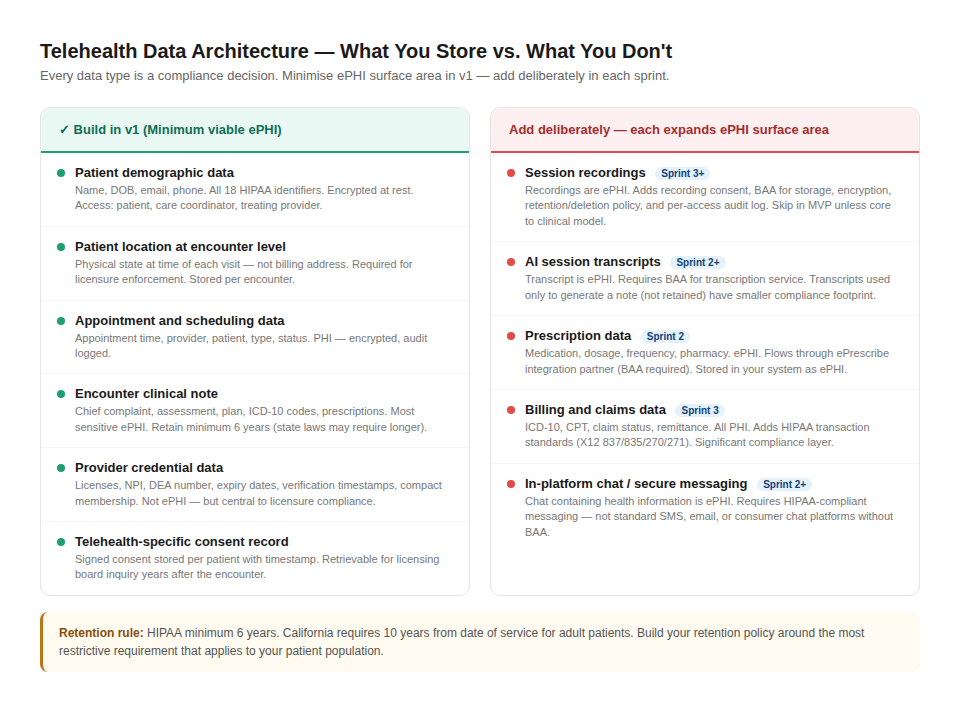
A telehealth platform touches more ePHI data types than most healthcare products. Every data type is a compliance decision. Here is the complete map.
Name, date of birth, address, phone, email, insurance ID. All PHI under the 18 HIPAA identifiers. Stored in the patient profile. Encrypted at rest. Access: patient (self), care coordinator, billing, provider (treating only).
The patient’s physical state at the time of each telehealth encounter, not their home address, their actual location. Required for licensure enforcement. Stored per encounter, not per patient profile. If a patient sees a provider while traveling, their location for that encounter is the state they were in when the call happened, which may differ from their home state.
License numbers, license states, expiration dates, verification timestamps, compact membership, NPI number, DEA registration number (if prescribing), board certifications, malpractice insurance. Not ePHI, provider data, but highly sensitive and central to your licensure compliance posture.
Appointment time, provider, patient, appointment type, status (scheduled, completed, cancelled, no-show), duration. PHI because it contains information about a patient receiving healthcare. Stored in the scheduling module. Encrypted. Audit logged.
The clinical note documenting the telehealth encounter, chief complaint, history, assessment, plan, diagnoses (ICD-10 codes), prescriptions issued. This is the most sensitive ePHI in your system. Access: treating provider (read/write), supervising provider where applicable, patient (read, under HIPAA right of access), billing (diagnosis codes and CPT codes only, not full narrative notes).
Retention: HIPAA minimum 6 years. State medical record retention laws vary, California requires 10 years from the date of service for adult patients. Build your retention policy around the most restrictive requirement that applies to your patient population.
Audio and/or video recordings of telehealth encounters are ePHI. Most telehealth platforms do not record sessions by default, recording introduces significant ePHI storage, consent, and retention complexity.
If you record: explicit patient consent required before recording begins (distinct from the general telehealth consent), BAA confirmation for your recording storage provider, encryption at rest, clear retention and deletion policy (most platforms retain for 30–90 days and then auto-delete unless the recording is clinically indicated), and audit log for every access to a recording.
Honest recommendation: Do not record sessions in your MVP unless recording is core to your clinical model (e.g., an AI clinical scribe that requires the audio for transcription). Recording adds engineering complexity, compliance exposure, and storage cost that most early-stage telehealth products do not need.
If you use AI transcription, Amazon Transcribe Medical, Nuance DAX, or a similar service, the transcript is ePHI and requires BAA coverage for the transcription service, encrypted storage, and clear retention and deletion policy. Transcripts that are used only to generate a clinical note (not retained themselves) have a smaller compliance footprint than transcripts retained as a permanent record.
Prescription details, medication, dosage, frequency, prescriber, patient, date, pharmacy, are ePHI. If you integrate ePrescribe, the prescription data flows through your ePrescribe integration partner (Surescripts, DrFirst, or DoseSpot, all offer HIPAA BAAs). The prescription record in your system is ePHI and must be treated accordingly.
If billing payers: diagnosis codes (ICD-10), procedure codes (CPT/HCPCS), claim status, remittance data, explanation of benefits. All PHI. HIPAA transaction standards (X12 837 for claims, 835 for remittances, 270/271 for eligibility) apply if you are submitting claims electronically, which you are.
In-platform messaging between patients and providers, whether pre-appointment intake questions, post-visit follow-up messages, or secure messaging, is ePHI if it contains health information. HIPAA-compliant messaging (not standard SMS, not standard email, not consumer chat platforms without BAA) is required for any in-platform communication that contains ePHI.
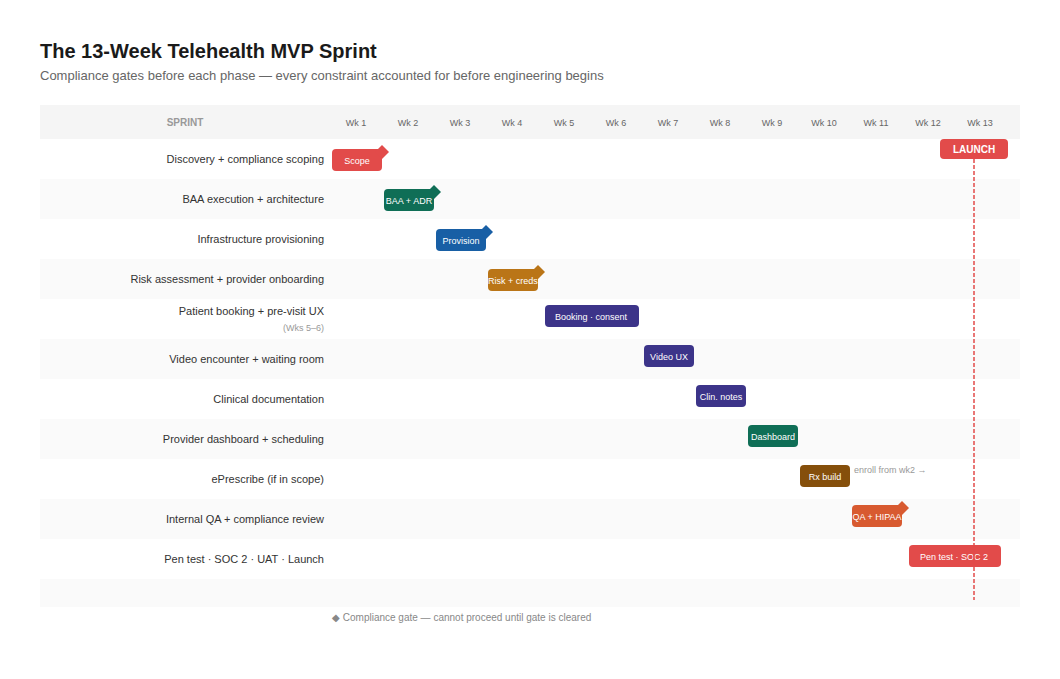
What we’d cut: For a HIPAA-ready Lean Telehealth MVP, we recommend starting with: patient profile, appointment scheduling, video encounter, and post-encounter clinical note. That is the minimum viable clinical workflow. Add ePrescribe in sprint 2. Add insurance billing in sprint 3. Add AI transcription and SOAP note generation in sprint 4. Each addition expands the ePHI surface area, add them deliberately, not all at once.
Prescribing is in scope for most telehealth platforms eventually. Almost every founder underestimates how complex it is to implement correctly in 2026.
The COVID-19 public health emergency ended in May 2023. During the PHE, the DEA granted broad flexibilities allowing providers to prescribe controlled substances via telehealth without a prior in-person evaluation. Those flexibilities expired. The DEA has issued new telemedicine prescribing rules under 21 CFR Part 1306, the framework is more permissive than pre-pandemic rules but more restrictive than PHE-era rules.
The current framework (as of 2026, confirm current status with a healthcare regulatory attorney before building):
Before you build ePrescribe integration, know exactly which medication categories your platform will support and get a regulatory attorney’s confirmation of the current federal and state requirements for each category. This is a $3,000–$8,000 legal investment that prevents a regulatory action that could cost 1,000× more.
Integration complexity: moderate to high. EPCS requires prescriber identity proofing (two-factor authentication plus identity verification meeting DEA requirements under 21 CFR §1311). The integration timeline for DrFirst with EPCS is 8–14 weeks depending on credentialing and testing requirements.
Integration complexity: lower than DrFirst. Timeline: 4–8 weeks. Our recommendation for Seed-stage telehealth products that need ePrescribe quickly and where the prescribing workflow does not require deep custom UI integration.
EB Index 2026: Across 32 telehealth products we have shipped, 18 included ePrescribe integration. The median time from ePrescribe integration kick-off to first live prescription was 10 weeks. The longest was 22 weeks, a platform that needed EPCS, had not completed prescriber enrollment before build started, and discovered a state-specific prescribing restriction in month two. Start prescriber enrollment the day you decide to include ePrescribe in scope. Do not wait until the integration is built.
Compliance trap: EPCS (Electronic Prescribing for Controlled Substances) requires that each controlled substance prescription be signed with a two-factor authentication step, something the prescriber knows (password) plus something they have (authenticator app or hardware token). The two-factor requirement is mandated by DEA under 21 CFR §1311.120. A telehealth platform that allows controlled substance prescriptions without EPCS-compliant two-factor authentication is in violation of federal DEA regulations from the first controlled substance prescription transmitted.
Many telehealth founders launch cash-pay and add insurance billing later. This is a legitimate sequencing choice, cash-pay is faster to build and faster to validate. But when you add insurance billing, you are adding a significant engineering and compliance layer. Here is what it actually involves.
Before a telehealth encounter, you need to verify that the patient’s insurance covers telehealth services, that the provider is in-network for that patient’s plan, and what the patient’s cost-sharing obligation is (deductible, copay, coinsurance). This is done via a 270/271 HIPAA eligibility transaction, an electronic query to the payer’s eligibility system.
Integration options: Change Healthcare (now part of Optum), Availity, Waystar, or a clearinghouse API like Eligibility.io or PokitDok (now part of Change Healthcare). The clearinghouse handles the HIPAA transaction formatting and payer connectivity so your platform sends a structured query and receives a structured response without building EDI (Electronic Data Interchange) capability internally.
For a telehealth platform, eligibility verification is ideally performed at appointment booking (to surface coverage information to the patient before the visit) and again at check-in (to catch coverage changes). Building a real-time eligibility check at booking that surfaces patient cost-sharing information reduces no-shows and billing disputes. It also requires the clearinghouse API integration, which has its own HIPAA transaction compliance requirements.
After a completed telehealth encounter, a professional claim (837P) is submitted to the payer for reimbursement. The claim includes: patient demographics, insurance information, provider NPI, place of service code (02 for telehealth), date of service, diagnosis codes (ICD-10), procedure codes (CPT), and modifiers (95 for live video telehealth, GT for Medicare telehealth, modifier requirements vary by payer).
Telehealth-specific billing nuances: the place of service code for telehealth (02) is different from in-person (11 for office). CMS and many commercial payers have specific modifier requirements for telehealth claims. Some payers still require telehealth claims to be submitted with the in-person place of service code depending on the state and plan type. Your billing logic must handle payer-specific variations.
The payer’s response to a claim, payment, denial, or request for additional information, comes back as an 835 remittance advice. Your platform must process these remittances, update claim status, identify denials (and the reason codes), and trigger a workflow for denied claim follow-up or appeal.
The billing architecture decision: Build it or buy it. Options:
From a US founder call: “We launched cash-pay. It was the right call, we validated the model in three months and raised our Seed on the cash-pay traction. When we added insurance billing eight months later, we discovered that our encounter data model was missing three fields required for claims submission, the rendering provider NPI was stored separately from the supervising provider NPI, and our diagnosis code storage was a free-text field instead of a structured ICD-10 code field.
The data migration and schema change cost us six weeks. If I had known I was going to add insurance billing in month nine, I would have designed those fields correctly from the start.”, Seed-stage primary care telehealth founder, NYC.
Telehealth has the highest dropout rate of any healthcare product category at every stage of the funnel: booking to visit, visit start to visit completion, and first visit to return visit. The UI/UX decisions that drive these rates are well-understood, and consistently underimplemented.
From a US founder call: “We launched with a generic video waiting room, a spinner and ‘Your provider will be with you shortly.’ Our first-visit completion rate was 71%. We added the pre-visit technical check, the patient intake summary in the waiting room, and the provider join notification. Three months later, first-visit completion was 89%. The UX changes cost us four weeks of engineering. The conversion improvement was worth more than anything else we shipped that quarter.”, Series A mental health telehealth founder, SF Bay Area.
What we’d cut: For a HIPAA-ready Lean Telehealth MVP, the minimum viable UX is: patient booking flow, pre-visit intake form (5–7 questions maximum), pre-visit technical check, HIPAA-compliant waiting room, video encounter, and post-encounter clinical note template. Provider scheduling management and AI-assisted documentation are sprint 2. Insurance eligibility and billing are sprint 3. Build the core clinical encounter first. Add the workflow optimization layer once you have clinical validation.
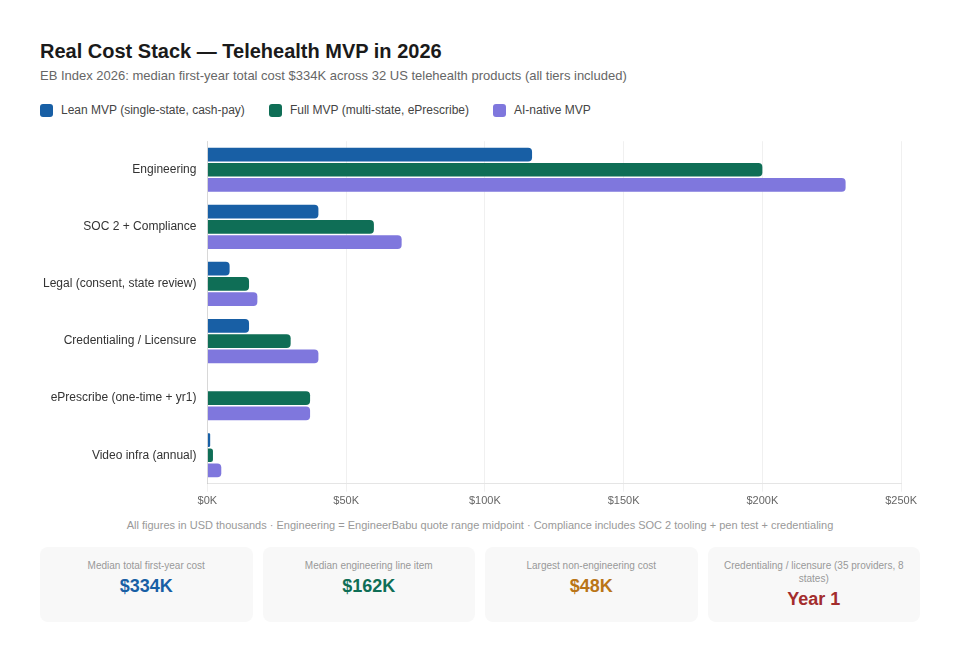
EB Index 2026: The median total first-year cost for a US telehealth MVP, engineering, compliance, video infrastructure, ePrescribe, legal, and credentialing, was $334,000. The median engineering line item was $162,000. The largest single non-engineering cost was credentialing and licensure operations at $48,000 for the first year, for a platform with 35 providers across 8 states.
Compliance trap: Malpractice insurance for telehealth encounters is not automatically included in a provider’s standard malpractice policy. Many malpractice policies were written before telehealth was widespread and contain exclusions or ambiguities about telehealth coverage.
Every provider on your platform should confirm with their malpractice insurer that their policy covers telehealth encounters in every state where they will see patients. This is a provider responsibility, not a platform responsibility, but it is a platform risk if a malpractice claim arises from an encounter and the provider discovers their coverage does not apply.
The AI features that are materially improving telehealth products in 2026:
The provider enables ambient listening at the start of the telehealth encounter. The session audio is transcribed in real time (Amazon Transcribe Medical, Nuance DAX, or a custom pipeline on AWS Bedrock). At the end of the encounter, the transcript is processed by an LLM to generate a structured SOAP note, Subjective, Objective, Assessment, Plan, pre-populated in the provider’s note template. The provider reviews, edits, and signs.
Time savings: 8–12 minutes per encounter in provider documentation time. At 20 encounters per day, that is 160–240 minutes of provider time recovered daily, the equivalent of 4–6 additional encounters per day.
HIPAA requirements: The session audio is ePHI. Transcription service requires BAA (Amazon Transcribe Medical is covered under the AWS BAA). The transcript is ePHI. The generated note is ePHI. Every step of the pipeline, audio capture, transcription, LLM processing, note storage, requires BAA coverage and encrypted storage.
Patient consent: Patients must consent to ambient recording separately from the general telehealth consent. The consent must explain that AI is used to assist with documentation. Most state-specific telehealth consent frameworks do not yet address AI documentation explicitly, your healthcare attorney should draft the AI documentation consent language.
An LLM-powered intake flow that adapts its questions based on the patient’s chief complaint, asking follow-up questions for specific symptoms, surfacing relevant history, and generating a structured intake summary for the provider before the encounter. Reduces encounter time and surfaces clinically relevant information the provider might not have asked about.
HIPAA requirements: The intake responses are ePHI. If an LLM processes the intake responses (to generate the summary or to adapt the question flow), the LLM call requires BAA coverage.
An LLM that generates patient-facing care plan instructions, medication instructions, lifestyle recommendations, follow-up timing, based on the clinical note, in plain language appropriate for the patient’s health literacy level. The provider reviews and sends.
This is a high-value feature for patient engagement and care plan adherence. It is also a high-risk feature if the LLM hallucinates a medication instruction or a follow-up timing recommendation. Every patient instruction generated by AI must be reviewed and approved by the provider before it is sent. No auto-send. Ever.
From a US founder call: “We added ambient documentation in sprint 2. Our NPS from providers went from 34 to 67 in two months. One provider told me it was the first time in fifteen years of practice that she finished her day with all her notes done. That feature, ambient documentation, is the single highest-ROI thing we have built. Build it early.”, Series A primary care telehealth founder, RTP.
If you add insurance billing post-launch, every provider on your platform must be credentialed with each payer they will bill. Credentialing, the payer’s process of verifying provider credentials, malpractice coverage, and practice information, takes 60–120 days per payer per provider. It is slow, manual, and cannot be accelerated significantly. Start it as soon as you decide to pursue payer contracts, not when the billing integration is ready.
Credentialing services (CAQH ProView, Medallion, Verifiable) streamline the provider data collection process. They do not accelerate the payer’s internal review process.
Being credentialed with a payer is not the same as being contracted with them. Credentialing is the qualification process. Contracting is the commercial negotiation, reimbursement rates, covered services, telehealth-specific contract terms. For a new telehealth platform, payer contracting at commercial rates requires either a large enough provider network to have negotiating leverage or a payer relationship developed through a group practice, hospital system, or employer health plan channel.
For early-stage telehealth platforms pursuing insurance billing: Medicare (PECOS enrollment, straightforward process) and Medicaid (state-by-state, varies significantly) are often faster paths to payer revenue than commercial payer contracting.
Each new state you expand into adds: provider licensure requirements (new state license or compact authorization), state-specific telehealth consent requirements (many states have their own telehealth consent statute), potential state-specific prescribing restrictions, and potential state-specific Medicaid telehealth coverage requirements.
Build your state expansion as a configuration, not a codebase change. A well-architected telehealth platform has state-specific rules (consent requirements, prescribing restrictions, Medicaid coverage rules) stored as configuration data, not hardcoded in application logic. Adding a new state is a configuration update, not a sprint.
EB Index 2026: The median time from telehealth platform launch to first payer contract signed was 7.2 months. The median time from payer contract signed to first payer-reimbursed claim paid was 3.1 months additional. Total median time from launch to first payer revenue: 10.3 months. Plan your cash runway accordingly if payer revenue is in your financial model.
An Indian product engineering partner is the wrong call for your telehealth product if: your product requires real-time clinical decision-making at the engineering level, where architecture decisions need a clinician in the room at 9 AM EST five days a week and you are not willing to fund the US-overlap staffing model.
If your telehealth product requires FedRAMP or CJIS compliance from Day 1, certain federal health programs fall into this category and require US-person handling of data.
If your founding team’s working style is synchronous and spontaneous, you need to be able to call your engineering team at 2 PM EST for an unscheduled 30-minute architecture review, and you are not willing to structure your collaboration around a defined overlap window.
If your telehealth platform’s clinical model is so novel and domain-specific that the provider workflow design requires daily, in-depth clinical domain expertise from the engineering team, a level of clinical immersion that requires US-based clinical consultants embedded in the engineering process, not available as occasional consultants.
These are honest constraints. Most US telehealth founders do not face all of them. If you face any of them, I will tell you on the first call.
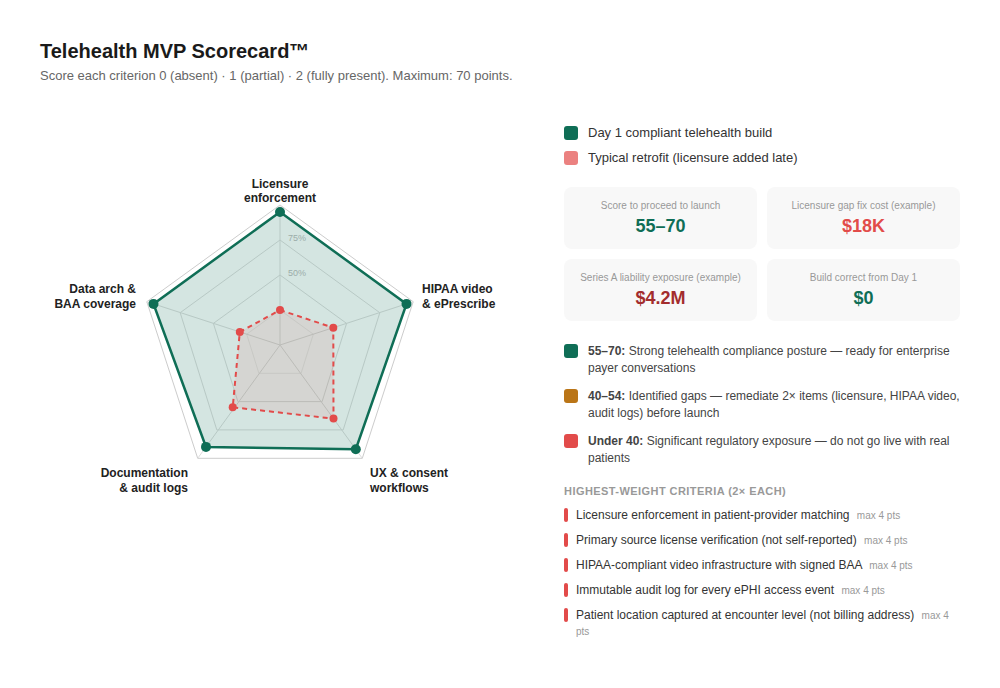
Score each row 0 (absent), 1 (partial), or 2 (fully present). Maximum score: 70.
| # | Criterion | Weight | Your Score |
| 1 | Licensure enforcement logic in patient-provider matching | 2× | /4 |
| 2 | Primary source license verification (not just self-reported) | 2× | /4 |
| 3 | License expiration monitoring and automated alerts | 2× | /4 |
| 4 | Patient location captured at encounter level (not just billing address) | 2× | /4 |
| 5 | HIPAA-compliant video infrastructure with signed BAA | 2× | /4 |
| 6 | Telehealth-specific informed consent collected and stored | 2× | /4 |
| 7 | Pre-visit technical check (camera, mic, browser, connection) | 1× | /2 |
| 8 | ePHI data classification map produced in discovery | 2× | /4 |
| 9 | BAA coverage confirmed for every sub-processor touching ePHI | 2× | /4 |
| 10 | Immutable audit log for every ePHI access event | 2× | /4 |
| 11 | HIPAA risk assessment completed before go-live | 2× | /4 |
| 12 | Third-party penetration test completed before go-live | 2× | /4 |
| 13 | EPCS-compliant ePrescribe integration (if controlled substances in scope) | 2× | /4 |
| 14 | Prescriber enrollment completed before first prescription | 1× | /2 |
| 15 | Clinical emergency protocol designed and documented | 1× | /2 |
| 16 | No-show prevention workflow (reminders, pre-visit check) | 1× | /2 |
| 17 | Provider scheduling with calendar sync | 1× | /2 |
| 18 | Post-encounter clinical note with structured data (ICD-10, CPT) | 1× | /2 |
| 19 | SOC 2 readiness built into architecture from Day 1 | 1× | /2 |
| 20 | State-specific rules stored as configuration (not hardcoded) | 2× | /4 |
| 21 | Malpractice insurance coverage confirmed for telehealth per provider | 1× | /2 |
| 22 | 42 CFR Part 2 awareness (if any SUD-adjacent use cases) | 1× | /2 |
| 23 | Provider credential data with verification timestamp stored | 1× | /2 |
| 24 | IP assignment on creation in MSA | 1× | /2 |
| 25 | MSA governed by US law | 1× | /2 |
Score interpretation:
Telehealth is not a video call with a medical form attached. It is a licensed medical practice delivered through technology, and every word of that sentence matters for how you build the product.
The licensure enforcement logic, the HIPAA-compliant video infrastructure, the ePrescribe integration with EPCS, the telehealth-specific consent workflow, the pre-visit technical check, the clinical emergency protocol, none of these are optional features you add when you have time. They are the product. They are what makes the difference between a telehealth platform that scales and one that creates liability faster than it creates revenue.
The founders I have worked with who built this right the first time have one thing in common: they treated the regulatory layer as a design constraint, not a legal problem to hand off. Their engineers knew why they were building the licensure enforcement logic. Their designers knew why the consent workflow mattered. Their product managers knew why the pre-visit technical check was non-negotiable.
If you want 30 minutes to talk through your telehealth product, what states you are launching in, what your provider network looks like, what your ePrescribe scope is, and what the right architecture is for where you are today, book a call with me or Aditi. No slides. No pitch. Just the product conversation.
Mayank Pratap Singh is the co-founder and CEO of EngineerBabu, a CMMI Level 5, Google AI Accelerator 2024 alumni product engineering studio based in Indore, India. EngineerBabu has shipped 1,200+ products since 2014, including 32+ telehealth products for US healthcare founders. Book a product audit at engineerbabu.com/discovery.
No. A provider must hold an active license in the patient’s state at the time of the encounter. The patient’s physical location at the time of the telehealth visit determines which state’s medical practice laws apply, not the provider’s location or the platform’s headquarters. Your platform must enforce licensure compliance at every patient-provider match.
The Interstate Medical Licensure Compact is a multi-state agreement that allows physicians who hold a license in their principal state of practice to obtain licenses in other IMLC member states (40+ as of 2026) through an expedited process. It streamlines the application process but does not eliminate the licensing requirement. A physician must still hold an active license in each state where they see patients via telehealth.
Under the DEA’s current telemedicine prescribing framework (post-COVID-19 PHE), certain Schedule III–V controlled substances can be prescribed via telehealth under specific conditions. Schedule II controlled substances generally still require a prior in-person evaluation with limited exceptions. State laws add additional requirements on top of federal DEA rules. Get a healthcare regulatory attorney’s guidance on prescribing scope before building ePrescribe.
The most common choice for early-stage telehealth products is Daily.co (BAA available on Scale plan) for its developer-friendly SDK, built-in waiting room, and clear HIPAA posture. Amazon Chime SDK is strong for AWS-native products. Twilio Video and Vonage Video are solid alternatives. Standard Zoom does not include a HIPAA BAA, the Zoom for Healthcare plan specifically is required, with correct configuration.
EPCS (Electronic Prescribing for Controlled Substances) is the DEA-mandated system for prescribing Schedule II–V controlled substances electronically. It requires two-factor authentication for each controlled substance prescription, with the prescriber enrolled and identity-proofed per DEA requirements under 21 CFR §1311. If your telehealth platform facilitates controlled substance prescribing, EPCS is required, it is not optional.
Every telehealth platform must have a documented clinical emergency protocol before the first patient encounter. The protocol typically includes: the provider instructs the patient to call 911 and provides the patient’s address to emergency services, the provider documents the emergency in the encounter record, the platform has a mechanism for the provider to alert a supervisor or care coordinator, and the encounter is documented as an emergency visit in the billing record. Design and document this protocol before you go live.
The platform itself typically does not carry malpractice insurance, malpractice coverage is per provider, not per platform. However, your platform may carry general liability and technology errors and omissions coverage. Every provider on your platform should confirm with their malpractice insurer that their policy covers telehealth encounters in every state where they will see patients. This is a provider responsibility, make it part of your provider onboarding checklist.
Most US states require that patients explicitly consent to the telehealth modality before their first telehealth encounter, acknowledging they understand they are receiving care via video, that they have the right to refuse telehealth, and that their provider is licensed in their state. This consent is distinct from your platform’s general terms of service. It must be obtained before the first encounter and stored in a retrievable format. Consent requirements vary by state, have a healthcare attorney draft your consent document and review it against the specific requirements of each state where you operate.
Provider credentialing for payer contracts takes 60–120 days per payer per provider. Primary source verification for platform onboarding (verifying a provider’s license is active and unrestricted) takes 1–5 business days depending on the state and the credentialing service used. EPCS identity proofing for controlled substance prescribing takes 1–3 weeks per prescriber. Start every credentialing workflow as early as possible, none of these processes can be significantly accelerated.