India vs Poland Software Outsourcing: A 14-Year Founder's Honest Breakdown


Create engaging, high-performance mobile applications tailored to your business needs. We craft future-ready apps that offer smooth user experiences on all devices.
Build robust and scalable websites and CMS platforms that help you manage content effortlessly. Our development ensures a seamless digital presence.
Launch secure, feature-rich online stores with intuitive shopping experiences. We build tailored eCommerce platforms designed for growth.
Design captivating games with immersive gameplay and stunning graphics. From concept to launch, we build engaging experiences that players love.
Enhance your customer relationships with customized Salesforce implementations. Drive growth and efficiency with smarter CRM solutions.
Harness artificial intelligence and machine learning to automate workflows and gain actionable insights. Our AI transforms data into smart decisions.
Accelerate your software delivery lifecycle with continuous integration, delivery, and infrastructure automation to boost efficiency.
Hire app developers ready to turn your ideas into sleek, high-performing mobile apps for any platform.
Bring in frontend pros who craft smooth, beautiful, and user-friendly interfaces that your visitors will love.
Get backend developers who build fast, secure, and reliable systems to keep everything running behind the scenes.
Hire eCommerce developers who build secure, scalable online stores designed to offer seamless shopping and grow your sales.
Get dedicated developers committed to your projects, delivering consistent quality and speed as an extension of your team.
Search “India vs Poland software outsourcing” and you’ll find 10 articles that all say the same thing. India is cheap. Poland is close to Europe. India has more developers. Poland has better timezone overlap. Pick based on your budget.
That framing is lazy. And it’s costing founders real money.
Geography is not the variable that determines whether your product ships well. I’ve seen Indian teams produce architecture-level work for $28/hour that a $95/hour Polish team would have been proud of.
I’ve also seen the reverse. After 14 years building software products and 500+ projects across 20+ countries, the pattern I keep seeing isn’t “India good, Poland good” — it’s “right context, right team, right stage.”
EngineerBabu, the company I co-founded, has built 75 YC-selected products and worked with 4 unicorn clients. We’ve had clients come to us from Polish agencies and Polish agencies come to us asking how we staffed certain capabilities. The market is more nuanced than the blogs make it sound.
Here’s the breakdown that actually helps you decide.
India vs Poland software outsourcing is not a simple cost comparison. It’s a strategic decision that affects your product architecture, communication rhythm, talent depth in specific domains, regulatory considerations, and long-term vendor relationship structure.
Both countries are credible outsourcing destinations. Both have produced world-class software. The question isn’t which is better in the abstract. The question is which fits your specific product, stage, and team structure.
And the answer is almost never as clean as the comparison blogs make it sound.
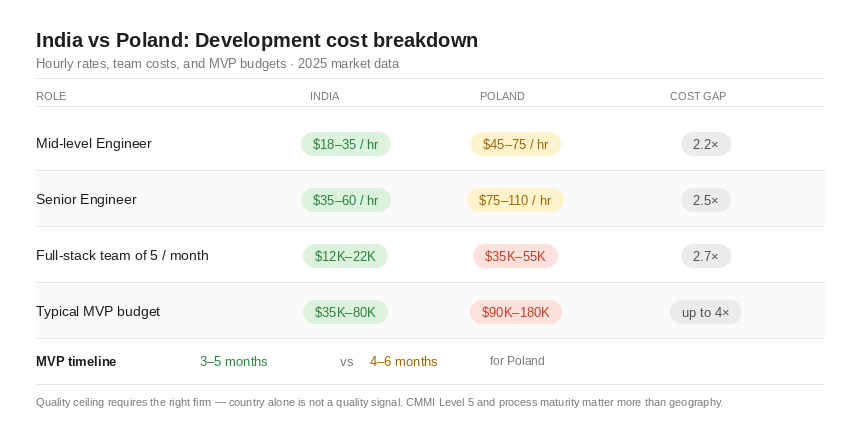
Here’s the cost reality as of 2025:
The cost gap is real. 2.5x to 4x depending on seniority and agency tier. If you’re building a $50,000 MVP, that gap is existential. If you’re a $50M enterprise with a $2M development budget, it matters much less than you think.
Multiple reports confirm that India holds 55% market share of global offshore software development, while Poland has grown to become the 4th largest tech talent hub in Europe with 450,000+ software developers.
Both markets are maturing, but in very different directions.
I’ll be honest here because most Indian agency blogs won’t be.
If you’re building a fintech app, healthtech, or any regulated product for the European market, Polish developers live inside GDPR, PSD2, and EU AI Act compliance culture. It’s not something they learn for your project. It’s how they think.
When the EngineerBabu team built OpenMoney’s neobank with mutual fund integration, compliance architecture was the first conversation.
We had to bring in external EU regulatory advisors. A senior Polish developer working in Warsaw would have that knowledge natively.
Poland is UTC+1/+2. If your core team is in London, Berlin, Amsterdam, or Paris, Polish developers work the same hours you do. Real-time collaboration. Same sprint ceremonies. No 5 AM calls.
This matters more than people acknowledge. Async-first development works well for isolated tasks. For architecture discussions, scope changes, and debugging in production — synchronous communication saves weeks.
This isn’t about stereotypes. It’s about documented communication patterns. European business culture values directness, formal documentation, and structured escalation.
Polish engineering teams tend to mirror those patterns more naturally with Western European counterparts.
Poland has produced exceptional talent in game development (CD Projekt Red effect on the local ecosystem), embedded systems, and C++/Rust-based systems programming. If your product sits in those categories, the talent depth in Poland is genuinely deep.
India produces 1.5 million engineering graduates per year. Poland produces roughly 100,000 total STEM graduates annually.
Scale matters when you need to ramp from 3 engineers to 15 in 60 days. That flexibility is real in India. In Poland, you’ll wait longer and pay more for the same ramp.
India’s outsourcing ecosystem evolved from IT services into product engineering. The best Indian product engineering firms and I’m obviously biased, but I’ve also seen the quality can handle end-to-end: product strategy, UI/UX design, backend architecture, mobile development, DevOps, and post-launch support. All under one roof.
When we built EarlySalary’s full lending stack, now processing ₹10,000 crore in disbursements, the team covered credit bureau integration, KYC/AML compliance modules, mobile app, analytics dashboard, and collections workflow. That kind of breadth in a single vendor relationship is easier to find in India than in Poland.
200+ VC-funded products built means EngineerBabu’s team has pattern-matched on what breaks at 10,000 users versus 10 million.
Horizontal scalability, database sharding, caching layers, microservices migration from monolith, these aren’t textbook decisions for us. They’re things we’ve debugged at 2 AM.
Indian product engineering firms with that kind of portfolio depth are more common than Polish equivalents at comparable price points.
India’s talent pool in machine learning, large language model fine-tuning, computer vision, and AI infrastructure is significantly deeper than Poland’s. If your product roadmap has any serious AI component, India has the talent density.
When we built AI inventory management for Simba Beer — real-time field intelligence, demand forecasting, distributor behavior modeling — finding engineers with both domain context and MLOps experience was a 2-week hiring process in India. That same search in Poland would have taken 8–12 weeks.
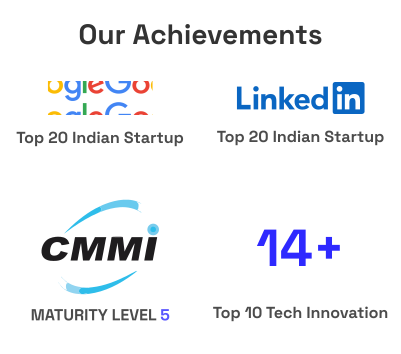
In 2024, EngineerBabu was selected in the Top 20 globally for Google’s AI Accelerator program. That’s not a credential I mention to impress. I mention it because it reflects the AI engineering depth that Indian product firms have built over the last 5 years. That ecosystem exists because the talent and the output quality are there.
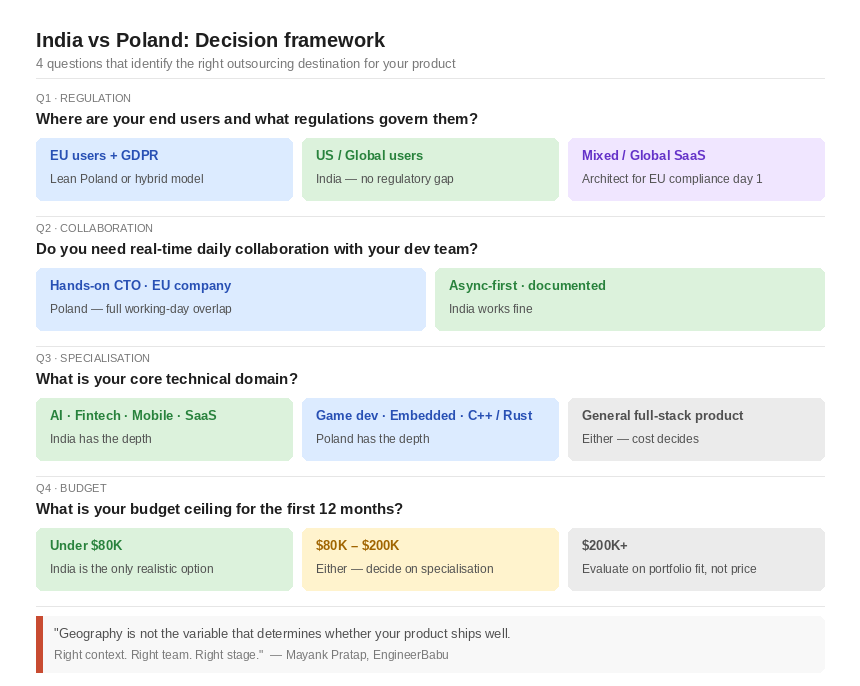
I’ve stopped thinking in terms of “India vs Poland.” I now ask 4 questions, and the answer falls out:
Here’s what I’ve seen work well for European founders specifically: a hybrid engagement where a Polish or European technical lead handles client-side architecture reviews and compliance oversight, while an Indian product engineering team handles execution.
This isn’t theory. Several of our EU-based clients structure it this way. They get timezone alignment for the conversations that matter, and cost efficiency for the execution that constitutes 80% of the work.
The model requires a vendor who can manage that structure without friction. Not every agency can. But when it works, it captures the best of both geographies.
The most common mistake I see: evaluating outsourcing geographies the way you’d evaluate cloud providers. You compare specs, pick the cheaper one, and assume the difference is negligible.
Software outsourcing is a team relationship, not a vendor purchase. The team that ships your product will make hundreds of undocumented decisions that your spec never covered. What database to use when PostgreSQL starts creaking. Whether to rebuild that module or patch it. How to handle a compliance edge case at 11 PM before a launch.
Those decisions get made better or worse based on trust, context, and experience. You can’t outsource relationship-building. You can only pick partners who’ll invest in it.
I’ve seen $30/hour developers in India outperform $90/hour developers in Poland on product judgment. I’ve seen the reverse. The hourly rate is the least predictive variable.
What predicts quality: the agency’s portfolio overlaps with your product category, the seniority of the actual engineers assigned to your project (not the seniors they showed you in the pitch), and whether the founder or a senior partner remains involved after onboarding.
EngineerBabu takes 20 projects per year. That constraint is deliberate. It’s the only way I stay on the architecture calls. The moment a company scales to 200 projects with an account manager layer, the quality floor drops.
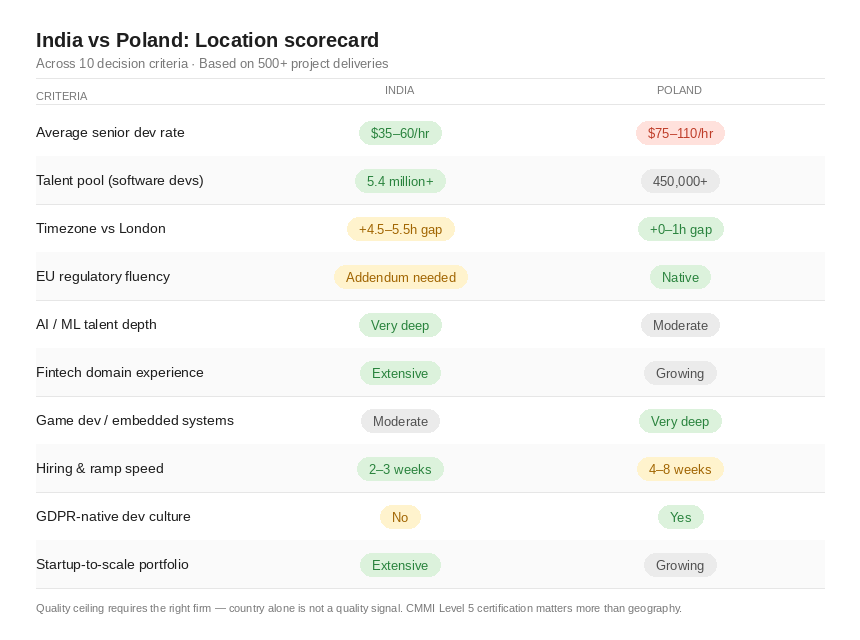
| Criteria | India | Poland |
| Average senior dev hourly rate | $35–60/hour | $75–110/hour |
| Talent pool size (software engineers) | 5.4 million+ | 450,000+ |
| Timezone (vs London) | +4.5 to +5.5 hours | +0 to +1 hour |
| EU regulatory fluency | Requires specialist overlay | Native |
| AI/ML talent depth | Very deep | Moderate |
| Fintech domain experience | Extensive (EarlySalary, Khatabook) | Growing |
| Game dev / embedded systems | Moderate | Strong |
| MVP timeline (typical) | 3–5 months | 4–6 months |
| GDPR-native development culture | No | Yes |
| Startup-to-scale portfolio depth | Extensive | Growing |
When we built LoanOS — a 7-module lending platform covering origination, underwriting, disbursement, servicing, collections, and bureau integration, the client was a US-based fintech targeting Southeast Asian markets.
They’d initially looked at both Polish and Indian vendors. Two Polish agencies came in with strong proposals. Their architecture was solid. Their teams were experienced.
They chose EngineerBabu for one reason: we’d already built 40+ lending products. The conversation about credit scoring model integration, bureau API quirks, collection workflow state machines, and multi-currency disbursement wasn’t education. It was pattern matching.
Geography was irrelevant. Domain depth was everything.
That’s the lens I’d encourage you to apply. Not India vs Poland. Not cost vs quality. Domain depth vs domain depth, with cost as a tiebreaker.
If you’re at the stage of evaluating India vs Poland for your next product build, the decision framework I’d actually use:
If you want to talk through the architecture decisions before you commit to a vendor — not a sales call, an actual conversation about what your product needs at this stage — I’m usually the one on those calls.
Reach me at mayank@engineerbabu.com.
Mayank Pratap
Co-founder, EngineerBabu, 14 years building technology products. 500+ projects. 20+ countries. Google AI Accelerator Top 20, 2024. CMMI Level 5. Backed by Vijay Shekhar Sharma (Paytm founder).
Yes, and more so than a decade ago. India’s outsourcing ecosystem has shifted from IT services toward product engineering. CMMI Level 5 certification (which EngineerBabu holds) is one signal of process maturity. The quality range is wide — as with any market — but the top-tier firms are genuinely world-class in product delivery.
For Western European startups, Poland offers timezone alignment and native EU regulatory context that India can’t match without deliberate effort. If your product is GDPR-critical or requires real-time collaboration with a European founding team, the Poland or hybrid model often works better.
Indian development typically costs 2.5x to 4x less than Polish development for comparable seniority levels. Senior engineers in India cost $35–60/hour versus $75–110/hour in Poland. For a 6-month MVP development, this translates to roughly $40,000–80,000 (India) versus $120,000–200,000 (Poland).
Three non-negotiable checks: look at their portfolio for domain overlap with your product (not general experience — specific overlap), ask to speak with 2 previous clients directly, and find out whether the partner who sold you the project will remain involved during execution. If they hand it to a project manager on day 30, your quality floor dropped significantly.
Yes, and it works well for EU-based startups. A European technical lead handles compliance architecture and client-side alignment; an Indian product engineering team handles execution. The cost savings from Indian execution typically offset the cost of European technical oversight. Not every agency supports this model, but it’s worth asking about.