Outsource Software Development to India from New Zealand: A Builder's Honest Guide (2025)


Create engaging, high-performance mobile applications tailored to your business needs. We craft future-ready apps that offer smooth user experiences on all devices.
Build robust and scalable websites and CMS platforms that help you manage content effortlessly. Our development ensures a seamless digital presence.
Launch secure, feature-rich online stores with intuitive shopping experiences. We build tailored eCommerce platforms designed for growth.
Design captivating games with immersive gameplay and stunning graphics. From concept to launch, we build engaging experiences that players love.
Enhance your customer relationships with customized Salesforce implementations. Drive growth and efficiency with smarter CRM solutions.
Harness artificial intelligence and machine learning to automate workflows and gain actionable insights. Our AI transforms data into smart decisions.
Accelerate your software delivery lifecycle with continuous integration, delivery, and infrastructure automation to boost efficiency.
Hire app developers ready to turn your ideas into sleek, high-performing mobile apps for any platform.
Bring in frontend pros who craft smooth, beautiful, and user-friendly interfaces that your visitors will love.
Get backend developers who build fast, secure, and reliable systems to keep everything running behind the scenes.
Hire eCommerce developers who build secure, scalable online stores designed to offer seamless shopping and grow your sales.
Get dedicated developers committed to your projects, delivering consistent quality and speed as an extension of your team.
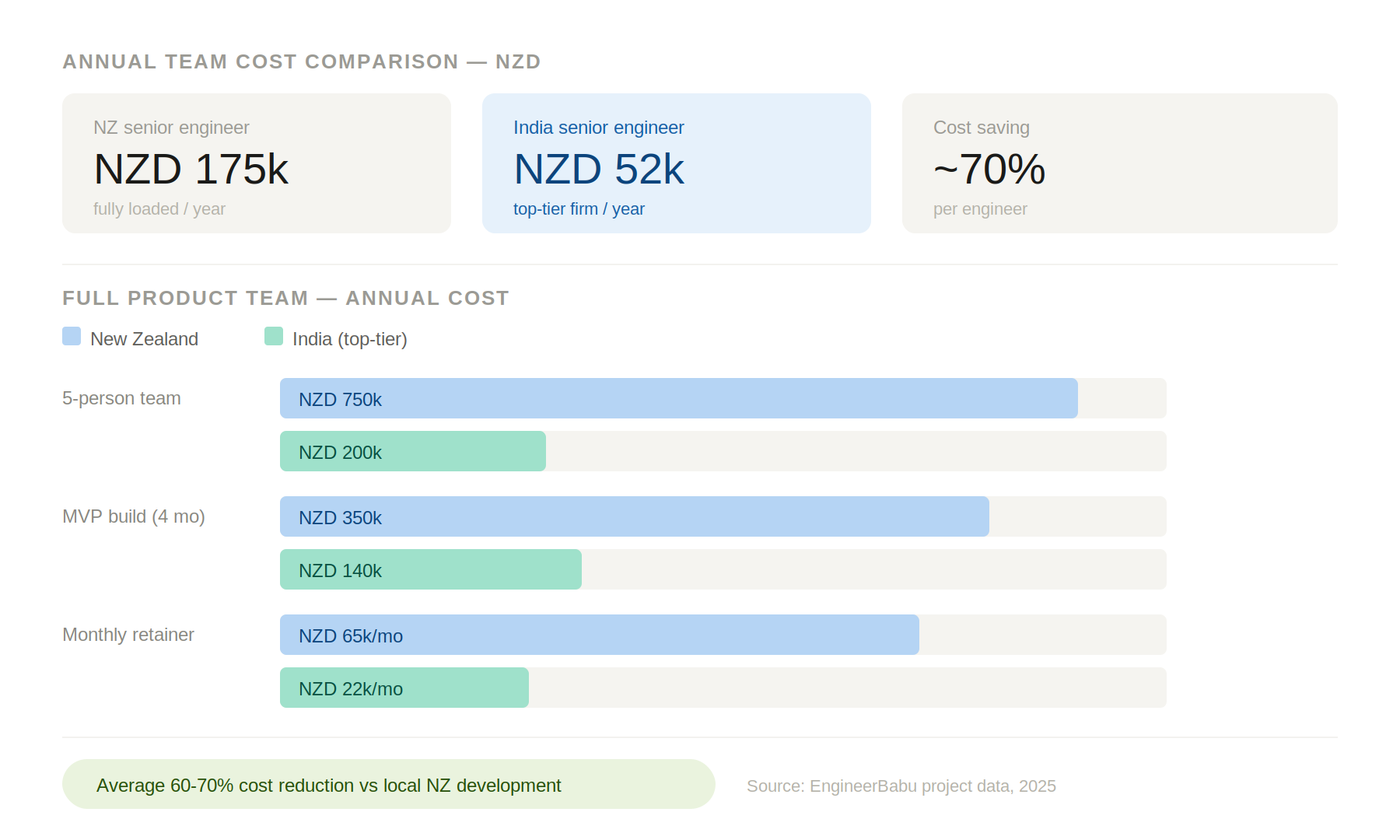
I recently spoke with a Kiwi SaaS founder who had been quoted NZD 480,000 by a Wellington agency for a product that a team in Pune built for NZD 140,000. The product worked.
The team was good. And the founder spent six months believing the gap had to mean a quality trade-off.
It didn’t. But the reason it took six months wasn’t price — it was trust architecture. He didn’t know what to verify, what to ask, or how to structure a working relationship across 7,400 kilometres and a 6.5-hour time zone gap. That’s the gap I’m writing this to close.
EngineerBabu, the company I co-founded, has built products for clients across 20+ countries. We’ve worked with founders from Auckland to Amsterdam, from VC-funded Series B teams to bootstrapped solo operators.
We take 20 projects a year, every client comes via referral, and I personally lead every engagement. We’ve delivered 500+ products, including 75 YC-selected builds and 200+ VC-backed platforms.
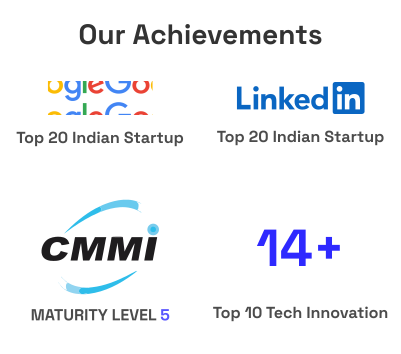
We’re CMMI Level 5 certified, one of NASSCOM’s recognised members, and were named among LinkedIn Top 20 Startups in India.
What follows is what I’d tell a founder before they sign anything.
Outsourcing software development to India from New Zealand means engaging an Indian product engineering firm to design, build, test, and deploy software products or features on behalf of a New Zealand business. This is either as a full-product build or as an extension of an in-house team.
This is not the same as hiring freelancers on Upwork. It is not “cheap code from strangers.” When structured correctly, it is a delivery partnership where a dedicated cross-functional team builds your product to spec, with accountability frameworks, IP protections, and quality gates that mirror what a local team would provide — at 40-60% lower cost.
The mechanics matter: Indian engineering teams typically work on Indian Standard Time (IST), which is 6.5 to 7.5 hours behind New Zealand Standard Time (NZST) in winter.
That’s a meaningful but workable gap. With structured async communication and a 2-hour daily overlap window in the morning, most teams manage it cleanly.
New Zealand’s technology talent market is genuinely constrained.
Senior developers in Auckland command NZD 130,000 to 180,000 in base salary alone. Add recruitment costs, benefits, equity dilution, and ramp time, and a 4-person local engineering team becomes a multi-million-dollar annual commitment.
India, by contrast, graduated approximately 1.5 million engineers in 2025. The talent pipeline is deep, the mid-to-senior layer is experienced with global clients, and the cost-to-competence ratio has no equivalent in the English-speaking world.
But cost is not the primary reason serious founders choose India. The primary reason is access to specialisation. A fintech product needs PCI-DSS expertise, payment gateway integrations, core banking API knowledge, and KYC/AML workflow design.
Finding all of that locally, at speed, at the capital level of a pre-Series A startup, is nearly impossible. With an Indian product engineering firm that has built 40+ fintech products, that specialisation walks in on day one.
This is where most “outsourcing guides” go vague. I’ll be specific.
The top-tier premium exists for a reason. A higher-tier firm brings architecture maturity, documented processes, senior oversight on every build, and — critically — a track record you can verify.
I’ve seen Kiwi founders save NZD 40,000 upfront by picking a cheaper Indian firm, then spend NZD 120,000 on a rebuild 8 months later. The rebuild cost calculation is never in the initial comparison.
Most vendor evaluation frameworks are useless because they measure the wrong things. Here is what I’d actually check:
Anyone can put logos on a website. Ask for a case study where they tell you what architecture decision they made, why they made it, what went wrong, and what the outcome was after 18 months. If they can’t do that, they haven’t built enough products or they’re hiding the failures.
Ask to speak to the architect who will work on your product. Not the sales lead. The architect. Ask them how they’d approach your authentication layer, your data model, your API design. If they deflect to “we’ll detail that in the proposal,” that’s a red flag.
CMMI (Capability Maturity Model Integration) is not marketing. Level 5 means the firm has audited, repeatable processes for requirements management, quality assurance, risk handling, and delivery.
It’s the difference between “we have a QA team” and “every build goes through 14 defined quality gates.” NASSCOM membership adds another layer of accountability.
A firm that says “we’ll adjust to your hours” often means one tired senior developer taking your calls at midnight. What you want is a firm with a structured 2-hour daily sync window, async stand-up documentation, and sprint tooling that works in both time zones. Ask to see their sprint ceremony schedule for a current client.
Your code needs to be yours. This sounds obvious, but I’ve seen contracts where IP transferred only after final payment, with no interim protections. For New Zealand clients, GDPR-adjacent data handling practices matter even if technically not required — ask how they handle user data residency and deletion requests.
Slack, Jira, Confluence, weekly video calls. That’s the baseline. What matters more: who do you call when something breaks on a Friday? Is there a named escalation path? Does the CTO/co-founder pick up the phone? I do. That’s a non-negotiable for EngineerBabu clients.
Ask for references from clients who are: (a) similar business size, (b) similar product complexity, (c) in a similar time zone to New Zealand. A reference from a US enterprise client tells you nothing about how they handle a 2-person Kiwi startup.
The 6.5-hour gap between India and New Zealand is the most cited objection from founders considering this route. It is real. It is manageable. And here’s the honest breakdown.
What actually works:
What requires active management:
What the good firms have solved: Overlap hours aren’t accidental — they’re engineered. The best Indian product firms have figured out that a split team structure works better than trying to match hours.
One senior engineer on your project keeps IST hours for maximum team productivity; a delivery manager with flexible hours handles your real-time needs.
I write from a specific vantage point and I think it’s fair to be explicit about it.
When the EngineerBabu team built EarlySalary’s full lending stack — now processing over ₹10,000 crore (approximately NZD 1.9 billion) in loan disbursements — the first architecture decision was around multi-tenancy.
We had to build a platform that could serve multiple financial institution partners, each with their own regulatory reporting requirements, risk models, and borrower data, without any data commingling. That’s a problem that sounds simple until you’re 4 months in and your data isolation strategy is leaking across tenant boundaries.
For Khatabook, we took a bookkeeping app and rebuilt it as a fintech platform — mutual fund integrations, digital credit lines, merchant payments. That pivot required us to re-architect the data layer mid-product, which we did without downtime across 7 million active users.
For Simba Beer, we built an AI-powered inventory management system with real-time field intelligence — distributors updating stock on mobile, the system predicting stockouts 48 hours in advance using demand signal data.
The machine learning layer wasn’t the hard part. The hard part was building a data pipeline that worked reliably in areas with 2G connectivity.
I reference these because the lessons in each — distributed data architecture, zero-downtime migrations, offline-first mobile engineering — aren’t in any article on outsourcing. They’re from shipping products.
This section isn’t glamorous. It’s where projects get protected or fall apart.
A signed MSA should cover: scope of work, payment terms, intellectual property assignment, confidentiality, liability caps, termination rights, and dispute resolution.
For New Zealand-based founders, I recommend specifying New Zealand law as the governing jurisdiction and New Zealand courts as the dispute resolution forum. Most reputable Indian firms will agree to this. If a firm insists on Indian jurisdiction only, consider that a yellow flag.
Your IP assignment should be unconditional and perpetual. The code is yours from the moment it’s written, not when the final invoice is paid. Include an assignment of moral rights in jurisdictions where that’s relevant.
If your product handles personal data of New Zealand users, you’re subject to the New Zealand Privacy Act 2020. This requires your Indian development partner to operate as a compliant data processor. A DPA should specify: what data they access, what they can and cannot do with it, data deletion obligations, breach notification timeframes (72 hours is the New Zealand standard), and cross-border transfer protections.
Milestone-based payments reduce risk for both sides. A typical structure: 25% upfront, 25% at design sign-off, 25% at beta delivery, 25% at production launch. Avoid 50% upfront. Avoid payment-on-completion-only — it misaligns incentives mid-project.
Always execute a bilateral NDA before sharing product specifications, architecture documents, or business strategy. A unilateral NDA (where only they promise confidentiality) is meaningless if you’re sharing sensitive commercial details.
I’ve seen 500+ projects. The patterns repeat.
The founders who get the best outcomes treat their Indian engineering team the way they’d treat a senior internal hire: they share context, explain the why behind features, invite pushback on scope.
The founders who get mediocre outcomes treat the team like a code vending machine — drop in requirements, expect a product. Software doesn’t work that way. The best decisions in a build happen in the gaps between requirements.
The single most common cause of cost and timeline overruns is a scope document that’s one page of bullet points. A well-defined MVP development has user stories, acceptance criteria, defined integrations, stated constraints (technology choices, performance thresholds), and explicit out-of-scope items. Spending 3 days on a proper spec document saves 3 weeks of rework.
Founders who are non-technical often feel unequipped to evaluate a development firm’s technical capability. They shouldn’t skip it — they should change the criteria. You don’t need to understand the code.
You need to ask: “Show me a product you built that’s at scale. Tell me what broke in year two and how you fixed it.” That answer tells you more than reviewing GitHub repos.
A surprising number of founders don’t think about code ownership until they need to change vendor or hire in-house. Good documentation, clean architecture, test coverage, and deployment automation should be contractual deliverables. If a vendor pushes back on documentation requirements, that tells you something important.
More daily calls do not equal better products. I’ve seen projects with 4 hours of daily calls and appalling delivery quality. The overlap time should be used for decisions, not status updates. Status goes in tools (Jira, Notion). Decisions happen in calls.
Use this to pressure-test your situation before making a decision.
| Scenario | India: Good Fit | India: Proceed with Caution |
| Product complexity | Medium-to-high. Complex products benefit from specialised experience. | Extremely regulated products (RBNZ-supervised financial services) may need local compliance expertise. |
| Founder bandwidth | You can dedicate 5-7 hours/week to vendor management. | You’re in raise mode and can’t do a sprint review for 3 weeks. |
| Team experience | You’ve worked with remote teams before. | First product build, no technical co-founder. |
| Timeline | 4-12 month build. India excels here. | Need production-ready in 6 weeks. Risky regardless of vendor geography. |
| Budget | NZD 80,000+. Below this, quality trade-offs become severe regardless of location. | Under NZD 50,000 for a full product. The math doesn’t work for quality. |
| IP sensitivity | Standard product with proper legal agreements. | Government contracts, defence, or products with explicit data sovereignty requirements. |
| Post-launch support | Maintenance retainer model is fine. | Need 15-minute SLA response time in NZST. Requires dedicated in-timezone support. |
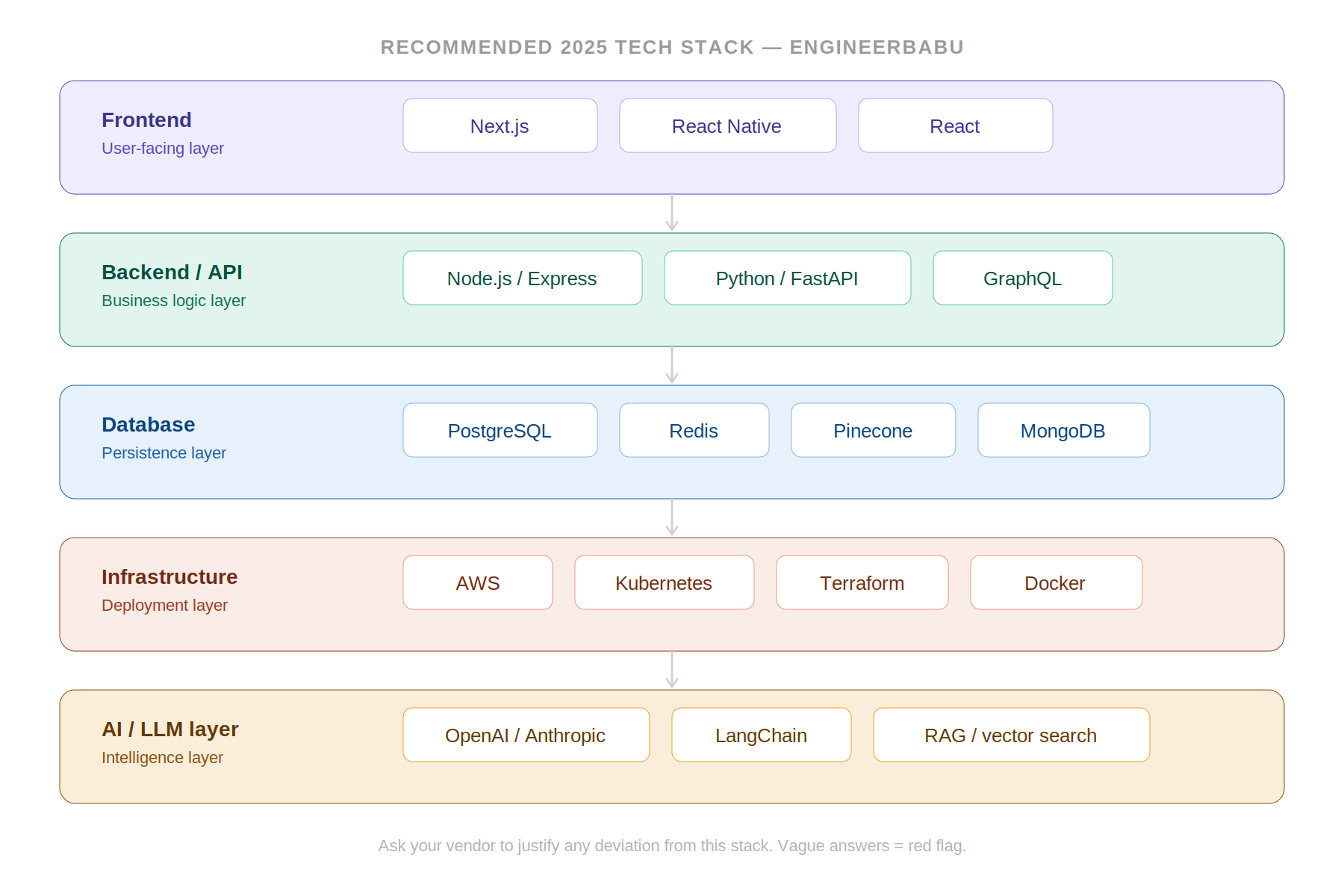
The technology choices your vendor makes are not neutral decisions. Architecture choices at MVP stage create constraints you’ll live with for years.
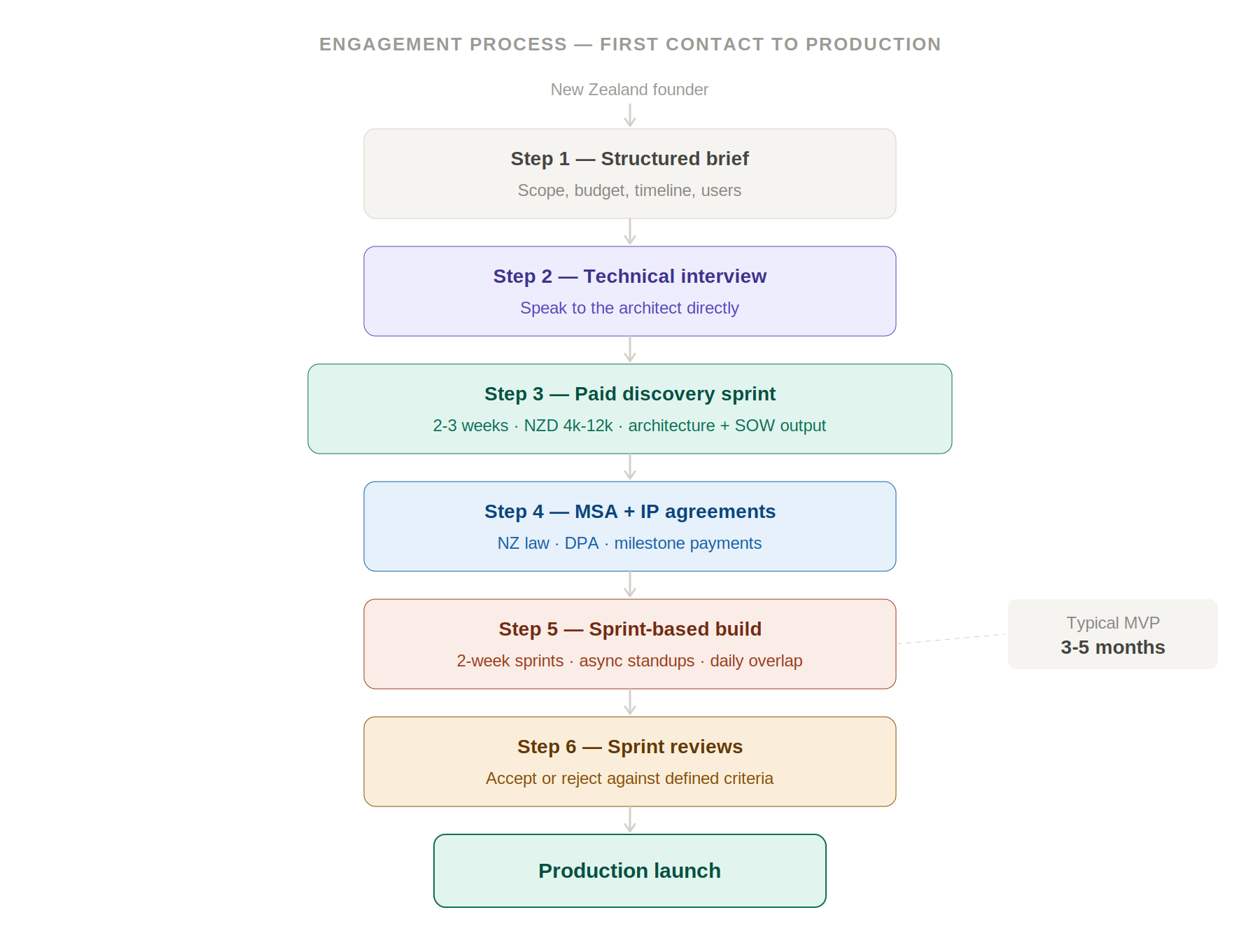
A step-by-step operational guide.
Sourcing from referrals beats directories every time. Ask other founders in your network who’ve built products. Check NASSCOM’s directory. Look at firms with CMMI certifications. Build a shortlist of 3-5 firms with verifiable case studies in your product category.
Your initial outreach should include: what you’re building, intended users, approximate scope, budget range, and timeline. Vague inquiries get template responses. Specific briefs get thoughtful proposals.
As above — speak to the actual architect. Ask scenario questions: “We need to handle 50,000 concurrent users at launch. How do you architect for that?” “Our product has strict data residency requirements. Walk me through your approach.” The quality of the answer is your signal.
Before committing to a full build, pay for a 2-3 week discovery sprint. The output: technical architecture document, sprint plan, risk register, and detailed SOW. This costs NZD 4,000 to 12,000. It tells you more about the team’s capabilities than any proposal ever will. A firm that won’t do a discovery sprint is skipping the most important phase of the project.
Daily async stand-up (written, Notion or Slack), 3x weekly video check-ins for the first month, weekly sprint review, bi-weekly architecture review. Document this in a shared team handbook from day one.
Every sprint produces a demo. Accept or reject sprint outputs based on predefined acceptance criteria, not feelings. If something isn’t right, log it, prioritise it, and move it to the next sprint. Do not let sprint debt accumulate silently.
If I distill 14 years of building products for global clients into one observation about New Zealand founders specifically: the ones who treat this as a capability acquisition rather than a cost reduction win.
The question that separates them isn’t “how much will this cost in India versus Wellington?” It’s “what kind of product engineering capability do I need to build something great, and where does the best version of that capability exist at this moment in time?”
For most product categories, in 2025, the honest answer points to India.
I’m personally on every early-stage product call for EngineerBabu. If you’re evaluating a build — MVP, platform, AI integration, fintech stack — and want to talk through the architecture decisions and vendor selection process before you sign anything, email me directly.
I won’t pitch you. I’ll tell you what I think the right approach is for your specific situation, and if it’s not us, I’ll tell you that too.
Mayank Pratap mayank@engineerbabu.com
Mayank Pratap is the co-founder of EngineerBabu, a CMMI Level 5 product engineering company. Over 14 years, the EngineerBabu team has delivered 500+ products across 20+ countries, including 75 YC-selected builds and 200+ VC-backed platforms.
EngineerBabu was named a Google AI Accelerator Top 20 globally in 2024, a LinkedIn Top 20 Startup in India, and is backed by Vijay Shekhar Sharma, founder of Paytm.
A well-scoped MVP built by a quality Indian firm typically costs NZD 80,000 to 200,000 for a 3-5 month build. An ongoing dedicated development team costs NZD 15,000 to 45,000 per month depending on size and seniority. These figures assume a top-tier firm with proper process maturity. Budget 15-20% contingency for scope changes, which are inevitable.
Yes, with proper legal agreements. Your MSA should include unconditional IP assignment from the moment code is written, a bilateral NDA, and data processing agreements aligned with the New Zealand Privacy Act 2020. Most reputable Indian firms with international client bases have standard-form agreements for this. Review them with a New Zealand technology lawyer before signing.
India is 6.5-7.5 hours behind New Zealand. The overlap window that works in practice: 9:00am-11:00am IST maps to 3:30pm-5:30pm NZST. This is enough for a daily stand-up and real-time decisions. 80% of project coordination should happen via async tools — Notion, Slack, Loom. Firms that have worked with APAC clients will have this infrastructure in place.
Outsourcing typically refers to a fixed-scope project engagement — you define what you want built, the firm builds it, the relationship ends at delivery. A dedicated development team is a long-term arrangement where a full-time team works exclusively on your product, integrated into your sprint process. For most product companies, a dedicated team model delivers better outcomes after the initial MVP because context continuity compounds over time.
Verify: CMMI certification (check the official CMMI Institute registry), NASSCOM membership, client references you can call directly, a physical office address (not just a website), and a company registration number. Ask for a video call with the team you’d actually work with — not just the sales representative. Review their GitHub activity (if public) or ask to see code samples from previous work.