Software Outsourcing India vs Europe: The Honest Comparison After 500+ Projects


Create engaging, high-performance mobile applications tailored to your business needs. We craft future-ready apps that offer smooth user experiences on all devices.
Build robust and scalable websites and CMS platforms that help you manage content effortlessly. Our development ensures a seamless digital presence.
Launch secure, feature-rich online stores with intuitive shopping experiences. We build tailored eCommerce platforms designed for growth.
Design captivating games with immersive gameplay and stunning graphics. From concept to launch, we build engaging experiences that players love.
Enhance your customer relationships with customized Salesforce implementations. Drive growth and efficiency with smarter CRM solutions.
Harness artificial intelligence and machine learning to automate workflows and gain actionable insights. Our AI transforms data into smart decisions.
Accelerate your software delivery lifecycle with continuous integration, delivery, and infrastructure automation to boost efficiency.
Hire app developers ready to turn your ideas into sleek, high-performing mobile apps for any platform.
Bring in frontend pros who craft smooth, beautiful, and user-friendly interfaces that your visitors will love.
Get backend developers who build fast, secure, and reliable systems to keep everything running behind the scenes.
Hire eCommerce developers who build secure, scalable online stores designed to offer seamless shopping and grow your sales.
Get dedicated developers committed to your projects, delivering consistent quality and speed as an extension of your team.
Three months ago, a CTO from a Series B fintech in London called me. They’d spent 14 months with a European nearshore team, had burned through €600,000, and had a product that still couldn’t process a live payment. He asked me one question: “Did we make the wrong call on the outsourcing location?”
The answer wasn’t simple. And it never is.
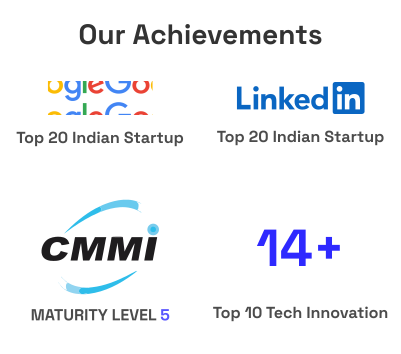
I’ve been building technology products for 14 years. At EngineerBabu, a CMMI Level 5 certified product engineering company, we’ve shipped 500+ projects across 20+ countries. We’ve built 75 YC-selected products and have 4 unicorn clients in our portfolio.
I’ve had the outsourcing conversation with hundreds of founders, CTOs, and engineering leads. And I can tell you with confidence: most people ask the wrong question.
The real question isn’t “India or Europe?” It’s “what does your project actually need, and which model gives you that at a price that makes business sense?”
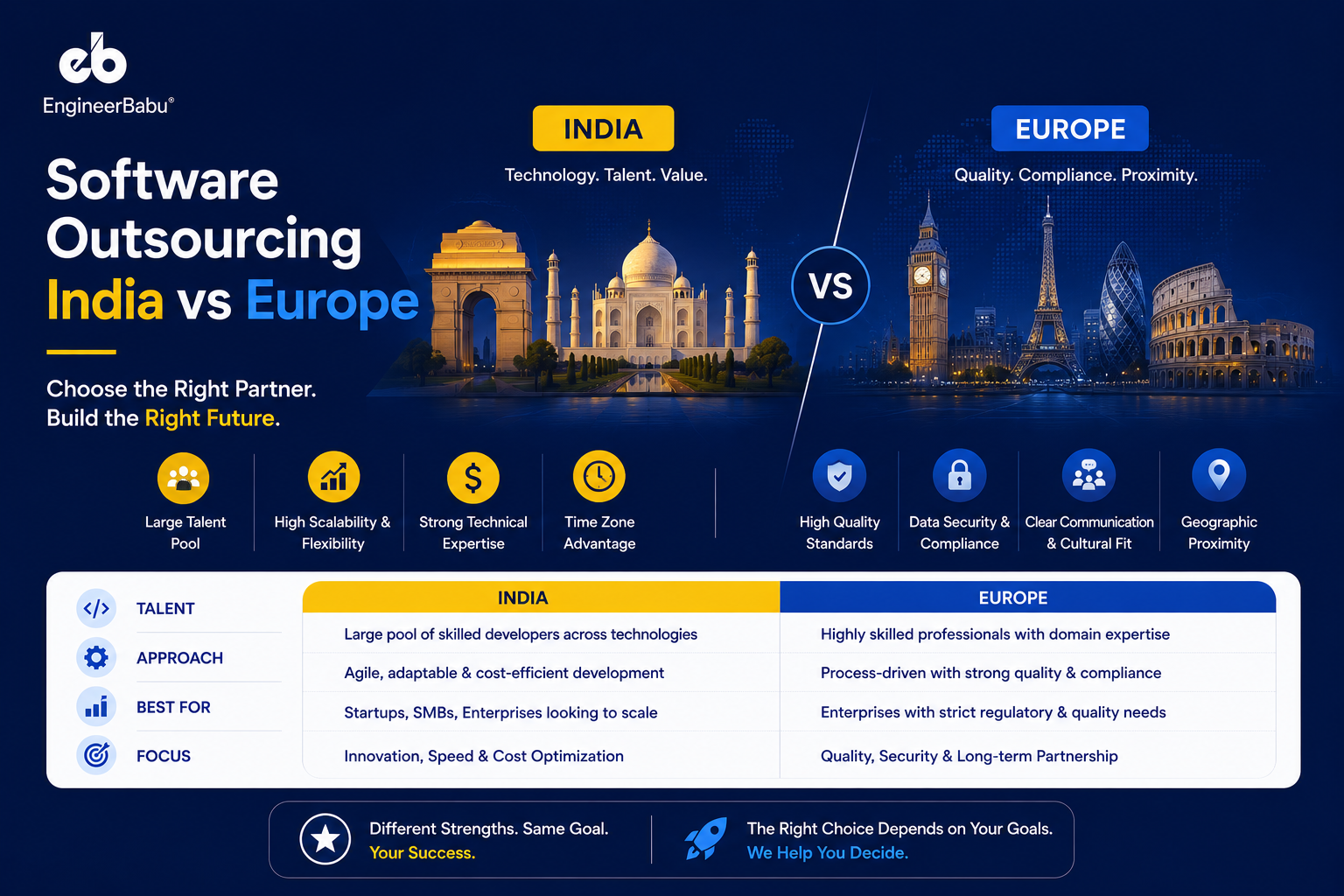
Software outsourcing in India vs Europe is a comparison of two fundamentally different operating models, not just two price tags.
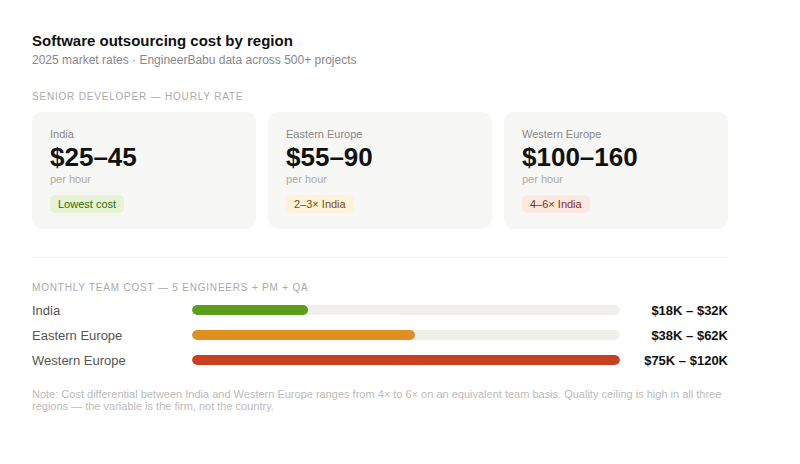
Here’s what it actually costs right now.
Those numbers aren’t theoretical. They’re what I see in proposals hitting my inbox every week.
According to Statista, global spending on IT services was estimated at $1.72 trillion in 2025 and is projected to grow further to around $1.87 trillion by 2026.
The cost differential between India and Eastern Europe sits at 2–3x. Between India and Western Europe, it’s often 4–6x. That’s not a rounding error. On a $500K project, that’s $300–400K of pure budget difference.
But here’s what people miss: the gap isn’t just hourly rates. It’s timezone overlap, communication infrastructure, the talent pool depth in your specific stack, and the company you choose to work with.
I’ve seen Indian teams outdeliver European ones by every metric. I’ve also seen Indian teams that couldn’t build a working login page after three months.
The variable isn’t the country. It’s the company.
India’s software outsourcing market didn’t happen by accident. It was engineered over four decades.
The IITs, NITs, and BITS produce 1.5 million engineering graduates a year. By 2025, India has over 5.4 million software developers.
What that means practically: if you need 3 React Native engineers with fintech experience and specific knowledge of payment gateway integrations, India has a deep enough talent pool that you can be selective.
You can find someone who’s done exactly this before. In most European markets, you’re waiting 3–4 months for a senior hire. In India, we can staff a team in 2–3 weeks.
When the EngineerBabu team built EarlySalary’s full lending stack, it went from architecture to processing ₹10,000 crore in disbursements. That required expertise in credit bureau integration, underwriting logic, EMI calculation engines, KYC/AML workflows, and RBI regulatory compliance. That kind of domain depth exists in India in ways it doesn’t in smaller European markets.
That said, India isn’t a monolith. There are 15,000+ IT companies operating in India. Maybe 200 of them are worth hiring for complex product work.
I’m not here to tell you India always wins. European outsourcing, particularly Eastern European nearshoring, has genuine advantages that matter depending on what you’re building.
This is the question I get most often. And the honest answer is: neither, inherently.
Quality is a function of the firm, not the country. Full stop.
What I can tell you from 500+ project deliveries is what separates good engineering firms from bad ones, regardless of where they sit.
The firms that consistently ship great product:
The firms that burn budgets and timelines:
I’ve seen this pattern equally in India and Europe. The country is not the differentiating variable.
When Simba Beer came to EngineerBabu needing AI-powered inventory management with real-time field intelligence, the complexity was in the data architecture, the ML pipeline, and the offline-first mobile sync. None of those problems had a geographic solution. They had an engineering solution.
Here’s what most outsourcing software development comparison articles don’t tell you: timeline risk is often higher with European teams, not lower, despite the proximity advantage.
Why? Hiring velocity.
If a European nearshore firm is building your team, and they need to replace a senior engineer who leaves, they’re competing in the same tight talent market you’re competing in. Replacement time: 6–10 weeks.
Indian firms, especially established ones with large benches, can replace and transition in 2–3 weeks. They have the depth.
Typical project timelines for a mid-complexity product (MVP to production):
The timelines aren’t dramatically different. Where they diverge is on revision cycles and responsiveness. With an 8-hour timezone gap to the US, you lose a day of iteration per feedback cycle. Multiply that across 6 months and you’ve lost 3–4 weeks of effective velocity.
This is solvable with process, but it requires intentional setup. Daily async standups, detailed spec documentation, and overlapping office hours (early India, late US) eliminate most of the pain.
I’ve seen the same mistake dozens of times. A founder or CTO looks at a European firm’s portfolio, sees recognisable brand logos, and assumes quality. They look at an Indian firm’s website, see generic stock photos and “we deliver excellence,” and assume risk.
The portfolio logos tell you about sales capability. They tell you almost nothing about engineering quality.
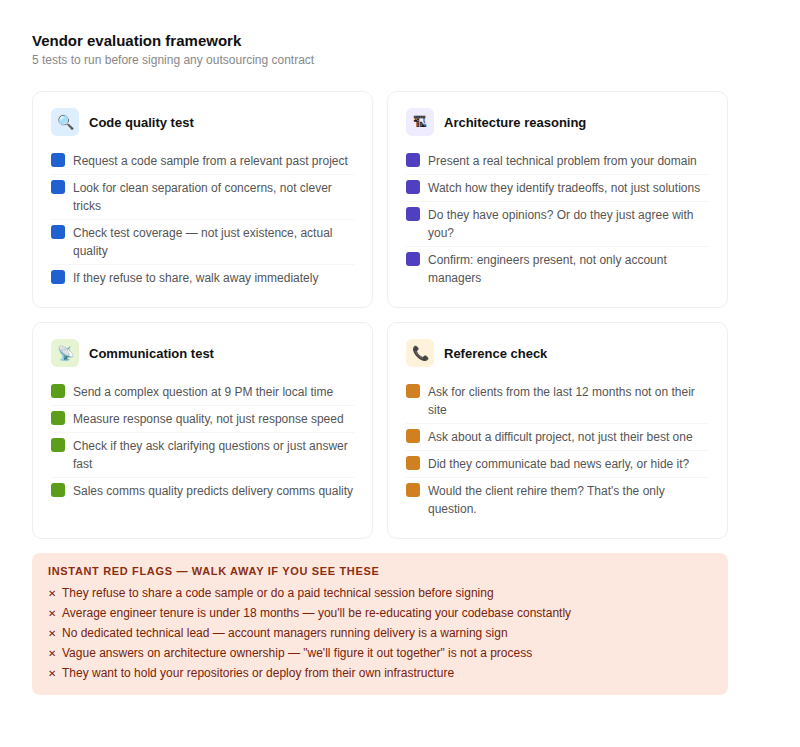
Here’s my actual evaluation framework when vetting any outsourcing partner:
CMMI certification matters here. CMMI Level 5 is the highest maturity level in software process capability, meaning the firm has repeatable, optimised processes for requirements management, engineering, and delivery. Less than 1% of global IT firms hold it.
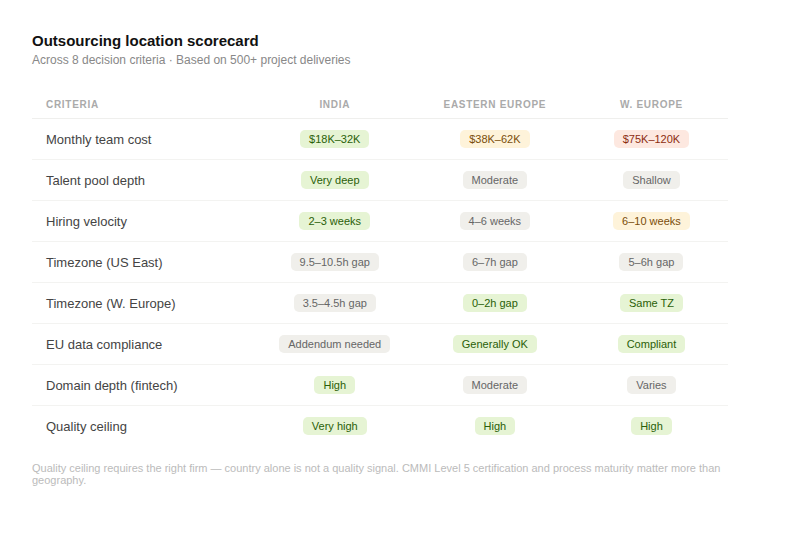
Here’s the table I’d use if I were making this decision for a specific project.
| Criteria | India | Eastern Europe | Western Europe |
| Cost for 5-person team/month | $18K–32K | $38K–62K | $75K–120K |
| Talent pool depth | Very deep | Moderate | Shallow |
| Timezone (US East) | 9.5–10.5h | 6–7h | 5–6h |
| Timezone (Western Europe) | 3.5–4.5h | 0–2h | Same |
| Data sovereignty (EU) | Requires GDPR addendum | Generally compliant | Compliant |
| Hiring velocity | Fast (2–3 weeks) | Moderate (4–6 weeks) | Slow (6–10 weeks) |
| Domain depth (fintech, healthtech, SaaS) | High | Moderate | Varies |
| Quality ceiling | Very high (with right firm) | High | High |
Outsourcing has a second price tag that almost nobody includes in their initial budget: the cost of managing the relationship.
Whether you’re working with India or Europe, you need 0.5–1 FTE equivalent of internal effort for vendor management, architecture guidance, and product clarity. If you’re not providing this, the team will build what they think you want, not what you need.
I’ve seen a $50K/month Indian team deliver $200K of value because the client had a strong product owner embedded in the process. I’ve seen the same rate produce $20K of value because the client thought the outsourcing partner would figure it out.
The management overhead doesn’t go away with geography. A European team 2 time zones away still needs the same clarity of requirements, the same architecture decisions, the same product leadership. The proximity advantage is real but it’s about minutes, not fundamentals.
Budget for the internal bandwidth. It’s not optional.
This is worth addressing directly because it’s changing fast.
AI-assisted development tools, primarily GitHub Copilot, Cursor, and internal AI coding agents, are compressing the velocity gap between senior and mid-level engineers. A mid-level engineer in India with strong AI tooling is now producing work that would have required senior hours two years ago.
What this means practically: the cost advantage of Indian firms is actually increasing in dollar-per-feature-delivered terms. The same $28/hour engineer is producing more working code per day than they were in 2022.
The firms that have adapted their workflows for AI-assisted development are going to outdeliver the ones still operating on pure human velocity. This is true regardless of geography, but the firms adopting it fastest tend to be the more sophisticated Indian firms and Eastern European ones.
When evaluating a partner right now, ask specifically: what’s your approach to AI-assisted development? What tools is your team using? How are you measuring the velocity impact? If they don’t have a coherent answer, they’re behind.
Software outsourcing in India vs Europe is not a binary choice. It’s a decision framework that starts with your specific constraints: budget, timezone requirements, regulatory context, and team bandwidth to manage the relationship.
For the majority of technology companies, especially startups and growth-stage SaaS, fintech, and consumer apps, India offers unmatched depth of talent at a cost structure that lets you build the team you actually need, not the team your budget allows.
The caveat is always the same: the firm matters more than the country. CMMI Level 5 certification, process maturity, and deep domain experience are the real filters.
If you’re evaluating your outsourcing options and want to talk through the architecture decisions, team structure, or how to evaluate vendors before you commit, I’m usually the one on those calls.
Mayank Pratap: Co-founder, EngineerBabu, 14 years building technology products, 500+ projects delivered, 20+ countries, Google AI Accelerator Top 20 Globally (2024), CMMI Level 5, NASSCOM Member, LinkedIn Top 20 Startups India and backed by Vijay Shekhar Sharma (Paytm)
Yes, with the right contractual structure. A well-drafted MSA with GDPR compliance clauses, data processing agreements, IP assignment clauses, and NDA provisions handles most of the legal exposure. The risk isn’t the geography. It’s the contract. I’ve seen EU-based firms handle data recklessly and Indian firms with security practices tighter than most US startups.
The fastest filter: request a 2-hour paid technical discovery session before signing anything. A serious firm will agree. A firm that tries to do discovery for free and then pitch you hard is showing you their process.
Even small projects, a $30–50K MVP, benefit from Indian outsourcing if the firm is right. The economics only improve at scale. The break-even point compared to hiring is roughly 3–4 months of sustained work. Below that, the onboarding and knowledge transfer cost eats the savings. For anything longer, the cost differential is hard to argue against.
All IP must be explicitly assigned in the contract, not implied. Your MSA should include a work-for-hire clause and a full IP assignment provision covering all code, designs, algorithms, and derivative works. Indian IP law recognises these assignments when properly documented.