How to Build a Treasury Management System, Cash Positioning, FX Risk, Liquidity Forecasting, and Bank Connectivity 2026


Create engaging, high-performance mobile applications tailored to your business needs. We craft future-ready apps that offer smooth user experiences on all devices.
Build robust and scalable websites and CMS platforms that help you manage content effortlessly. Our development ensures a seamless digital presence.
Launch secure, feature-rich online stores with intuitive shopping experiences. We build tailored eCommerce platforms designed for growth.
Design captivating games with immersive gameplay and stunning graphics. From concept to launch, we build engaging experiences that players love.
Enhance your customer relationships with customized Salesforce implementations. Drive growth and efficiency with smarter CRM solutions.
Harness artificial intelligence and machine learning to automate workflows and gain actionable insights. Our AI transforms data into smart decisions.
Accelerate your software delivery lifecycle with continuous integration, delivery, and infrastructure automation to boost efficiency.

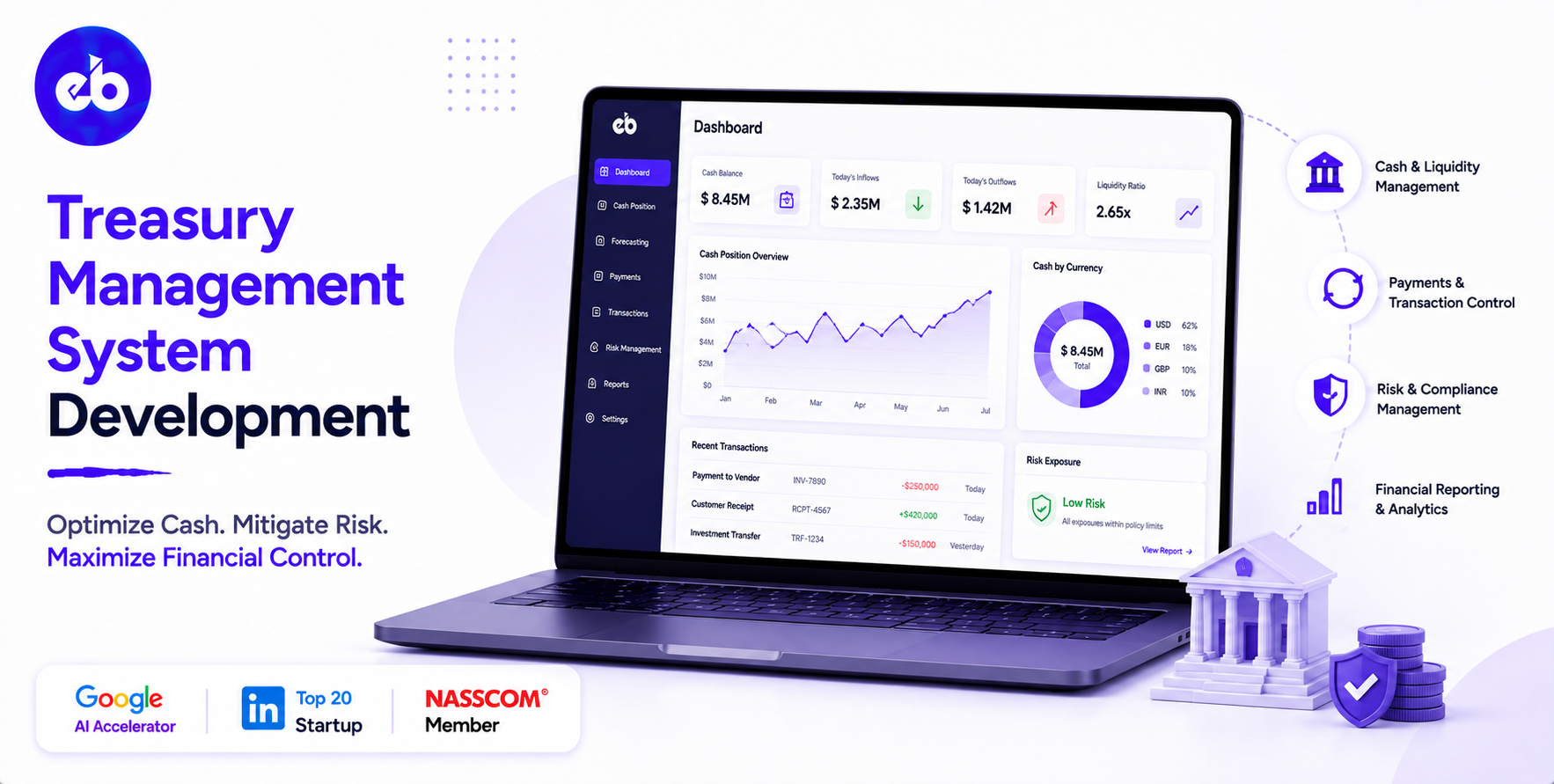
A mid-size enterprise with operations across five countries, banking relationships with eight banks, and daily cash movements of $5 to $20 million is managing its treasury function with spreadsheets in 2026.
The CFO does not know the company’s exact cash position until 48 hours after each business day. FX exposure is hedged based on guesswork rather than real-time exposure calculation. Intercompany settlements are managed through email chains.
This is not unusual. It is the default for companies between $50M and $500M in revenue, too large for basic banking tools, too small to justify enterprise treasury platforms that cost $500,000 to $2,000,000 in licensing and implementation.
A custom treasury management system built for this segment delivers real-time cash visibility, automated bank statement reconciliation, FX exposure monitoring, short-term liquidity forecasting, and the controls that prevent the treasury errors that cost companies millions.
EngineerBabu built financial infrastructure for Adani Group, one of India’s most complex multi-currency treasury operations, and lending platforms for EarlySalary/Fibe. CMMI Level 5. Google AI Accelerator 2024 Top 20. Contact: mayank@engineerbabu.com
| Function | Module |
| Bank connectivity | SWIFT, bank APIs, bank statement ingestion |
| Cash position | Real-time consolidated cash across all accounts and currencies |
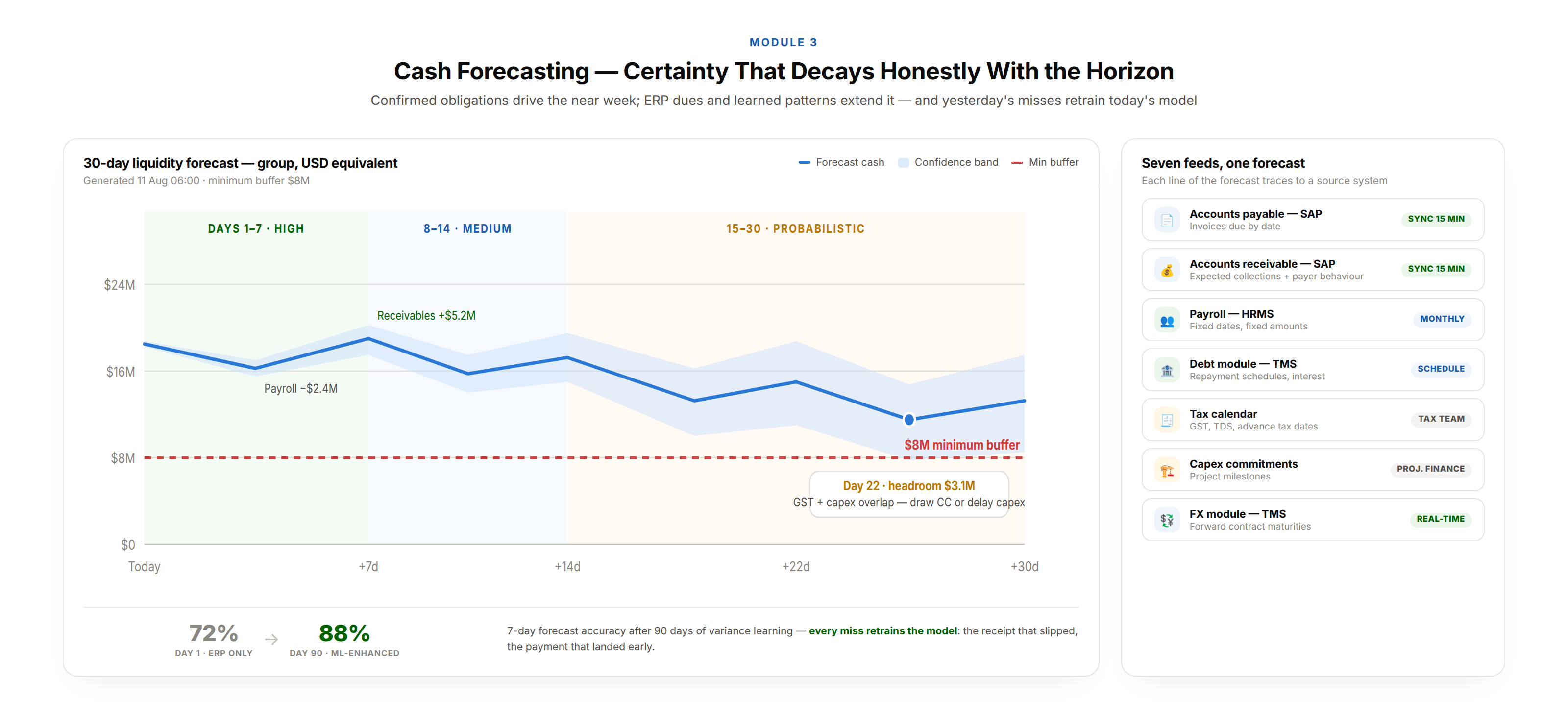
| Cash forecasting | Short-term (7, 14, 30-day) liquidity forecast |
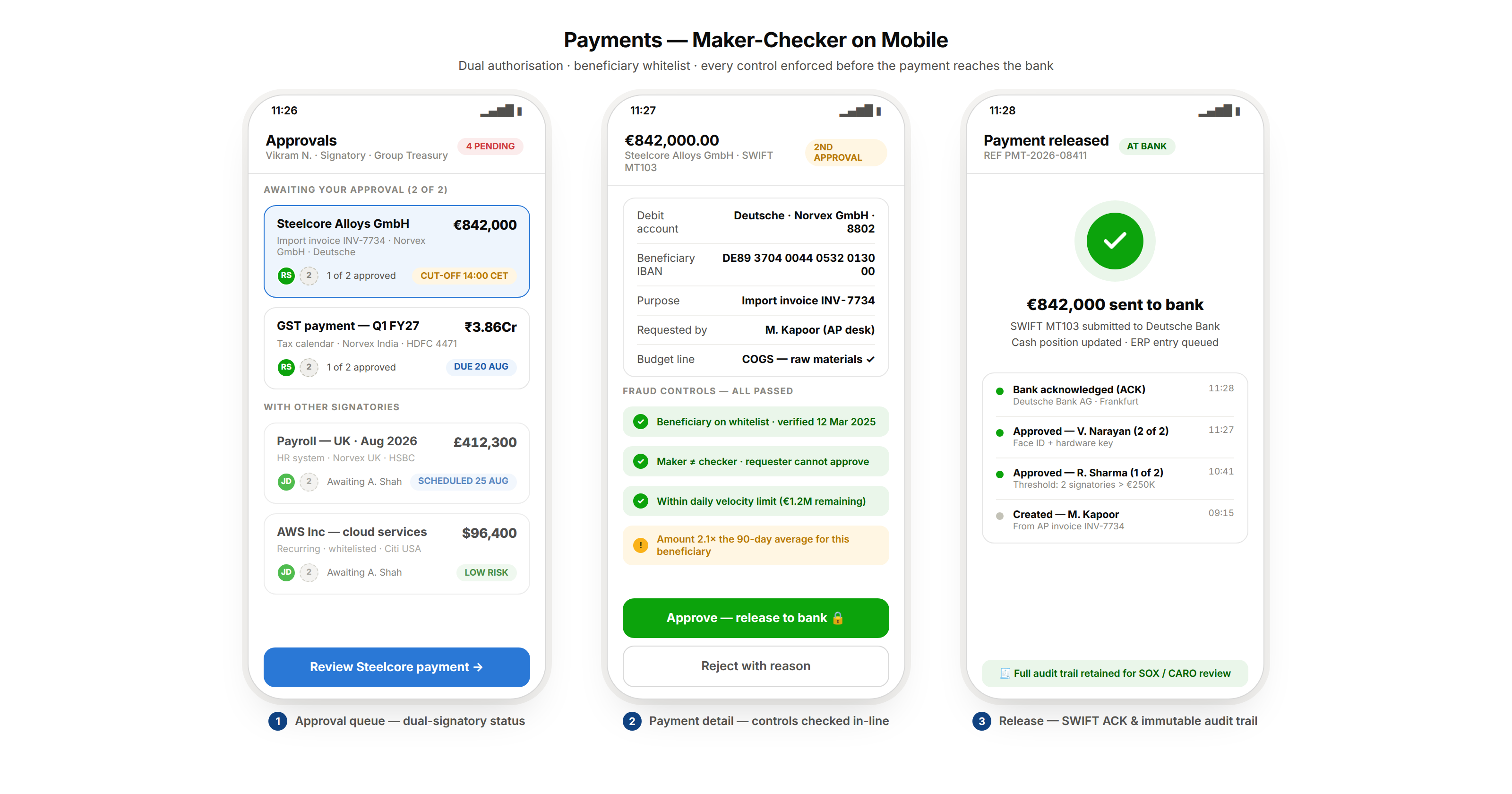
| Payments | Payment initiation, approval workflow, bank submission |
| FX management | Exposure calculation, hedge tracking, rate monitoring |
| Investments | Short-term investment tracking, maturity management |
| Debt management | Loan facility tracking, covenant monitoring, maturity alerts |
| Bank account management | Account registry, signatories, mandates |
| Intercompany | Intercompany loans, netting, settlement |
| Reconciliation | Bank statement to ledger reconciliation |
| Reporting | Treasury dashboard, CFO report, board report |
| Compliance | FEMA, CARO, SOX controls |
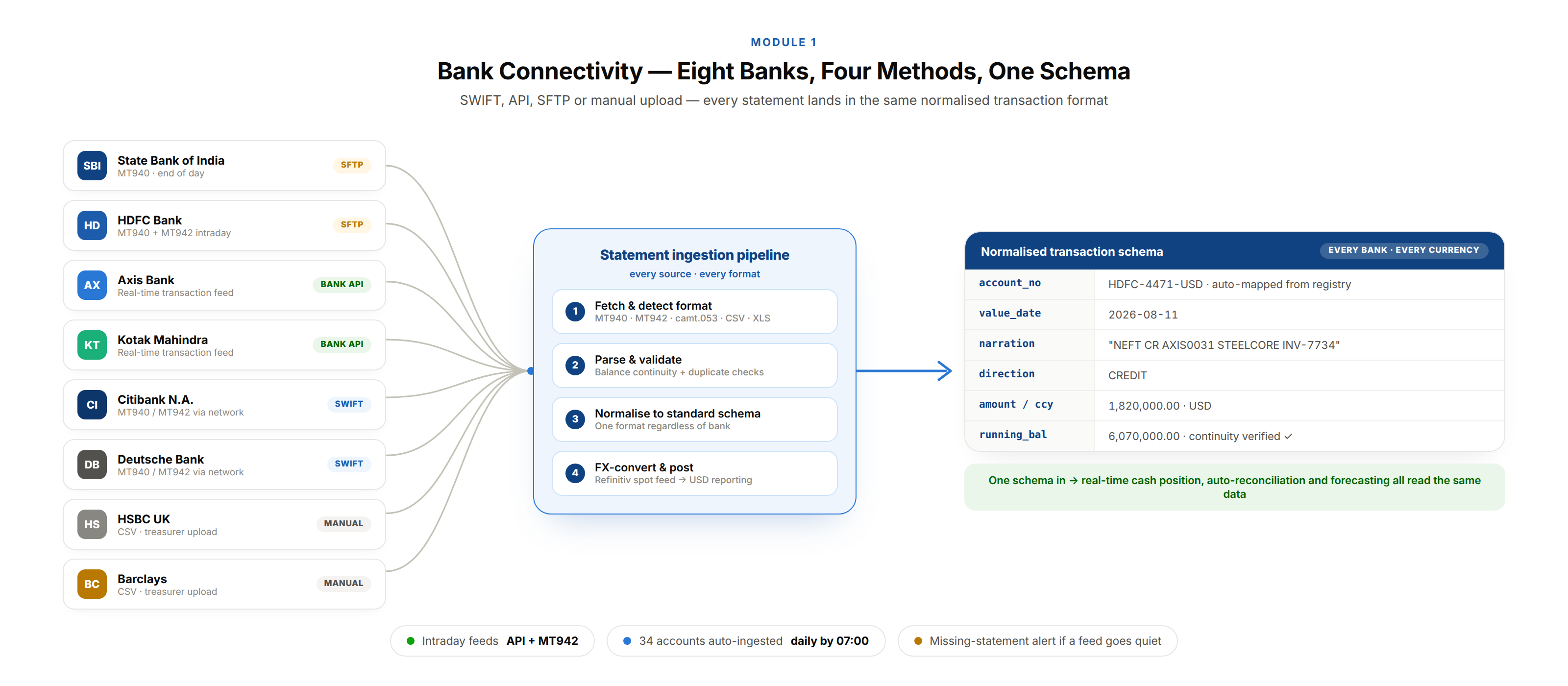
Bank connectivity methods:
| Method | Description | Best For |
| SWIFT MT940/MT942 | Industry-standard bank statement message | Large banks with SWIFT connectivity |
| Bank API (Open Banking) | Direct API to bank’s data | Modern banks with API programmes |
| SFTP file download | Scheduled statement file download | Most Indian and regional banks |
| Manual upload | Treasurer uploads bank statement file | Banks without automated connectivity |
| Screen scraping | Automated portal login and download | Last resort, unreliable |
The statement ingestion pipeline:
Every bank statement, regardless of source, is parsed into a standard transaction schema:
| Field | Details |
| Account number | Bank account identifier |
| Transaction date | Value date |
| Transaction description | Narration from bank |
| Credit/debit | Direction |
| Amount | Local currency amount |
| Currency | Transaction currency |
| Running balance | Account balance after transaction |
Multi-currency consolidation:
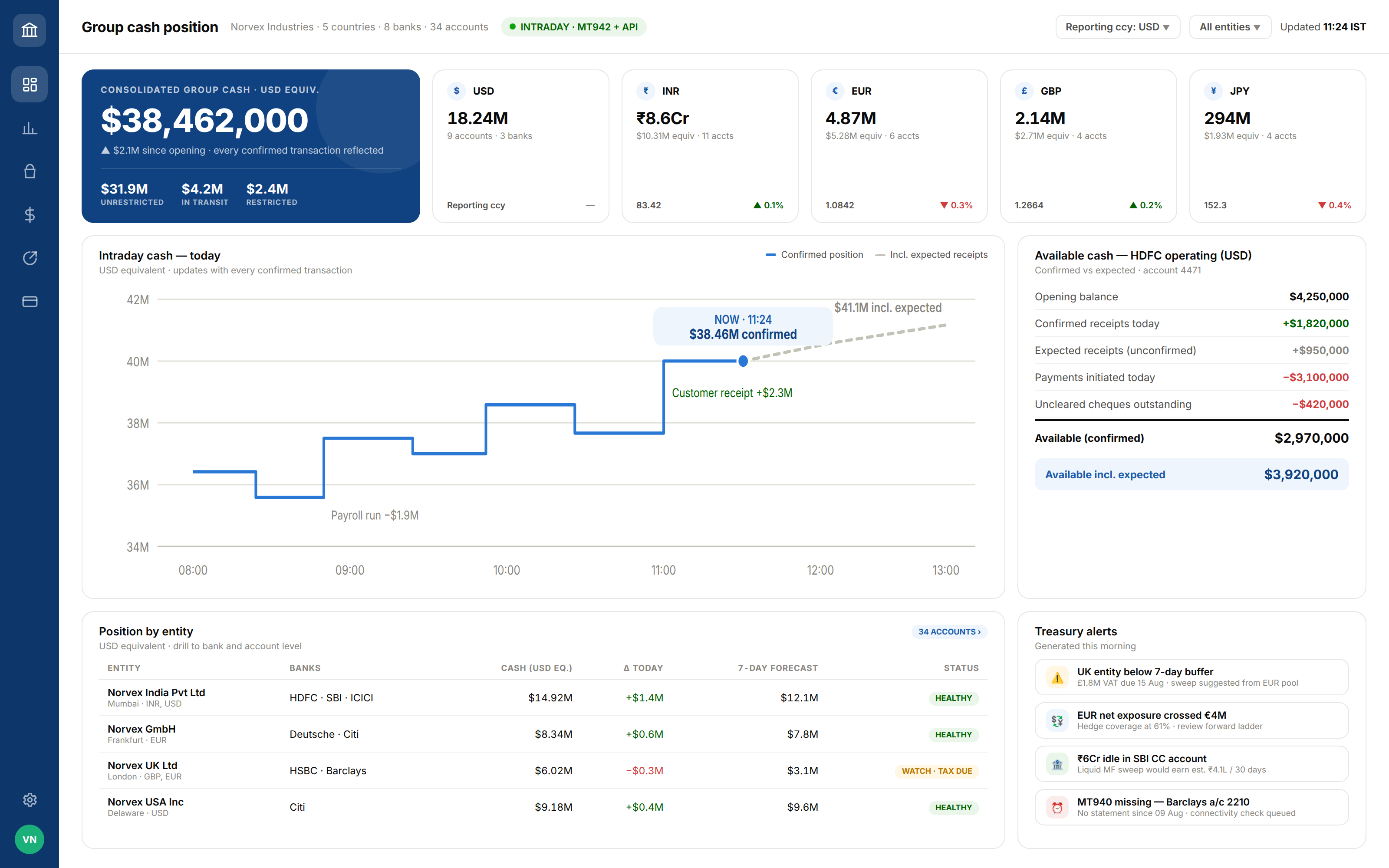
The TMS maintains a spot rate feed, typically from a currency data provider like Refinitiv or Bloomberg, or from the company’s relationship bank, and converts all account balances to the reporting currency in real time. The cash position dashboard shows both local currency and reporting currency balances for every account.
The cash position hierarchy:
| Level | View | Audience |
| Consolidated group | Total cash across all entities, all banks, all currencies | CFO, Group Treasurer |
| Entity level | Cash position for one legal entity | Entity Finance Head |
| Bank level | Cash across all accounts at one bank | Relationship management |
| Account level | Individual account balance and transactions | Operational treasury team |
| Currency level | Total exposure in each currency | FX risk management |
The intraday cash position:
For companies with high daily payment volumes, the cash position changes significantly throughout the day. The TMS updates the cash position with every confirmed transaction, either from real-time bank API feeds or from same-day bank statements (MT942).
The treasurer knows at any moment how much cash is available in each account rather than working from yesterday’s closing balance.
The available cash calculation:
| Component | Amount |
| Opening balance | $4,250,000 |
| Confirmed receipts today | +$1,820,000 |
| Expected receipts today (unconfirmed) | +$950,000 |
| Payments initiated today | -$3,100,000 |
| Uncleared cheques outstanding | -$420,000 |
| Available cash (confirmed) | $2,970,000 |
| Available cash (including expected) | $3,920,000 |
The forecast horizon:
| Horizon | Forecast Basis | Accuracy |
| 1–7 days | Confirmed payments + expected receipts from ERP | High, known obligations |
| 8–14 days | ERP payables/receivables due + historical patterns | Medium |
| 15–30 days | Planned payments + statistical extrapolation | Lower, probabilistic |
| 31–90 days | Budget-based + planned capex + rolling average receipts | Low, indicative |
The cash forecast data sources:
| Source | Data | Integration |
| Accounts payable (ERP) | Invoices due by date | SAP/Oracle AP module |
| Accounts receivable (ERP) | Invoices expected by date | SAP/Oracle AR module |
| Payroll | Fixed date, fixed amount | HR system |
| Loan repayments | Fixed schedule | TMS debt module |
| Tax payments | Calendar-based | Tax team input |
| Capex commitments | Project-based | Project finance team input |
| FX settlement | Forward contract maturities | TMS FX module |
The forecast variance analysis:
Every day, the previous day’s forecast is compared against actual cash movements. Where the forecast was wrong, a large receipt that did not arrive, a payment that came earlier than expected, the forecasting model learns and adjusts.
Over 90 days of operation, the TMS’s forecast accuracy for the 7-day horizon typically improves from 70 to 75% (from ERP data alone) to 85 to 90% (with ML-enhanced pattern recognition).
The payment workflow:
| Step | Action | Control |
| Payment request | Any user creates a payment request | Request validated against budget and mandate |
| Dual approval | Two authorised signatories approve | Configurable per amount threshold and account |
| Bank submission | Approved payment submitted to bank | Via SWIFT, bank API, or file upload |
| Bank confirmation | Bank confirms receipt | Status updated in TMS |
| Accounting entry | Payment posted to ERP | Automated or manual depending on integration |
Payment fraud controls:
| Control | Description |
| Beneficiary whitelist | Payments only to pre-approved beneficiaries |
| Dual authorisation | Two signatories required for payments above threshold |
| Maker-checker | Payment creator cannot also approve |
| Bank account verification | New beneficiary bank account verified before first payment |
| Payment velocity limits | Maximum amount per day per beneficiary |
| Time-of-day restrictions | Payments only during business hours |
| Geo-restriction | Login from unusual geography requires additional authentication |
The FX exposure calculation:
The company’s FX exposure is the net of:
| Exposure Type | Source | Currency |
| Receivables | Export invoices due | USD, EUR, GBP |
| Payables | Import invoices due | USD, EUR, JPY |
| Intercompany | Intercompany loans and balances | Multiple |
| Cash balances | Foreign currency accounts | Multiple |
| Forecast | Expected foreign currency flows next 90 days | Multiple |
The hedge tracking module:
For each hedging instrument, forward contract, options, cross-currency swap, the platform records:
| Field | Details |
| Instrument type | Forward, option, swap |
| Notional amount | Currency and amount |
| Trade date | When the hedge was transacted |
| Maturity date | When the hedge settles |
| Strike rate | Contracted exchange rate |
| Counterparty | Bank or FX dealer |
| Underlying exposure | Which receivable or payable this hedge covers |
| Mark-to-market | Current fair value of the hedge |
The hedge effectiveness report:
Every quarter, the platform generates a hedge effectiveness report, comparing the gain or loss on hedging instruments against the gain or loss on the hedged items. This report is the primary evidence for hedge accounting treatment under AS 30 or IFRS 9.
Debt facility tracking:
| Facility | Amount | Used | Available | Interest Rate | Maturity | Covenant Status |
| Term loan, HDFC Bank | ₹50Cr | ₹50Cr | ₹0 | 9.25% | March 2028 | Compliant |
| CC facility, SBI | ₹20Cr | ₹14Cr | ₹6Cr | MCLR+1.5% | Annual renewal | Compliant |
| WCDL, Axis Bank | ₹30Cr | ₹0 | ₹30Cr | 8.75% | On demand | N/A |
Covenant monitoring:
Every loan facility has financial covenants, minimum net worth, maximum debt-to-equity, minimum interest coverage ratio. The TMS monitors these covenants in real time using financial data from the ERP:
Current covenant status: compliant or at risk. Headroom, how much buffer exists before the covenant is breached. Alert trigger, when the projected ratio approaches within 10% of the covenant threshold.
Short-term investment management:
Surplus cash is often invested in short-term instruments, treasury bills, commercial paper, liquid mutual funds. The TMS tracks:
All active investments with maturity dates, invested amount, expected return, and the bank or investment platform holding them.
Maturity alerts, 7 days before maturity, the treasurer is reminded to reinvest or deploy the maturing proceeds. Yield comparison, return on each instrument versus market alternatives.
| Module | Cost Range (USD) | Notes |
| Bank connectivity + statement ingestion | $10K – $18K | SWIFT, bank APIs, SFTP, manual upload |
| Multi-currency cash position (real-time) | $8K – $15K | Spot rate feed integration |
| Cash forecasting engine | $8K – $15K | ERP integration, ML enhancement |
| Payment management + dual authorisation | $8K – $15K | Fraud controls, bank submission |
| FX exposure calculation + hedge tracking | $10K – $18K | Mark-to-market, hedge effectiveness |
| Debt facility tracking + covenant monitoring | $6K – $12K | |
| Short-term investment tracking | $5K – $10K | |
| Bank account registry + mandate management | $4K – $8K | |
| Intercompany netting + settlement | $6K – $12K | |
| Reconciliation engine | $6K – $12K | Bank to ledger automated matching |
| CFO and board reporting | $5K – $10K | |
| AWS + VAPT + Year 1 ops | $5K – $10K | |
| Total | $81K – $155K | Full treasury management system |
EngineerBabu built financial infrastructure for Adani Group and lending platforms for EarlySalary/Fibe. CMMI Level 5. Google AI Accelerator 2024 Top 20. Contact: mayank@engineerbabu.com
Cash positioning is the consolidated view of a company’s cash balances across all bank accounts, all entities, and all currencies at a specific point in time. Real-time cash positioning matters because treasury decisions, whether to draw down a credit facility, whether to invest surplus cash, whether a payment can be made without overdrawing an account, require current information, not yesterday’s numbers. A company that discovers its current account is overdrawn only when it receives the bank’s morning statement is managing treasury reactively. A company with a real-time cash position dashboard that updates with every confirmed transaction is making decisions with current information, avoiding overdraft fees, optimising investment of surplus cash, and preventing fraud through anomaly detection in real-time transaction flows.
FX hedge effectiveness testing is the accounting process that determines whether a hedging instrument, a forward contract, options, or swap, qualifies for special hedge accounting treatment under accounting standards (AS 30 in India, IFRS 9 internationally, ASC 815 in the US). A qualifying hedge allows gains and losses on the hedging instrument to be deferred in other comprehensive income rather than recognised immediately in P&L, matching the timing with the underlying hedged item. Effectiveness testing requires demonstrating, at inception and ongoing, that the hedge is expected to be and is highly effective, typically defined as 80 to 125% offset between the change in fair value of the hedging instrument and the change in fair value of the hedged item. A treasury management system performs this test automatically each quarter, generating the required documentation and effectiveness ratio calculation.
The priority depends on bank relationships and IT infrastructure. For large Indian and international banks, State Bank of India, HDFC Bank, ICICI Bank, Citibank, direct SFTP connectivity with MT940 format statements is the most reliable and widely supported option. Banks with modern API programmes, Yes Bank, Kotak, Axis Bank, offer direct API connectivity that enables real-time (intraday) transaction reporting rather than end-of-day statements. SWIFT connectivity is appropriate for companies with SWIFT membership or that can access SWIFT through a service bureau. The recommended approach for most mid-market companies is a multi-method connectivity architecture, direct API where available, MT940 SFTP for traditional banks, and manual upload as fallback, with all methods feeding into the same normalised transaction schema in the TMS.