Software Outsourcing vs In-House Development: 2026 Guide


Create engaging, high-performance mobile applications tailored to your business needs. We craft future-ready apps that offer smooth user experiences on all devices.
Build robust and scalable websites and CMS platforms that help you manage content effortlessly. Our development ensures a seamless digital presence.
Launch secure, feature-rich online stores with intuitive shopping experiences. We build tailored eCommerce platforms designed for growth.
Design captivating games with immersive gameplay and stunning graphics. From concept to launch, we build engaging experiences that players love.
Enhance your customer relationships with customized Salesforce implementations. Drive growth and efficiency with smarter CRM solutions.
Harness artificial intelligence and machine learning to automate workflows and gain actionable insights. Our AI transforms data into smart decisions.
Accelerate your software delivery lifecycle with continuous integration, delivery, and infrastructure automation to boost efficiency.
Hire app developers ready to turn your ideas into sleek, high-performing mobile apps for any platform.
Bring in frontend pros who craft smooth, beautiful, and user-friendly interfaces that your visitors will love.
Get backend developers who build fast, secure, and reliable systems to keep everything running behind the scenes.
Hire eCommerce developers who build secure, scalable online stores designed to offer seamless shopping and grow your sales.
Get dedicated developers committed to your projects, delivering consistent quality and speed as an extension of your team.
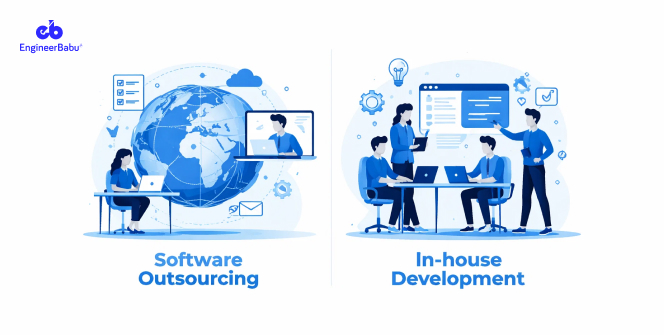
Software outsourcing vs in-house development is a critical decision that shapes how modern businesses build, scale, and sustain digital products. As companies across industries accelerate digital transformation, choosing the right development model directly impacts cost efficiency, speed to market, product quality, and long-term innovation. While in-house teams offer deeper control and alignment with business goals, outsourcing provides access to global talent, faster execution, and flexible scaling, making the decision highly context-dependent.
According to Deloitte, nearly 70% of companies outsource to reduce costs, highlighting how widespread and strategically important outsourcing has become in the competitive landscape. Businesses must also consider factors like intellectual property, security, talent availability, and operational agility when comparing the two approaches.
Should you spend months hiring and building a team internally, or partner with experienced external experts who can help you move faster and stay competitive? Customers expect software to evolve quickly, work flawlessly, and keep improving over time, which creates real pressure on companies to build strong development teams without slowing things down.
Software Outsourcing is a way of building software by working with an external team instead of relying only on internal resources. They work closely with your business, using your tools, following your roadmap, and aligning with your goals so that the output feels like it is coming from an extended part of your team.
Some common outsourcing forms include dedicated offshore development teams that work as long term extension of your business, managed product teams, project-based outsourcing, and staff augmentation where you add external experts to fill specific skill gaps in your existing team.
In-house software development means building your own internal engineering team and managing everything with the company. This includes hiring the right talent, onboarding them, managing salaries and benefits, and ensuring long term retention, right infrastructure, tools, and processes to support development.
These teams usually have a deeper understanding of the product and company culture, which can be a strong advantage but this approach also comes with higher fixed costs and less flexibility.
| Factor | Software Outsourcing | In-House Development |
|---|---|---|
| Cost | Lower and flexible | High and fixed |
| Hiring Speed | Faster, usually within weeks | Slower, can take months |
| Scalability | Easy to scale up or down | Difficult and time-consuming |
| Control | Shared control with defined processes | Full control |
| Talent Access | Access to global talent | Limited to local talent pool |
| Risk | Process-driven and structured | Depends heavily on individuals |
| Best For | Speed, flexibility, and scaling | Core product and long-term IP |
Building an in-house development cost across regions (US,UAE,EU) must have teams that carry fixed and compounding expenses. Companies need to invest in onboarding, salaries, benefits, and long-term retention.
For a team of 3–4 engineers, the monthly cost can be quite high depending on the region. In the US, it typically ranges between $30k–$50k, while in the UAE it falls between $25k–$45k. In European markets, it is slightly lower but still significant, around $20k–$40k.
Outsourcing shifts this model from fixed to flexible spending. Instead of carrying long-term financial commitments, companies pay for what they need, when they need it. For a similar team size offshore, the monthly cost usually ranges from $6k–$12k. This cost difference allows businesses to allocate resources more strategically, especially during early-stage growth or uncertain product phases.
Building an internal team takes time. Hiring alone can take a few months, followed by onboarding and ramp-up before actual development begins. Progress often depends on individual performance, which can slow down delivery if not managed well.
Outsourcing enables quicker project initiation where teams are often ready to start within weeks and come with established workflows. Many outsourcing partners also work across time zones, allowing parallel development and faster iteration cycles which results that outsourcing is often the preferred option for businesses aiming to launch quickly or test ideas in the market.
When hiring locally, companies are restricted to a smaller talent pool. Finding experts in niche areas like AI, fintech, or DevOps can be challenging and time-consuming. There is also a higher dependency on individual team members.
Companies can work with experienced engineers who already have domain expertise. It also becomes easier to scale skills up or down based on project needs without long hiring cycles. This approach helps businesses stay competitive by accessing the right expertise at the right time.
With in-house teams, companies have direct visibility into processes and stronger alignment with internal culture. However, maintaining consistent quality and security standards depends heavily on internal maturity and leadership.
Established outsourcing partners often follow well-defined processes for development, testing, and security. They rely on documentation and proven frameworks, which can improve consistency and reliability. While outsourcing requires clear contracts and governance, intellectual property typically remains fully owned by the client when agreements are properly structured.
Scaling an internal team is not always easy. Hiring takes time, and reducing team size during slower periods can be difficult and costly. This creates financial and operational pressure.
Outsourcing offers the flexibility to quickly scale teams up or down based on project requirements. Companies can adapt to changing roadmaps without long-term commitments or HR challenges. This makes outsourcing especially useful for businesses dealing with evolving products or uncertain demand.
Outsourcing tends to make more sense when you need to move fast and stay flexible. For example, if you are trying to launch a product quickly or test a new idea, waiting months to hire an in-house team can slow you down. With outsourcing, you can get started almost immediately and bring in people who have already worked on similar problems. It also helps when your plans are still changing, because you can scale the team up or down without being locked into long-term costs. This is why many companies rely on outsourcing for MVPs, SaaS products, or complex builds that need niche expertise.
In-house development feels like the right choice when your product is at the heart of your business and you want complete control over how it evolves. Having your own team means they understand your vision deeply and can build with long-term goals in mind. It works well for companies that are growing steadily, have strong technical leadership, and can invest in building a solid team over time. Even then, many businesses don’t stick to just one approach. They keep their core work in-house and use outsourcing to handle additional workload or specialized tasks when needed.
Software Outsourcing vs In-House Development is not about choosing one over the other, but about finding what works best for your business goals and growth stage. Some companies need speed and flexibility, while others need deeper control and long-term alignment. Many successful businesses combine both approaches to get the best of both worlds.
Companies choose EngineerBabu for this balance, backed by Google AI Accelerator (Batch ’24), recognition among LinkedIn’s Top 10–20 Companies, and experience with 75+ year combinator backed startups. With senior-led decisions, strong security, and full IP ownership, the focus remains on building scalable, reliable products that support long-term success.
For startups, Software Outsourcing vs In-House Development often leans toward outsourcing. It allows faster product launches, lower upfront costs, and access to experienced developers without long hiring processes, which is crucial in early growth stages.
Yes, many companies combine Software Outsourcing vs In-House Development through a hybrid approach. They keep core product decisions in-house while outsourcing execution or specialized tasks, helping them balance control with speed and scalability.
To choose between Software Outsourcing vs In-House Development, consider your priorities such as budget, timeline, and product complexity. If you need fast delivery and flexibility, outsourcing is a good fit. If your product is central to your business, an in-house team may be more suitable.
Product quality in Software Outsourcing vs In-House Development depends more on the team and processes than the model itself. A skilled outsourcing partner with strong workflows can deliver the same, or even better, quality compared to an in-house team.
Yes, many companies find that combining Software Outsourcing vs In-House Development works best. A hybrid model allows businesses to maintain control over core areas while using outsourcing for speed, flexibility, and specialized skills.