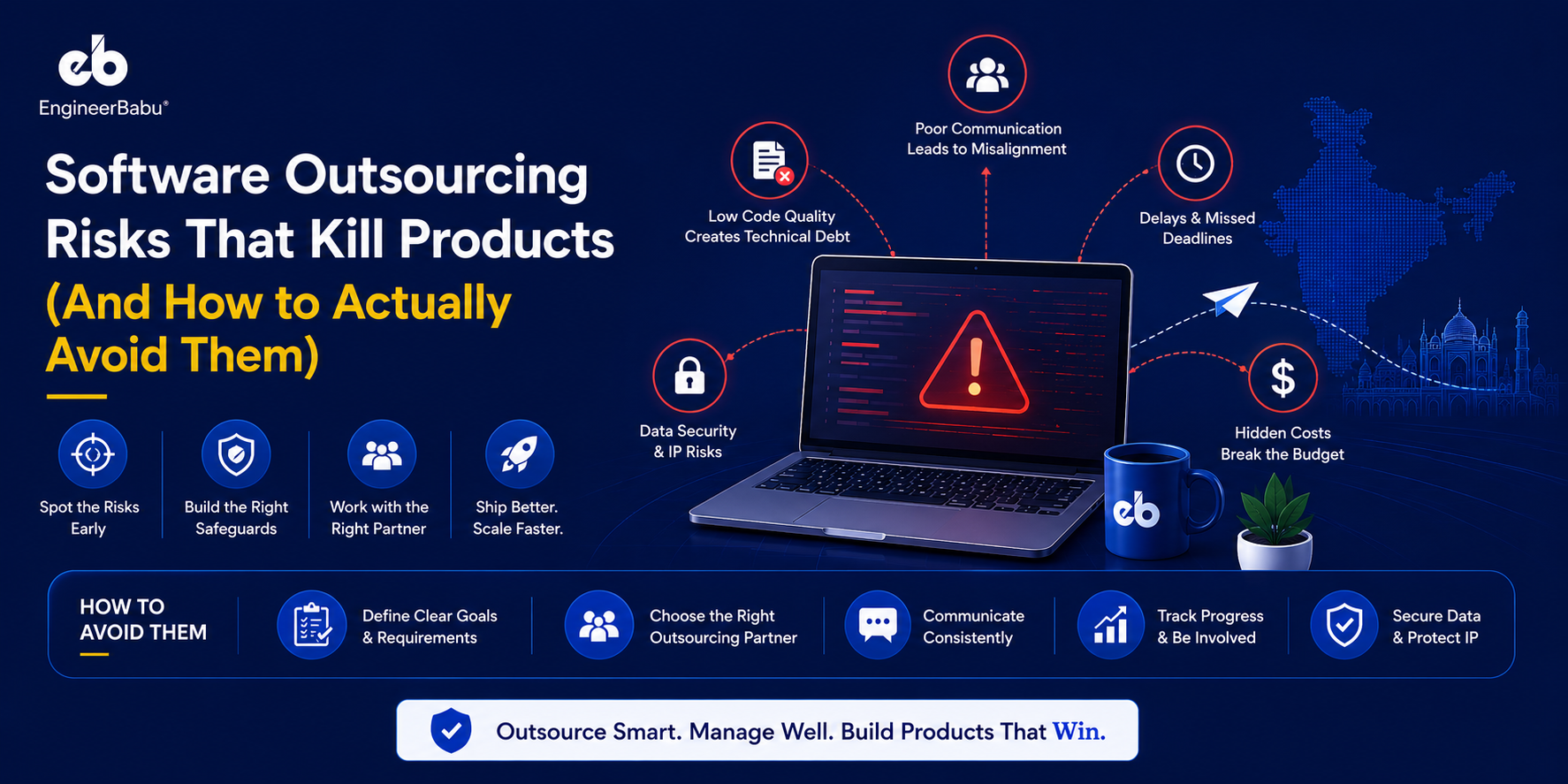
Software Outsourcing Risks That Kill Products (And How to Actually Avoid Them)


Create engaging, high-performance mobile applications tailored to your business needs. We craft future-ready apps that offer smooth user experiences on all devices.
Build robust and scalable websites and CMS platforms that help you manage content effortlessly. Our development ensures a seamless digital presence.
Launch secure, feature-rich online stores with intuitive shopping experiences. We build tailored eCommerce platforms designed for growth.
Design captivating games with immersive gameplay and stunning graphics. From concept to launch, we build engaging experiences that players love.
Enhance your customer relationships with customized Salesforce implementations. Drive growth and efficiency with smarter CRM solutions.
Harness artificial intelligence and machine learning to automate workflows and gain actionable insights. Our AI transforms data into smart decisions.
Accelerate your software delivery lifecycle with continuous integration, delivery, and infrastructure automation to boost efficiency.
50-70% of software outsourcing engagements that fail do so in the first 60 days. Not because the vendor couldn’t build. Because nobody stress-tested whether they were building the right thing, for the right architecture, with the right ownership terms.
That number isn’t from a report. It’s from 14 years of building software and being brought in to salvage projects that didn’t make it.
The IT Services Outsourcing Market is projected to reach USD 462.10 billion in 2026 and grow at a CAGR of 9.3%, eventually hitting USD 861.10 billion by 2033.
More companies are outsourcing more critical software than at any point in history. And the failure rate hasn’t dropped. It’s kept pace.
I co-founded EngineerBabu, a CMMI Level 5 product engineering company that has delivered 500+ projects across 20+ countries, including products for 4 unicorn clients and 75 YC-selected startups.
The pattern I’ve seen in every failed outsourcing engagement isn’t bad code. It’s predictable, avoidable decisions made in the first few weeks that compound into disasters six months later. This article is the map of those decisions.
Software outsourcing risks are the predictable failure patterns that emerge when a company hires an external team to build, maintain, or scale their technology product.
They span technical execution, communication breakdown, intellectual property exposure, hidden cost escalation, and vendor lock-in.
The risk isn’t outsourcing itself. The risk is outsourcing without a framework.
Most failed outsourcing engagements don’t collapse at the code level. They collapse in the first two weeks.
The vendor runs a quick requirements session. The client sends a 30-page spec. The vendor nods, sends back a proposal, and the engagement begins. Nobody has stress-tested whether the spec actually solves the business problem.
When the EngineerBabu team built LoanOS, a 7-module lending platform covering origination, underwriting, servicing, collections, and regulatory compliance, the first 3 weeks were entirely discovery.
No code. Just architecture decisions, user journey mapping, and assumption stress-testing. The client pushed back on the timeline. We held firm. That platform went live on time, handles 40,000+ loan applications monthly, and required zero major re-architecture.
Bad vendors rush discovery. Good ones treat it as the highest-risk phase of the engagement.
Red flag: A vendor who can scope your project in under 3 days of conversation.
This one is rarer now than it was in 2018, but it’s made a quiet comeback through proprietary frameworks and cloud-native dependency mismanagement.
I’ve reviewed codebases where the entire architecture was built on a single vendor’s proprietary ORM layer. Switching would require a full rewrite. I’ve seen mobile apps built with internal boilerplate frameworks that the agency owned the license to.
I’ve audited backends where all infrastructure was managed through a vendor’s internal DevOps tooling with no handoff documentation.
In each case, the client was effectively renting their own product.
Before signing any outsourcing contract, verify three things: who owns the IP, who has access to all repository credentials, and whether the codebase can be handed to a different team on day 90 without the original vendor’s involvement. If any of these have caveats, renegotiate before you start.
The most underestimated outsourcing risk isn’t technical. It’s timezone-driven communication collapse.
A 12-hour timezone gap means one round of feedback per day. If you’re managing a sprint with 3 unclear requirements, that’s 3 days of drift before alignment. Over a 6-month project, this accumulates into a 4-8 week delay minimum.
I’ve spoken to CTOs who underestimate this by 3-4x. They think daily standups fix it. They don’t. Asynchronous decision-making needs to be embedded into the process architecture itself, not bolted on through more meetings.
The best distributed teams I’ve seen operate on a principle I call “decision-ready documentation.” Every requirement is written to a level of detail where a developer in a different timezone can proceed without asking a question. Ambiguity is resolved before the sprint starts, not during it.
Scope creep is the most statistically consistent risk in software outsourcing.
The mechanism is always the same. Client asks for “a small change.” Vendor says yes. No change order. No timeline impact documented. Multiply this by 40 iterations over 6 months and you’ve added 30% to the project scope with 0% additional budget negotiated.
Governance isn’t bureaucracy. It’s the thing that keeps projects from silently doubling in cost.
Every change request, regardless of size, should generate a written impact assessment. Not a long one. Three lines: what changes, how long it takes, what it delays. If a vendor resists this, that’s your signal.
I recently did a code review for a fintech app development that had been outsourced for development for 18 months. The product worked. Users were transacting. Revenue was growing. And then they hired a CTO.
He came back with a report: 68% test coverage gap, 14 critical security vulnerabilities, and an architecture that would require a full refactor before they could scale to their Series A roadmap. The estimate to fix the accumulated technical debt: $320,000 and 7 months.
They had been paying for velocity. What they were actually buying was a mortgage on future engineering capacity.
Require code reviews to be built into the contract. Mandate test coverage thresholds (I use 70% as a floor for production-bound code). Ask to see CI/CD pipeline setup before the first sprint begins. If a vendor can’t show you their engineering standards documentation, they don’t have any.
This risk is category-specific but devastating when it hits.
In fintech, healthtech, or any product handling PII, building without compliance architecture is not a shortcut. It’s a deferred liability. I’ve seen products built without proper KYC/AML integration, data residency controls, or encryption-at-rest standards that had to be torn down and rebuilt before a single enterprise client would sign.
When the EngineerBabu team built EarlySalary’s lending stack, now processing over ₹10,000 crore in disbursements, the compliance architecture was designed in week one alongside the technical architecture. Credit bureau integrations, regulatory reporting, data residency for RBI compliance: these weren’t features added later. They were foundational decisions.
Regulated industry outsourcing without a vendor who has shipped in that regulatory environment before isn’t outsourcing. It’s experimenting with your compliance exposure.
Agencies staff up on wins. They staff down when new logos come in.
You start an engagement with a senior architect and two experienced developers. By month 4, the architect has rolled off to a new client, and your project is being managed by two developers who joined the company 6 months ago. No knowledge transfer. The codebase familiarity walks out the door with the original team.
I require contracts to include a named-resource clause for any engagement over $150,000. The clause specifies that any key personnel change requires 30 days written notice and a documented knowledge transfer period. Most vendors push back. That pushback tells you exactly how they staff their projects.
The product ships. The vendor celebrates. You go live.
Three weeks later, a bug emerges in production. The vendor responds in 48 hours. The SLA says 72 hours. It’s technically compliant. Your users are churning.
Post-launch support is one of the most under-negotiated elements of outsourcing contracts. Most contracts specify response time. Very few specify resolution time, escalation paths, or the technical depth of the support team.
For any product launch, I negotiate post-launch retainer terms before the build contract is signed. Not after. After, you have zero leverage.
The assumption that the cheapest option is the most cost-effective is the mistake I see most often from first-time outsourcers.
Offshore at $15/hour with 3x the communication overhead, 2x the revision cycles, and post-launch technical debt that requires $200,000 to resolve is not cheaper than nearshore at $50/hour that delivers clean code, on time.
Total cost of engagement is not the same as rate per hour.
I’m not arguing against offshore development. The EngineerBabu team operates across India and delivers globally competitive quality. What I’m arguing against is optimizing for the wrong number.
Before signing, score your vendor on these criteria:
| Evaluation Criteria | What Good Looks Like | Red Flag |
| Discovery process | 2-4 week structured discovery phase | “We can scope it in 2 days” |
| IP ownership terms | Clean IP assignment to client on signing | Vague “joint ownership” language |
| Engineering standards | Documented code review, CI/CD, test coverage policy | No standards documentation |
| Team continuity | Named resource clause available | “We’ll staff the best available team” |
| Regulatory experience | Cases in your industry vertical | Generic tech portfolio only |
| Post-launch SLA | Resolution time specified, not just response time | Only response time in contract |
| Communication architecture | Async-first process with async decision documentation | “We’ll do daily standups” |
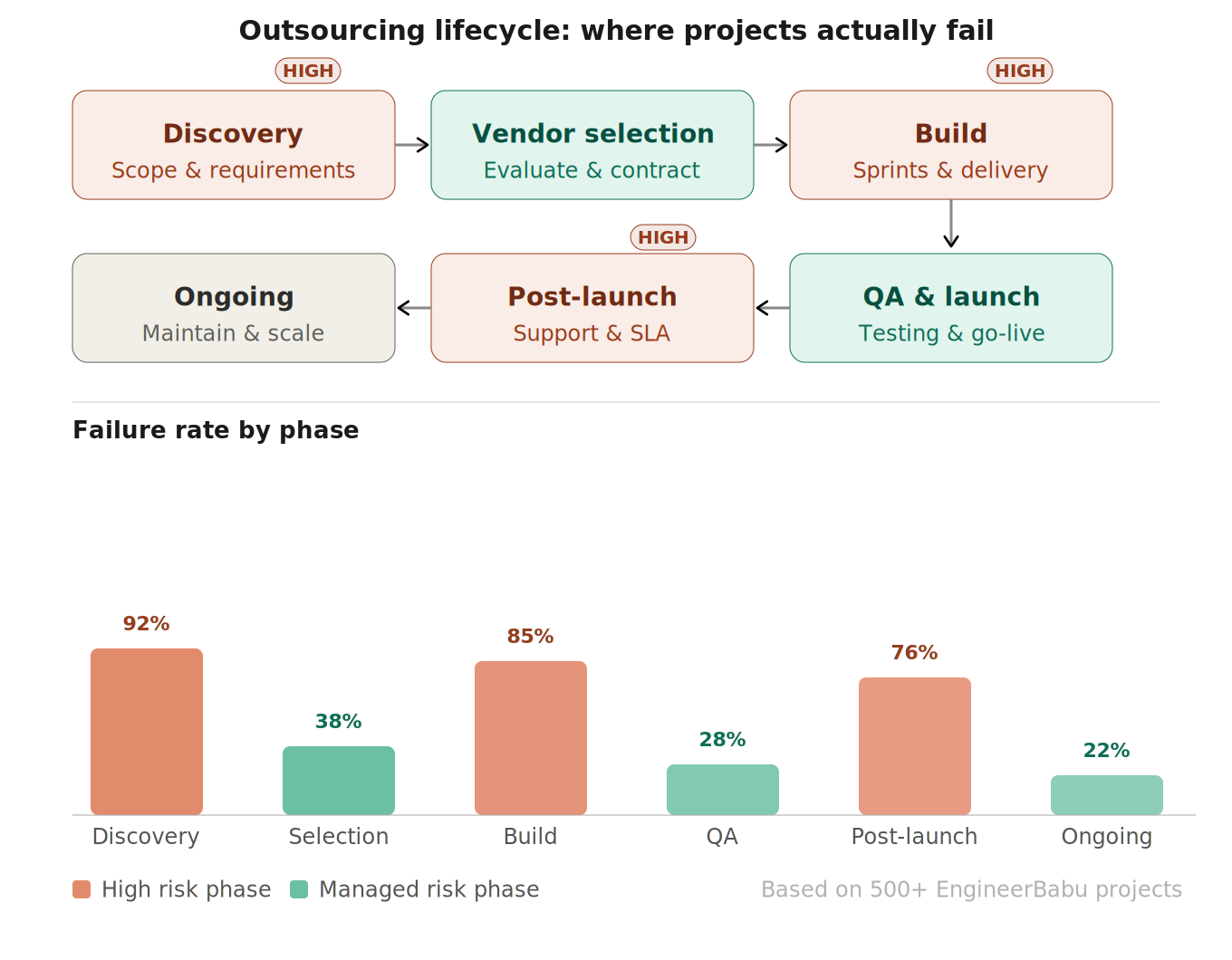 What Most People Get Wrong About Software Outsourcing Risks
The popular advice is: check references, look at portfolios, run a paid trial sprint.
All of that is correct. None of it is sufficient. The real signal is how a vendor behaves before money changes hands.
Do they push back on your spec? A vendor who tells you your requirements are incomplete before signing is worth 10x more than one who tells you what you want to hear. Do they bring up risks you haven’t raised?
The EarlySalary team I worked with flagged three regulatory edge cases in discovery that hadn’t appeared in any requirements document. Those flags saved 4 months of rework.
The vendors most likely to deliver are the ones who make the engagement harder to start. They ask uncomfortable questions. They scope things you didn’t ask them to scope. They tell you the timeline you want isn’t realistic.
After reviewing hundreds of vendor proposals across 14 years and 500+ projects: the vendor who tells you “yes, 3 months, here’s the quote” on a project that should take 6 is not optimistic. They’re either naive or they’re selling.
These are from actual recovery engagements I’ve been brought into, not industry estimates:
The math on getting outsourcing right the first time is not close.
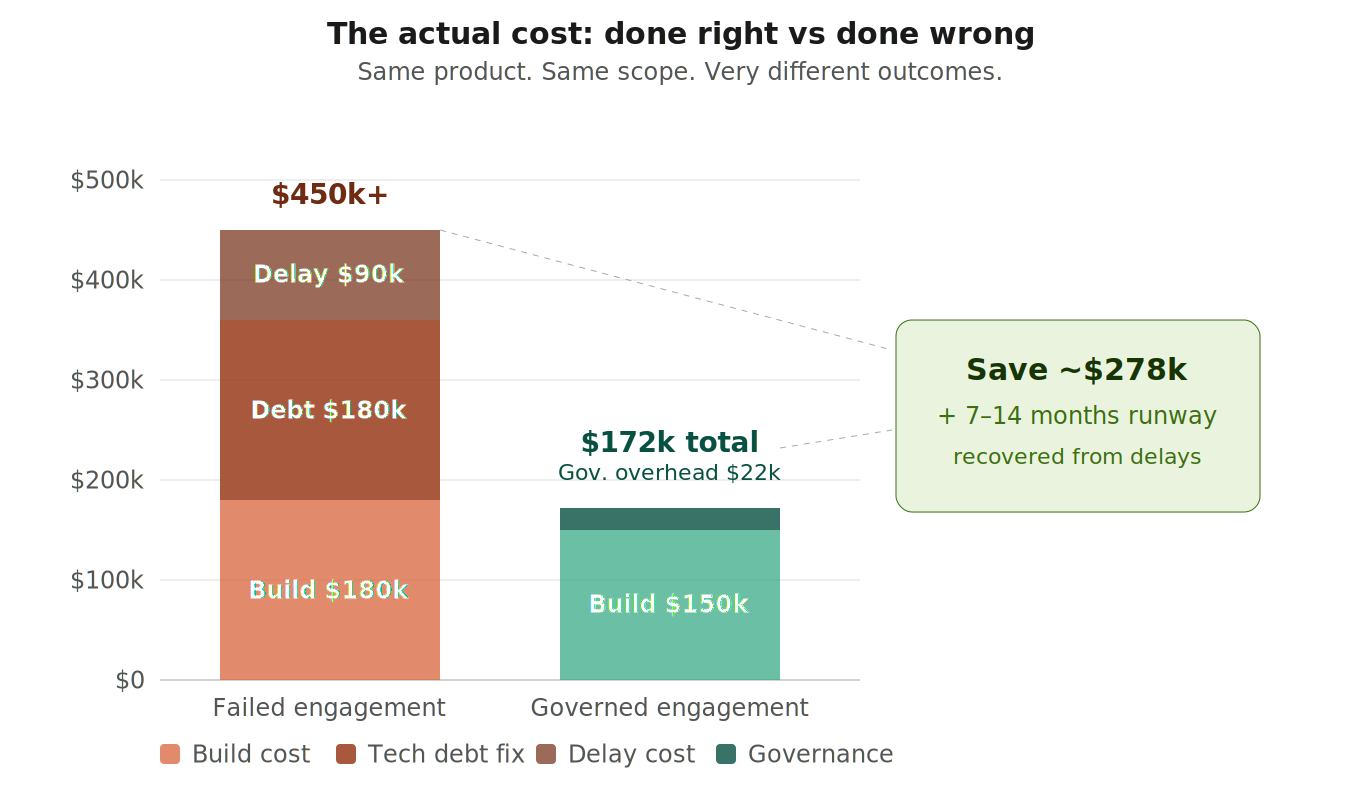
The risk is not the vendor you hire. The risk is the information asymmetry between you and the vendor in the first 30 days of an engagement.
The vendors who manage risk well close that asymmetry fast. They surface problems before they’re problems. They build governance into the process. They push back when the brief is incomplete.
Every project failure I’ve audited in 14 years had warning signs in the first month. Not always visible to the client. Almost always visible to anyone who knew what to look for.
If you’re evaluating a software development engagement and want to talk through the architecture decisions, vendor evaluation criteria, or risk profile of your specific project before you commit, I’m usually the one on those calls. No account managers, no sales team.
About the Author
Mayank Pratap is Co-founder of EngineerBabu, a CMMI Level 5 product engineering company that has delivered 500+ software products across 20+ countries.
EngineerBabu is a Google AI Accelerator Top 20 globally (2024) and a NASSCOM member, backed by Vijay Shekhar Sharma. Mayank leads product architecture, client engagements, and engineering strategy personally.
The highest-impact risks are misaligned discovery leading to wrong-problem builds, vendor lock-in through proprietary architecture or IP clauses, technical debt accumulation from low-quality code, and post-launch support gaps.
Communication breakdown due to timezone and process misalignment is the most common cause of project delays. Security and compliance failures are the most expensive to remediate.
Require a clear IP assignment clause in the Master Services Agreement that transfers all code, documentation, and derivative works to the client upon payment. Verify that subcontractors used by the vendor sign the same IP agreement. Ensure all repository access credentials are held by the client, not the vendor.
Location alone is not the primary risk driver. Process maturity, communication architecture, and engineering standards are better predictors of outcome than geography. A CMMI Level 5 certified offshore team with structured async processes will outperform an unstructured local agency in most engagements.
Implement a formal change control process before the project starts. Every requirement change, regardless of size, generates a written impact assessment covering scope, timeline, and cost implications. This should be contractually required, not informally agreed to.
MVP builds typically run 3 to 5 months for well-scoped projects. Full product platforms with integrations run 6 to 12 months. Any vendor quoting under 10 weeks for a non-trivial product is compressing your timeline in ways you’ll pay for later.