Outsource Software Development to India from Germany: What 500+ Projects Actually Taught Me


Create engaging, high-performance mobile applications tailored to your business needs. We craft future-ready apps that offer smooth user experiences on all devices.
Build robust and scalable websites and CMS platforms that help you manage content effortlessly. Our development ensures a seamless digital presence.
Launch secure, feature-rich online stores with intuitive shopping experiences. We build tailored eCommerce platforms designed for growth.
Design captivating games with immersive gameplay and stunning graphics. From concept to launch, we build engaging experiences that players love.
Enhance your customer relationships with customized Salesforce implementations. Drive growth and efficiency with smarter CRM solutions.
Harness artificial intelligence and machine learning to automate workflows and gain actionable insights. Our AI transforms data into smart decisions.
Accelerate your software delivery lifecycle with continuous integration, delivery, and infrastructure automation to boost efficiency.
Hire app developers ready to turn your ideas into sleek, high-performing mobile apps for any platform.
Bring in frontend pros who craft smooth, beautiful, and user-friendly interfaces that your visitors will love.
Get backend developers who build fast, secure, and reliable systems to keep everything running behind the scenes.
Hire eCommerce developers who build secure, scalable online stores designed to offer seamless shopping and grow your sales.
Get dedicated developers committed to your projects, delivering consistent quality and speed as an extension of your team.
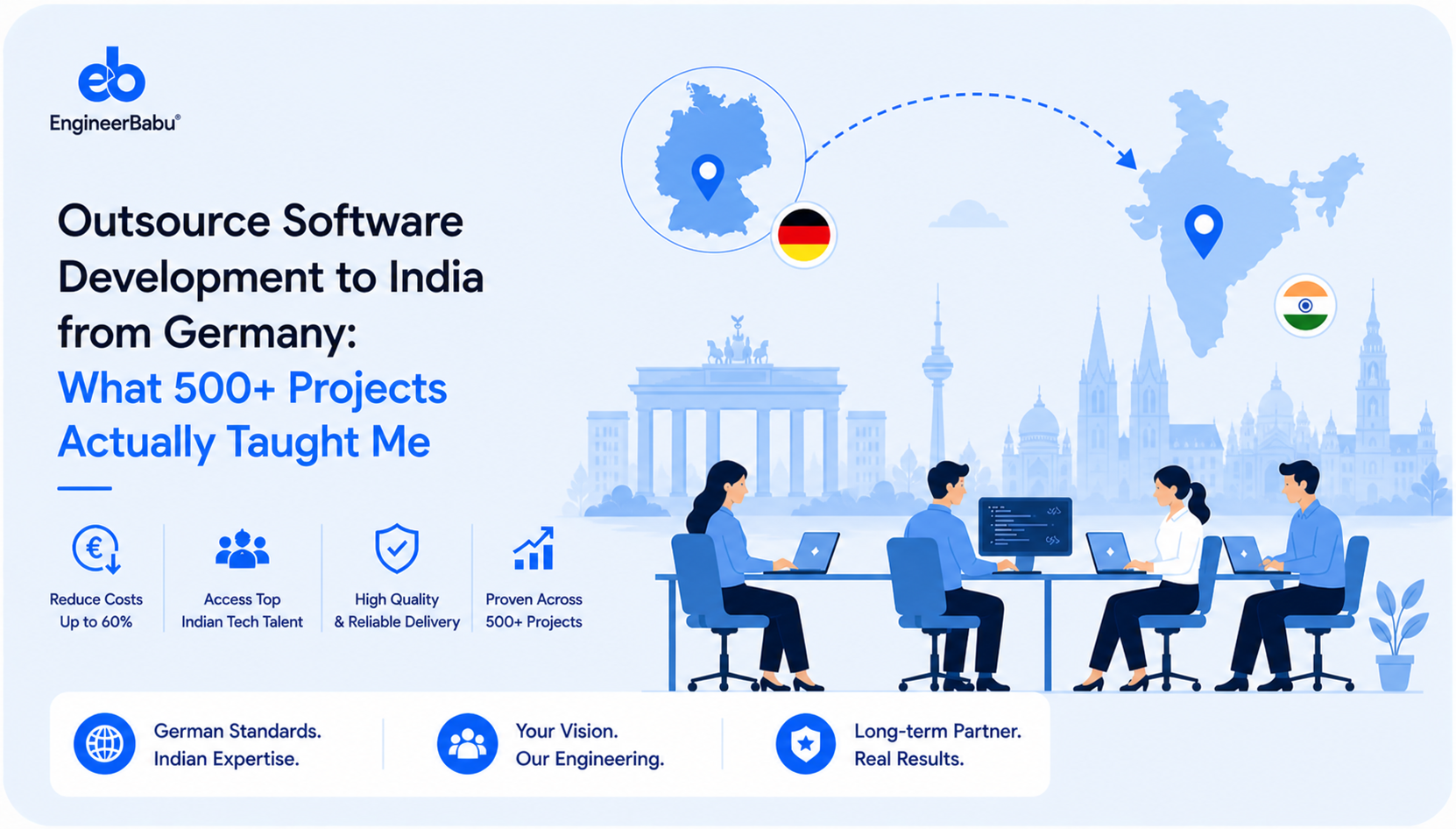
75 of the products EngineerBabu has built were for YC-selected startups. Not YC-adjacent. Not “we applied once.” Selected, funded, in the batch.
I didn’t lead with that to impress you. I lead with it because most German companies’ mental model of outsourcing software development to India is still stuck somewhere in 2009: offshore body shops, ticket-driven execution, developers who do exactly what you spec and nothing more.
The reality in 2025 is different. India’s top product engineering firms are building the same products as the best German and European agencies, for the same demanding clients, at 40-60% of the cost. The gap isn’t quality anymore. The gap is in knowing which firms are actually doing that work versus which ones are marketing their way into appearing like they are.
I’ve spent 14 years on this side of the equation. EngineerBabu, a CMMI Level 5 product engineering company, has delivered 500+ projects across 20+ countries, including platforms that have processed ₹10,000 crore in loan disbursements and AI systems running in real-time across field operations. I’m personally on every client architecture call. No sales team, no account managers.
What follows is the unfiltered version of what I know about how to do this right.
Outsource software development to India from Germany is the practice of contracting a software engineering team based in India to design, build, test, and maintain software for a German company, while the product ownership, business decisions, and client relationship remain on the German side.
It is not “hiring cheap coders.” It is not giving up control. Done correctly, it’s building a high-output engineering function at 40-70% of the equivalent German cost, with timezone overlap windows structured to keep delivery velocity high and GDPR compliance built into the architecture from day one.
According to NASSCOM’s 2025 India Tech Sector Report, India’s software export revenue crossed $200 billion USD in FY 2025, with product engineering services (not just IT services) now accounting for 31% of that total.
European companies, particularly from Germany, represent one of the fastest-growing client segments. The talent pipeline exists. The question is always whether you’re accessing the right part of it.
Here’s what I actually see across projects:
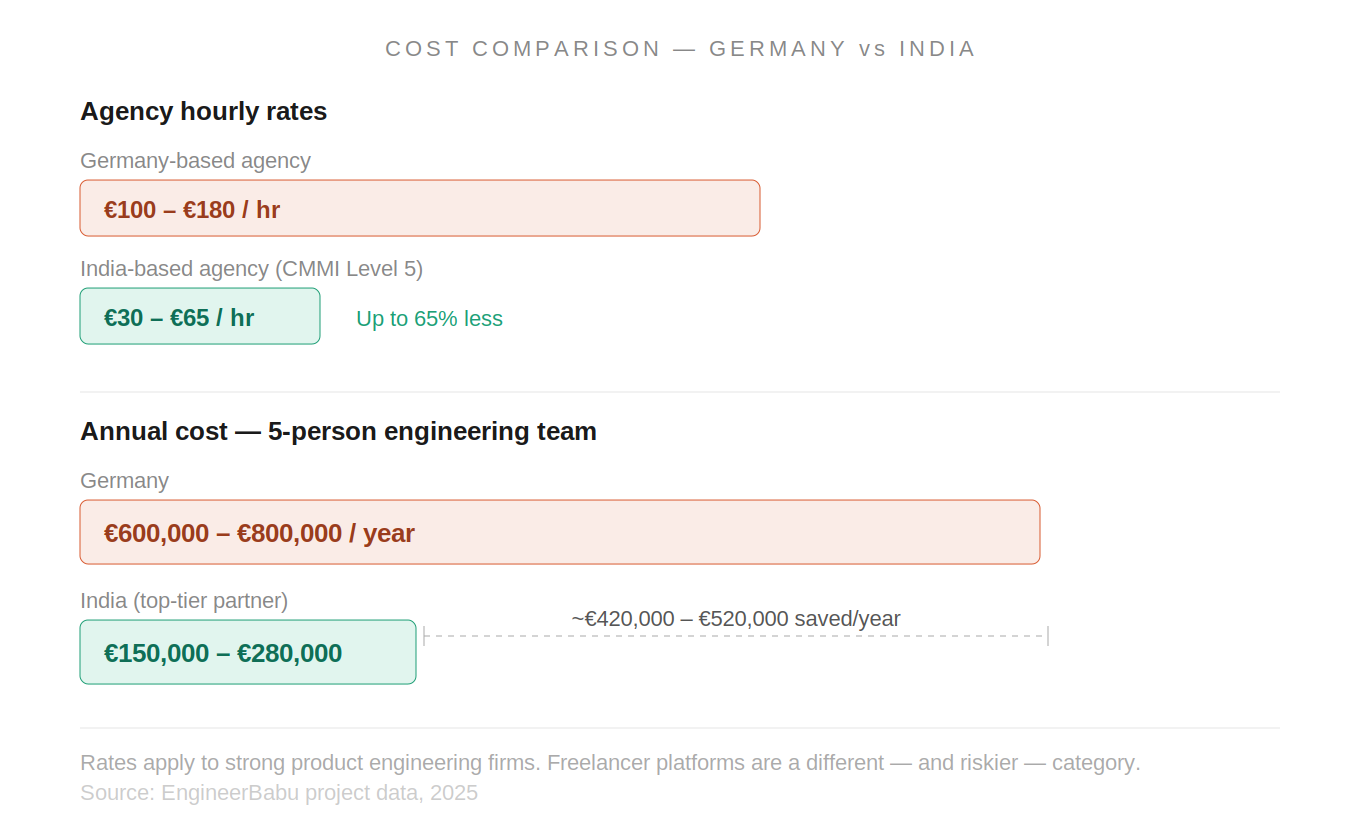
A 5-person engineering team in Germany costs roughly €600,000 to €800,000 per year. The equivalent team in India from a credible partner costs €150,000 to €280,000. That’s not a 20% saving. That’s the difference between burning through your Series A in 12 months or making it last 36.
I want to be specific about one thing: these numbers apply to strong product engineering firms. Not freelancer platforms. Not IT staffing companies that call themselves product engineers. The €15/hour Upwork developer is a different category entirely and a false economy.
German companies have historically been cautious about offshore development, often for good reason. The engineering culture in Germany values precision, documentation, and process rigour. The assumption has been that Indian development firms cut corners on all three.
That assumption is outdated for the top tier.
India produces approximately 1.5 million engineering graduates annually (AICTE data, 2025). A subset goes directly into product engineering. A further subset gets filtered through the rigorous hiring processes of top-tier product firms.
What’s left after that filtering is a talent pool with genuine depth in exactly the areas German companies care about: clean architecture, thorough documentation, and repeatable process.
CMMI Level 5 certification, which EngineerBabu holds, was in fact developed to satisfy the quality expectations of demanding Western clients. It is the software equivalent of ISO 9001. German engineering companies understand certification-backed process maturity. This is the credential that closes the cultural gap.
More relevantly: the best Indian engineers now have 10 to 15 years of experience building products for European clients. They understand GDPR, data residency requirements, and the documentation standards that German enterprises expect. The EngineerBabu team has 200+ VC-funded products in its delivery history. That makes architecture conversations move fast.
This is the section most Indian development companies skip. I won’t.
German companies outsourcing software development face a hard GDPR requirement: if your product processes personal data of EU residents, your data processing arrangements must comply with Chapter V of GDPR, which governs international data transfers. India is not on the EU’s list of countries with adequacy decisions, which means you need a legal mechanism to transfer data.
The three practical paths:
The most common mechanism. Your contract with the Indian development firm must include the EU’s standard data processing clauses. Any serious Indian firm working with German clients will have these ready. Ask for them before you sign anything else.
The cleanest technical solution. Design your system so that the development team never processes actual personal data. They work with anonymised or synthetic datasets. Production personal data stays in EU-hosted environments. This is the architecture I recommend for any product with sensitive user data.
Even when the development team is in India, production systems run on AWS Frankfurt, Azure Netherlands, or Google Cloud Belgium. The engineering happens offshore. The data never leaves EU jurisdiction. This is table-stakes for any German client working with EngineerBabu.
When we built OpenMoney’s neobank platform, data residency was a first-week architecture decision, not a last-week legal review. Every component that touched personal financial data was designed to stay within EU-approved infrastructure.
That’s the approach I bring to every regulated product build.
Before I talk about process, I need to talk about a technical decision that most clients make wrong.
When you outsource software development to India from Germany, the biggest risk is not the timezone gap. It’s architectural coupling. If your codebase is a monolith where every feature touches every other feature, remote development slows to a crawl.
Every PR requires context that lives in someone’s head. Every review takes three days because the reviewer needs to understand 14 other files to evaluate the change.
The teams that work best across distributed setups are the ones building on modular architectures: microservices, API-first development, event-driven systems. Each service has a clear interface. Ownership is explicit. A team in Bangalore can own the notification service end-to-end without needing to understand how the payment service works internally.
When EarlySalary hired EngineerBabu to build their full lending stack, the first four weeks weren’t code. They were architecture. We mapped 7 distinct modules: origination, underwriting, disbursement, servicing, collections, KYC/AML integration, and credit bureau connectivity.
Each module was independently deployable and independently owned. That structure is why we could ship from India at scale without daily dependency bottlenecks. EarlySalary has since disbursed over ₹10,000 crore through that platform.
I’ve been on the other side of this evaluation hundreds of times. Here’s what actually separates serious partners from mediocre ones:
Not “we built a fintech app.” Ask: what was the monthly transaction volume? What was the API response time at P99? How did you handle GDPR data subject requests? If they can’t answer with specifics, they’ve never shipped at scale in a European-regulated context.
Give them a 2-page technical problem statement and ask for their recommended architecture. See if they default to a generic three-tier stack or if they reason through your traffic patterns, your compliance requirements, and your team’s ability to maintain it post-handoff.
Ask directly: how do you handle SCCs? What is your approach to data residency for German clients? Where do you recommend hosting production systems for EU users? If the answer is vague, walk away.
Timezone overlap, async documentation practices, escalation paths. I personally lead every architecture review at EngineerBabu. No client is handed off to a project manager who has never written production code.
CMMI Level 5 and ISO 27001 are the certifications that matter for German enterprise clients. Ask for the certificates, not just the claim.
Ask about attrition rates on client projects. A team that loses 3 engineers mid-project and replaces them with new hires is going to cost you months of context loss.
After 500+ projects, I’ve watched the same failure modes repeat. German companies tend to add one specific mistake to the universal list.
A €18/hour developer with no experience in your sector will cost you 3x the work of a €50/hour developer who has shipped 12 similar products. The billing rate is not the project cost. The project cost includes every hour your internal team spends reviewing bad work, fixing integration bugs, and re-architecting decisions made by someone who didn’t understand the problem.
By the time your legal team reviews the DPA, the architecture has already been built. Data flows are baked in. Changing them post-build is expensive. GDPR compliance for software products is an engineering problem first. It needs to be in the architecture spec, not the contract addendum.
Most project failures I’ve seen in the first month are handoff failures, not execution failures. Two weeks of detailed documentation, recorded walkthroughs of your existing systems, and written coding standards will pay back 10x in the first three sprints.
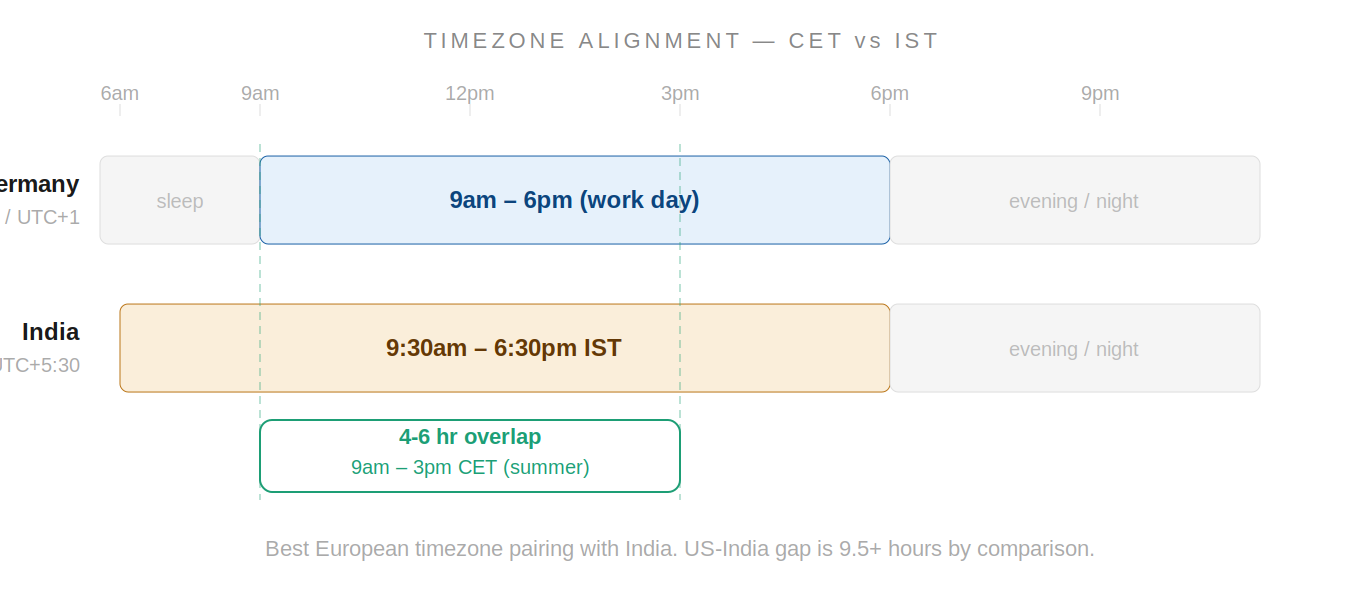
CET to IST is UTC+1 to UTC+5:30, a gap of 3.5 to 4.5 hours depending on daylight saving time. This is actually one of the better timezone gaps for European-Indian collaboration. There is a genuine overlap window: if the Germany-based team works until 6 PM CET, and the India team starts at 9:30 AM IST, you have roughly 30 to 90 minutes of real overlap.
Fixed-price for well-defined scope. Time-and-materials for evolving products. Dedicated team for long-running development. Getting this wrong is not the vendor’s fault.
CET is UTC+1 (UTC+2 in summer CEST). IST is UTC+5:30. The gap is 3.5 hours in summer, 4.5 hours in winter.
This is the best timezone pairing for European-Indian collaboration. Better than UK-India (4.5 to 5.5 hours). Far better than US-India (9.5 to 10.5 hours).
Here is how EngineerBabu structures it for German clients:
The India team works 9:30 AM to 6:30 PM IST. That translates to 6:00 AM to 3:00 PM CET in summer, and 5:00 AM to 2:00 PM CET in winter. The practical overlap window for German business hours (9 AM to 6 PM CET) is 9 AM to 3 PM CET in summer, giving you a solid 6-hour overlap. In winter it’s tighter, but a 9:30 AM IST start still covers German morning hours.
This means daily stand-ups at German morning time work without anyone burning the midnight oil. Architecture reviews mid-morning work.
The async-first discipline that US clients need to impose by policy happens naturally here, because the overlap is enough for synchronous decision-making and the gap is short enough that async responses come back the same business day.
Week 1: Discovery and Architecture. Not coding. I’m personally on these calls. We map what exists, what needs to be built, the technical constraints, and the GDPR/compliance requirements specific to your product. By end of week 1, we have an architecture document and delivery plan.
Week 2: Team Assembly and Environment Setup. Engineers assigned on domain fit. For a German fintech or enterprise SaaS client, that means engineers who have worked with EU data residency requirements, German-language localisation, SEPA payment integrations, or whatever your specific stack requires. Environment setup: repositories, CI/CD pipelines, staging on EU-region infrastructure, code review tooling.
Week 3: First Sprint. Small, shippable scope. The goal is not volume. It’s establishing the collaboration pattern that will govern the next 6 to 18 months.
Month 2 onwards: Weekly progress reviews, biweekly architecture reviews for complex projects, sprint demos the German product team attends.
A real project archetype: a B2B SaaS application with a web dashboard, mobile app, REST API backend, GDPR-compliant data architecture, and three third-party integrations.
The EngineerBabu range sits in the top-tier bracket. We’re not the cheapest option in India. We’re also not the option that gives you a codebase you’ll need to rewrite in 18 months, or a GDPR incident six months after launch.
Per a 2025 McKinsey analysis of digital transformation initiatives, the average cost overrun on poorly managed offshore projects is 67%. Firms with CMMI Level 5 certification report cost overruns under 15%. Process maturity is risk control.
Stack choice has a non-obvious impact on offshore delivery quality.
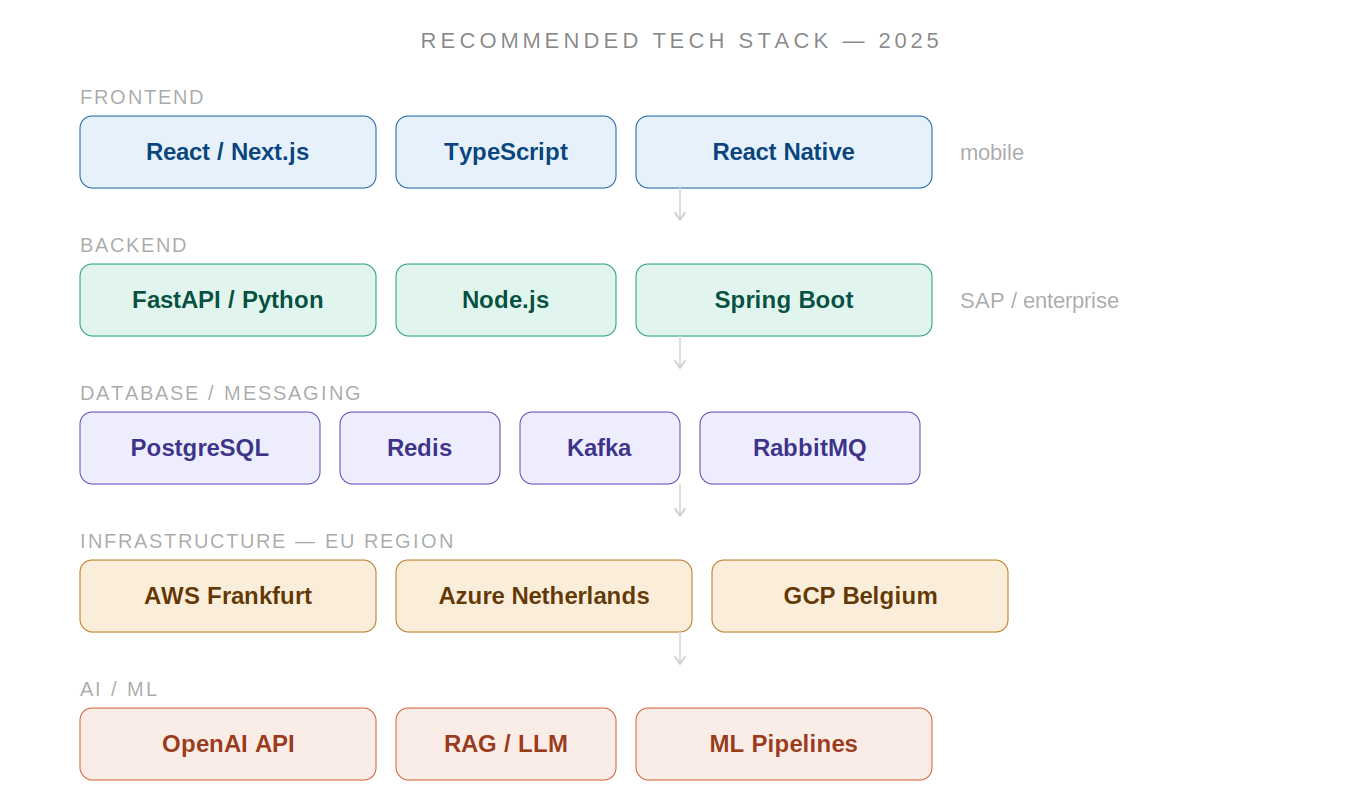
Popular stacks in India’s best product engineering firms in 2025: React/Next.js for frontend, Node.js or Python (FastAPI/Django) for backend, PostgreSQL or MySQL for relational data, Redis for caching, Kafka or RabbitMQ for event-driven workflows, Kubernetes on AWS Frankfurt or GCP Belgium for EU-compliant infrastructure.
For German enterprise clients with existing SAP environments: Java and Spring Boot talent in India is strong. SAP integration experience exists, though it’s more specialised. Ask for specific SAP project references, not just a claim of capability.
For AI/ML-intensive products: Python is the primary choice. India has strong data science and ML engineering talent. For the AI inventory management system we built for Simba Beer, we used a Python ML pipeline for demand forecasting, a FastAPI backend for real-time field intelligence, and a React dashboard. Concept to production in 4 months.
My recommendation for German companies choosing a stack today: if you know you’ll be running distributed development, pick from the mainstream. React + FastAPI + PostgreSQL + Kubernetes on EU-region cloud has a deep talent pool in India and satisfies German data residency requirements out of the box.
Before signing with any Indian development partner, get answers to these specific questions:
A vendor who cannot answer questions 1, 2, 3, 4, and 9 with specifics is not a serious partner for a German company.
I personally take calls for every project we consider. Not because I have to. Because architecture missteps in the first two weeks cost clients 3 months of re-work, and I’d rather spend an hour getting scope right than have my team spend 300 hours untangling it later.
If you’re a German company evaluating outsource software development to India and want a direct conversation about the architecture decisions, GDPR requirements, or team structure before you commit to any vendor, email me.
I’m usually the one who replies.
Mayank Pratap is the co-founder of EngineerBabu, a CMMI Level 5 product engineering company with 500+ projects delivered across 20+ countries. He has been building technology products for 14 years, with direct involvement on every client engagement.
EngineerBabu has been recognised by Google AI Accelerator (Top 20 globally, 2024), NASSCOM, and LinkedIn (Top 20 Startups India), and is backed by Vijay Shekhar Sharma, founder of Paytm.
EngineerBabu’s work spans 75 YC-selected product builds, 200+ VC-funded products, and clients including 4 unicorn companies.
Start with a technical brief, not an RFP. Write 2-3 pages describing what you’re building, the problem it solves, your expected scale, and your compliance requirements including GDPR data flows.
Share it with 3-4 shortlisted firms. Evaluate the quality of their technical and compliance response, not just their pricing. The firm that asks about your data architecture before quoting a price understands what it’s building.
India does not have EU adequacy status, which means personal data transfers to Indian development teams require a legal mechanism. The most practical path is Standard Contractual Clauses (SCCs) combined with a GDPR-compliant Data Processing Agreement.
A better technical approach is designing the system so developers work with anonymised or synthetic data, and production personal data never leaves EU-region infrastructure. Any serious Indian development partner working with German clients will have SCC templates ready.
CET (UTC+1) to IST (UTC+5:30) is a 3.5-hour gap in winter and 2.5 hours in summer (when Germany moves to CEST). This is one of the best European-to-India timezone pairings.
German business hours and Indian business hours overlap by 4 to 6 hours, enough for daily stand-ups, architecture reviews, and same-day async responses without anyone working outside normal hours.
Top-tier CMMI Level 5 firms charge €30 to €65 per hour. Mid-tier firms charge €18 to €35 per hour. For a full product build, project costs typically run €70,000 to €200,000 depending on scope. The correct comparison is not against Indian freelancers. It’s against German agency rates of €100 to €180 per hour for equivalent seniority and process rigour.