Restaurant Table Reservation App Development Guide 2026


Create engaging, high-performance mobile applications tailored to your business needs. We craft future-ready apps that offer smooth user experiences on all devices.
Build robust and scalable websites and CMS platforms that help you manage content effortlessly. Our development ensures a seamless digital presence.
Launch secure, feature-rich online stores with intuitive shopping experiences. We build tailored eCommerce platforms designed for growth.
Design captivating games with immersive gameplay and stunning graphics. From concept to launch, we build engaging experiences that players love.
Enhance your customer relationships with customized Salesforce implementations. Drive growth and efficiency with smarter CRM solutions.
Harness artificial intelligence and machine learning to automate workflows and gain actionable insights. Our AI transforms data into smart decisions.
Accelerate your software delivery lifecycle with continuous integration, delivery, and infrastructure automation to boost efficiency.

TL;DR
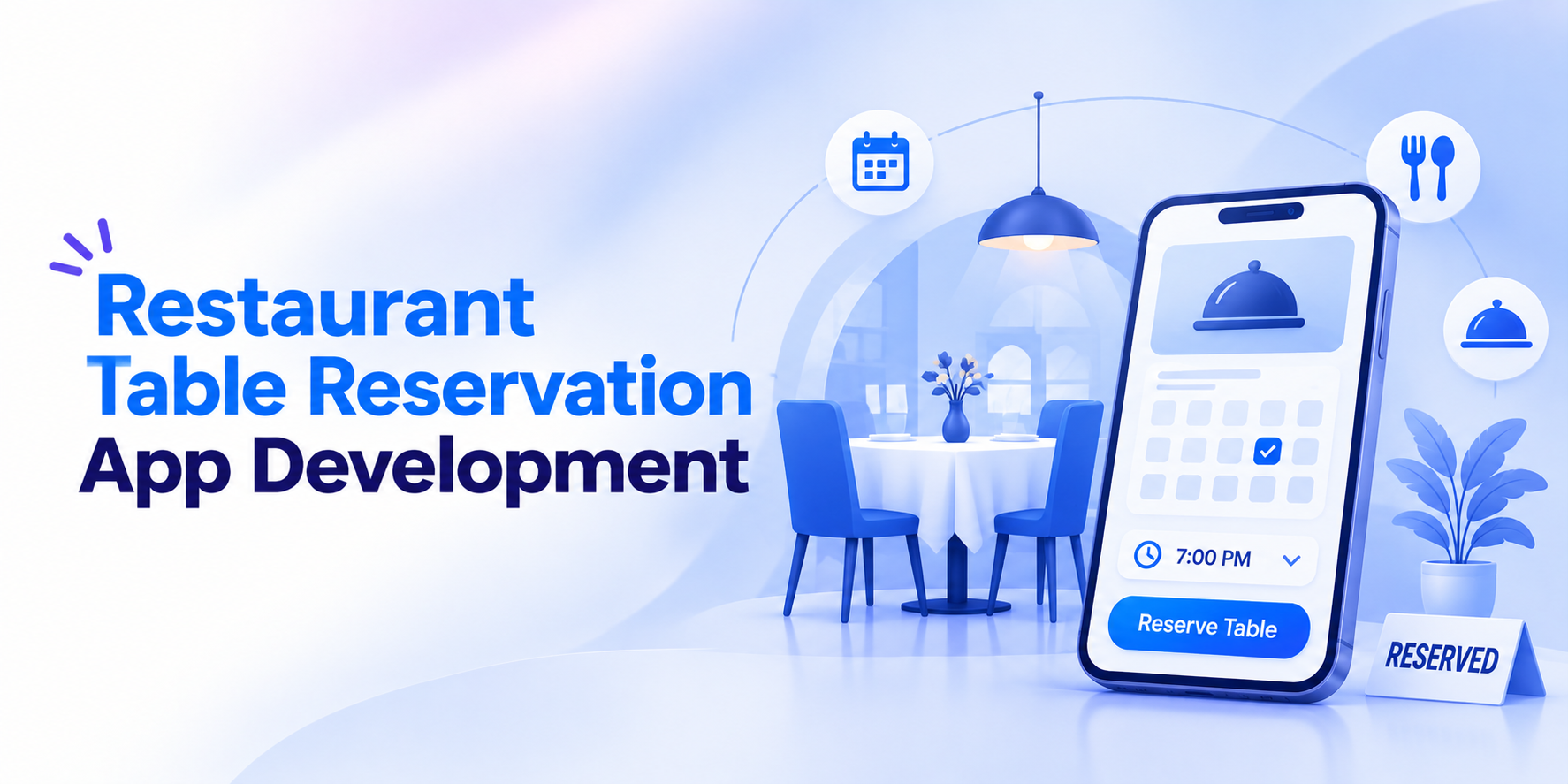
Restaurant table reservation app development is the work of building a branded booking system that controls seating, guest data, deposits and no-shows.
Restaurants invest in it to take bookings directly, instead of paying commission on every table a marketplace sends.
This guide covers what the app must do, how the build runs, what restaurant table reservation app development costs, and which decisions quietly wreck the result. It applies whether you run one dining room, a group of outlets, or several brands.
Restaurant table reservation app development is not a form that emails the host stand. It is an availability engine wrapped in a guest-facing app.
The system holds your real floor plan and knows how long each table type stays occupied. It then decides in milliseconds whether 8:15 PM for six people is genuinely bookable.
Around that engine sit the parts guests and staff touch. Guests get search, booking and cancellation. Staff get a floor view, a waitlist, guest notes and pacing controls.
Owners get occupancy, no-show and spend data that reconciles with the POS. Everything else in restaurant table reservation app development, from loyalty to review prompts, layers on top of that core.
Aggregators deliver volume, but they keep the relationship and the margin. This section covers three business reasons operators fund restaurant table reservation app development. Each one shows up in revenue within the first few months after launch.
The case for restaurant table reservation app development starts with channel control. The National Restaurant Association’s 2026 State of the Restaurant Industry report found that 56% of delivery customers prefer ordering directly through the restaurant. The same instinct applies to tables.
Guests book with you directly when the experience is smooth. A branded app captures the email, the preferences and the visit history, so marketing stops depending on someone else’s database.
Empty reserved tables cost more than empty open ones, because you turned other guests away to hold them. Restaurant table reservation app development attacks this with deposits on peak slots, card holds, timed confirmations and automatic release of unconfirmed bookings.
Policy enforcement stops being a conversation the host dreads. It becomes a rule the system applies identically every night.
Once bookings run through your own system, you see which tables earn and which slots underperform. Restaurant table reservation app development also reveals how long each party type really stays.
That data drives staffing, menu timing and promotions. It feeds smarter seating too, since AI in restaurant apps now handles table assignment and demand forecasting well.
Feature lists are easy to write and expensive to get wrong. This section covers the functionality that separates a working reservation product from a glorified contact form. Build these before adding anything else to the roadmap.
The availability engine is the product. Restaurant table reservation app development must combine table sizes, combinable tables, turn times by party size, service periods and kitchen capacity. A six-top at 7:00 PM may be bookable while the same table at 8:30 PM is not. Get this right and every other screen feels effortless.
Every booking should attach to a guest record holding allergies, seating preferences, past spend, celebrations and no-show history. Hosts then greet regulars correctly without relying on memory. Well-planned restaurant mobile app features treat these notes as operational data, not marketing fluff. Profiles also let you apply stricter deposit rules to repeat no-shows automatically.
Payment logic deserves its own design pass in restaurant table reservation app development. Decide which slots need a deposit, how much it is, and when cancellation becomes chargeable. Your payment integration must support holds, partial captures and clean reversals. Weak handling produces disputes, and disputes damage reviews faster than slow service does.
Reservations cover part of the night and walk-ins cover the rest. Restaurant table reservation app development should include a digital waitlist with quoted times, SMS alerts and automatic promotion when a table clears. Accurate quotes matter more than short ones. A 40-minute wait that lasts 40 minutes beats a 20-minute wait that stretches.
Automated messaging is the cheapest revenue protection in restaurant table reservation app development. Send confirmation at booking, a reminder 24 hours out, and a confirm-or-release prompt before service. A short rebooking nudge after the visit pulls guests back. Every message should stay editable, since tone carries real brand weight in hospitality.
A reservation app that does not talk to the POS creates two versions of the truth. Table status, check totals and turn times should sync both ways, the same discipline retail POS software development teams apply to store systems. Solid API development work keeps the floor view accurate during a packed Saturday service.
Most delays come from sequencing, not coding. This section walks through how an experienced team runs restaurant table reservation app development from discovery to launch. Each stage produces something testable rather than a document nobody reads.
Restaurant table reservation app development starts by documenting physical reality. Capture table counts, seat counts, combinable configurations, service periods, turn times by party size and kitchen throughput limits. Then record house rules, such as which slots need deposits and how large parties get handled.
This stage runs one to two weeks and prevents expensive rework later. Groups should map one flagship location fully, then note where other sites differ. Skipping it is the most common reason reservation projects miss their launch date.
Guests abandon bookings when a flow asks too much too early. Design the shortest path from date, party size and time to confirmation, with sign-in requested late. Staff screens need different treatment in restaurant table reservation app development, since hosts work standing up on a tablet.
Strong UI/UX design work means testing the host view under realistic noise and speed. Prototype both journeys and run them past actual floor staff before development begins.
This is the heaviest engineering block in restaurant table reservation app development. The engine must handle concurrent requests without double-booking, apply turn-time logic per party size, and release held tables on a timer.
Build it as a service with its own test suite covering race conditions. Many teams ship a focused version first, which is what sensible MVP development looks like in hospitality. Prove the engine under load before layering extras on top.
Integrations are where timelines slip, so schedule them early in restaurant table reservation app development. Payments need holds, captures, refunds and clear failure states. POS integration covers table status, check data and turn times.
Messaging covers SMS, email and push, with retry logic when delivery fails. Treat each provider as its own mini project with sandbox testing. Teams shipping online booking app products learn fast that integration failures surface at peak hours, never during quiet testing windows.
Functional testing alone never proves a reservation product. Simulate a full Friday night, with concurrent bookings, modifications, walk-ins and cancellations hitting the system together. Run the staff app on the oldest tablet in the building, on the weakest Wi-Fi corner.
Then pilot at one location for two to four weeks before wider rollout. Restaurant table reservation app development earns trust during service, and a failure at 8 PM costs more than any patch recovers.
Stack decisions should follow operational needs, not developer preference. Guest apps usually go cross-platform, since the booking interface is similar on both operating systems. Flutter development services suit the guest side well, giving one codebase for iOS and Android.
The backend carries the harder requirements in restaurant table reservation app development. Bookings need transactional integrity, which points toward PostgreSQL with carefully designed locking.
Redis handles availability caching, and a queue service manages reminders and table release jobs. Cloud hosting with autoscaling covers the spikes that follow a reservation drop for a holiday weekend.
For staff tools, a web app often beats a native build in restaurant table reservation app development. Hosts work on fixed tablets, browsers update instantly, and you avoid app store delays during a service-critical fix.
Teams that shipped food delivery app development projects reuse this split, since the operational demands overlap closely.
Pricing moves with scope, integration count and team location. This section gives realistic ranges instead of a single misleading number. Treat any quote well below the lower bound with suspicion, because something is being skipped.
| Build scope | What it includes | Typical cost | Timeline |
| Single-location MVP | Guest app, availability engine, host view, basic payments | $25,000 to $45,000 | 12 to 16 weeks |
| Full-featured product | Waitlist, deposits, POS sync, analytics, loyalty hooks | $50,000 to $90,000 | 18 to 26 weeks |
| Multi-outlet platform | Central admin, per-site rules, AI seating, reporting suite | $90,000 upward | 26 weeks plus |
Three factors move restaurant table reservation app development budgets most. Integration count matters more than screen count, since every POS or payment provider adds testing cycles.
Multi-location rule handling adds backend complexity that stays invisible in a wireframe. Budget a further 15 to 20% each year for mobile app maintenance and support.
For a wider view of what drives these figures, this breakdown of mobile app development cost is a useful companion read.
Restaurant table reservation app development rewards teams that have already handled real-time availability, payment holds and third-party integrations under pressure.
EngineerBabu works as a restaurant app development company across booking, ordering and on-demand platforms, with senior engineers staying on through launch.
The work covers floor rule mapping, guest and staff app builds, availability engine development, POS and payment integration, cloud setup and post-launch support.
EngineerBabu operates on a CMMI Level 5 delivery process, has supported 200+ VC-funded products and has worked with four unicorn clients. You can also extend your in-house team with dedicated developers instead of outsourcing the whole build.
The restaurants that win at bookings rarely have the prettiest app. They have availability logic that matches how the dining room actually runs, and staff who trust the system at 8 PM on a Saturday.
Get the engine, the host workflow and the integrations right. Everything else in restaurant table reservation app development becomes far easier to add once those three hold up under real service.
Ready to scope your build? Talk to the EngineerBabu team about your floor plan, your booking rules and the timeline you need to hit.
Yes, if the POS exposes an API or a partner integration, and most major platforms do. Legacy or local-only systems need middleware, which adds development time and cost.
Guests book through both, so many restaurants launch a mobile web flow first and add a native app once repeat bookings justify it. Staff tools work best browser-based.
Large parties route to a request-and-approve flow instead of instant confirmation. The system holds combinable tables, notifies the manager, and confirms once staff verify kitchen capacity.
Usually yes above roughly 300 covers a week, where commission savings and no-show control outweigh the build cost. Below that, a lighter booking module on your website fits better.
Most restaurants keep both for a while. Marketplaces bring discovery from new diners, while your own app retains regulars at zero commission and holds the guest data.
A well-built staff app caches the current night’s bookings locally and keeps showing the floor view offline. Changes queue and sync automatically once the connection returns.