How to Build a Property Management Platform, Tenant Portal, Lease Management, Maintenance Requests, and Rent Collection 2026


Create engaging, high-performance mobile applications tailored to your business needs. We craft future-ready apps that offer smooth user experiences on all devices.
Build robust and scalable websites and CMS platforms that help you manage content effortlessly. Our development ensures a seamless digital presence.
Launch secure, feature-rich online stores with intuitive shopping experiences. We build tailored eCommerce platforms designed for growth.
Design captivating games with immersive gameplay and stunning graphics. From concept to launch, we build engaging experiences that players love.
Enhance your customer relationships with customized Salesforce implementations. Drive growth and efficiency with smarter CRM solutions.
Harness artificial intelligence and machine learning to automate workflows and gain actionable insights. Our AI transforms data into smart decisions.
Accelerate your software delivery lifecycle with continuous integration, delivery, and infrastructure automation to boost efficiency.
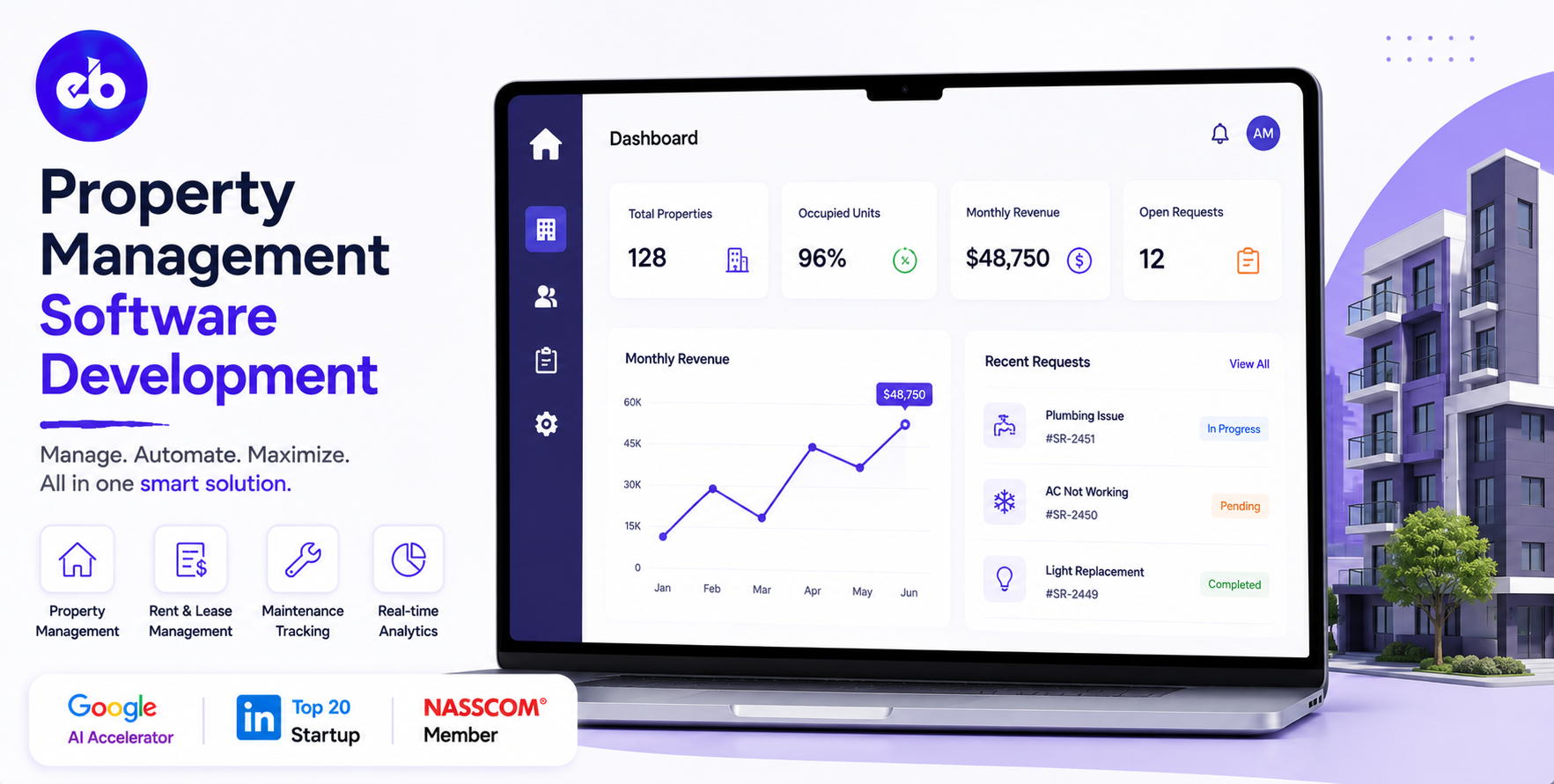
Property management is one of the most relationship-intensive, document-intensive, and operationally complex businesses that still largely runs on spreadsheets, physical rent receipts, and phone calls.
A property manager handling 200 units with Excel and WhatsApp is at their operational ceiling. The same manager on a purpose-built platform can handle 500 units with better tenant satisfaction, faster maintenance resolution, and complete financial visibility.
The US property management software market is expected to reach $2.8 billion. India’s rental housing market, 110 million rented households, is at the earliest stages of digitisation, with almost no platforms serving the mid-market property management company managing 50 to 1,000 units.
This guide covers how to build a property management platform, from the tenant portal through lease management, maintenance workflow, rent collection, and the financial reporting that lets property owners see exactly how their portfolio is performing.
EngineerBabu has shipped 500+ software products across real estate, fintech, and enterprise verticals. CMMI Level 5. Google AI Accelerator 2024 Top 20. Contact: mayank@engineerbabu.com
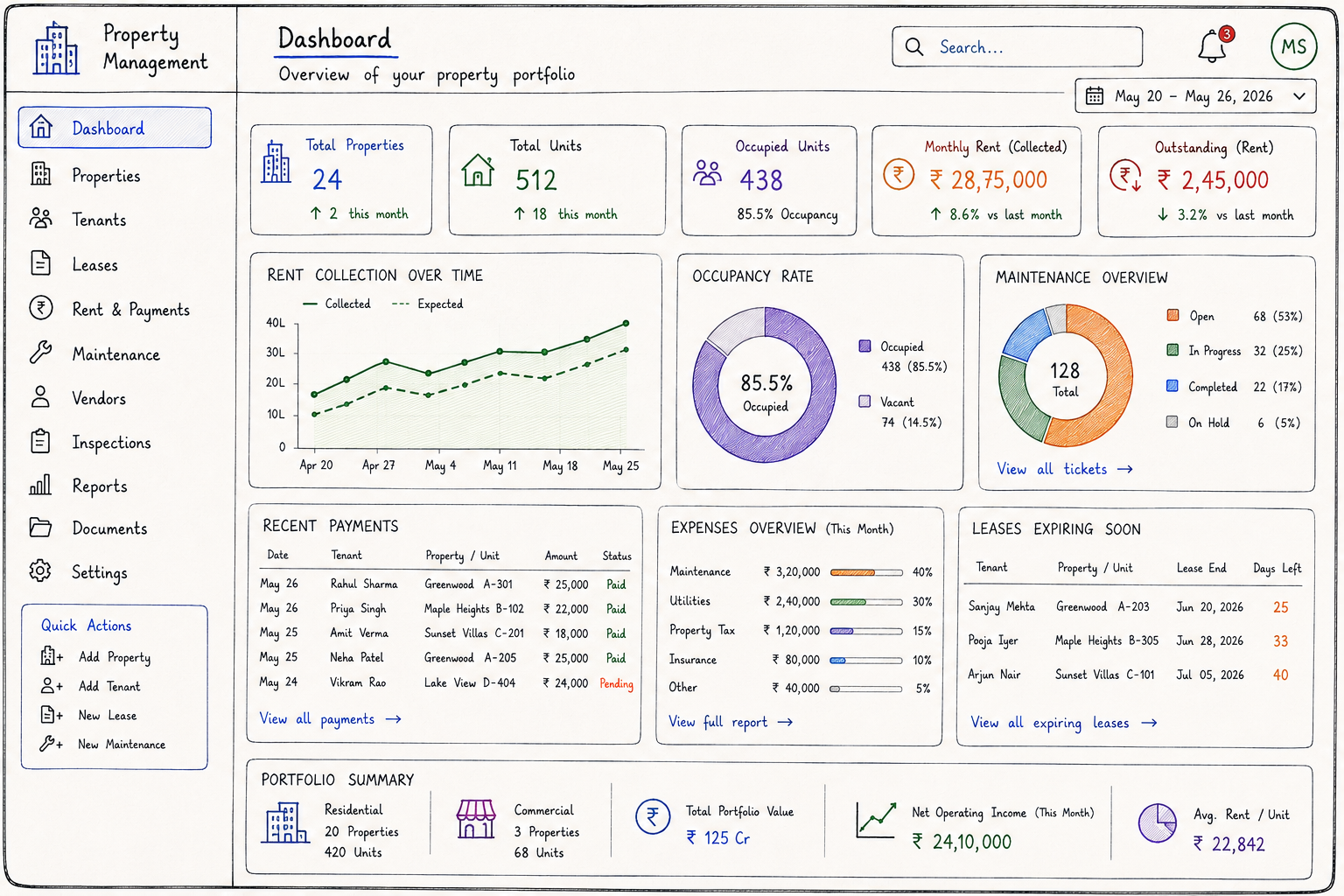
| Function | Module |
| Real estate CRM | Property portfolio, unit details, amenities |
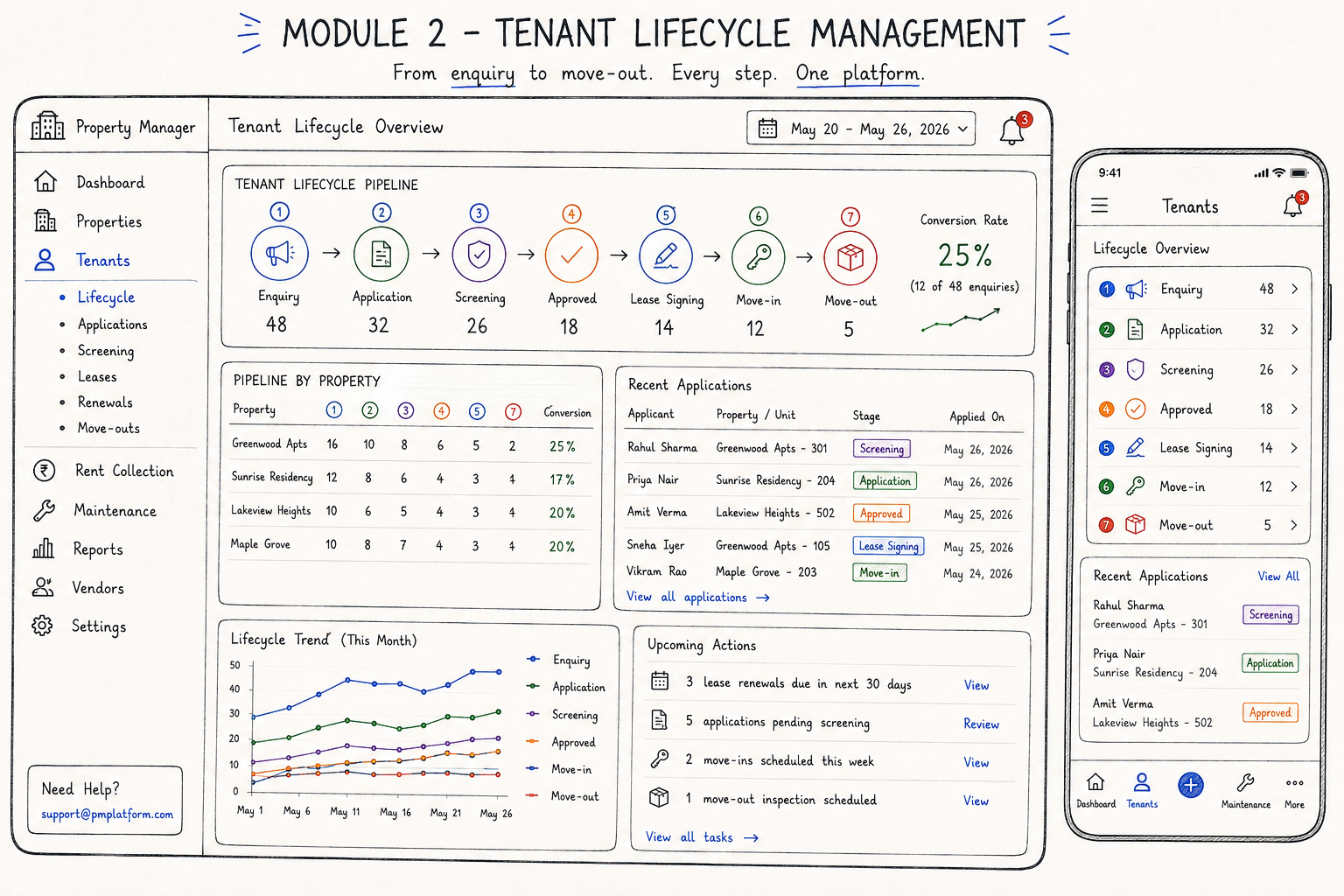
| Tenant lifecycle management | Enquiry, application, screening, onboarding, renewal, move-out |
| Lease management | Lease creation, e-signing, storage, renewal alerts |
| Rent collection | Invoice generation, payment gateway, receipts, late fee |
| Maintenance management | Ticket submission, assignment, tracking, completion |
| Tenant portal | Self-service access to lease, payments, maintenance |
| Owner portal | Portfolio performance, rent status, maintenance costs |
| Financial management | Income and expense tracking, P&L per property |
| Vendor management | Maintenance vendors, work orders, invoices |
| Inspection management | Move-in and move-out inspections with photo documentation |
| Compliance | Lease document compliance, deposit management |
| Reporting | Occupancy rate, rent roll, maintenance costs, NOI |
The property hierarchy:
| Level | Example | Data Managed |
| Portfolio | All properties under management | Aggregate financials, occupancy |
| Property | Greenwood Apartments, 123 Main St | Address, type, total units, amenities |
| Building | Building A, Building B | Floors, common areas, building amenities |
| Unit | Unit 301 | Size, bedrooms, bathrooms, rent, status |
Unit profile:
| Field | Details |
| Unit number | Internal unit identifier |
| Floor plan type | Studio / 1BHK / 2BHK / 3BHK |
| Area | Square feet or square metres |
| Bedrooms / Bathrooms | Configuration |
| Current status | Vacant / Occupied / Under maintenance / Reserved |
| Market rent | Current listed rent |
| Actual rent | Rent being collected from current tenant |
| Last rent increase date | For renewal pricing strategy |
| Amenities | Parking, balcony, furnished/unfurnished, pet-friendly |
| Maintenance history | All past maintenance requests for this unit |
| Photos | Current condition photos |
The tenant journey from enquiry to move-out:
| Stage | Action | Platform Function |
| Enquiry | Prospect contacts about a unit | Lead capture, unit match, viewing schedule |
| Application | Prospect applies for a unit | Online application form, document upload |
| Screening | Background, credit, employment check | Screening service API integration |
| Approval | Application approved or rejected | Approval workflow, communication |
| Lease signing | Lease agreement executed | E-sign, lease creation, deposit collection |
| Move-in | Tenant takes possession | Move-in inspection, key handover |
| Tenancy | Ongoing relationship | Rent collection, maintenance, communication |
| Renewal | Lease approaching expiry | Renewal offer, negotiation, new lease |
| Move-out | Tenant gives notice | Move-out inspection, deposit reconciliation |
| Offboarding | Final settlement | Final invoice, deposit refund or deduction |
Tenant screening integrations:
For US property managers, tenant screening involves criminal background check, credit check, eviction history, and employment verification. The platform integrates with screening providers, TransUnion SmartMove, RentPrep, or Experian RentBureau, to run screening on applicants and return a recommendation automatically.
For Indian property managers, screening is less formalised but the platform supports document verification (Aadhaar, PAN, employment proof), reference check tracking, and police verification status.
The lease is the legal foundation of the tenant-landlord relationship. Every financial transaction, every maintenance obligation, every rule about rent increases and renewals, all of it flows from the lease document.
Lease data model:
| Field | Details |
| Lease start date | |
| Lease end date | |
| Rent amount | Monthly/weekly/annual |
| Rent due date | Day of month rent is due |
| Grace period | Days after due date before late fee applies |
| Late fee | Amount or percentage charged after grace period |
| Security deposit | Amount held, conditions for deduction |
| Pet deposit | If applicable |
| Lease type | Fixed term / Month-to-month / Commercial |
| Renewal terms | Automatic renewal, required notice period |
| Rent increase clause | Annual increase, fixed percentage or CPI-linked |
| Utility responsibility | Landlord-paid vs tenant-paid utilities |
| Maintenance responsibility | What tenant is responsible for |
| Termination conditions | Early termination penalty, notice required |
The lease document engine:
The platform generates the lease agreement from a template, populating the tenant names, property address, unit number, rent amount, dates, and all configured terms automatically.
The generated document is sent to both tenant and landlord for electronic signature via DocuSign or Aadhaar eSign. Signed leases are stored in the platform’s document vault and accessible to both parties at all times.
Renewal management:
90 days before lease expiry, the platform sends the property manager an alert. 60 days before expiry, it sends the tenant a renewal offer, automatically calculating the new rent based on the increase clause in the existing lease. The manager can modify the renewal offer before it is sent. The tenant accepts or initiates negotiation through the portal.
Rent collection is the most operationally critical function for a property management company. Late payments affect cash flow. Manual follow-up for late payments consumes disproportionate time. A systemised collection process with automated reminders and online payment drastically reduces both delinquency and follow-up effort.
The rent collection cycle:
| Day | Action | System |
| 1st of month (or lease date) | Rent invoice generated | Auto-generated from lease terms |
| Rent due | Invoice sent to tenant | Email + WhatsApp + portal notification |
| Day 1 after due date | First reminder | Automated, gentle tone |
| Day 3 after due date | Second reminder | Automated, with late fee warning |
| Day 5 after due date | Late fee applied | Auto-calculated, added to account |
| Day 7 after due date | Third reminder | Automated, with escalation warning |
| Day 15+ | Manager escalation | Flag for personal follow-up or formal notice |
Payment methods:
| Market | Payment Methods | Integration |
| US | ACH bank transfer, credit/debit card, check | Plaid for ACH, Stripe for card |
| India | UPI, NEFT, bank transfer, cheque | Razorpay |
Security deposit management:
Security deposits are legally regulated, in many US states, they must be held in a separate escrow account, interest must be accrued, and they must be returned within a defined number of days after move-out with an itemised statement of deductions.
The platform tracks deposit amounts, the account they are held in, accrued interest (where applicable), and deductions, generating the required deposit disposition documentation automatically.
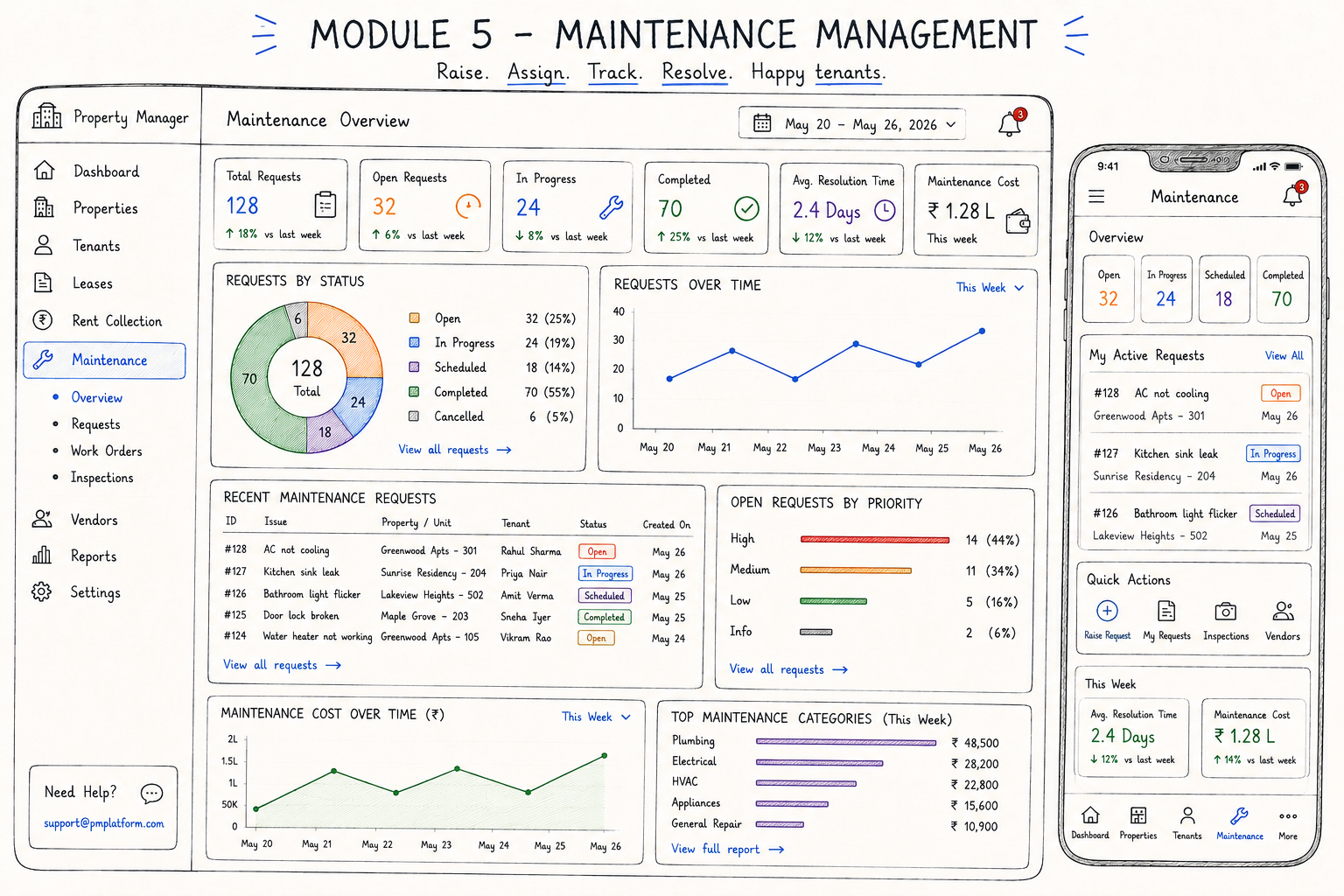
Maintenance is the primary driver of tenant satisfaction and tenant retention. Tenants who experience fast, professional maintenance resolution renew their leases. Tenants who submit maintenance requests and hear nothing leave, and leave negative reviews.
The maintenance ticket lifecycle:
| Stage | Action | Timeline |
| Submission | Tenant submits request with description and photo | Immediate, via portal or app |
| Acknowledgement | Property manager acknowledges receipt | Within 2 hours |
| Categorisation | Request categorised by type and priority | During acknowledgement |
| Vendor assignment | Appropriate vendor assigned | Within 4 hours for urgent |
| Scheduling | Vendor and tenant agree on access time | Within 24 hours |
| Work in progress | Vendor updates status | Regular updates |
| Completion | Vendor marks complete, uploads photo | On completion |
| Tenant confirmation | Tenant confirms satisfaction | Within 24 hours of completion |
| Billing | Vendor invoice received and approved | Within 7 days of completion |
Priority classification:
| Priority | Examples | Target Resolution |
| Emergency | Water leak, no heat in winter, security issue | 4 hours |
| Urgent | Broken appliance, hot water failure | 24 hours |
| Standard | Minor plumbing, HVAC service | 72 hours |
| Low | Cosmetic issues, non-essential repairs | 7–14 days |
Vendor management:
The platform maintains a vendor directory, plumbers, electricians, HVAC technicians, painters, cleaners, with their contact details, service areas, and historical performance ratings. When a maintenance ticket is created, the manager can assign it to a preferred vendor or the system can auto-assign based on availability and service area.
Tenant portal:
| Feature | Details |
| Rent payment | Pay online, card, UPI, ACH |
| Payment history | All past payments, receipts downloadable |
| Lease access | Current lease document, key terms summary |
| Maintenance requests | Submit, track, communicate on tickets |
| Document vault | Insurance requirements, move-in checklist, rules |
| Notifications | Rent reminders, maintenance updates, announcements |
| Renewal | Accept or negotiate lease renewal |
Owner portal:
| Feature | Details |
| Portfolio overview | All properties, occupancy, rent status |
| Financial summary | Gross rent, maintenance costs, NOI per property |
| Rent roll | Current tenants, rents, lease expiry dates |
| Maintenance costs | Spend by category, by property, by vendor |
| Maintenance backlog | Open tickets with ages and statuses |
| Vacancy report | Units vacant, how long vacant, listed rent |
| Document access | All lease agreements, inspection reports |
| Module | Cost Range (USD) | Notes |
| Property + unit management | $5K – $10K | |
| Tenant lifecycle + screening integration | $8K – $15K | TransUnion/Experian API |
| Lease management + document engine + e-sign | $8K – $15K | DocuSign or Aadhaar eSign |
| Rent collection + payment gateway + late fee | $8K – $15K | ACH + card + UPI |
| Security deposit management | $4K – $8K | Escrow tracking, disposition |
| Maintenance management + vendor portal | $8K – $15K | Full ticket lifecycle |
| Tenant portal (web dev + mobile app) | $8K – $15K | |
| Owner portal | $6K – $12K | |
| Financial reporting + NOI analytics | $5K – $10K | |
| Inspection management (move-in/move-out) | $4K – $8K | Photo documentation |
| Lease renewal management + alerts | $3K – $6K |
A real estate CRM manages the sales process, leads, site visits, bookings, and channel partner relationships for developers selling properties. A property management platform manages the operational relationship after the sale or rental transaction is complete, tenant onboarding, lease management, rent collection, maintenance, and financial reporting for the owner. The two platforms serve different users at different stages of the property lifecycle. A developer needs a CRM to sell units. A landlord or property management company needs a property management platform to operate those units after they are occupied. Some companies, developers who retain units for rental income, need both, and integration between the two is a natural Phase 2 requirement.
Automated rent collection reduces delinquency through three mechanisms. First, payment friction removal, when a tenant can pay rent in 30 seconds through UPI or ACH from their phone rather than writing a cheque or visiting the office, on-time payment rates improve significantly. Second, automated reminder sequences, a reminder on the due date, a follow-up on day 3, and a late fee warning on day 5 consistently recover late payments without requiring the property manager to make a single phone call for routine lateness. Third, auto-debit capability, for tenants who authorise it, rent is automatically debited on the due date from their bank account via ACH (US) or NACH (India), eliminating the cognitive step of remembering to pay. Property managers using automated collection typically see 15 to 25 percentage point reductions in chronic late payments within the first six months of deployment.
A rent roll is a document that lists every rental unit in a property or portfolio with its current tenant, monthly rent, lease start and end dates, and payment status. It is the single most important financial document for a rental property owner, it shows gross potential rental income, current occupancy, lease expiry schedule (and therefore renewal risk), and actual rent collected versus potential. Lenders require a rent roll when evaluating refinancing applications. Buyers require a rent roll when evaluating an acquisition. Property managers use it to plan renewal outreach and lease-up campaigns. In a property management platform, the rent roll is a live report, updated in real time as leases are signed, renewals are executed, and tenants move out, rather than a spreadsheet manually updated once a month.