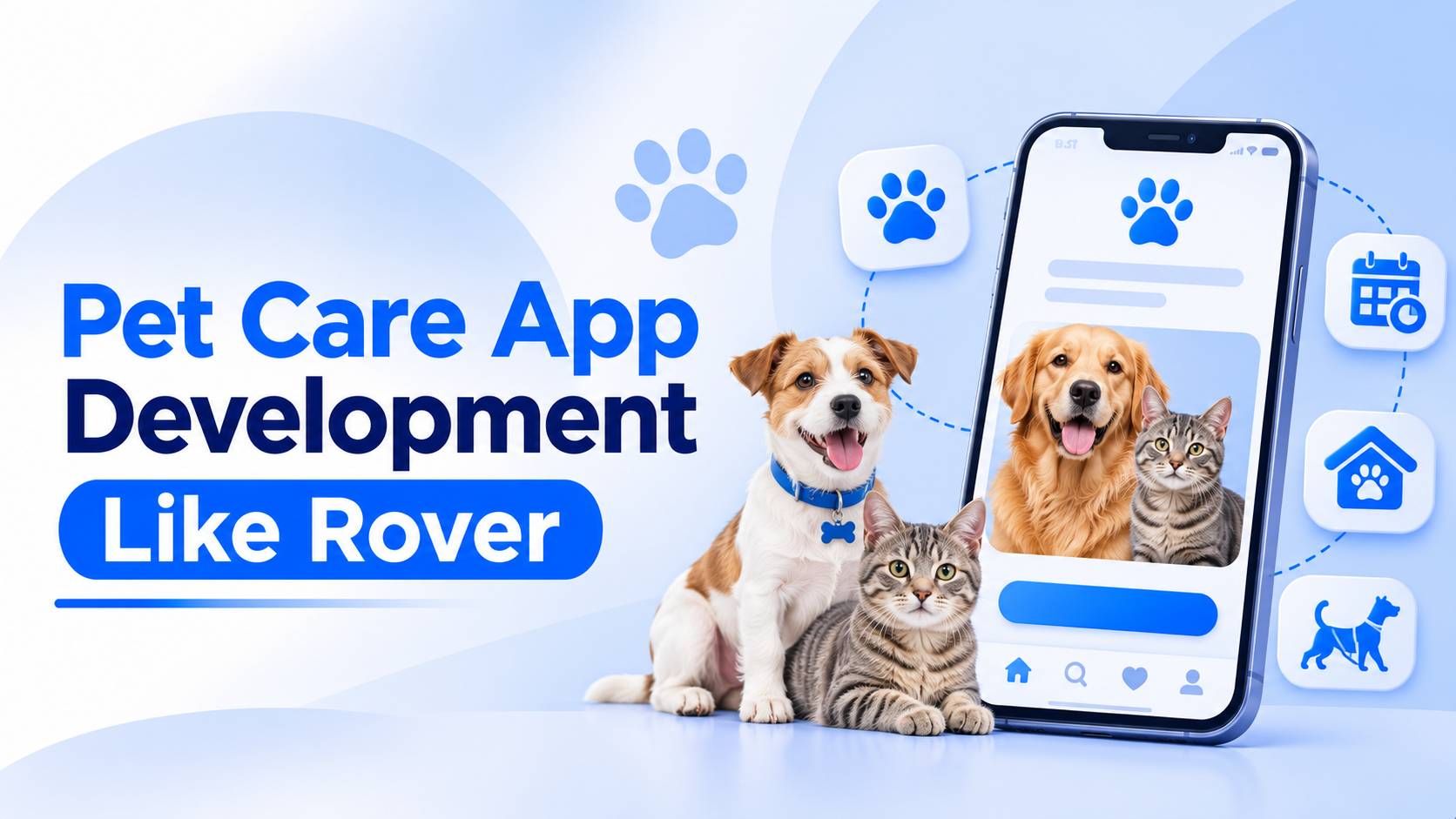
Pet Care App Development Like Rover: Features & Cost


Create engaging, high-performance mobile applications tailored to your business needs. We craft future-ready apps that offer smooth user experiences on all devices.
Build robust and scalable websites and CMS platforms that help you manage content effortlessly. Our development ensures a seamless digital presence.
Launch secure, feature-rich online stores with intuitive shopping experiences. We build tailored eCommerce platforms designed for growth.
Design captivating games with immersive gameplay and stunning graphics. From concept to launch, we build engaging experiences that players love.
Enhance your customer relationships with customized Salesforce implementations. Drive growth and efficiency with smarter CRM solutions.
Harness artificial intelligence and machine learning to automate workflows and gain actionable insights. Our AI transforms data into smart decisions.
Accelerate your software delivery lifecycle with continuous integration, delivery, and infrastructure automation to boost efficiency.
Pet owners stopped accepting kennels years ago. They want a background-checked sitter, a photo at 3 PM, and a GPS trail of the walk they paid for. That shift is why pet care app development like Rover is a genuine business opportunity and not a copycat project.
Rover turned a casual pet sitting into a structured marketplace with payments, screening, and insurance baked into every booking.
This guide breaks down the features, business model, tech stack, build process, and real cost behind that kind of platform, along with the mistakes that quietly kill most pet marketplaces before year two.
TL;DR
The demand side is no longer the risky part of this business. The global pet sitting market is projected to grow from $3.43 billion in 2026 to $8.47 billion by 2034, at a CAGR of 11.98% (Fortune Business Insights). Pet ownership rose sharply, offices called people back, and travel recovered. Somebody has to watch the dog.
What is still unsolved is local supply. Rover dominates a handful of metros, but coverage thinns out fast in mid-sized cities, in specialty care like senior dogs, cats, reptiles, and in regions outside North America.
Those gaps are where new entrants win. The smarter play is not a national Rover clone but a dense, well-reviewed network in one city that expands outward.
If you already plan to build an on-demand app, pet care has an advantage most categories lack: bookings repeat weekly, and switching sitters feels risky to the customer. Retention is structurally high once trust is earned.
Understanding the mechanics matters more than copying the interface. This section breaks the platform into its three working parts: the marketplace structure, the money flow, and the trust layer. Each one carries a product decision you will have to make in week one.
Rover does not employ sitters. It connects pet owners with independent caregivers offering boarding, house sitting, drop-in visits, day care, and dog walking. The platform owns discovery, booking, messaging, and payment, while the service itself stays peer to peer.
That structure keeps operating costs low and liability contained, but it creates the classic cold-start problem. Every online service marketplace faces it: no sitters means no owners, and no owners means sitters go inactive.
Solve it the way ride-hailing did, by saturating one neighborhood before opening the next.
Rover charges sitters a commission on each completed booking and adds a service fee on the owner’s side. Funds are held until the service is delivered, then released on a payout schedule.
This escrow pattern is non-negotiable for trust and is the same mechanism behind any serious app like Uber. You are a money movement business whether you like it or not, so plan for KYC, payout delays, chargebacks, and refund disputes from day one.
This is the real moat. Background checks, identity verification, reviews tied to completed bookings, in-app messaging, photo updates, and booking-linked insurance all exist to make a stranger feel safe in someone’s home with their pet.
Strip any one of these out and conversion drops noticeably. Trust features are not a phase two item in pet care app development like Rover, they are the product.
A pet marketplace is three applications, not one. The sections below separate what the owner needs, what the sitter needs, and what you need internally to run the business. Build them as one codebase with role-based access rather than three disconnected products.
Owners need search filtered by service type, dates, pet size, and distance, plus sitter profiles with verification badges, photos, rates, and review history. Pet profiles should carry breed, age, feeding schedule, medications, vet contact, and behavior notes.
Booking requires a calendar, instant-book or request-to-book logic, secure checkout, and cancellation terms shown before payment. Live GPS walk tracking built on geofencing is the feature owners talk about most, alongside photo and video check-ins pushed during the service.
Sitters need a different app entirely. Give them availability calendars, service and rate configuration, booking request alerts with accept or decline, route navigation, a check-in and check-out flow with timestamps, and an earnings dashboard with payout history.
Onboarding is where most sitters drop off, so keep verification steps short and show progress clearly. Reliable disbursement also depends on your payment rails, and the same tradeoffs covered in payment gateways for startups apply directly to split payouts here.
Your operations team needs sitter approval queues, document verification, dispute handling, refund controls, commission settings, promo code management, and analytics on bookings, cancellations, and repeat rate.
Most founders underbuild this and end up managing a marketplace through spreadsheets and support emails. Build the admin panel in the first release, not the third.
Pet care app development like Rover follows a sequence that protects your budget. These four steps move from narrowing scope to shipping a real product in one city. Skipping ahead to feature building is the most expensive mistake available to you.
Rover offers five services. You should launch with two, usually dog walking and drop-in visits, because they repeat weekly and need no overnight liability. Pick one city and one or two neighborhoods inside it. Interview twenty pet owners and twenty prospective sitters before design starts.
Ask what they currently do, what they pay, and what went wrong last time. That research defines your verification bar, your pricing floor, and your cancellation policy. It also tells you whether your city has enough supply to make the marketplace feel alive at launch.
Design the booking path before anything else, because that is where revenue is won or lost. Map search, profile view, date selection, pet details, payment, and confirmation as a single uninterrupted flow. Then design the sitter side of the same transaction.
Strong UI/UX design here means fewer taps, visible trust signals at the decision moment, and no surprise fees at checkout. Prototype it and run it past real pet owners. Fixing a confusing booking flow after development costs several times more than fixing it in Figma.
Scope the first release to search, profiles, booking, payments, messaging, reviews, and the admin panel. Leave out video calls, loyalty points, and AI matching. A disciplined MVP development cycle for a two-sided pet marketplace runs roughly four to five months with a team of five to six people.
Build owner and sitter apps from one cross-platform codebase to halve the work. Ship to one city, watch real bookings, and let actual cancellation and no-show data tell you what to build next instead of guessing.
Payments are the hardest technical piece. You need escrow until service completion, automatic commission splits, sitter onboarding with tax and identity details, refunds, and failed-payment retries. Test every path, including cancellations, mid-booking and disputed services.
Run a closed beta with thirty sitters and a hundred owners before public launch. Watch booking completion rate, time to first booking for new sitters, and repeat rate at thirty days. Those three numbers tell you whether the marketplace is actually working or just collecting signups.
| Layer | Recommended choice |
| Mobile apps | Flutter or React Native |
| Backend | Node.js or Django |
| Database | PostgreSQL with Redis caching |
| Real-time tracking | Socket.io or Firebase Realtime Database |
| Maps and routing | Google Maps Platform or Mapbox |
| Payments and payouts | Stripe Connect or Adyen for Platforms |
| Background checks | Checkr or a regional equivalent |
| Media storage | AWS S3 with CloudFront |
| Notifications | Firebase Cloud Messaging |
Cross-platform is the right call here because owner and sitter apps share most of their logic. Using Flutter development services lets one team maintain both iOS and Android builds for both user types.
Keep the backend modular from the start, with booking, payments, messaging, and tracking as separate services. Clean API development makes it far easier to add insurance partners, vet telehealth, or pet supply commerce later without rewriting the core.
| Build scope | What it includes | Estimated cost |
| MVP, single city | Owner app, sitter app, booking, payments, admin panel | $25,000 to $45,000 |
| Mid-scale platform | Both platforms, live tracking, chat, reviews, promo engine | $50,000 to $90,000 |
| Full marketplace | Multi-city, smart matching, insurance workflows, video check-ins | $100,000 to $180,000 |
The variables that move these numbers are service count, the depth of your verification process, and whether tracking is real-time or periodic. Smart matching and other uses of AI in mobile app development add 20% to 35% on top of the base build.
Your engineering location matters just as much, since US agency rates run three to four times Indian rates for comparable output.
A detailed stage-by-stage view of mobile app development cost is worth reading before you approve any quote.
Commission alone is enough at launch. Adding subscriptions too early punishes the sitters you are still trying to recruit.
Pet care app development like Rover needs a partner who has shipped two-sided marketplaces, not just mobile apps. EngineerBabu has built booking platforms, on-demand services, and payment-heavy products across fintech, healthtech, and consumer marketplaces, delivered through a CMMI Level 5 process.
That means the escrow logic, split payouts, GPS tracking, and dispute tooling are familiar territory rather than first attempts.
Engagements cover discovery and scoping, UX, cross-platform builds, backend architecture, payment integration, and post-launch support. You can also extend your in-house team with dedicated developers instead of outsourcing the entire build. The full range of mobile app development services covers everything from MVP to multi-city scale.
Rover did not win because of its app design. It won because it made leaving a dog with a stranger feel safe, then made booking that stranger take ninety seconds. Any attempt at pet care app development like Rover has to clear the same two bars, in that order.
Start narrow, verify hard, and launch where you can create real density. The market is growing fast enough that the opening is still there, but only for the platform pet owners actually trust.
Ready to scope your build? Talk to the EngineerBabu team about your pet care marketplace.
Most platforms carry general liability and vet care coverage per booking. Requirements vary by country and state, so confirm with an insurance broker before accepting your first paid booking.
Separate apps work better. The workflows, notifications, and screens barely overlap, and a single merged app confuses both audiences during onboarding and daily use.
Recruit sitters directly from local pet groups, vet clinics, and existing freelance sitters. Offer zero commission for ninety days so early supply has a concrete reason to stay.
Yes for owner-side booking, no for sitters. Walkers need mobile check-ins, navigation, and photo updates in the field, which a mobile browser handles poorly.
Set tiered policies by notice period, show them before checkout, and automate partial refunds. Manual case-by-case decisions create disputes and erode sitter trust quickly.
Generally yes. Indian development rates run significantly lower than US or UK agencies for comparable engineering quality, which is why most marketplace founders build offshore and scale locally.