Outsourcing Software Development to India from Singapore — The Startup Nation's Best-Kept Secret


Create engaging, high-performance mobile applications tailored to your business needs. We craft future-ready apps that offer smooth user experiences on all devices.
Build robust and scalable websites and CMS platforms that help you manage content effortlessly. Our development ensures a seamless digital presence.
Launch secure, feature-rich online stores with intuitive shopping experiences. We build tailored eCommerce platforms designed for growth.
Design captivating games with immersive gameplay and stunning graphics. From concept to launch, we build engaging experiences that players love.
Enhance your customer relationships with customized Salesforce implementations. Drive growth and efficiency with smarter CRM solutions.
Harness artificial intelligence and machine learning to automate workflows and gain actionable insights. Our AI transforms data into smart decisions.
Accelerate your software delivery lifecycle with continuous integration, delivery, and infrastructure automation to boost efficiency.
Hire app developers ready to turn your ideas into sleek, high-performing mobile apps for any platform.
Bring in frontend pros who craft smooth, beautiful, and user-friendly interfaces that your visitors will love.
Get backend developers who build fast, secure, and reliable systems to keep everything running behind the scenes.
Hire eCommerce developers who build secure, scalable online stores designed to offer seamless shopping and grow your sales.
Get dedicated developers committed to your projects, delivering consistent quality and speed as an extension of your team.
Singapore doesn’t talk about it publicly. But it does it constantly.
Grab built significant engineering capacity in India. Sea Group has Indian engineering operations. Shopee, Lazada, Gojek — major Southeast Asian tech companies with Singapore headquarters lean heavily on Indian engineering talent. Even Singapore’s homegrown startups — funded by Temasek, GIC, Sequoia Southeast Asia — quietly engage Indian development teams to build their core products.
The reason nobody talks about it: there’s a perception in Singapore’s startup ecosystem that admitting you outsource to India somehow diminishes your technical credibility. As if having your engineering in Bangalore or Indore instead of Raffles Place makes the code less sophisticated.
That perception is wrong. And it’s expensive.
Singapore is one of the most expensive cities in the world to hire engineers. A senior developer in Singapore costs SGD 120,000-180,000/year ($90,000-$135,000 USD). The same calibre of talent in India — from a top-tier company with CMMI certification, Google-validated AI capabilities, and unicorn clients — costs 60-70% less.
The timezone difference? Two and a half hours.
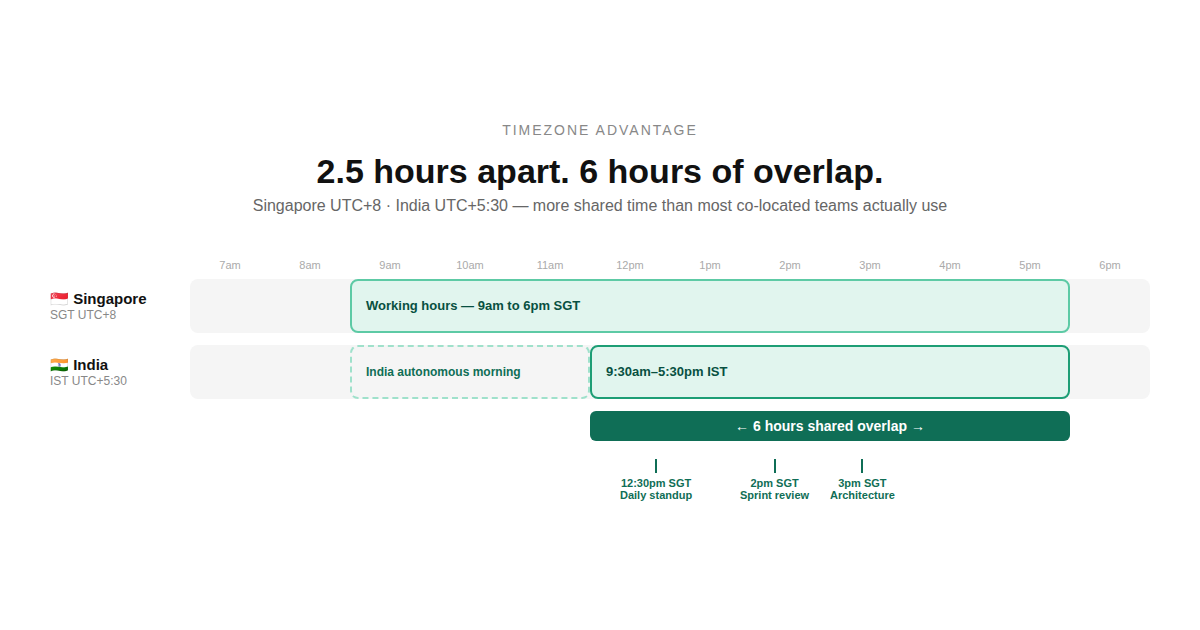
Let me say that again. Two and a half hours. Singapore is UTC+8. India is UTC+5:30. When it’s 9AM in Singapore, it’s 6:30 AM in India. When the Indian team starts at 9:30 AM IST, it’s 12 PM in Singapore. By noon Singapore time, both teams are working simultaneously. The overlap runs until the end of Singapore’s business day.
That’s 5-6 hours of shared working time. Every single day. More overlap than Singapore has with its own Southeast Asian neighbours like Philippines or Vietnam in practical terms — because the overlap falls during peak productivity hours for both teams.
I know this because the EngineerBabu team has delivered products to clients across 15+ countries, including Singapore-based companies and Southeast Asian businesses. My name is Mayank Pratap. I co-founded EngineerBabu 14 years ago. The team has shipped 500+ products. 75 for Y Combinator-selected startups — and Singapore’s startup ecosystem runs on the same velocity, the same ambition, the same “build fast, validate faster” mindset that YC demands.
4 of our clients became unicorns. Google selected us for the AI Accelerator 2024. CMMI certified us at Level 5. Vijay Shekhar Sharma — the founder of Paytm — backs us personally.
Singapore doesn’t need to be convinced that outsourcing works. Singapore needs to know which Indian companies actually deliver. That’s what this blog is about.
Singapore is a paradox. One of the world’s greatest startup ecosystems. One of the world’s worst places to build an engineering team.
The city-state produces exceptional founders, product managers, and business leaders. It does not produce enough engineers. NUS, NTU, and SUTD graduate approximately 5,000 IT-related graduates per year. The technology sector needs multiples of that.
The result: Singapore imports engineering talent through work visas, outsources to regional hubs, or does both. The Employment Pass system has become more restrictive in recent years, making it harder and more expensive to bring foreign engineers to Singapore. The practical alternative — engaging offshore teams — is no longer a compromise. For many Singapore companies, it’s the optimal strategy.
India has structural advantages over every other outsourcing destination for Singapore.
Talent depth. 5.8 million developers. Not generalists — specialists. When the EngineerBabu CTO needed to build real-time credit decisioning for EarlySalary — a system processing thousands of decisions daily — the expertise already existed within the team. The CTO had spent 17 years at Wishfin building exactly this kind of infrastructure. Finding equivalent specialization in Singapore would take months of hiring at 3x the cost.
English fluency. India and Singapore share English as a business language. Technical discussions, architecture reviews, sprint demos, documentation — all happen in English without translation friction. This sounds obvious until you compare it to Vietnam (significant English gaps outside major cities) or China (requires Mandarin for deep technical communication with most teams).
Startup ecosystem alignment. India’s startup ecosystem is the third largest globally. Indian engineers understand the startup playbook — MVP development, rapid iteration, pivot readiness, investor-grade architecture. The 75 YC-selected projects the EngineerBabu team has shipped were built at startup speed for startup standards. Singapore founders don’t need to explain what “build for scale from day one” means. The team already operates that way.
Cost reality. A Singapore-based 4-person team (2 developers, QA, PM) costs SGD 500,000-700,000/year. The same team from a quality Indian company: SGD 100,000-200,000/year. The savings fund longer runway, faster market expansion, and competitive hiring for Singapore-based roles that genuinely need to be local — sales, partnerships, customer success.
Most outsourcing discussions treat timezone as a problem to solve. For Singapore-India, it’s not a problem. It’s an advantage.
India is 2.5 hours behind Singapore. When Singapore starts work at 9 AM SGT, India is at 6:30 AM IST. When the EngineerBabu team starts at 9:30 AM IST, it’s noon in Singapore. From noon SGT onwards, both teams are fully online.
The practical schedule: the Indian team works their full morning — 9:30 AM to 12 PM IST — on autonomous development. Building features. Writing code. Running tests. This is deep work time without interruption.
At noon SGT (9:30 AM IST becomes 12 PM SGT — actually, let me give this to you precisely), the overlap begins. The standup happens at 12:30 PM SGT (10 AM IST). Sprint reviews happen at 2 PM SGT (11:30 AM IST). Architecture discussions, code reviews, product decisions — all during the overlap window that runs until 6:30 PM SGT (4 PM IST).
That’s 6 hours of overlap. Six. More than most co-located teams spend in actual collaborative work.
And the morning gap — where the Indian team works while Singapore hasn’t started — creates a productivity multiplier. The Singapore PM defines priorities at end-of-day. The Indian team picks them up first thing. By the time Singapore’s day starts, fresh work is ready for review. It’s a near-continuous cycle.
Philippines: same timezone (UTC+8). Perfect overlap. But 190,000 developers versus India’s 5.8 million. The talent depth trade-off is severe.
Vietnam: 1 hour behind Singapore. Good overlap. But English limitations and thinner domain specialization — especially in fintech, healthcare, and AI. Growing fast but not there yet.
Eastern Europe: 5-6 hours behind. The overlap shrinks to 2-3 hours. Expensive — rates approach Singapore levels. Quality is high but the cost advantage disappears.
US: 12-15 hours behind. The opposite side of the clock. Collaborative work requires one team working nights.
India offers Singapore the best balance: strong timezone overlap (6 hours), massive talent depth, domain specialization, English fluency, and 60-70% cost advantage. No other destination matches this combination.
The Singapore-India technology relationship is maturing rapidly. It’s no longer about maintenance and basic development. Singapore companies are outsourcing core product engineering to India. Let me tell you what’s being built.
Singapore is Asia’s fintech capital. MAS (Monetary Authority of Singapore) has created one of the world’s most progressive regulatory environments for fintech innovation. Digital banking licenses, payment services frameworks, sandbox programmes, open banking APIs — the infrastructure for fintech innovation is world-class.
The fintech talent to build on this infrastructure? Not enough in Singapore. Not even close.
This is where Indian fintech development company become essential.
The EngineerBabu team’s fintech credentials are among the deepest of any development company globally. EarlySalary — lending platform, ₹10,000 crore disbursed, real-time credit decisioning. Bank Open — neobank that became a unicorn, core banking integrations built by the team. OpenMoney — full-stack financial platform unifying payments, investments, and credit. Razorpay ecosystem — payment orchestration. TaptapSend — 5-country regulated remittance platform. Kulu Fintech — GCC financial infrastructure. LoanOS — the team’s own lending product processing ₹1,000 crore annually.
The CTO’s 17 years at Wishfin — credit infrastructure, bureau integrations, risk models at scale — is the kind of specialization that Singapore fintech companies struggle to find locally at any price.
MAS compliance is different from India’s RBI or UAE’s CBUAE. But the engineering discipline of building compliant financial software is universal. The team has navigated five regulatory jurisdictions through TaptapSend. CBUAE and SAMA through Kulu Fintech. RBI through EarlySalary. PCI-DSS across multiple payment products. The patterns transfer directly. MAS requirements — Technology Risk Management Guidelines, outsourcing requirements, business continuity standards — are rigorous but well-documented. The team translates regulatory requirements into compliant architecture. That’s what they do.
For Singapore fintech founders, the value proposition is precise: world-class fintech engineering, proven across multiple regulatory jurisdictions, at 60-70% of what a local Singapore team would cost, with 6 hours of daily overlap.
Singapore is positioning itself as Southeast Asia’s AI hub. The National AI Strategy 2.0 is allocating billions to AI infrastructure, research, and commercialization. AI Singapore (AISG) is driving national AI capabilities. Every major industry — finance, healthcare, logistics, government — is deploying AI.
Building production AI requires specialized talent that’s scarce everywhere — and particularly scarce in a city of 6 million people.
Google selected EngineerBabu for the AI Accelerator 2024. Not for general development — specifically for AI development in production applications. The team builds AI-driven credit scoring engines, fraud detection systems, predictive analytics, and intelligent automation. Not AI demos. AI that runs in production handling real decisions.
India produces more AI/ML engineers than any country except the US and China. The IITs and IISc produce world-class AI researchers. The practical gap — taking ML models from research to production — is where experienced companies like EngineerBabu excel. The team has deployed production AI for EarlySalary (credit scoring), for healthcare platforms (diagnostic support), and for enterprise applications (intelligent automation).
For Singapore AI startups, engaging an Indian team with Google-validated AI capabilities solves the talent problem at a fraction of local hiring cost.
Singapore’s SaaS ecosystem punches above its weight. Nium, PatSnap, Funding Societies, Carro — Singapore-founded SaaS companies that have become regional and global leaders.
The next generation of Singapore SaaS founders is building now. And many of them face the same challenge: exceptional product vision, limited engineering bandwidth.
The EngineerBabu team has built 75 products for YC-selected startups. The Harvard Innovation Lab winner in the portfolio was built by the team. Supersourcing — the B2B SaaS platform Mayank co-founded — proves the team builds and operates their own SaaS products. LoanOS is a SaaS lending product.
For Singapore SaaS founders, the parallel to YC is direct. YC companies build fast, iterate faster, and ship with investor-grade architecture. That’s the standard the team operates at. 75 projects worth of practice.
Singapore is a global logistics hub. Port of Singapore is the world’s second-busiest container port. Changi Airport is a cargo hub. The logistics technology ecosystem — fleet management, warehouse automation, supply chain analytics, last-mile delivery platforms — needs software.
The EngineerBabu team built BURQ — a US logistics platform where fintech meets operations. Simba Beer’s supply chain technology recovered millions in blocked capital. Adani Group’s enterprise technology includes logistics-adjacent systems.
For Singapore logistics companies, this means a team that understands both the operational complexity and the financial flows of supply chain technology.
Let me address this directly because it’s the unspoken fear in Singapore’s startup ecosystem.
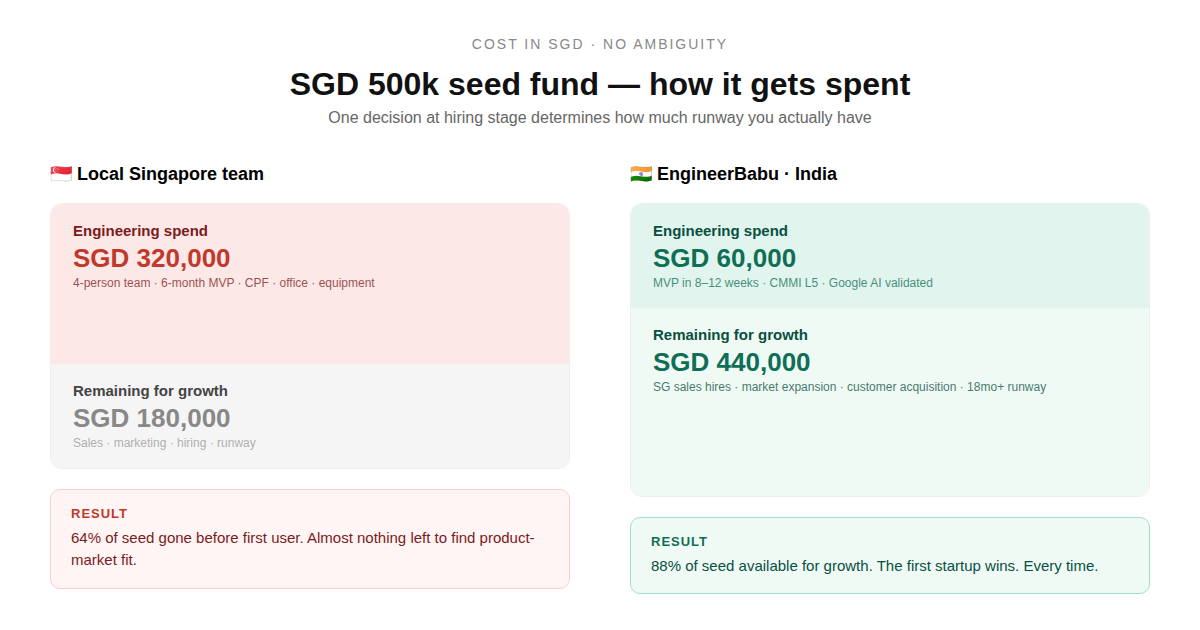
Singapore VCs — Sequoia Southeast Asia, Vertex Ventures, Jungle Ventures, Golden Gate Ventures — invest in companies that outsource to India. They know the model works. They’ve seen the cap table math: a startup that spends SGD 100,000 on an Indian engineering team and SGD 400,000 on growth versus a startup that spends SGD 500,000 on a local engineering team and has nothing left for growth. The first startup wins. Every time.
75 Y Combinator-selected startups built their products with the EngineerBabu team. YC is the most selective investor in the world. They funded these companies knowing the development was done in India. They funded them because the products were good — not because they cared where the developers sat.
4 of the team’s clients became unicorns. Their investors didn’t penalize them for using Indian engineering. They rewarded them — because the capital efficiency was a competitive advantage.
Investors care about three things: product quality, capital efficiency, and speed to market. A quality Indian team delivers all three better than a local Singapore team that takes three months to hire and costs 3x as much.
The smart Singapore founders already know this. They’ve been building with Indian teams for years. They just don’t advertise it at networking events.
Here’s how an engagement actually works.
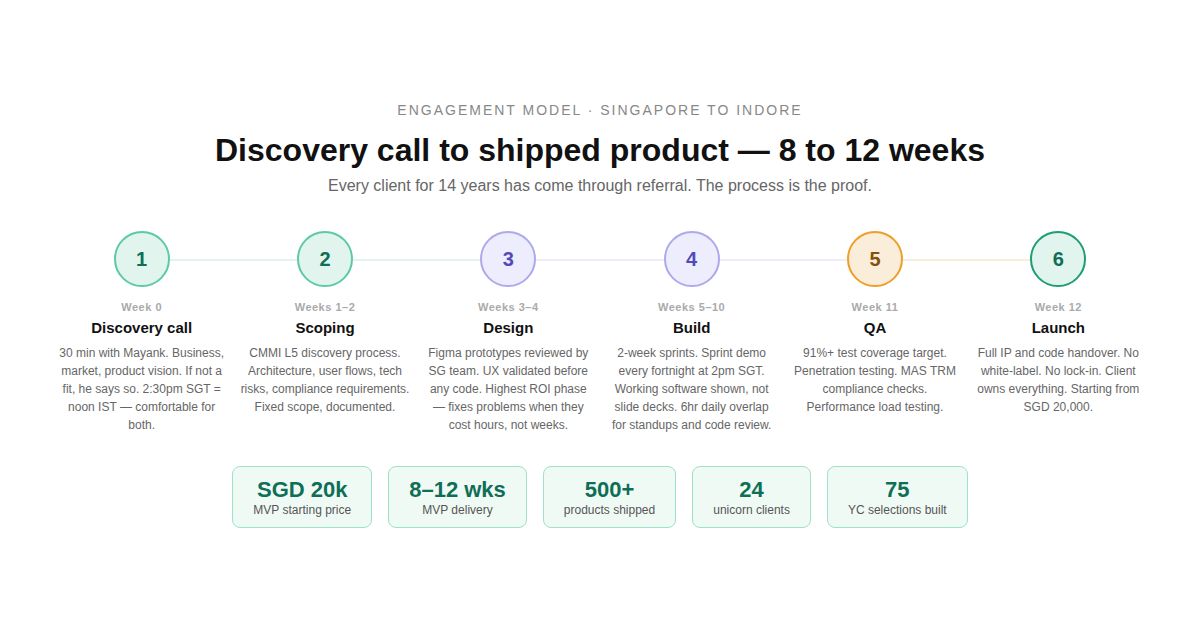
Before contract: Mayank gets on a call with the Singapore founder or CTO. The timezone makes this easy — 2:30 PM SGT is noon IST. A comfortable midday call for both. The conversation covers the business, the market, the product vision. If the project isn’t a fit, Mayank says so. Every client for 14 years has come through referral — that reputation matters more than any single contract.
Week 1-2: Discovery and scoping. Daily calls during the 6-hour overlap window. The team maps the product architecture, user flows, technical risks, and compliance requirements. CMMI Level 5 processes mean the scoping is rigorous and documented.
Week 3-4: Design. Figma prototypes reviewed by the Singapore team. User experience validated before code is written. This phase is the highest-ROI investment in any project — it catches problems when fixing them costs hours, not weeks.
Week 5 onwards: Development. Two-week sprints. Sprint demo every two weeks at 2 PM SGT (11:30 AM IST). Both teams in their productive afternoon/morning. Working software demonstrated, not slide decks.
The daily rhythm: Indian team’s morning (9:30 AM – 12 PM IST) is autonomous deep work. Noon SGT onwards (9:30 AM IST onwards for meaningful collaboration) — standups, code reviews, architecture discussions. By end of Singapore’s day, priorities are set. The Indian team picks them up the next morning. Fresh work ready by Singapore’s next noon.
Travel: Singapore to Indian tech hubs is a 5-6 hour flight. Direct connections to Bangalore, Mumbai, Delhi. Affordable flights. Same-day travel for milestone reviews or team visits. Some clients do quarterly visits. Others never visit — the daily video collaboration is sufficient.
The team ships MVPs in 8-12 weeks. 500+ products of pattern recognition means no wasted effort. For Singapore startups burning through seed funding — speed is survival.
Building locally in Singapore: Senior developer: SGD 120,000-180,000/year. Mid-level developer: SGD 84,000-120,000/year. QA engineer: SGD 72,000-96,000/year. Project manager: SGD 96,000-144,000/year. A 4-person team: SGD 372,000-540,000/year — before CPF, office space in CBD, equipment. A 6-month MVP: SGD 250,000-400,000 all-in.
Building with EngineerBabu (Tier 1 — CMMI Level 5, Google AI Accelerator, 4 unicorn clients): MVP: Starting from SGD 20,000 ($15K USD). Mid-complexity product: SGD 54,000-134,000 ($40K-$100K USD). Enterprise platform: SGD 134,000-400,000 ($100K-$300K USD).
Savings: 60-70%. The quality is equivalent — validated by Google, audited by CMMI, proven by 4 unicorn outcomes.
For a Singapore seed-stage startup with SGD 500,000 in funding: an Indian team means the
MVP ships in 8-12 weeks for SGD 40,000-80,000, leaving SGD 400,000+ for growth, hiring Singapore-based commercial roles, and runway. A local team means SGD 300,000+ on engineering alone, leaving almost nothing for everything else.
The math isn’t close.
Three killers. Same as every market. Singapore-specific context.
Choosing the cheapest Indian bid. Singapore procurement teams — especially at larger companies — run RFPs. The lowest bid wins. The lowest bidder sends junior developers. The product is late, buggy, and architecturally unsound. The Singapore team blames “India” when they should blame their vendor selection process. Price is the worst possible selection criterion for software development.
The EngineerBabu team isn’t found through RFPs. Every client comes through referral. The team takes 20 projects a year. CMMI Level 5, Google AI Accelerator, 4 unicorn clients — these credentials exist so that the selection conversation is about capability, not cost.
Underestimating the need for product management on the Singapore side. An Indian engineering team — even an exceptional one — needs a product owner who defines what to build and why. Singapore companies that outsource engineering but don’t invest in product management end up with technically excellent software that solves the wrong problem.
The best outsourcing relationships have clear ownership: Singapore owns the what and the why. India owns the how. Mayank and the CTO participate in the intersection — helping translate business requirements into technical architecture. But the product vision must come from the Singapore team.
Not treating the Indian team as a partner. “Vendor” thinking creates vendor outcomes. “Partner” thinking creates partnership outcomes. The EngineerBabu team functions best when they’re included in product discussions, user research insights, market strategy context, and competitive intelligence. Not because they need to know — but because contextual engineering is better engineering. A developer who understands why a feature matters builds it differently than one who just receives a ticket.
Mayank Pratap leads the company personally. The Singapore founder talks to the same person from discovery through launch. 2.5 hours of timezone difference means 6 hours of daily overlap — more collaborative time than most co-located teams spend together.
Custom builds from scratch. Full code and IP ownership. No white-label. No shared codebases. No vendor lock-in. The client’s product, the client’s property.
Google AI Accelerator 2024 — validated AI capabilities. Not a landing page claim. A Google selection. CMMI Level 5 — audited engineering processes. Not “we follow agile.” Independently certified process maturity. CTO with 17 years of financial infrastructure experience from Wishfin. 4 unicorn clients. 75 YC selections — the same startup velocity that Singapore founders operate at. 200+ VC-funded products. 500+ total deliveries across 15+ countries.
EarlySalary. Khatabook. OpenMoney. Bank Open. Razorpay. TaptapSend. Kulu Fintech. Simba Beer. Adani Group. Apollo Hospitals. Manipal. ResMed. 1MG. Supersourcing. LoanOS.
Fourteen years. Every client through referral. Zero marketing budget. The work speaks.
Starting from SGD 20,000 ($15K USD). Exact numbers after understanding the specific project.
If you’re a Singapore-based company — startup, scaleup, or enterprise — evaluating Indian development partners, email me. mayank@engineerbabu.com. The founder. Not a form.
It’s 2:30 PM in Singapore right now? It’s noon in Indore. Perfect time to talk.
Tell me about the product, the market, the regulatory environment. I’ll give you 30 minutes of honest assessment. If we’re the right fit, we’ll move forward. If not, I’ll tell you why.
75 YC-selected startups trusted the team. 4 unicorns trusted the team. The question isn’t whether Indian outsourcing works. The question is whether you’ve found the right Indian company.
Let’s find out.
Mayank Pratap Co-founder, EngineerBabu mayank@engineerbabu.com | engineerbabu.com
Google AI Accelerator 2024 · CMMI Level 5 · Backed by Vijay Shekhar Sharma · 4 Unicorn Clients · 75 YC Selections · 200+ VC-funded Products · LinkedIn Top 20 Startups India · NASSCOM Member
India offers 60-70% cost savings versus Singapore development, 5.8 million developers with deep specialization, 6 hours of daily timezone overlap (only 2.5 hours difference), and established compliance expertise. EngineerBabu has shipped 75 YC-selected projects — matching the startup velocity Singapore founders demand — with Google AI Accelerator capabilities and CMMI Level 5 processes. The talent depth in fintech, healthcare, and AI that India provides simply doesn’t exist at sufficient scale within Singapore.
Singapore is 2.5 hours ahead of India (SGT UTC+8 vs IST UTC+5:30). This creates 5-6 hours of shared working time daily — the Indian team’s late morning through afternoon coincides with Singapore’s afternoon. EngineerBabu runs standups at 2:30 PM SGT (12 PM IST) and sprint reviews at 2 PM SGT (11:30 AM IST). The overlap is more collaborative time than most co-located teams actually use.
Projects with quality Indian teams start from SGD 20,000 ($15K USD) for MVPs. Mid-complexity products range SGD 54,000-134,000. Enterprise platforms range SGD 134,000-400,000. Compared to local Singapore development — where a 4-person team costs SGD 372,000-540,000/year — the savings are 60-70%. EngineerBabu provides exact estimates after detailed scoping.
EngineerBabu has compliance engineering experience across RBI (India), CBUAE/SAMA (Gulf), HIPAA (US healthcare), PCI-DSS (global payments), and multi-jurisdiction compliance through TaptapSend (5 countries). MAS Technology Risk Management Guidelines and outsourcing requirements use engineering patterns the team has already proven. The team translates regulatory requirements into compliant architecture — the compliance expertise is in the engineering patterns, applied to MAS-specific requirements with the client’s legal guidance.
For complex software — fintech, healthcare, AI, enterprise platforms — India is significantly stronger. India has 5.8 million developers vs Vietnam’s 530,000, deeper domain specialization, CMMI process maturity,
Google-validated AI capabilities, and stronger English proficiency for technical discussions. Vietnam is 10-20% cheaper and has a 1-hour timezone advantage over India from Singapore.
For well-specified web and mobile development at the lowest cost, Vietnam is competitive. For complex, regulated, or AI-heavy products, India’s depth is decisive.
EngineerBabu | Product Engineering for Companies That Build for the World