MVP App Development Company USA


Create engaging, high-performance mobile applications tailored to your business needs. We craft future-ready apps that offer smooth user experiences on all devices.
Build robust and scalable websites and CMS platforms that help you manage content effortlessly. Our development ensures a seamless digital presence.
Launch secure, feature-rich online stores with intuitive shopping experiences. We build tailored eCommerce platforms designed for growth.
Design captivating games with immersive gameplay and stunning graphics. From concept to launch, we build engaging experiences that players love.
Enhance your customer relationships with customized Salesforce implementations. Drive growth and efficiency with smarter CRM solutions.
Harness artificial intelligence and machine learning to automate workflows and gain actionable insights. Our AI transforms data into smart decisions.
Accelerate your software delivery lifecycle with continuous integration, delivery, and infrastructure automation to boost efficiency.
Hire app developers ready to turn your ideas into sleek, high-performing mobile apps for any platform.
Bring in frontend pros who craft smooth, beautiful, and user-friendly interfaces that your visitors will love.
Get backend developers who build fast, secure, and reliable systems to keep everything running behind the scenes.
Hire eCommerce developers who build secure, scalable online stores designed to offer seamless shopping and grow your sales.
Get dedicated developers committed to your projects, delivering consistent quality and speed as an extension of your team.
A founder I spoke to last month had already spent $80,000 on an MVP. Three developers. Six months. The product didn’t have a single paying user.
When I looked at their codebase, I found 11 features built to near-perfection. Not one of them was the thing their target users actually needed in week one. They had built a full authentication system with social login, an onboarding flow with 7 steps, and an admin dashboard before they had validated a single hypothesis.
This is the pattern I see over and over. And it’s why choosing the right MVP app development services in the USA is one of the highest-stakes decisions a non-technical founder makes. Not because code is complex3. Because strategy is.
EngineerBabu, a CMMI Level 5 product engineering company recognized in Google’s AI Accelerator Top 20 globally in 2024, has built 200+ VC-funded products and 75 YC-selected MVPs. I’ve been on the architecture calls, the scope trade-off conversations, and the post-launch retrospectives. Here’s what that experience actually teaches you.
An MVP app development company is a technical partner that helps founders build the smallest, sharpest version of their product — the version that validates one core hypothesis with real users before any serious capital is deployed.
That’s the textbook answer. But here’s the part most definitions skip.
The word “minimum” is routinely misunderstood. Founders read it as “cheap” or “fast.” Development companies read it as “small scope = easier to sell.” Neither is right. Minimum means minimum to validate. Not minimum to exist. Not minimum to demo at a pitch. Minimum to learn something definitive from real user behavior.
According to CB Insights, 42% of startups fail because they build products nobody needs. Separately, a 2025 study found that startups using a disciplined MVP methodology are 2.5x more likely to secure follow-on funding compared to those that pitch concept-only presentations. The numbers make the case clearly. Execution is where most companies fall apart.
A good MVP development partner isn’t a vendor. They’re the person telling you “you don’t need that feature yet” when you’re ready to add it.
After 14 years of building products and reviewing pitches from hundreds of development teams, I’ve narrowed down what actually matters when evaluating a partner.
Track record with funded products, not just launched products. Launching isn’t the goal. Getting users, retaining them, and attracting capital is. Ask how many products they’ve built have gone on to raise a Series A or beyond. EngineerBabu has shipped products for 4 unicorn clients and 75 YC-selected companies. Those numbers exist because we focus on what happens after launch, not just on shipping.
Architecture decisions made upfront, not after. The most expensive MVPs I’ve reviewed weren’t expensive because of large teams. They were expensive because the architecture had to be rebuilt at scale. If an MVP company can’t explain microservices vs. monolith trade-offs for your specific use case in 10 minutes, that’s a red flag.
Founder-led engagement, not account manager-led. When someone other than the decision-maker reviews your product specs, things get lost. At EngineerBabu, I’m personally on every product call. Not a project manager. Not a sales lead. Me. That’s also why the company takes only 20 projects a year.
Honest scope conversations, not “yes we can do that.” The best development partners push back. If an agency never says “you don’t need that in version one,” they’re optimizing for billing hours, not your outcome.
Most articles quote a range and leave it there. Let me break this down the way I’d break it on a call.
For a standard SaaS or mobile MVP in 2025, the budget range looks like this:
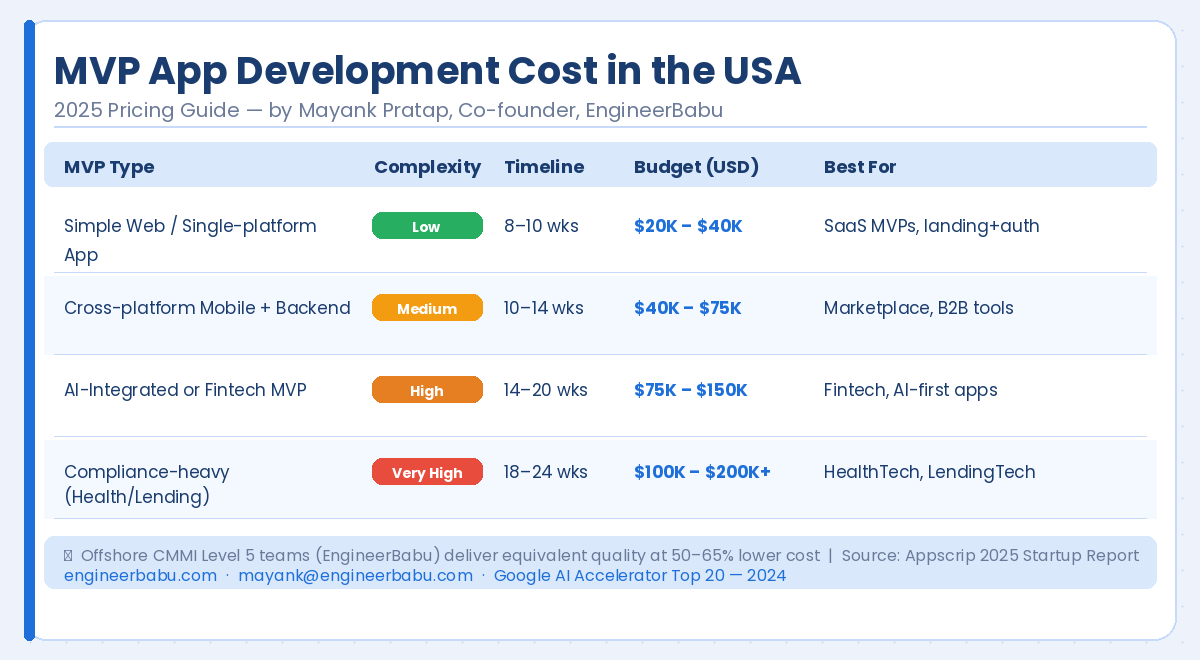
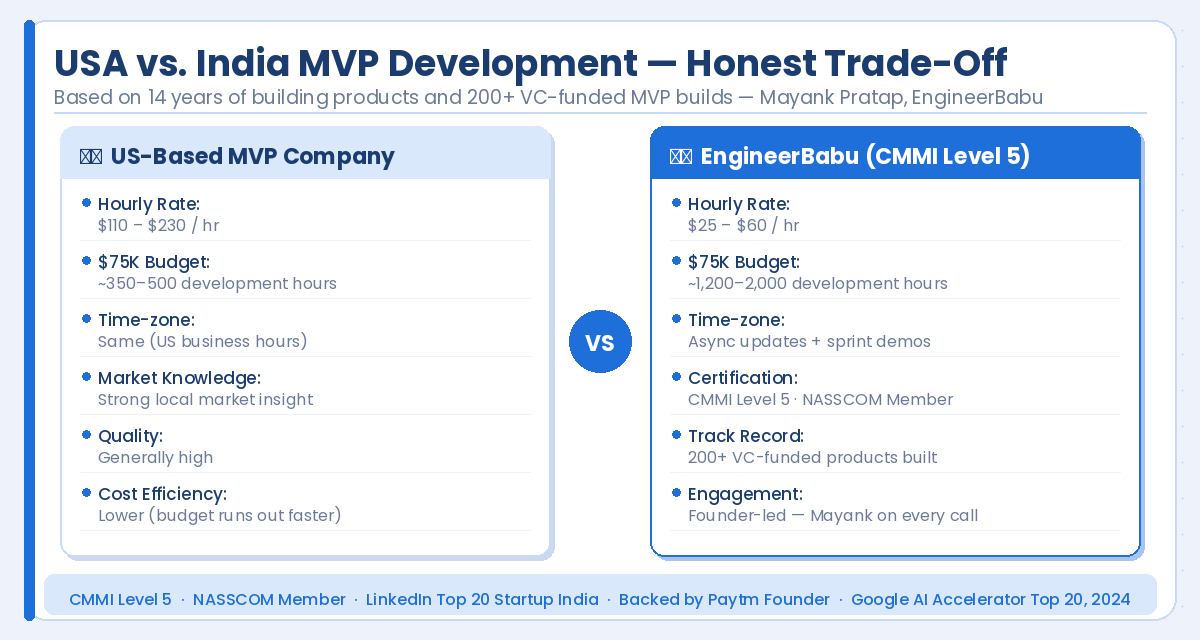
North American development teams typically bill at $110 to $230 per hour. That same quality of work, with a CMMI Level 5 certified team like EngineerBabu operating out of India, runs $25 to $60 per hour — without the communication overhead that makes offshore development frustrating in the first place.
The hidden cost most founders don’t plan for: rebuilds. I’ve seen $45,000 MVPs turn into $150,000 rebuilds within 8 months because the initial architecture didn’t account for multi-tenancy, or the database schema was designed for demo data, not production load. That’s not a development cost. That’s a strategy cost.
I want to be specific here, because this is where general content about MVP development completely loses the plot.
Mistake 1: Building for investors, not users. The demo you show at YC looks polished, has 6 screens, and tells a story. The MVP your users need has 2 screens and solves one problem completely. These are different products. A significant number of founders I’ve worked with conflate the two and end up building neither well.
Mistake 2: Selecting technology based on familiarity, not fit. I’ve seen React Native chosen for internal enterprise tools because “it’s what we know.” I’ve seen PostgreSQL passed over in favor of MongoDB because a CTO liked NoSQL — for a product with deeply relational data. Tech stack decisions made in week one have a compounding cost over 2 years. This is one of the first conversations I have on every architecture review.
Mistake 3: Underestimating API integrations. The average fintech MVP we build at EngineerBabu involves 12 to 17 third-party API integrations — payment gateways, KYC providers, credit bureaus, analytics platforms. Each one has documentation variability, rate limits, sandbox-to-production differences, and its own failure modes. Founders budget 2 weeks for integrations and find out on launch day that one provider’s production API behaves nothing like the sandbox. Plan 3-5 weeks. Buffer for this.
Mistake 4: Skipping CI/CD pipelines. It sounds like infrastructure bloat for an MVP. It isn’t. Without a CI/CD setup from day one, every hotfix becomes a deployment event. Every iteration slows down. By week 6, teams are spending 30% of their sprint managing releases instead of shipping features. Set up the DevOps pipeline in week one.
Mistake 5: No error monitoring before launch. Sentry, Datadog, or even basic CloudWatch setup before the first user arrives. Every MVP I’ve reviewed that launched without monitoring spent the first two weeks in reactive mode, debugging with no context, losing early users before they could understand why.
This is the framework the EngineerBabu team applies across every MVP engagement, refined over 500+ projects.
Step 1: Hypothesis Definition (Week 1) Before any design or code, define the one hypothesis the MVP needs to validate. Not “will people use the app.” Specifically: “will working professionals in Tier 1 US cities pay $29/month for a tool that automates expense categorization?” One hypothesis. One MVP.
Step 2: User Story Mapping (Week 1-2) Map every feature to a user story. If a feature doesn’t connect to the core hypothesis, it doesn’t go into version one. This is where scope trade-offs happen. This is also where most development companies say “yes” when they should say “not yet.”
Step 3: Technology Architecture Decision (Week 2) Stack selection based on: team expertise, scaling requirements, compliance requirements, third-party integration ecosystem. For most SaaS MVPs: React or Next.js frontend, Node.js or Python backend, PostgreSQL, hosted on AWS or GCP. For mobile: Flutter for cross-platform unless the use case demands native performance. For fintech: microservices from day one.
Step 4: UI/UX Prototyping (Week 2-3) Figma prototypes validated with 5-8 real users before a line of code is written. The EngineerBabu team has caught scope-killing UX issues at this stage more times than I can count. One SaaS product discovered in user testing that their primary flow was understood by only 2 of 7 users. That discovery in week 2 cost nothing. Discovering it post-launch would have cost 3 months of iteration.
Step 5: Sprint-Based Development (Week 3-10) 2-week sprints. Each sprint ends with a deployable build. No dark sprints. No “we’ll show you in 6 weeks.” Founders see the product working every 2 weeks.
Step 6: QA and Testing (Throughout + Week 9-10) Automated unit testing from day one. Manual UAT in the final sprint. Load testing for the primary user flow before launch, not after.
Step 7: Beta Launch with Analytics (Week 10-11) Launch to a limited user group with Mixpanel or Amplitude instrumented on every key action. Track: activation rate, core action completion, D1/D7/D30 retention, and NPS. These are the metrics investors will ask for.
Step 8: Feedback Loop and Iteration Plan (Week 11-12) Analyze first 30 days of data. Identify what the product should become in version 1.1. This is the handoff point where the MVP has done its job.
When the EngineerBabu team built EarlySalary’s lending stack — now processing ₹10,000 crore in disbursements — the initial MVP was deliberately constrained to a single credit product for a single salaried segment. No mutual funds. No buy-now-pay-later. One hypothesis. The MVP validated repayment behavior and credit eligibility modeling in 90 days. Everything else was built on the back of that validation.
For Khatabook, what started as a simple digital ledger MVP revealed a massive untapped behavior: small business owners in Tier 2 and Tier 3 Indian cities keeping accounts on paper. The MVP’s job was to validate whether they’d switch to digital. They did, at a rate nobody expected. That behavioral signal is what drove the fintech pivot that followed.
For a US-based SaaS product in the HR tech space — which I can’t name — the first MVP had 4 features. We pushed back on the founder’s original 18-feature scope document. The 4-feature build launched in 11 weeks at $52,000. Three months later, they had 200 paying customers and closed a $1.2M pre-seed round. The full 18-feature product never got built. The market told them what it actually needed.
These are the outcomes that matter. Not the tech stack footnotes.
I get asked this question on almost every initial call from US founders. Let me give you a straight answer.
If you hire a US-based MVP development company:
If you hire an India-based CMMI-certified team (EngineerBabu):
The companies that have gotten the best outcome from working with us are founders who bring a clear product vision, value strategic pushback, and aren’t looking for the cheapest bid. They’re looking for a team that will tell them when they’re wrong.
These are the 7 questions that separate a genuine product partner from a development shop:
If an agency hesitates on questions 1, 2, or 5, that tells you something. The willingness to be specific about past outcomes and current risks is one of the most reliable signals of a mature development partner.
Here’s the pattern recognition from 200+ builds that most content on this topic completely misses.
The MVP isn’t supposed to be the product. It’s supposed to be a learning instrument.
Most founders treat the MVP as a smaller version of the product they want to build. They prioritize features based on what they’d want to show investors or what they personally find interesting to build. That approach produces a product that’s 60% of the full vision but validates 0% of the core hypothesis.
The right way to think about it: what is the cheapest, fastest experiment that tells me whether users will pay for the thing I’m solving? Sometimes that’s an app. Sometimes it’s a landing page with a “Join Waitlist” button. Sometimes it’s a Typeform.
The best MVP I’ve helped architect in the last two years took 6 weeks to build, cost $28,000, and told the founder with certainty that their original B2B hypothesis was wrong but the B2C version of the same product had strong pull. That $28,000 saved them from spending $300,000 on the wrong market.
Speed is a strategy, but speed without direction is expensive.
I see this especially in founders who’ve raised a pre-seed and now have pressure to ship. They optimize for launch date. They skip user research. They skip architecture review. They launch on time and spend the next 6 months rebuilding things that were wrong from the start.
The 8-14 weeks I quoted earlier isn’t arbitrary. It accounts for getting the architecture right in week 2. Getting the UX validated before development in weeks 2-3. Building with testing integrated from week 3. These aren’t nice-to-haves. They’re the reason you don’t spend $150,000 on a rebuild 8 months post-launch.
In 2025, average MVP development costs reach approximately $76,325 for US-based teams, with simple MVPs ranging from $20,000 to $40,000 and complex AI-integrated or compliance-heavy builds ranging from $100,000 to $200,000+. Working with a quality offshore partner like EngineerBabu reduces this cost by 50-65% without sacrificing architecture quality. Source: Appscrip 2025 Startup Development Report.
A well-scoped MVP typically takes 8 to 14 weeks with a dedicated team. Simple single-platform apps can ship in 8-10 weeks. Cross-platform mobile products with backend infrastructure take 10-14 weeks. Fintech or healthtech MVPs with compliance requirements take 14-24 weeks. Any company quoting under 6 weeks for a non-trivial product is cutting corners you’ll pay for later.
A prototype demonstrates the idea. An MVP validates it with real users. A prototype is usually clickable mockups in Figma. An MVP is a deployed, functional product with at least one working user flow that real users can complete and provide behavior data on. Investors who understand product development prefer MVP metrics over prototype demos.
It depends on what you’re optimizing for. US-based teams offer time-zone overlap and local market familiarity at $110-$230/hour. Quality offshore teams (CMMI Level 5 certified) offer the same technical depth at $25-$60/hour, which means 3-4x more development hours for the same budget. The risk with offshore is quality variance — mitigated by certification, founder-led engagement, and verified track records.
For most web or SaaS MVPs: React or Next.js frontend, Node.js or Python backend, PostgreSQL database, deployed on AWS or GCP. For mobile MVPs: Flutter for cross-platform unless the use case demands hardware-specific features. For fintech: microservices architecture from day one, not a monolith you’ll have to break apart at scale. The right answer always depends on your use case — any company that gives you a stack without understanding your product first isn’t doing their job.
Look for: verified client outcomes post-launch (not just “we launched X”), architecture expertise demonstrated in conversation, willingness to push back on scope, founder or senior technical lead involvement in your engagement, and certifications that indicate process maturity (CMMI Level 5, ISO, NASSCOM membership). Ask for 3 client references from the last 18 months and actually call them.
Fintech (lending platforms, neobanks, payment products), SaaS (B2B workflow tools, analytics platforms), consumer mobile (marketplace, social commerce), and AI-integrated products. Industries where we’ve shipped the most: fintech (EarlySalary, LoanOS, OpenMoney), B2B SaaS, and consumer apps. We’ve delivered across 20+ countries, and 200+ of those projects are VC-funded products.