Generative AI Development Company USA


Create engaging, high-performance mobile applications tailored to your business needs. We craft future-ready apps that offer smooth user experiences on all devices.
Build robust and scalable websites and CMS platforms that help you manage content effortlessly. Our development ensures a seamless digital presence.
Launch secure, feature-rich online stores with intuitive shopping experiences. We build tailored eCommerce platforms designed for growth.
Design captivating games with immersive gameplay and stunning graphics. From concept to launch, we build engaging experiences that players love.
Enhance your customer relationships with customized Salesforce implementations. Drive growth and efficiency with smarter CRM solutions.
Harness artificial intelligence and machine learning to automate workflows and gain actionable insights. Our AI transforms data into smart decisions.
Accelerate your software delivery lifecycle with continuous integration, delivery, and infrastructure automation to boost efficiency.
Hire app developers ready to turn your ideas into sleek, high-performing mobile apps for any platform.
Bring in frontend pros who craft smooth, beautiful, and user-friendly interfaces that your visitors will love.
Get backend developers who build fast, secure, and reliable systems to keep everything running behind the scenes.
Hire eCommerce developers who build secure, scalable online stores designed to offer seamless shopping and grow your sales.
Get dedicated developers committed to your projects, delivering consistent quality and speed as an extension of your team.
I recently asked three founders I know one in Austin, one in New York, one in San Francisco what their biggest regret was after their first generative AI project.
All three gave some version of the same answer: they picked a vendor based on a demo.
Not production track record. Not how the team actually handles hallucination in a financial context, or what happens when your RAG pipeline returns irrelevant chunks to 10,000 concurrent users.
A demo.
Every generative AI development company in the USA will show you something impressive in a sandbox.
That’s table stakes in 2025. What separates the vendors who deliver from the ones who disappear six months post-launch is something most evaluation checklists never capture.
I’ve spent 14 years building technology products. EngineerBabu, the company I co-founded, has delivered 500+ projects across 20+ countries, built 200+ VC-funded products, and was recognized as a Top 20 company globally in Google’s AI Accelerator program in 2024.
I’ve seen this pattern play out enough times to have a pattern recognition for where generative AI projects fall apart and it’s almost never where the founders expected.
This is what I’d want someone to have read before they signed their first contract.
A generative AI development company is a specialized technology partner that designs, builds, and deploys production-grade AI systems, including large language model (LLM) integrations, retrieval-augmented generation (RAG) pipelines, agentic systems, AI copilots, and custom model fine-tuning workflows, for businesses that want AI embedded into real products and operations.
That last part matters. “Embedded into real products and operations” is the delta between a prototype and a system that generates business value at scale.
What most generative AI companies in the USA actually deliver falls into four categories:
Building domain-specific AI assistants, copilots, document processing systems, and intelligent automation on top of foundation models like GPT-4o, Claude, Gemini, or open-source models like LLaMA and Mistral.
The bread-and-butter of enterprise GenAI in 2025. Building the vector databases, ETL pipelines, embedding workflows, and semantic retrieval layers that let LLMs work with your proprietary data without hallucinating.
Taking pre-trained models and adapting them on domain-specific datasets. Relevant when you need consistently high accuracy on narrow tasks, latency requirements that hosted APIs can’t meet, or data privacy constraints that make cloud inference impossible.
Autonomous systems that can plan, reason, and execute multi-step workflows using tool calls, API integrations, and dynamic decision logic.
Treating your production system like a proof of concept, selling you model training when RAG would work fine at 60% of the cost, or handing you a codebase with zero MLOps infrastructure.
This isn’t a geography lecture. It’s a practical point.
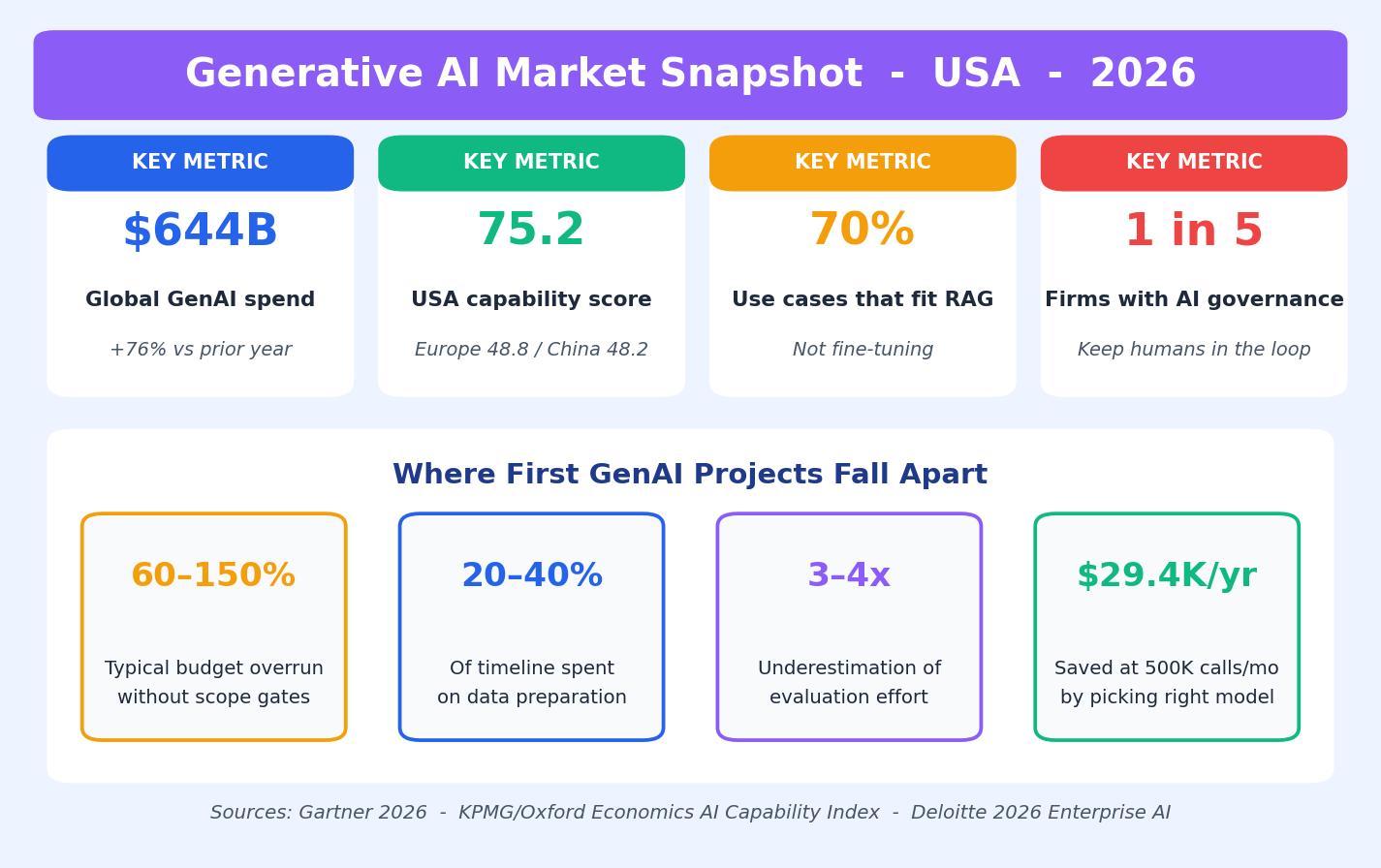
The USA leads the global AI development market in a way that directly affects vendor selection. A KPMG/Oxford Economics study scores the USA at 75.2 out of 100 on the Strategic AI Capability Index, versus 48.8 for Europe and 48.2 for China.
The gap is driven by access to capital, density of AI-native engineering talent, and proximity to the frontier model providers.
OpenAI, Anthropic, Google DeepMind, and Meta AI are all US-based, which means USA-based development teams often have earlier access to APIs, better technical support relationships, and more developed ecosystems around those models.
According to Gartner, worldwide generative AI spending reached $644 billion in 2025, a 76.4% jump from the prior year.
But here’s the tension: the same market explosion that drove that number also flooded the vendor landscape.
Every software consultancy with two Python developers and a ChatGPT API key now calls itself a generative AI company. Evaluating vendors in the USA in 2025 is harder than it’s ever been, not easier.
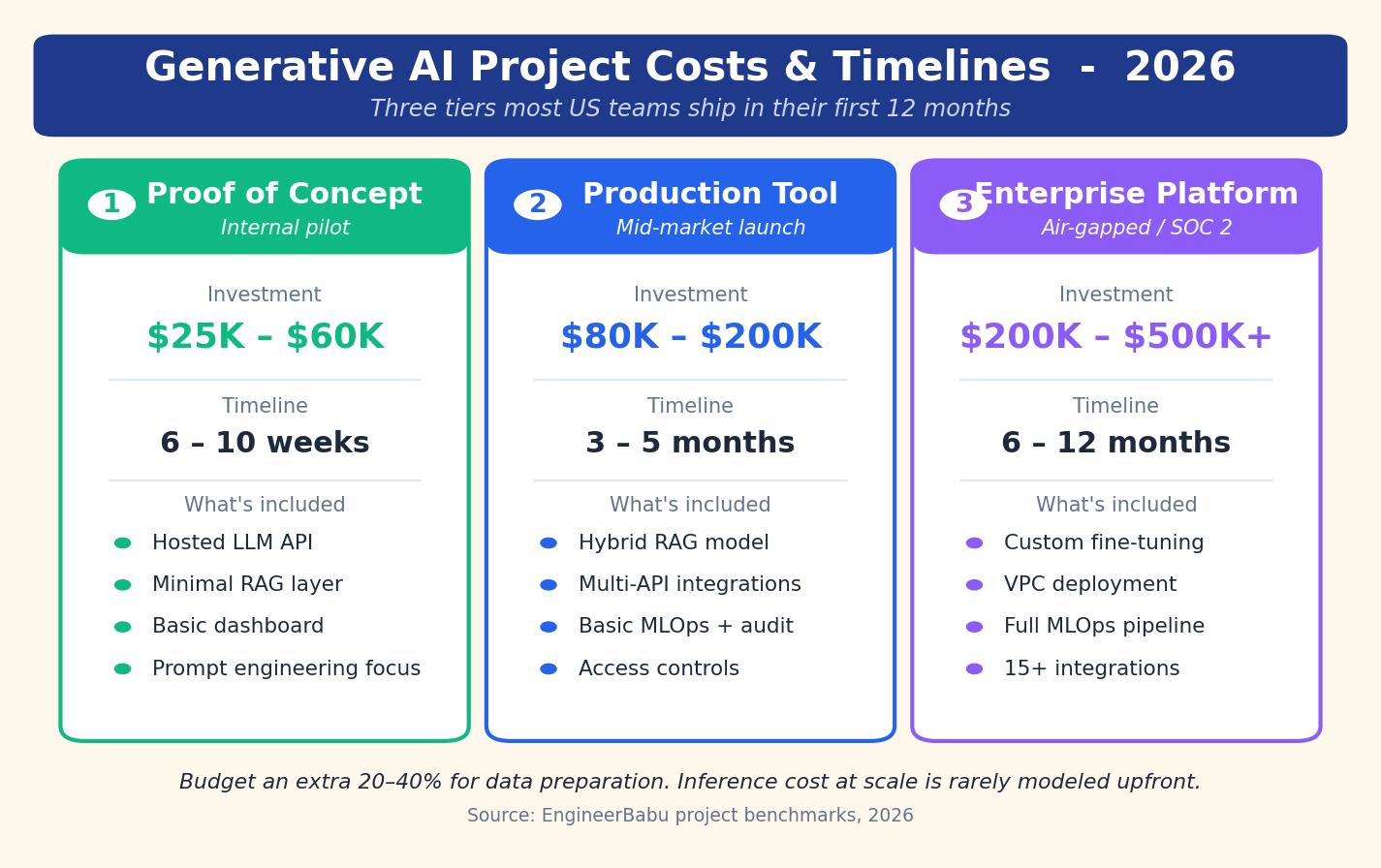
Most content on this topic gives you ranges so wide they’re useless. “Anywhere from $20,000 to $500,000” tells you nothing.Here’s how I’d break it down based on what the EngineerBabu team actually builds:
Hosted LLM API (GPT-4o, Claude, Gemini) + minimal RAG layer + basic dashboard. Timeline: 6 to 10 weeks. Cost: $25,000 to $60,000.
The majority of spend goes into data preparation and prompt engineering, not the model itself. If a vendor quotes you less than $25,000 for a real PoC with your proprietary data, they’re cutting corners on data engineering.
Fine-tuned or hybrid model, RAG architecture, multi-API integrations, basic MLOps, access controls, audit logging.
Timeline: 3 to 5 months. Cost: $80,000 to $200,000. This is where most mid-market companies land.
Custom model fine-tuning, air-gapped or VPC deployment, SOC 2 / HIPAA compliance, multi-tenant architecture, full MLOps pipeline, 15 or more system integrations.
Timeline: 6 to 12 months. Cost: $200,000 to $500,000+.
Three hidden costs that never make it into the initial quote:
First, inference costs at scale. At 500,000 API calls per month, the difference between a $0.005/call model and a $0.0001/call model is $29,400 per year on a single feature. Nobody models this upfront.
Second, data preparation. Expect data cleaning, labeling, and ETL work to consume 20 to 40% of the total project timeline. Teams that skip this get AI systems that hallucinate on their own internal documents.
Third, model drift. LLM performance degrades as your data and use cases evolve. Budget $15,000 to $40,000 per year for retraining cycles, or build it into the contract.
Budget overruns of 60 to 150% are common on generative AI projects without hard scope gates, according to multiple vendor analyses.
The fix is not a bigger budget. It’s a more disciplined discovery phase before a single line of code is written.
I’ve reviewed the AI architecture of a lot of projects fintech platforms, healthcare tools, enterprise SaaS products and the single most common mistake is using the wrong implementation pattern for the use case.
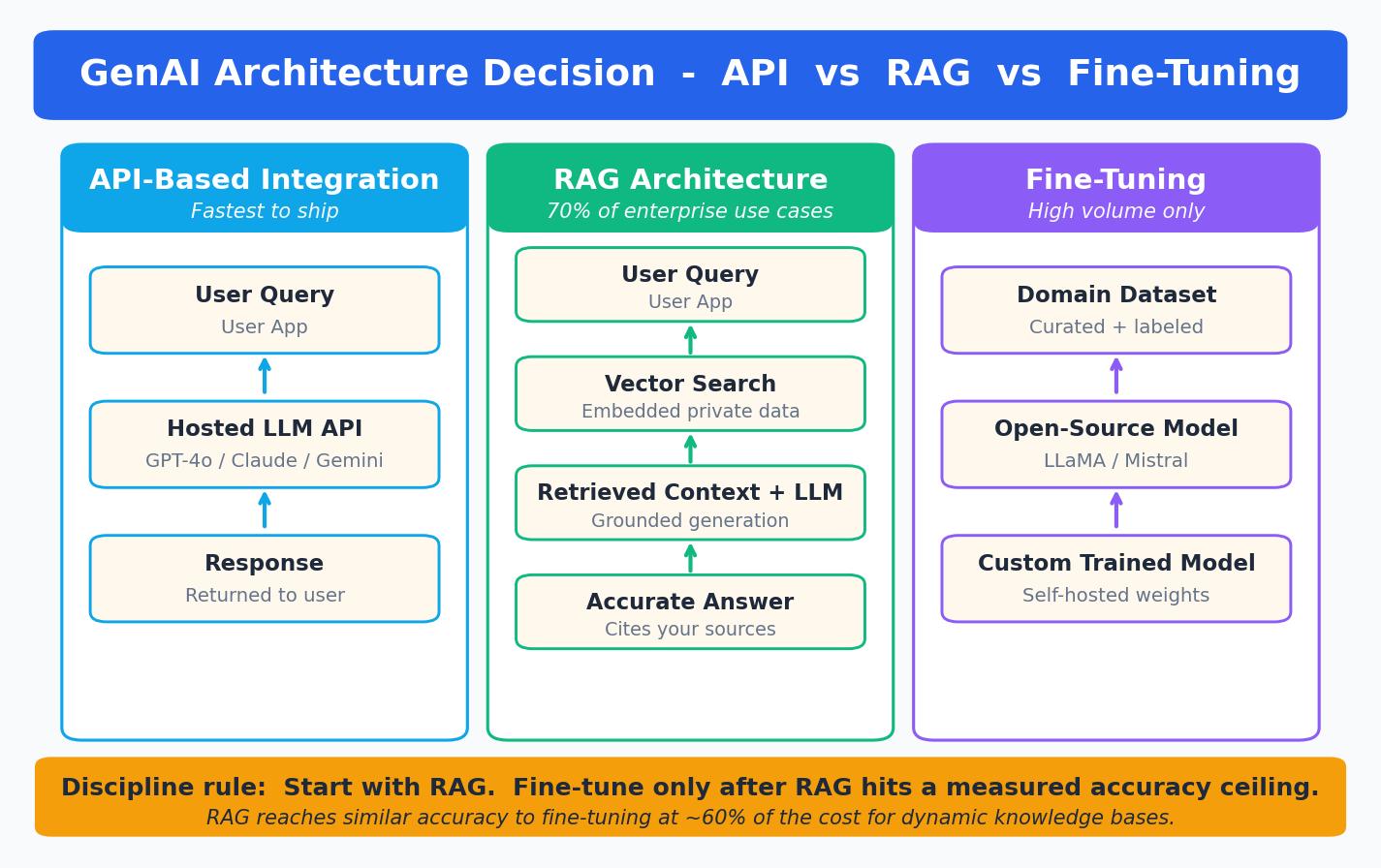
There are three primary patterns, and they’re not interchangeable:
You call OpenAI, Anthropic, or Google’s API. Low upfront cost. Fast to ship. High variable costs at scale. Data leaves your infrastructure on every call.
Right for: MVPs development, internal tools with low query volume, use cases where the model’s general knowledge is sufficient.
Your documents, your data, your knowledge base vectorized, stored, retrieved at query time, injected into the LLM context.
Data stays in your infrastructure. RAG is the default choice for roughly 70% of enterprise use cases, particularly dynamic knowledge bases that require real-time updates.
Right for: customer-facing assistants on proprietary data, compliance-sensitive applications, anything where factual accuracy on internal information is non-negotiable.
You take an open-source model (LLaMA 3, Mistral, Falcon), train it further on your domain-specific dataset, and host it yourself. Complete control over latency, privacy, and IP ownership.
High upfront infrastructure cost. Makes sense at high volume 100,000+ daily queries where the economics of hosted APIs become unfavorable.
The mistake I see regularly: teams default to fine-tuning because it sounds more technically impressive, when RAG would solve the problem at roughly 60% of the cost and get to production three months faster.
The discipline rule is: start with RAG, fine-tune only after RAG hits a measured accuracy ceiling.
When the EngineerBabu team built the AI inventory management and field intelligence system for Simba Beer, the first decision was which pattern to use.
The use case, real-time field intelligence from sales reps, distributor data, and inventory feeds, was clearly a RAG problem, not a fine-tuning problem. The data was dynamic and frequently updated.
Fine-tuning on a static snapshot would have produced worse results and required continuous retraining.
We chose RAG, built the vector pipeline on top of the live data feeds, and shipped a working system in 11 weeks. That architecture decision alone saved the client approximately $60,000 in unnecessary model training infrastructure.
The questions most people ask during vendor evaluation are the wrong questions.
“What models do you work with?” and “Can you show me a demo?” tell you almost nothing about production capability.
Here’s what actually separates vendors who can deliver from vendors who can prototype:
What is the p95 response latency of their RAG systems in production?
What’s the hallucination rate on domain-specific queries? What’s the uptime on their deployed LLM applications?
If a vendor can’t answer these with real numbers, they haven’t shipped production AI.
How do they monitor for model drift? What does their retraining pipeline look like? How do they handle embedding updates when the underlying data changes?
A vendor with no answer to these questions will hand you a system that works at launch and degrades over six months with no one to call.
How do they handle data ingestion from heterogeneous sources PDFs, databases, APIs, internal wikis? What’s their chunking strategy?
Naive chunking (splitting documents at fixed character counts) produces poor retrieval. Semantic chunking with adaptive overlap is table stakes for any serious RAG implementation.
For generative AI in fintech, healthcare, or any regulated industry, you need a partner who has actually dealt with SOC 2, HIPAA, or GDPR at the model layer not just the application layer. These are different problems.
Who actually builds? What’s the ratio of AI/ML engineers to project managers?
In a founder-led company with no account management layer, you get senior engineers on your project. In a large agency, you get whoever’s available.
The evaluation framework I’d use as a shortlist filter:
| Criterion | What to Look For | Red Flag |
| Production track record | Live deployed systems with real traffic | Only demos or PoCs |
| RAG architecture depth | Adaptive chunking, semantic retrieval, vector DB expertise | “We use LangChain” as a complete answer |
| MLOps maturity | Monitoring, retraining, drift detection | No plan post-launch |
| Compliance experience | Specific certifications worked within | Generic “we follow best practices” |
| Team access | Direct access to engineers | Account manager as primary contact |
| Cost transparency | Token-level cost modeling upfront | Vague estimates without discovery |
After reviewing the architecture of enough failed AI projects, the patterns are consistent.
The LLM is not the product. The data pipeline, the retrieval architecture, the evaluation framework, the monitoring setup, and the integration layer — that’s the product.
I’ve seen a $400,000 enterprise AI initiative fail because the team spent 70% of the budget on model fine-tuning and nothing on the data infrastructure that was supposed to feed it.
The fine-tuned model worked perfectly. It just had no reliable data.
Most CTOs I talk to underestimate how much time proper evaluation takes — by a factor of 3 to 4. Evaluation in generative AI means building test suites that catch hallucinations, measure retrieval precision, detect regressions when the model is updated, and validate output format consistency.
Without it, you ship something that looks fine and find out three months later it’s confidently wrong 15% of the time in a high-value customer scenario.
LLMs are brains in a jar. They cannot naturally connect to your CRM, ERP, internal wiki, or compliance systems. Each integration requires a middleware layer handling authentication, API rate limiting, error handling, data transformation, and output validation.
Each integration adds $3,000 to $10,000 to project scope and 1 to 3 weeks to the timeline.
A project with 12 integrations and a budget that assumed 4 is already 6 months behind before the first sprint ends.
A 5,000-person offshore agency has overhead, layers of project management, and senior engineers who disappear after the sales call.
A focused team of 8 to 15 senior AI engineers who have shipped 20+ production LLM systems will outperform a large vendor on almost every quality metric that matters.
OpenAI deprecated GPT-4 32k. Anthropic released Claude 3.5 Sonnet with different token pricing and context windows. Every hosted model will change.
Every vendor contract needs clear terms around what happens when the underlying model gets deprecated, updated, or repriced.
I’ve seen production systems break on a model update with zero plan for remediation.
contract review, medical records extraction, financial document analysis. RAG-based, high accuracy on structured documents, strong ROI from labor displacement. Real numbers: 90%+ accuracy is achievable; teams that skip evaluation frameworks get 65 to 75% and wonder why.
enterprise chatbots trained on internal documentation, HR policies, product knowledge bases, and compliance guidelines.
The use case is straightforward; the implementation challenge is data hygiene. Most companies have terrible internal documentation. The AI surfaces exactly that problem.
sales intelligence, code review, customer support triaging, clinical documentation. The highest-ROI category because the AI is augmenting an expensive human workflow, not replacing a simple one.
this one surprised us. When the EngineerBabu team built the Simba Beer AI system, the use case was giving field sales reps real-time intelligence on distributor inventory, route optimization, and sales pattern anomalies. 17 data sources, real-time feeds, multi-region deployment.
The outcome: a 34% reduction in stockouts in the first quarter.
fully autonomous AI agents for high-stakes decisions. Not because the technology can’t do it — it’s improving fast — but because most organizations don’t have the governance frameworks or human oversight processes to catch when these systems go wrong.
Only 1 in 5 companies has a mature model for governance of autonomous AI agents, according to Deloitte’s 2025 State of Enterprise AI report.
Ship human-in-the-loop before you ship autonomous. Get the outputs right before you remove the human reviewer.
Fastest time to value. Zero engineering overhead. No customization. Data goes to a third-party vendor. Right for standard use cases where Notion AI, Salesforce Einstein, or GitHub Copilot solves the problem. Wrong for proprietary data, compliance-sensitive industries, or differentiated product experiences.
Full control. IP ownership. Highest cost and timeline. In the USA, the average compensation for a senior ML engineer hit $206,000 in 2025, excluding equity. A production AI team — ML engineer, data engineer, MLOps engineer, AI architect — runs $700,000 to $1,000,000+ annually in fully loaded US compensation. Right for companies with 18+ month AI roadmaps, dedicated AI product lines, or data privacy requirements that preclude outsourcing.
Access to a built-out team without the 6 to 9 month hiring timeline. Faster to production. The right model for most VC-funded products and mid-market enterprises running a first or second AI initiative.
The hybrid approach is often the smartest: partner to build the first production system, document the architecture thoroughly, then hire selectively to own the maintenance layer. You get speed to market and you build internal capability simultaneously.
A production-ready generative AI application typically costs $80,000 to $200,000 for a mid-complexity deployment, covering the RAG pipeline, integrations, MLOps, and compliance setup.
Simple PoCs with hosted APIs run $25,000 to $60,000. Enterprise platforms with fine-tuned models and air-gapped infrastructure run $200,000 to $500,000+.
Budget an additional 20 to 30% for data preparation, which vendors routinely underquote.
A working PoC takes 6 to 10 weeks. A production-ready internal tool with integrations takes 3 to 5 months.
An enterprise AI platform with compliance, multi-tenancy, and custom model training takes 6 to 12 months.
Projects that claim production readiness in under 8 weeks for complex use cases are usually shipping PoC-grade code into a production environment.
Retrieval-Augmented Generation (RAG) is an architecture pattern where an LLM retrieves relevant information from a vector database of your proprietary content before generating a response.
It dramatically reduces hallucination on domain-specific queries and keeps your data in your infrastructure.
RAG is the right approach for roughly 70% of enterprise use cases and delivers similar accuracy to fine-tuning at 60% of the cost for most dynamic knowledge base scenarios.
Ask for p95 response latency, uptime SLAs, hallucination rates on domain-specific test suites, and production traffic volumes from deployed systems.
Ask about their MLOps infrastructure monitoring, drift detection, retraining pipelines.
Ask who specifically will work on your project. If the answers are vague, the production experience is thin.
Generative AI development services like financial services (lending decisioning, fraud detection, document processing), healthcare (clinical documentation, prior authorizations, patient engagement), logistics and supply chain (field intelligence, demand forecasting, route optimization), and enterprise SaaS (copilots, intelligent search, automation of knowledge worker tasks).
The unifying factor is document-heavy workflows where AI can process information faster and more consistently than humans.
—————————————————————————————————————————
One Thing Before You Sign a Contract
The decision you make on your first generative AI project shapes your AI roadmap for the next two to three years. A bad first deployment creates internal skepticism that takes longer to overcome than the project itself took to build.
If you’re evaluating a generative AI development company in the USA and want to talk through the architecture decisions before you commit to a vendor — RAG vs. fine-tuning, build vs. partner, what a realistic scope and timeline looks like for your specific use case — I’m usually the one on those calls.
———————————————————————————————————————-
*Mayank Pratap is the Co-founder of EngineerBabu, a CMMI Level 5 product engineering company recognized in the Google AI Accelerator Top 20 globally (2024), LinkedIn Top 20 Startups India, and backed by Vijay Shekhar Sharma (Paytm founder). EngineerBabu has delivered 500+ products across 20+ countries, including 75 YC-selected product builds and 4 unicorn clients. Mayank leads every engagement personally — no sales team, no account managers.*