Custom Mobile App Development vs Off-the-Shelf Apps: Which One Actually Pays Off


Create engaging, high-performance mobile applications tailored to your business needs. We craft future-ready apps that offer smooth user experiences on all devices.
Build robust and scalable websites and CMS platforms that help you manage content effortlessly. Our development ensures a seamless digital presence.
Launch secure, feature-rich online stores with intuitive shopping experiences. We build tailored eCommerce platforms designed for growth.
Design captivating games with immersive gameplay and stunning graphics. From concept to launch, we build engaging experiences that players love.
Enhance your customer relationships with customized Salesforce implementations. Drive growth and efficiency with smarter CRM solutions.
Harness artificial intelligence and machine learning to automate workflows and gain actionable insights. Our AI transforms data into smart decisions.
Accelerate your software delivery lifecycle with continuous integration, delivery, and infrastructure automation to boost efficiency.
A logistics startup in Bangalore once ran its entire fleet operation on a $79-a-month off-the-shelf app. Within a year, the team was reconciling data across four different tools by hand.
They were chasing bugs the vendor wouldn’t fix, and losing drivers because the app kept lagging during peak hours.
That tension shows up in almost every growing business eventually. The choice between mobile app development vs off the shelf apps isn’t really about which option is “better” in the abstract.
It’s about which one matches your workflow, your growth curve, and how much control you actually need over your own product.
This blog breaks down both paths honestly, with real tradeoffs instead of a pitch for either side.
Off-the-shelf apps are pre-built and ready to configure. Think Shopify for e-commerce, Calendly for scheduling, or a white-label delivery app you can rebrand in a week.
You skip discovery, wireframes, and long QA cycles entirely. Setup usually takes days, not months. Support comes bundled in, and updates roll out automatically without your team lifting a finger.
The tradeoff shows up later. You’re renting someone else’s roadmap. Features you need might sit in a “coming soon” backlog for years, while features you’ll never touch keep adding to your monthly bill.
Custom mobile app development means building the product around your workflow. Instead of bending your process to fit someone else’s software, every screen and piece of logic gets built for your specific users.
This is where a dedicated mobile app development partner earns its cost. They handle architecture, native performance, and scalability from day one, instead of layering fixes onto a generic template.
That preference for control isn’t rare. In a GoodFirms survey of roughly 640 businesses, 61.9% of respondents ranked customization as the single biggest factor when choosing app development software. That beat out price, brand recognition, and every other factor on the list (GoodFirms).
The upfront cost and timeline both run higher with custom builds. A typical project takes 10 to 20 weeks depending on complexity, compared to days for off-the-shelf setup. But you own the codebase, the data, and every decision about where the product goes next.
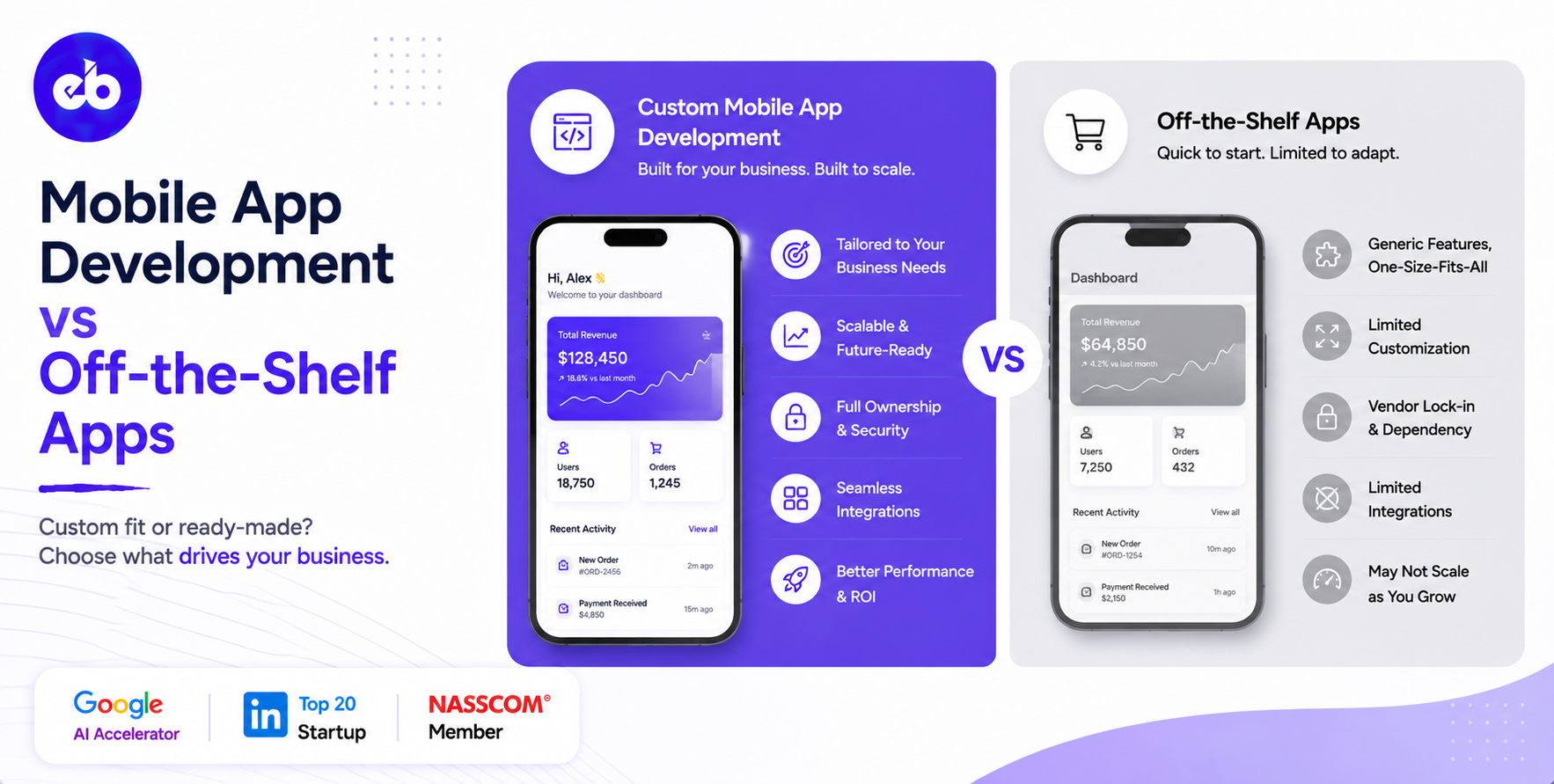
Here’s how the two options compare once you get past the marketing copy.
| Factor | Off-the-Shelf Apps | Custom Mobile App Development |
| Upfront cost | Low, often $0 to $500/month | High, $15,000 to $150,000+ |
| Time to launch | Days to weeks | 10 to 20+ weeks |
| Ownership | Vendor owns the code | You own the code and data |
| Scalability | Capped by the vendor’s roadmap | Built for your specific growth path |
| Customization | Limited to settings and plugins | Unlimited, built to spec |
Off-the-shelf pricing looks attractive because it’s small and recurring. But add-ons, per-seat fees, and third-party plugins stack up fast once your team grows past the basic tier.
Custom development front-loads the cost instead. You pay more early, especially if your app needs solid API development for payments or third-party data. In exchange, you stop paying monthly for features you never use.
If speed to market is the only variable that matters right now, off-the-shelf wins without much debate. You can be live within a week.
Custom builds take longer because there’s real engineering behind every screen. Architecture planning, integrations, security testing, and QA across devices all take time. That time buys you a product built around your business, not one you have to work around.
Off-the-shelf platforms cap what you can do once your user base or transaction volume outgrows their standard tier. You’ll hit walls around custom reporting, complex permissions, or high-volume data processing.
Custom apps get built with your five-year plan in mind, not just your launch date. Database architecture and server infrastructure both get shaped around where you’re headed, not where you are today.
Off-the-shelf software is a bigger target simply because so many businesses run the same code. One vulnerability can expose thousands of companies at once, not just you.
Custom apps aren’t automatically more secure. But they let you build compliance directly into the architecture, which matters enormously for regulated industries handling financial or medical data.
Off-the-shelf makes sense when your needs are genuinely standard. A small clinic booking appointments or a team scheduling shifts doesn’t need custom software to solve a problem thousands of other businesses already solved.
It also makes sense when you’re still validating an idea. Founders testing early demand often start with off-the-shelf tools or a lean MVP development approach before committing real budget to a full build. There’s no point over-engineering a product before you know people want it.
Budget matters here too. If your runway is tight and your needs are simple, off-the-shelf buys you time. You save capital instead of burning it on something you might pivot away from in six months.
Custom development earns its cost when your business runs on a process nobody else has. It also earns its cost when the app itself is the product, not a support tool around it.
It’s also the right call once AI becomes part of your roadmap. A chatbot that handles support tickets end to end is a job for AI development. A recommendation engine trained on your own transaction history is a job for ML development. Off-the-shelf platforms rarely let you plug in models built around your own data.
Scale is the other trigger. If you’re processing thousands of transactions daily or managing sensitive user data, a generic app was never going to hold up long term anyway.
Some industries make this decision for you before you even start comparing vendors.
A lending startup handling credit checks and repayment schedules needs real compliance depth. That’s usually a job for a dedicated fintech app development company, since generic platforms rarely handle regulatory reporting well.
Education platforms hit a similar wall. Course sequencing, progress tracking, and cohort-based learning paths tend to outgrow generic LMS templates fast. That’s why many founders end up comparing edtech app development companies once their product needs real customization instead of a plugin.
Healthcare and logistics follow the same pattern. The moment compliance, data sensitivity, or operational complexity enters the picture, off-the-shelf options start running out of room.
List the five things your app absolutely must do well, then check if any off-the-shelf platform handles all five without workarounds. Be honest here. If you’re already imagining three plugins and an automation tool just to make it work, pay attention. That’s a sign the fit isn’t as clean as it looks on the sales page.
Most founders underestimate how much manual patchwork off-the-shelf tools eventually require once real usage kicks in. Write the list down before a slick demo pulls you in, because demos are built to hide exactly the gaps you’re trying to find.
A cheap monthly plan can quietly cost more than a custom build once per-seat pricing, plugin fees, and workaround hours get added in. Run the math over three years instead of month one. Include integration costs, support tickets, and the time lost to features that almost fit but not quite.
Custom development looks expensive upfront because the bill arrives early instead of trickling in monthly. Total cost of ownership often tells a very different story once you actually sit down and add it up properly.
If you’re handling payment data, health records, or personal information, check what compliance standards apply to your industry before choosing either path. Off-the-shelf vendors may claim compliance, but you’re still liable if their infrastructure gets breached.
Ask vendors directly for certifications, audit history, and data handling documentation in writing. If those answers feel vague or slow to arrive, treat that as useful information about how seriously they take security. It tells you more than any feature list on their pricing page ever will.
Think honestly about where your business will be in two years, not just where it stands today. If you expect steady, predictable growth within a narrow use case, off-the-shelf can serve you well past launch.
If you expect new markets, new user types, or new revenue lines, a custom foundation saves you from rebuilding everything later. The businesses that regret their choice most usually picked based on where they stood at launch. They didn’t plan for where they were realistically headed a year or two down the road.
There’s no universal right answer in the mobile app development vs off the shelf apps debate. The right choice depends on your budget, your timeline, your compliance exposure, and how unique your workflow really is.
What matters is making the call deliberately, not defaulting to whichever option feels easier this quarter. Off-the-shelf buys speed. Custom buys control. Pick based on what your business will actually need a year from now, not just what’s easiest to set up this week.
If you’re evaluating partners for a custom build, it helps to compare a few teams side by side before committing budget. This breakdown of mobile app development companies in the USA lays out strengths and fit for different project types.
Upfront, yes. Custom builds typically start around $15,000 and scale with complexity. Off-the-shelf plans can start under $100 a month. Over three to five years, though, off-the-shelf costs often catch up once licensing, plugins, and workarounds get factored in.
Yes, and many businesses do exactly this once they outgrow their initial platform. The switch takes planning around data migration and user downtime, but it’s a common and often necessary step as a product scales.
Most custom builds take 10 to 20 weeks from discovery to launch, depending on feature complexity and backend requirements. Simple MVPs move faster, while apps with heavy integrations or AI features take longer.
Not automatically, but they are bigger targets since the same codebase runs across thousands of businesses. Custom apps aren’t immune to risk either, but they let you build security controls around your specific data and compliance needs.
Choosing based on launch-day cost alone is the most common trap. Weigh mobile app development vs off the shelf apps costs over three to five years, not just the first invoice you get.