How GLP-1 Digital Health Platforms Work in the USA And What It Takes to Build One in 2026


Create engaging, high-performance mobile applications tailored to your business needs. We craft future-ready apps that offer smooth user experiences on all devices.
Build robust and scalable websites and CMS platforms that help you manage content effortlessly. Our development ensures a seamless digital presence.
Launch secure, feature-rich online stores with intuitive shopping experiences. We build tailored eCommerce platforms designed for growth.
Design captivating games with immersive gameplay and stunning graphics. From concept to launch, we build engaging experiences that players love.
Enhance your customer relationships with customized Salesforce implementations. Drive growth and efficiency with smarter CRM solutions.
Harness artificial intelligence and machine learning to automate workflows and gain actionable insights. Our AI transforms data into smart decisions.
Accelerate your software delivery lifecycle with continuous integration, delivery, and infrastructure automation to boost efficiency.
Hire app developers ready to turn your ideas into sleek, high-performing mobile apps for any platform.
Bring in frontend pros who craft smooth, beautiful, and user-friendly interfaces that your visitors will love.
Get backend developers who build fast, secure, and reliable systems to keep everything running behind the scenes.
Hire eCommerce developers who build secure, scalable online stores designed to offer seamless shopping and grow your sales.
Get dedicated developers committed to your projects, delivering consistent quality and speed as an extension of your team.
42.5% of American adults currently have obesity. By 2035, that number is projected to reach 46.9%.
Semaglutide produces ~15% mean weight loss in 68 weeks. Tirzepatide produces ~20%. These are numbers the pharmaceutical industry hadn’t seen in obesity treatment in decades.
The collision of those two realities created one of the fastest-growing digital health categories of the last five years: GLP-1 telehealth platforms. Hims & Hers, Ro, LifeMD, Noom, Calibrate, Found, WeightWatchers Clinic, all built technology infrastructure to connect patients to GLP-1 prescriptions at scale.
The total addressable market is 107 million Americans with obesity, most of whom have never received pharmacological treatment.
The regulatory environment in 2026, however, has shifted significantly from the compounding era that powered most of these platforms’ growth. Understanding what a GLP-1 digital health platform actually is technically, legally, and clinically, is essential before building one.
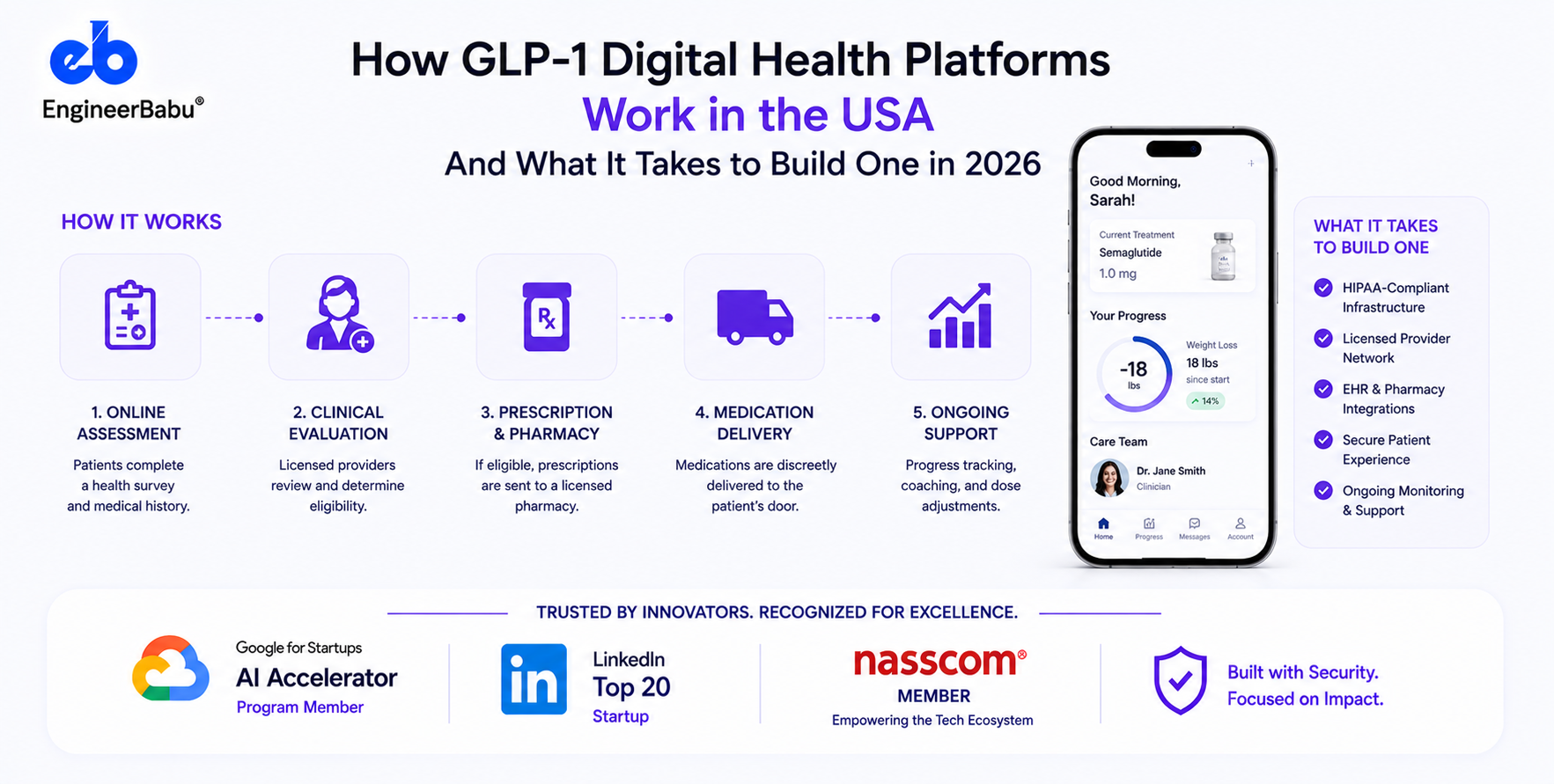
A GLP-1 digital health platform is a technology infrastructure that connects patients seeking prescription weight management medications, primarily semaglutide (Wegovy, Ozempic) and tirzepatide (Zepbound, Mounjaro) with licensed healthcare providers for clinical evaluation, prescription, and ongoing care management.
The platform itself does not practice medicine; it enables the three-entity structure that characterizes compliant telehealth: technology platform, independent licensed clinicians, and licensed pharmacy partners.
In 2026, successful platforms are moving beyond prescription access to differentiate on outcomes, adherence support, and long-term chronic disease management infrastructure.
Understanding this structure is foundational, both for compliance and for product design. Every compliant GLP-1 telehealth platform in the USA operates this way:
The platform itself: patient onboarding, intake forms, clinical communication tools, prescription routing, medication fulfillment coordination, billing, patient engagement features. The technology company is not a healthcare provider. It does not employ clinicians (in most structures). It builds and operates the infrastructure through which care is delivered.
The prescribing physicians, nurse practitioners, and physician assistants are organized as independent medical practices or affiliated medical groups that use the platform’s technology. This separation is legally significant, it preserves the independence of clinical judgment from business incentives.
The clinician reviews the patient intake, evaluates eligibility, and makes independent prescribing decisions. A patient completing an intake form is not guaranteed a prescription.
Fulfillment of GLP-1 prescriptions requires a licensed pharmacy. For branded FDA-approved medications (Wegovy, Zepbound), platforms partner with specialty pharmacies or manufacturers directly. For compounded semaglutide or tirzepatide (during shortage periods), platforms partner with licensed compounding pharmacies.
The regulatory line: The technology platform cannot cross into clinical decision-making. Intake questionnaires inform the clinician but do not determine the prescription. Algorithmic eligibility screening can facilitate the workflow but cannot substitute for licensed clinician review. This line has regulatory and legal enforcement behind it.
Every GLP-1 platform that scaled on compounded semaglutide is now navigating a forced transition.
The FDA declared the semaglutide shortage resolved on February 21, 2025. When a shortage is resolved, the legal basis for compounding pharmacies to produce copies of brand-name drugs evaporates.
In February 2026, FDA Commissioner Marty Makary announced the agency’s intent to crack down on non-FDA-approved GLP-1 compounding. Novo Nordisk filed a legal challenge against Hims & Hers, characterizing mass compounding of semaglutide as illegal given the shortage resolution.
This regulatory shift has three practical effects on GLP-1 platforms:
Platforms that built their unit economics around compounded semaglutide at $199–$349/month are losing their cost advantage as FDA enforcement increases. FDA-approved Wegovy costs $1,000–$1,350/month at full price without insurance.
The Trump administration announced negotiated pricing agreements with Novo Nordisk and Eli Lilly, Ozempic, Wegovy, Mounjaro, and Zepbound will be priced at $245/month through the TrumpRx platform. Medicare beneficiaries will pay just $50/month in copay starting July 2026. This dramatically increases the accessible patient population for branded medications and makes the compounding price advantage less significant.
When semaglutide is $245/month and prescribable through any platform, the access arbitrage that powered the first generation of GLP-1 platforms disappears. The platforms that survive are the ones that built longitudinal care infrastructure, adherence support, behavioral change programming, comorbidity management, outcome tracking rather than just prescription access.
This is the technical specification that most product discussions skip. Here is the complete module breakdown:
The clinical onboarding flow: demographic information, weight/BMI capture, medical history (current medications, contraindications, prior weight loss attempts), comorbidity screening (T2DM, hypertension, cardiovascular disease, GLP-1s have additional indications beyond obesity for these conditions), and written informed consent.
Technical requirements: HIPAA-compliant form infrastructure (HIPAA BAA required with form tool), clinical questionnaire logic with branching based on responses, PHI stored in encrypted database, consent management with audit trail. This is not a standard web form, it is a regulated clinical intake that feeds a licensed clinician’s review.
The contraindication screening layer: GLP-1 receptor agonists are contraindicated for patients with personal or family history of medullary thyroid carcinoma, Multiple Endocrine Neoplasia syndrome type 2, and active pancreatitis. The intake must screen for these. Failure to screen creates clinical and legal liability.
After intake submission, the case routes to a licensed clinician’s queue. The clinician reviews the intake, evaluates eligibility against clinical guidelines (typically BMI ≥30, or ≥27 with weight-related comorbidities), may conduct a synchronous or asynchronous video/chat consultation, makes the prescribing decision, and transmits the prescription electronically.
Technical requirements: Provider dashboard with patient queue management, asynchronous messaging with HIPAA-compliant secure messaging, telemedicine video (Twilio Video or Daily.co with BAA for synchronous consults), e-prescribing integration (Surescripts for controlled substance-compliant prescription transmission), and clinical notes documentation.
The clinical decision engine question: Some platforms use algorithmic pre-screening to route patients to providers more efficiently. This is appropriate, the algorithm can surface contraindications, flag high-risk patients for synchronous consultation, and pre-populate clinical notes. The algorithm cannot substitute for the clinician’s final determination. This distinction is what separates compliant platforms from those drawing regulatory scrutiny.
The prescription routes to a licensed pharmacy partner. For branded medications, this means specialty pharmacy networks (NovoCare, LillyDirect, CenterWell Specialty Pharmacy) or retail pharmacies via Surescripts. For compounded medications during shortage periods, compounding pharmacy partners.
Technical requirements: E-prescribing API integration (Surescripts or pharmacy-specific APIs), prescription status tracking (transmitted, received, dispensed, shipped), medication shipment tracking integration, refill management with clinical oversight for dose titration, and prior authorization support for insurance-covered prescriptions.
The prior authorization reality for GLP-1s: Most commercial insurance plans require prior authorization for GLP-1 medications. The AI prior authorization framework from Blog 5 applies directly here: platforms that automate PA submission, pulling clinical documentation from the intake, mapping to payer criteria, submitting via FHIR-based PAS or X12 278, dramatically improve patient access rates and reduce dropout at the authorization stage.
This is where first-generation platforms left the most value on the table and where second-generation platforms are differentiating.
GLP-1 medications require dose titration over weeks: semaglutide typically escalates from 0.25mg to 2.4mg over 16–20 weeks. Side effect management (nausea affects 15–20% of patients in the first month) requires clinical touchpoints. Long-term adherence is the core challenge, patients who stop GLP-1 medications typically regain significant weight.
Features that drive outcomes and retention:
The AI layer in 2026: AI-driven coaching that analyzes patient adherence patterns, predicts dropout risk, and triggers personalized outreach before a patient stops engaging is the technology that moves GLP-1 platforms from prescription access tools to chronic disease management platforms.
The platforms with the best long-term outcomes and the best unit economics from patient LTV are the ones investing here.
Self-pay: Most GLP-1 telehealth platforms today operate primarily on self-pay economics, subscription fees covering consultation, monitoring, and sometimes medication. Pricing typically ranges from $99–$299/month for platform fees, plus separate medication costs.
Insurance billing: Wegovy is covered under many commercial plans for patients with BMI ≥30 and at least one weight-related comorbidity. TrumpRx Medicare coverage starts July 2026 at $245/month ($50/month copay for beneficiaries). Building insurance billing capability, claims submission, ERA processing, denial management, significantly expands the addressable market but adds substantial compliance infrastructure.
Technical requirements for insurance billing: EDI 837 claim generation, ERA/EOB parsing, benefit eligibility verification (Availity or Change Healthcare), prior authorization workflow, and denial appeals management.
HIPAA compliance: Full infrastructure including AES-256 encryption, TLS 1.3 in transit, RBAC, 6-year audit logging, BAAs with all vendors, annual penetration testing.
DEA and state pharmacy regulations: E-prescribing of GLP-1 medications is subject to state-by-state telehealth prescribing laws. Some states require an in-person examination before prescribing; most have maintained pandemic-era telehealth flexibilities. The platform must track clinician licensing by state and route patients to appropriately licensed providers.
Ryan Haight Act compliance: For any controlled substances (not GLP-1s specifically, but if the platform expands to other medications), the DEA’s Ryan Haight Act requires an in-person evaluation before prescribing. GLP-1 receptor agonists are not controlled substances, but this is an important architectural constraint as platforms expand their medication portfolios.
| Layer | Component | Notes |
| Patient app | Flutter (iOS + Android) | Biometric logging, coaching, messaging |
| Web platform | Next.js | Patient portal, provider dashboard |
| Backend | Python FastAPI or Node.js NestJS | Clinical workflow orchestration |
| Database | PostgreSQL (AWS RDS, AES-256) | PHI in separate encrypted schema |
| E-prescribing | Surescripts API | Prescription transmission and status |
| Video consults | Twilio Video (HIPAA BAA) | Synchronous clinical consultations |
| Messaging | Twilio (HIPAA BAA) | Async patient-provider communication |
| AI coaching | GPT-4o via Azure OpenAI (HIPAA BAA) | Personalized adherence coaching |
| Lab integration | Labcorp/Quest FHIR APIs | Lab result ingestion |
| Prior auth | Da Vinci PAS / X12 278 | Insurance PA submission |
| Wearables | Apple Health / Google Health Connect | Weight, activity, glucose data |
| Infrastructure | AWS HIPAA-eligible | All HIPAA-eligible services |
A GLP-1 digital health platform has two distinct build scopes:
Prescription access platform (MVP): Intake → clinician review → e-prescribe → pharmacy fulfillment → basic refill management. Cost range: $80,000–$150,000. Timeline: 14–20 weeks. This is the minimum viable platform that can legally operate.
Full chronic disease management platform: All MVP modules plus insurance billing, prior authorization, AI adherence coaching, RPM device integration, behavioral health integration, lab monitoring, population health analytics. Cost range: $300,000–$700,000. Timeline: 18–30 months.
The unit economics that justify the larger build: a GLP-1 patient with good adherence over 24 months generates $2,400–$7,200 in platform revenue. The platforms competing purely on prescription access are racing to the bottom.
The platforms competing on outcomes, demonstrable weight loss, comorbidity improvement, cardiovascular risk reduction are building sustainable businesses and attracting payer contracts.
Author: Mayank Pratap | Co-Founder, EngineerBabu | Google AI Accelerator 2024 · CMMI Level 5
A technology platform connecting patients with licensed clinicians for GLP-1 prescription evaluation and ongoing care management, using a three-entity structure: technology platform, independent clinical providers, and licensed pharmacy partners. The platform does not practice medicine, it enables the infrastructure through which care is delivered.
The FDA resolved the semaglutide shortage on February 21, 2025, eliminating the shortage-based justification for compounding. FDA enforcement against non-FDA-approved compounded GLP-1 medications increased significantly in early 2026. Platforms should consult healthcare regulatory counsel for current compliance status, the regulatory environment is actively evolving.
A compliant prescription access MVP costs $80,000–$150,000. A full chronic disease management platform with insurance billing, AI coaching, and RPM integration costs $300,000–$700,000. Annual maintenance runs 15–20% of build cost.
Primarily semaglutide (Wegovy for obesity, Ozempic for T2DM) and tirzepatide (Zepbound for obesity, Mounjaro for T2DM). Some platforms also offer other weight management medications (phentermine, bupropion/naltrexone) and are expanding to adjacent GLP-1 indications including cardiovascular risk reduction.
TrumpRx is a federal program negotiating manufacturer pricing agreements for GLP-1 medications, bringing Ozempic, Wegovy, Mounjaro, and Zepbound to $245/month, with a $50/month Medicare copay starting July 2026. This expands the accessible patient population for branded medications and reduces the price advantage of compounded alternatives.
For commercially insured patients accessing FDA-approved GLP-1 medications, yes. Prior authorization is required by most commercial plans. Platforms with automated PA workflows, AI-assisted clinical documentation extraction, FHIR-based PAS submission, achieve higher first-pass approval rates and better patient access outcomes.