How to Build a Food Safety Traceability Platform, Farm to Fork, FSMA Compliance, Recall Management, and GS1 Standards 2026


Create engaging, high-performance mobile applications tailored to your business needs. We craft future-ready apps that offer smooth user experiences on all devices.
Build robust and scalable websites and CMS platforms that help you manage content effortlessly. Our development ensures a seamless digital presence.
Launch secure, feature-rich online stores with intuitive shopping experiences. We build tailored eCommerce platforms designed for growth.
Design captivating games with immersive gameplay and stunning graphics. From concept to launch, we build engaging experiences that players love.
Enhance your customer relationships with customized Salesforce implementations. Drive growth and efficiency with smarter CRM solutions.
Harness artificial intelligence and machine learning to automate workflows and gain actionable insights. Our AI transforms data into smart decisions.
Accelerate your software delivery lifecycle with continuous integration, delivery, and infrastructure automation to boost efficiency.
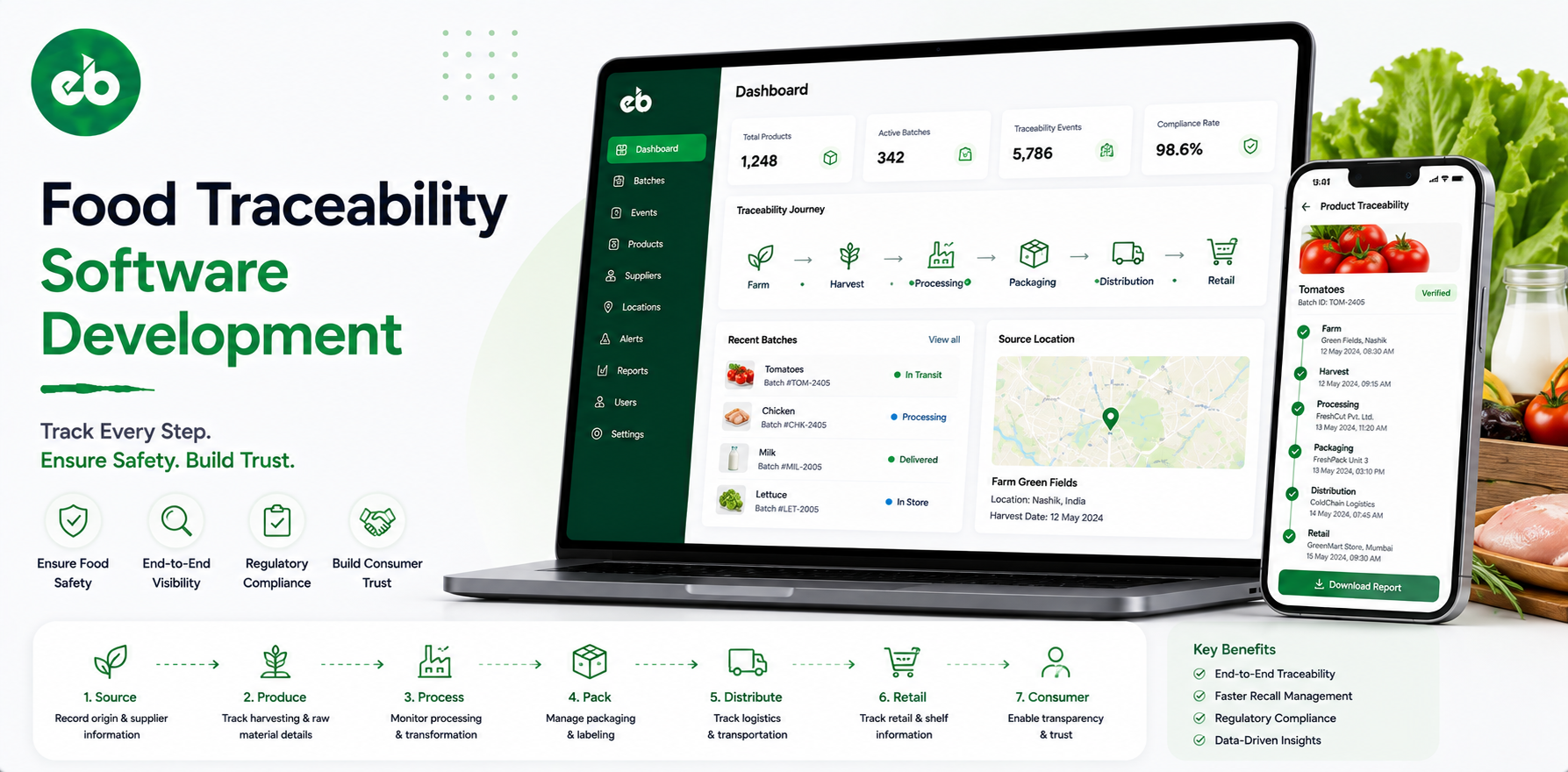
In November 2022, a single E. coli outbreak linked to romaine lettuce sickened 40 people across 16 US states before the source was traced, 11 days after the first reported illness. Under FDA’s FSMA Section 204 Food Traceability Rule, which came into full effect in January 2026, that 11-day trace would need to happen in hours, not days.
The rule requires companies in the food supply chain to maintain electronic records linking every lot of high-risk food through every critical tracking event from farm to final consumer.
FSMA 204 compliance alone is not the full picture. Globally, food safety regulation is converging on the same principle: every food product must be traceable, every supply chain link must be documented, and when something goes wrong, the responsible lot must be identified and removed from commerce in hours.
The global food traceability market is projected to reach $30.50 billion by 2030. The buyers are food manufacturers, processors, distributors, retailers, food service companies, and fresh produce operators, anyone in the supply chain for FSMA-regulated foods.
EngineerBabu built enterprise supply chain management for Adani Group and distribution intelligence for Simba Beer. CMMI Level 5. Google AI Accelerator 2024 Top 20. Contact: mayank@engineerbabu.com
| Function | Module |
| Supply chain mapping | Supplier network, facility registry, product catalogue |
| Critical tracking event (CTE) recording | All supply chain events per FSMA 204 |
| Key data element (KDE) capture | All required data per event type |
| GS1 standards | GS1-128 barcodes, EPCIS 2.0, GTIN management |
| Lot and batch management | Lot creation, linkage through transformation events |
| Blockchain-optional immutability | Optional distributed ledger for audit integrity |
| Mock recall capability | Trace forward and backward in under 30 minutes |
| Recall management | Product identification, withdrawal, consumer notification |
| Supplier compliance | Supplier portal, self-reporting, document management |
| Analytics | Traceability coverage, supplier compliance rate |
| Integration | ERP, WMS, IoT sensors, blockchain platforms |
What FSMA 204 requires:
FDA’s Food Traceability Rule applies to foods on the Food Traceability List (FTL), fresh produce, shell eggs, nut butters, fresh-cut fruits and vegetables, ready-to-eat deli salads, and several other high-risk categories. For every lot of these foods, the entire supply chain must maintain records of Critical Tracking Events (CTEs).
The seven Critical Tracking Events:
| CTE | Definition | Who Records It |
| Growing | Where and when the food was grown | Farm / Grower |
| Receiving | Receipt of a food lot at a facility | Processor, distributor, retailer |
| Transforming | Processing or manufacturing that changes the food | Processor, manufacturer |
| Creating | Creating a traceable lot from ingredients | Manufacturer, co-packer |
| Shipping | Departure of a food lot from a facility | Grower, distributor, manufacturer |
| Harvesting | Harvest of a raw agricultural commodity | Farm / Grower |
| Cooling | Post-harvest cooling that changes the food’s status | Packing house, cooling facility |
Key Data Elements (KDEs) per CTE:
Each CTE has a defined set of Key Data Elements that must be captured and maintained:
| CTE | Required KDEs |
| Receiving | Traceability lot code, product quantity and unit of measure, date of receipt, location receiving (GLN), TLC source |
| Transforming | New lot codes created, input lot codes consumed, product quantity, date of transformation, location |
| Shipping | Traceability lot code, product quantity, date of shipment, origin location (GLN), destination (GLN) |
Why GS1 matters:
GS1 is the global standards organisation that defines the identifiers and communication protocols for supply chain traceability. Without GS1 standards, every company invents its own lot numbering system, and tracing across supply chain boundaries becomes impossible.
The key GS1 identifiers:
| Identifier | What It Identifies | Format |
| GTIN (Global Trade Item Number) | A specific product at a specific pack level | 14-digit numeric |
| GLN (Global Location Number) | A specific physical location, facility, dock door | 13-digit numeric |
| SSCC (Serial Shipping Container Code) | A specific logistics unit (pallet, case) | 18-digit numeric |
| Traceability Lot Code (TLC) | A specific production lot | GS1 format |
| GS1-128 barcode | Encodes GTIN + lot + dates on labels | Linear barcode |
| QR code (GS1 Digital Link) | Links to full product information online | QR format |
EPCIS 2.0, the event communication standard:
EPCIS (Electronic Product Code Information Services) 2.0 is the GS1 standard for communicating supply chain events. Every CTE is formatted as an EPCIS event and can be shared across supply chain partners through the EPCIS API.
A distributor’s WMS emits EPCIS Shipping events when a lot ships. The retailer’s receiving system emits EPCIS Receiving events when the lot arrives. The platform ingests all EPCIS events from all supply chain participants and assembles the complete trace record.
The platform’s GS1 implementation:
| Function | Implementation |
| GTIN management | Maintain a GTIN master for all products in scope |
| GLN registry | Register all facility locations with unique GLNs |
| TLC generation | Generate FSMA-compliant traceability lot codes at creation events |
| GS1-128 label printing | Generate labels at packing and shipping |
| EPCIS event emission | Emit EPCIS 2.0 events for all CTEs |
| EPCIS event reception | Receive and parse EPCIS events from supply chain partners |
The lot linkage model:
A lot of finished product was manufactured from multiple input lots, raw materials, ingredients, packaging. When those input lots came from multiple suppliers, the finished lot’s traceability record must link back to all of them.
A transformation example, fresh-cut salad manufacturer:
| Input Lot | Product | Supplier | Harvest Date | Field |
| LOT-ROM-20260615-A | Romaine lettuce | Green Valley Farm | June 15, 2026 | Field 12-C |
| LOT-CAR-20260614-B | Carrots | Sunrise Produce | June 14, 2026 | Block 7 |
| LOT-TOM-20260615-C | Cherry tomatoes | Fresh Farms | June 15, 2026 | Greenhouse 3 |
| PKG-2026-0041 | Film packaging | PackCo | Manufactured June 1 | — |
The transformation event records:
When these four lots are combined to produce output lot LOT-SALAD-20260616-001, the transformation event records all four input lot codes, the output lot code, the facility GLN, and the transformation date and time.
This linkage means that if Romaine from Field 12-C is recalled, the platform can identify within seconds that LOT-SALAD-20260616-001 is affected and trace it forward to every retailer and distribution point where it was shipped.
The FSMA 204 trace requirement:
FDA expects covered companies to be able to provide complete supply chain records within 24 hours of a request. In practice, companies that invest in platform-based traceability can trace in minutes, not hours.
The trace forward query:
“Which lots were affected by the contamination event at Green Valley Farm Field 12-C, and where are they now?”
| Query | Result |
| All TLCs with origin: Green Valley Farm, Field 12-C | 14 input lots |
| All transformation events consuming those input lots | 8 output lots produced |
| All shipping events for those output lots | 23 shipments to 15 customers |
| Current location of each shipment | 12 in retailer DCs, 8 at store level, 3 unknown |
This entire trace, from farm to current location, completes in under 2 minutes on the platform. The same trace through paper records and phone calls takes 2 to 5 days.
The mock recall drill:
The platform supports scheduled mock recall drills, the food safety team selects a random lot and runs a forward and backward trace, measuring the time to complete the trace and the completeness of the data returned.
The drill generates a report showing: trace completion time, percentage of supply chain links with complete KDE data, any gaps in the trace chain, and the estimated number of units that would need to be recalled.
The recall workflow:
When a contamination event or safety concern requires a product recall, the platform supports the full recall execution:
| Step | Action | Time |
| Recall initiation | Safety event identified, affected lots defined | Hour 0 |
| Affected lot identification | Trace all lots from contamination source | < 30 minutes |
| Distribution mapping | Identify all customers and locations with affected product | < 1 hour |
| Recall notification | Notify customers, retailers, and regulatory authorities | Hour 1–4 |
| Acknowledgement tracking | Track which customers acknowledged and confirmed withdrawal | Ongoing |
| Product return | Manage return shipments, destruction records | Days 1–7 |
| Regulatory reporting | Submit recall report to FDA (Form 3177) or FSSAI | Per timeline |
| Closure | Confirm all affected product accounted for | Per regulatory guidance |
The customer notification engine:
When a recall is initiated, the platform generates customer-specific recall notifications, showing each customer exactly which lots they received, the quantities, and the requested action (hold, withdraw, return, or destroy).
Notifications are sent simultaneously to all affected customers via email, with read receipts tracked to confirm acknowledgement.
The supplier portal:
Every supplier in the food supply chain has a portal where they:
| Function | Details |
| Register lots | Enter traceability lot codes and associated KDEs when shipping |
| Upload documentation | Certificates of analysis, grower certifications, audit reports |
| Receive compliance alerts | Notification when their data is incomplete or non-conforming |
| View performance scores | Their traceability compliance rate vs programme expectations |
The supplier compliance scorecard:
| Metric | Calculation | Target |
| KDE completeness rate | % of shipping events with all required KDEs | > 98% |
| Timeliness | % of events submitted within required timeframe | > 95% |
| Traceability lot code format | % of TLCs in GS1-compliant format | 100% |
| Document upload rate | % of lots with required certificates uploaded | > 95% |
| Module | Cost Range (USD) | Notes |
| Supply chain mapping + facility registry | $5K – $10K | GLN management |
| CTE recording engine (all 7 CTEs) | $8K – $15K | FSMA 204 compliant |
| KDE capture forms per CTE | $5K – $10K | |
| GS1 standards (GTIN, SSCC, EPCIS 2.0) | $10K – $18K | EPCIS event emission and reception |
| GS1-128 label generation + printing | $4K – $8K | |
| Lot transformation linkage engine | $8K – $15K | Input-to-output lot mapping |
| Forward + backward trace engine | $8K – $15K | Sub-2-minute trace |
| Mock recall drill module | $4K – $8K | |
| Recall management + notification | $8K – $15K | Customer notification, acknowledgement |
| Supplier portal + compliance scorecard | $6K – $12K | |
| ERP + WMS integration | $8K – $15K | Automated event capture |
| Analytics + compliance dashboard | $5K – $10K | |
| AWS + VAPT + Year 1 ops | $5K – $10K | |
| Total | $84K – $161K | Full food traceability platform |
EngineerBabu built supply chain management for Adani Group and distribution intelligence for Simba Beer. CMMI Level 5. Google AI Accelerator 2024 Top 20. Contact: mayank@engineerbabu.com
FSMA Section 204 is the FDA’s Food Traceability Rule, part of the Food Safety Modernization Act, which came into full compliance effect in January 2026. It applies to foods on the FDA’s Food Traceability List (FTL), a defined set of high-risk foods that have been frequently associated with foodborne illness outbreaks. The FTL includes: fresh produce (leafy greens, herbs, tomatoes, cucumbers, peppers, melons, tropical tree fruits), shell eggs, nut butters, fresh-cut fruits and vegetables, ready-to-eat deli salads, and finfish and crustaceans. For all foods on the FTL, any company that manufactures, processes, packs, or holds the food must maintain electronic records of all Critical Tracking Events with their required Key Data Elements, and must be able to provide those records to FDA within 24 hours of a request.
One-up one-down traceability, the minimum traceability standard in most food safety regulations before FSMA 204, requires each supply chain participant to know only who they received a lot from and who they shipped it to. A distributor knows their supplier and their customers but has no visibility into upstream farm origin or downstream retailer location. Farm-to-fork traceability links every supply chain event from the specific field where the food was grown through every processing, storage, and distribution step to the specific retailer and store where the food is sold. FSMA 204’s Critical Tracking Event framework requires farm-to-fork depth, not just one step in each direction. This is what enables a recall to identify a specific contaminated field and trace every lot of food that touched that field forward to its current location in hours rather than days.
A mock recall drill tests the company’s ability to execute a real recall quickly and completely. The platform’s mock recall module works as follows: the food safety coordinator selects a random lot code from the system, initiates the drill, and the platform runs a complete forward and backward trace, identifying all input lots that contributed to the selected lot, all output lots that the selected lot was transformed into, and all shipments of those lots with current location. The drill measures three outcomes: trace completion time (should be under 30 minutes for a well-implemented system), data completeness rate (what percentage of required KDEs are present for every link in the chain, gaps indicate supplier data collection issues), and affected lot quantity accuracy (can the system determine with confidence how much product is affected and where it is). A good mock recall result is trace completion in under 15 minutes with 98%+ data completeness. Results below these thresholds identify specific suppliers or supply chain links where data collection needs improvement before a real recall event.