How Much Does It Cost to Build a Custom EHR System from Scratch in the USA?


Create engaging, high-performance mobile applications tailored to your business needs. We craft future-ready apps that offer smooth user experiences on all devices.
Build robust and scalable websites and CMS platforms that help you manage content effortlessly. Our development ensures a seamless digital presence.
Launch secure, feature-rich online stores with intuitive shopping experiences. We build tailored eCommerce platforms designed for growth.
Design captivating games with immersive gameplay and stunning graphics. From concept to launch, we build engaging experiences that players love.
Enhance your customer relationships with customized Salesforce implementations. Drive growth and efficiency with smarter CRM solutions.
Harness artificial intelligence and machine learning to automate workflows and gain actionable insights. Our AI transforms data into smart decisions.
Accelerate your software delivery lifecycle with continuous integration, delivery, and infrastructure automation to boost efficiency.
The honest answer is that most teams asking this question shouldn’t build one.
Custom EHR development makes sense for a specific, well-defined set of use cases. For those use cases, specialty-specific clinical platforms, digital health startups with differentiated workflows, health systems building clinical tools that Epic’s templates cannot accommodate, the cost question deserves a real answer.
Not the vague “$50K to $5M” range that every other article provides. The specific range, broken down by scope, with the hidden costs that routinely push budgets 30–50% over initial projections.
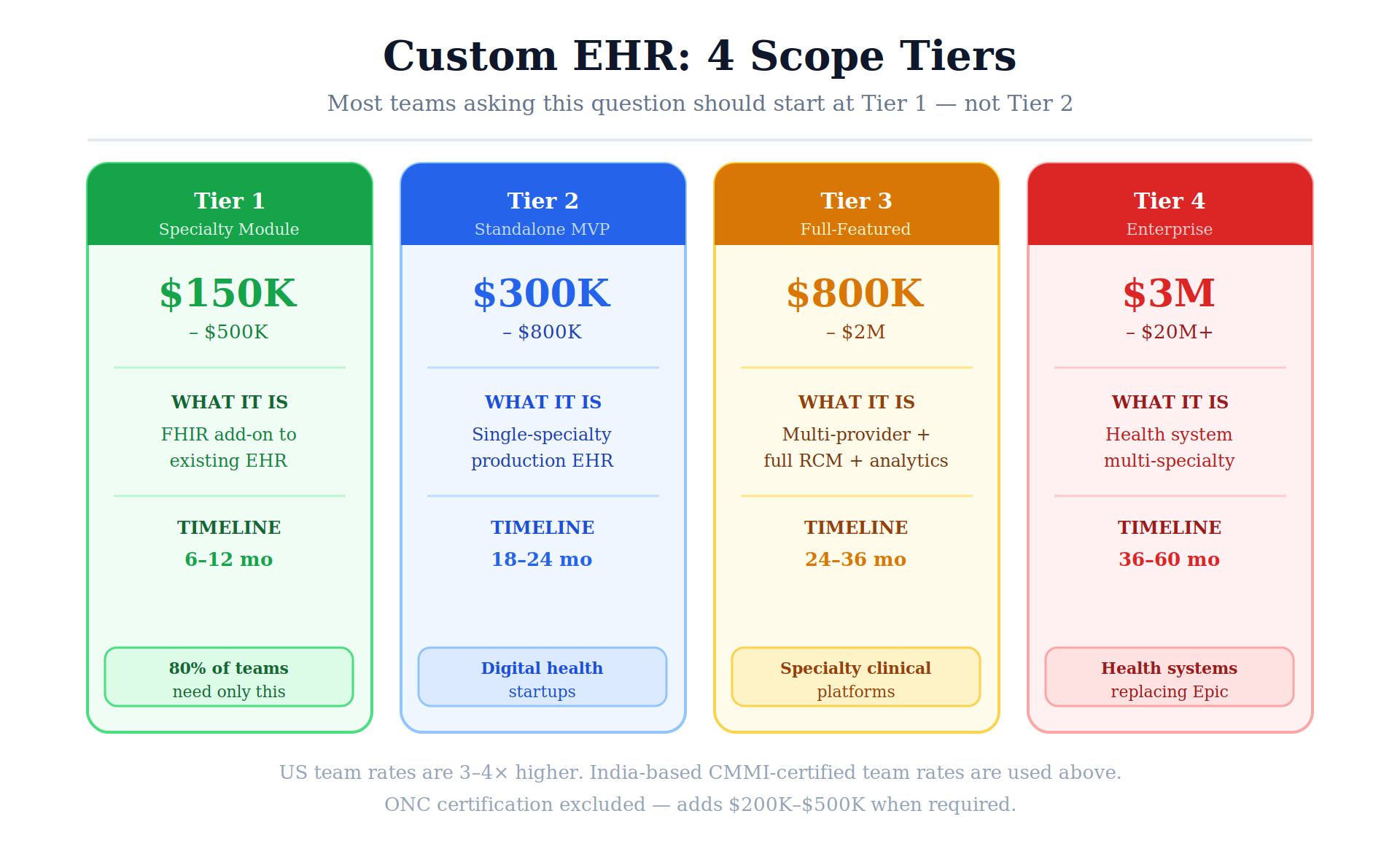
A basic specialty EHR MVP development, covering patient registration, scheduling, clinical documentation, e-prescribing, and billing for a single specialty, costs $300,000–$800,000 to build and $60,000–$160,000 per year to maintain.
A full-featured multi-specialty EHR with EHR interoperability, population health tools, and revenue cycle management costs $2,000,000–$10,000,000+.
These figures assume HIPAA compliance built from day one, ONC certification excluded, and an India-based CMMI-certified team, US team rates are 3-4× higher, making equivalent build costs $900,000–$2,400,000 and $6,000,000–$30,000,000 respectively.
Not a standalone EHR, a clinical workflow tool that integrates with an existing EHR (Epic, Athenahealth) via FHIR APIs and extends its capabilities for a specific clinical use case.
What it includes: FHIR R4 integration with the existing EHR, specialty-specific documentation templates, procedure-specific workflows, clinical data capture not supported by the base EHR.
Examples: Oncology genomics integration, addiction medicine documentation, fertility clinic clinical tracking, physical therapy outcome measurement, wound care photo documentation.
Why this is the most common “custom EHR” decision: 80% of teams that think they need to build a standalone EHR can solve their actual problem with a specialty module on top of their existing EHR. Cheaper, faster, and preserves the interoperability of the base platform.
A production-ready, HIPAA-compliant clinical management system for a specific specialty, operating independently from major EHR platforms.
Core modules:
ONC certification excluded: Achieving ONC certification (required for a product marketed to Medicare/Medicaid providers as a certified EHR) adds $200,000–$500,000 in testing, documentation, and certification fees. Most specialty EHR startups launch without ONC certification initially and add it in year 2–3.
Timeline: 18–24 months from project start to production-ready MVP.
Complete specialty EHR platform with multi-provider support, advanced clinical workflows, full revenue cycle management, population health analytics, and multi-location deployment.
Additional modules over Tier 2:
Health system-grade clinical platform covering inpatient, outpatient, emergency, and specialty care across multiple facilities.
This is where the comparison to Epic’s $10M–$100M implementation cost becomes relevant.
At this scope, the custom EHR cost is comparable to a commercial EHR implementation but the custom EHR is purpose-built for the organization’s specific workflows rather than configured to match a generic template.
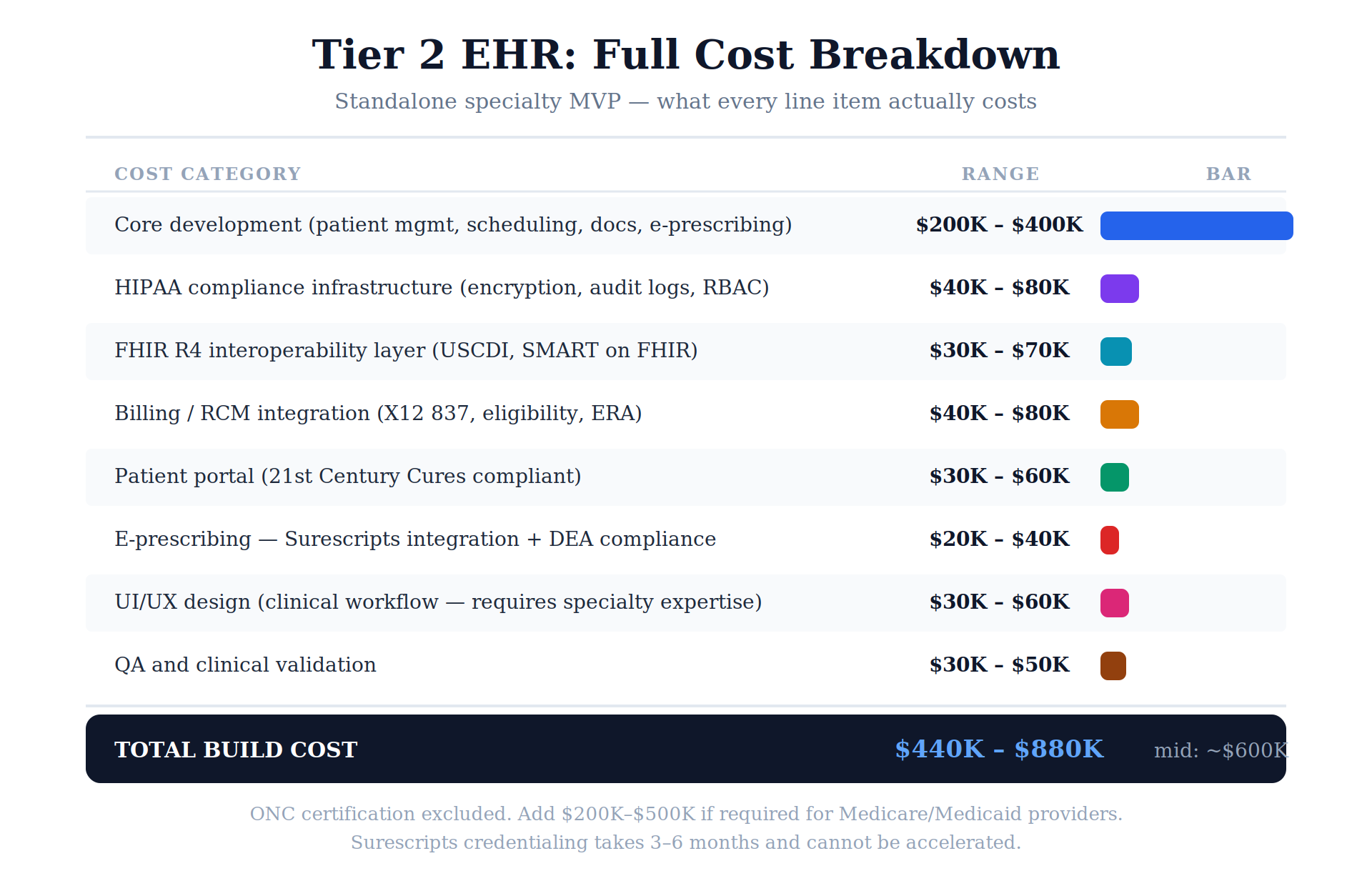
For the scope most teams are actually evaluating:
| Cost Category | Range | Notes |
| Core development (CMMI India team) | $200,000–$400,000 | Patient mgmt, scheduling, documentation, e-prescribing |
| HIPAA compliance infrastructure | $40,000–$80,000 | Encryption, audit logging, RBAC, BAAs, pen test |
| FHIR R4 interoperability layer | $30,000–$70,000 | USCDI compliance, patient data APIs, SMART on FHIR |
| Billing/RCM integration | $40,000–$80,000 | X12 837 claims, Availity eligibility, ERA processing |
| Patient portal | $30,000–$60,000 | 21st Century Cures compliant |
| E-prescribing (Surescripts) | $20,000–$40,000 | Integration + DEA compliance |
| UI/UX design | $30,000–$60,000 | Clinical workflow design requires specialty expertise |
| QA and clinical validation | $30,000–$50,000 | Healthcare QA is more complex than standard software |
| Project management | $20,000–$40,000 | 18–24 month timeline requires dedicated PM |
| Total build cost | $440,000–$880,000 | Mid-range: $600,000 |
Hidden costs that push budgets over:
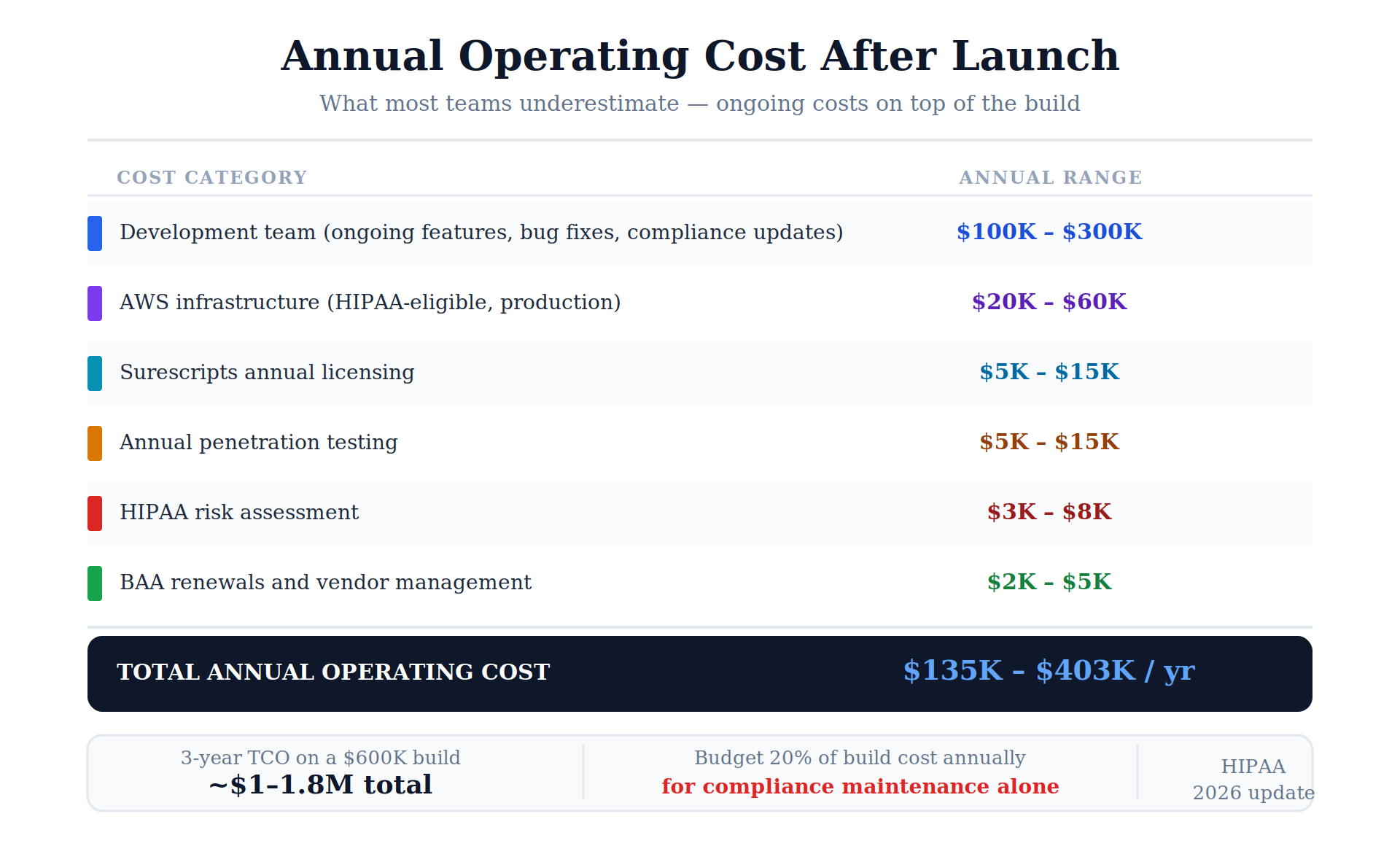
A custom EHR’s total cost of ownership includes ongoing costs that most teams underestimate at launch:
| Annual Cost Category | Range |
| Development team (ongoing features, bug fixes, compliance updates) | $100,000–$300,000 |
| AWS infrastructure (HIPAA-eligible, production) | $20,000–$60,000 |
| Surescripts annual licensing | $5,000–$15,000 |
| Annual penetration testing | $5,000–$15,000 |
| HIPAA risk assessment | $3,000–$8,000 |
| BAA renewals and vendor management | $2,000–$5,000 |
| Total annual operating cost | $135,000–$403,000 |
For a $600,000 EHR build, the 3-year total cost of ownership is approximately $1,000,000-$1,800,000. Compared to:
The build-vs-buy inflection point: Custom EHR builds make financial sense when (1) the practice has workflows that commercial EHRs genuinely cannot accommodate, (2) the custom platform is a strategic asset that creates competitive differentiation or IP value (as in a digital health company), or (3) the practice is building for a market where no appropriate commercial EHR exists.
Author: Mayank Pratap | Co-Founder, EngineerBabu | Google AI Accelerator 2024 · CMMI Level 5
Specialty EHR MVP: $300,000–$800,000. Full-featured specialty EHR: $800,000–$2,000,000. Enterprise multi-specialty EHR: $3,000,000–$20,000,000+. These assume HIPAA compliance built in, ONC certification excluded, and an India-based CMMI-certified development team.
Specialty EHR MVP: 18–24 months to production-ready. Full-featured platform: 24–36 months. Enterprise system: 36–60 months. EHR development is substantially slower than standard software because of clinical validation requirements, regulatory compliance, and the depth of specialty workflow engineering required.
For most practices needing standard EHR functionality, buying (Athenahealth, Epic Community Connect, eClinicalWorks) is dramatically cheaper than building. Custom builds make financial and strategic sense when your clinical workflows are genuinely not served by commercial options, you’re building a specialty clinical platform as a product rather than an internal tool, or you’re in a market where commercial EHRs don’t have strong presence.
ONC certification is required if you want to receive EHR incentive payments, participate in certain CMS quality programs, or market your EHR as certified to Medicare/Medicaid providers. It is not required for all clinical software. Most specialty EHR startups launch without certification and pursue it in year 2–3. ONC certification adds $200,000–$500,000 to the build cost.