Chatbots in Loan Servicing: How to Improve Customer Experience


Create engaging, high-performance mobile applications tailored to your business needs. We craft future-ready apps that offer smooth user experiences on all devices.
Build robust and scalable websites and CMS platforms that help you manage content effortlessly. Our development ensures a seamless digital presence.
Launch secure, feature-rich online stores with intuitive shopping experiences. We build tailored eCommerce platforms designed for growth.
Design captivating games with immersive gameplay and stunning graphics. From concept to launch, we build engaging experiences that players love.
Enhance your customer relationships with customized Salesforce implementations. Drive growth and efficiency with smarter CRM solutions.
Harness artificial intelligence and machine learning to automate workflows and gain actionable insights. Our AI transforms data into smart decisions.
Accelerate your software delivery lifecycle with continuous integration, delivery, and infrastructure automation to boost efficiency.
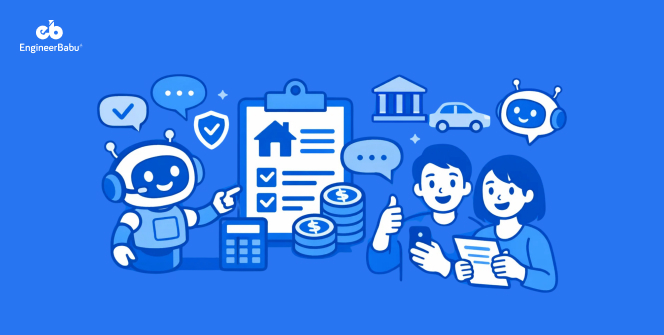
A borrower misses an EMI reminder. They call customer support. They wait 12 minutes on hold. By the time someone picks up, they are already frustrated. That one interaction can quietly damage trust that took months to build.
This is the reality for many lenders still relying on manual support channels. It is also the exact gap that chatbots in loan servicing are designed to close. Not by replacing human teams, but by removing the friction borrowers face at every routine touchpoint.
Global banking chatbot use, for example, is expected to save $7.3 billion in 2026, driven by faster response times, lower abandonment rates, and reduced call center pressure.
For lenders looking to improve customer experience without ballooning operational costs, chatbots are no longer optional. They are infrastructure.
Chatbots in loan servicing are not just FAQ bots. When built properly, they handle a wide range of borrower interactions across the loan lifecycle.
This includes answering repayment queries, sending payment reminders, sharing statement copies, explaining interest calculations, and helping borrowers raise service requests.
The difference between a basic chatbot and a useful one comes down to integration. A chatbot that sits on top of your website without connecting to your loan management system can answer generic questions.
A chatbot that plugs into your servicing platform can tell a specific borrower their exact EMI due date, outstanding principal, and payment history in seconds.
This is the standard lenders should be building toward.
Chatbots improve loan servicing by providing fast, accurate responses to customer queries. They should personalize interactions and enable smooth handoffs to human agents when needed. Here are the steps to improve customer satisfaction.
Before building or deploying anything, lenders need to identify where borrowers most commonly struggle. Common friction points include:
These are the interactions where borrowers either call support or silently disengage. Prioritising chatbot deployment around these specific moments creates immediate, measurable improvement in satisfaction.
A chatbot without backend access is just a dressed-up FAQ page. Lenders need to integrate the chatbot directly with their loan management system so it can pull live data. This means the bot should be able to:
This requires clean API development between the chatbot layer and the core servicing platform. Without this, borrowers get generic responses that do not resolve their actual queries and end up calling support anyway.
Most lenders treat reminders as a collections function. But proactive reminders before a due date are a customer experience feature.
A chatbot can send a personalised message three to five days before an EMI is due. It can include the exact amount, due date, and a direct payment link.
If the borrower has already paid but the system has not yet reconciled the payment, the chatbot should be able to flag this and reassure them rather than sending a generic overdue alert. This level of context-awareness reduces inbound support calls significantly.
One of the biggest complaints borrowers have about chatbots is getting stuck. The bot cannot resolve the query, and there is no obvious way to reach a real person.
Good chatbot design always includes a clean escalation trigger. If a borrower expresses frustration, repeats the same query twice, or explicitly asks for a human, the bot should hand off the conversation immediately. This handoff should carry context so the agent knows exactly what the borrower already explained.
This is not a failure of the chatbot. It is the chatbot doing its job correctly by knowing its own limits.
Loan closure is one of the most emotionally significant moments in a borrower’s journey. They want to know the exact foreclosure amount, when they can get their NOC, and how long the process takes. Many lenders handle this poorly, forcing borrowers to call branches or wait for email responses.
A chatbot can handle this cleanly. It can calculate the foreclosure amount based on the outstanding principal and applicable charges. It can explain the document collection timeline. It can even raise the closure request automatically and send the borrower a confirmation.
When borrowers get this kind of experience at closure, they remember it. Referrals and repeat business follow.
Every chatbot interaction is a data point. When borrowers frequently ask about a specific charge, that signals a communication gap in your loan agreement or statement design.
When they repeatedly ask about part payment rules, it suggests the policy needs to be communicated earlier in the journey.
Lenders that review chatbot conversation logs regularly can identify patterns and fix upstream problems. This is not just a customer experience improvement. It reduces support volume structurally over time.
Platforms built on machine learning development can make this analysis continuous by learning from conversation trends and adjusting responses automatically.
Deploying a chatbot without integrating it with real loan data is the most common mistake. The second is treating the chatbot as a one-time project rather than a product that needs ongoing maintenance. As loan products change, the chatbot content needs to change too.
Lenders should also avoid designing chatbots that make it difficult to reach a human agent. Hiding the escalation option to reduce call volumes creates more frustration and more complaints.
Borrowers who cannot resolve their issue through a chatbot and cannot reach a human agent either will simply stop trusting the lender.
A chatbot deployed specifically for loan servicing should handle the following without needing human involvement:
When these use cases are covered, borrowers get a self-service experience that is actually useful rather than a bot that only knows how to say “please contact your nearest branch.”
Most borrowers interact with their lenders through a smartphone. A chatbot that works only on a desktop website misses the majority of the audience.
Lenders investing in mobile app development should embed the chatbot directly within the borrower app rather than relying on a third-party chat widget.
In-app chatbots benefit from being pre-authenticated, which means the bot already knows who the borrower is and can pull their loan data immediately. The experience is faster and far more relevant.
Early chatbots worked on fixed decision trees. If the borrower phrased a question in an unexpected way, the bot failed. Modern chatbots powered by generative AI development can understand intent rather than just matching keywords.
This matters significantly in loan servicing. Borrowers do not always use precise financial terminology. They say things like “what happens if I skip next month’s payment” or “can I pay half now and the rest later.”
A well-trained AI chatbot understands what they are asking and gives a meaningful answer based on actual loan product rules.
This level of capability is now accessible to mid-sized lenders and NBFCs, not just large banks with enterprise budgets.
Chatbots in loan servicing work when they are built with the borrower journey in mind, connected to real loan data, and maintained as a live product rather than a one-time deployment.
The lenders seeing real results from chatbots are not the ones that deployed the most sophisticated AI. They are the ones that mapped their borrower pain points honestly and built something that genuinely solved those problems.
If you are ready to build a loan servicing chatbot that actually improves customer experience, EngineerBabu’s chatbot development team builds custom solutions for NBFCs, banks, and fintech lenders.
The right chatbot does not just answer questions. It builds borrower confidence at every step of the loan journey.
A chatbot in loan servicing can handle EMI queries, payment confirmations, statement downloads, interest certificate requests, foreclosure amount calculations, NOC requests, and part payment information. When integrated with the lender’s backend system, it gives borrowers real-time, account-specific responses.
A general support bot answers FAQs from a static knowledge base. A loan servicing chatbot connects to your loan management platform and pulls live borrower data. This makes it capable of giving personalised, accurate responses instead of generic replies.
Yes. Without backend integration, the chatbot cannot access individual loan data, which makes it far less useful for borrowers. Integration enables the chatbot to fetch outstanding balances, EMI schedules, payment history, and trigger service requests in real time.
The chatbot should escalate when the borrower explicitly requests human support, when the query falls outside the bot’s capability, or when the borrower has repeated the same question without resolution. The escalation should carry full conversation context so the agent does not start from scratch.