How to Build an App Like Swiggy Instamart?


Create engaging, high-performance mobile applications tailored to your business needs. We craft future-ready apps that offer smooth user experiences on all devices.
Build robust and scalable websites and CMS platforms that help you manage content effortlessly. Our development ensures a seamless digital presence.
Launch secure, feature-rich online stores with intuitive shopping experiences. We build tailored eCommerce platforms designed for growth.
Design captivating games with immersive gameplay and stunning graphics. From concept to launch, we build engaging experiences that players love.
Enhance your customer relationships with customized Salesforce implementations. Drive growth and efficiency with smarter CRM solutions.
Harness artificial intelligence and machine learning to automate workflows and gain actionable insights. Our AI transforms data into smart decisions.
Accelerate your software delivery lifecycle with continuous integration, delivery, and infrastructure automation to boost efficiency.
Hire app developers ready to turn your ideas into sleek, high-performing mobile apps for any platform.
Bring in frontend pros who craft smooth, beautiful, and user-friendly interfaces that your visitors will love.
Get backend developers who build fast, secure, and reliable systems to keep everything running behind the scenes.
Hire eCommerce developers who build secure, scalable online stores designed to offer seamless shopping and grow your sales.
Get dedicated developers committed to your projects, delivering consistent quality and speed as an extension of your team.
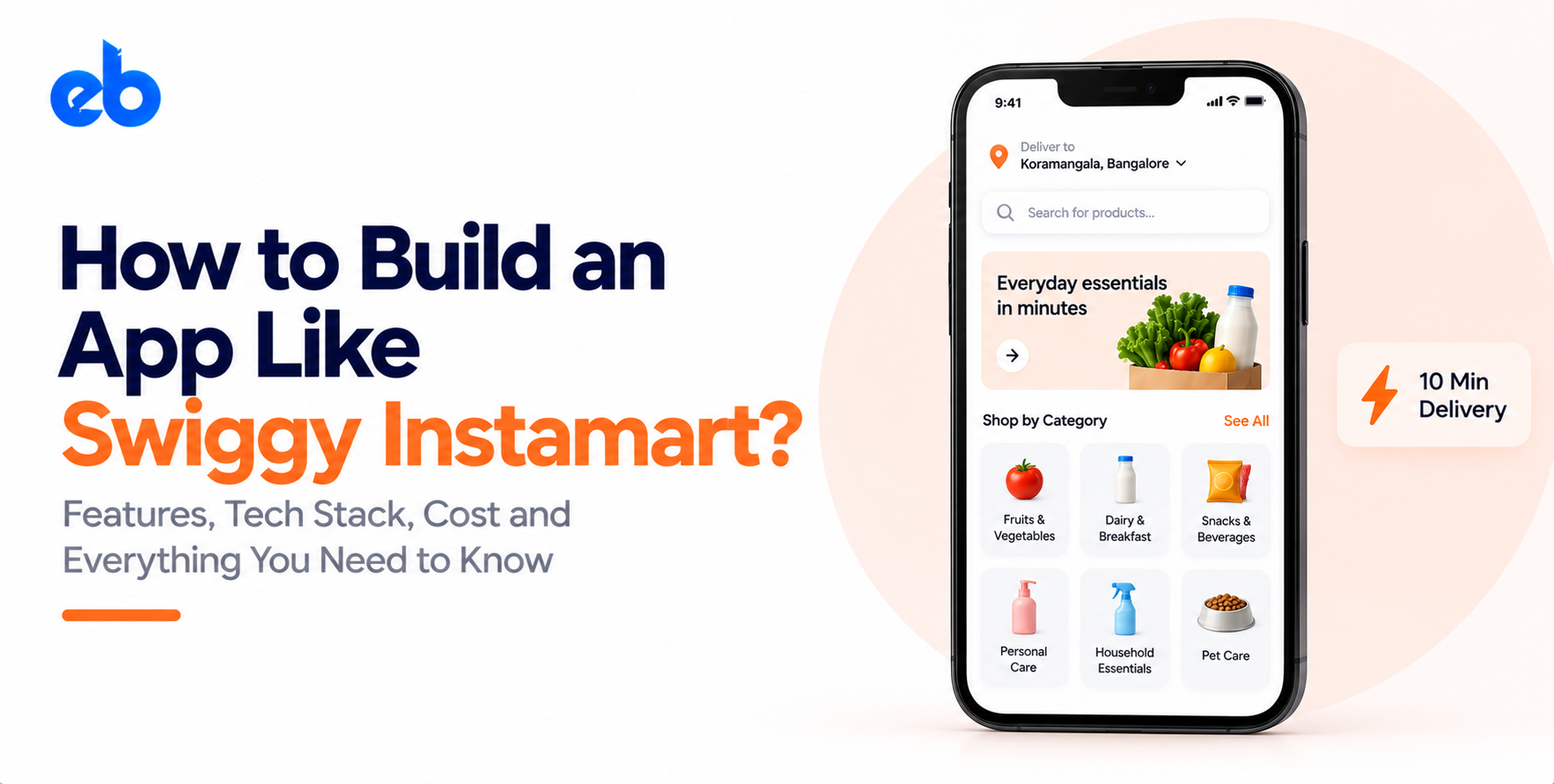
TL;DR
Ten minutes is not a marketing promise. It is a scheduling constraint that your software either respects or breaks.
Swiggy’s own Q2 FY26 shareholder letter puts Instamart at 1,102 dark stores across 128 cities. Those stores average 1,025 orders per day against a capacity of 2,000-plus (Swiggy Shareholder Letter, Q2 FY26). Read that gap again. The bottleneck is not store count. It is how well the software squeezes throughput out of each store.
That is the real lesson for anyone who wants to build an app like Swiggy Instamart. You are not cloning a grocery catalog. You are building a throughput engine.
Most teams that set out to build an app like Swiggy Instamart start with the customer screens. That is the last thing that matters.
A dark store is a 2,000 to 4,000 square foot micro-warehouse closed to walk-ins, serving a 2 to 3 km radius. Every SKU sits in a mapped bin location. Your software assigns each order to a store based on distance, current stock, and picker queue depth.
Get store assignment wrong and you either ship nothing or ship late. There is no middle outcome.
The ten-minute clock splits roughly into 90 seconds of picking, 60 seconds of packing, and 7 minutes of riding. Picking is the only part you fully control through code.
That means real-time stock counts, bin-level item mapping, and pick sequences ordered by aisle rather than by cart order. Miss this and your riders wait while a picker walks the floor twice.
Underestimating this is the most expensive mistake in quick commerce. Teams that set out to build an app like Swiggy Instamart should budget for four builds, not one.
Location detection, serviceability check, category browse, search with typo tolerance, cart, slot-free checkout, live order tracking, and refunds. This is the only app users see, and it carries maybe 25% of your engineering effort.
Runs on a handheld inside the dark store. It shows the pick list in aisle order, scans barcodes to confirm the right SKU, flags out-of-stock items, and triggers instant substitution prompts to the customer.
Handles order acceptance, batching of two to three nearby orders, turn-by-turn navigation, proof of delivery, cash collection, and earnings visibility. Rider retention lives or dies on how honest this app is about payouts.
Store managers watch live order flow, stock-out rates, picker productivity, and rider availability here. Your ops team will spend more hours in this than customers spend in the consumer app.
| Layer | Must-have features |
| Discovery | Geofenced serviceability, search, category nesting, personalized rails |
| Cart and checkout | Substitution rules, minimum order logic, coupons, one-tap pay |
| Inventory | Bin mapping, real-time stock sync, reorder alerts, shelf-life tracking |
| Fulfillment | Store assignment, pick optimization, order batching, ETA engine |
| Logistics | Rider allocation, live tracking, surge staffing, route optimization |
| Money | Wallet, UPI and card payments, refunds, rider payout ledger |
| Ops | Store dashboards, SLA alerts, fraud checks, returns handling |
Strong mobile app development execution matters when you build an app like Swiggy Instamart. Still, the fulfillment layer is where the margin actually hides.
Do not start the effort to build an app like Swiggy Instamart with a 20,000 SKU catalog. Begin with 1,500 to 3,000 fast movers. Pick one dense neighborhood with clear demand signals, high order frequency, and short rider distances. Map the physical store layout before writing code, because your bin numbering scheme becomes a permanent database structure.
Decide early whether you own inventory or run a marketplace model. Owned inventory gives you speed and margin control. Marketplace reduces capital burn but weakens your grip on stock accuracy. This one choice reshapes your entire data model.
This is the foundation of any effort to build an app like Swiggy Instamart. You need a product master, per-store stock ledger, and an event stream that updates counts the moment a picker scans an item.
Use optimistic locking so two customers cannot buy the last unit at once. Add soft reservations that hold stock for 90 seconds during checkout. Model substitutions as first-class data, since roughly one in ten quick commerce orders needs one.
The dispatch engine decides which store fulfills the order, which picker gets it, and which rider carries it. Build it as a rules engine first, with distance, stock, and queue depth as inputs.
Add order batching once volume justifies it. Two orders on one trip cuts delivery cost per order significantly. Set hard guardrails so batching never pushes the second customer past the promised ETA. Predictable beats fast.
Quick commerce runs on integrations. Payment gateways, UPI, maps, SMS, push notifications, and KYC for riders all connect through a clean service layer. Deliberate API development here saves months when you switch a vendor later.
Never call a third party directly from your app code. Wrap each one behind an internal interface. When your payment provider has an outage, you want a fallback switch, not a hotfix deploy at 9 PM on a Friday.
Launch in one pin code cluster with one dark store. Resist the urge to build an app like Swiggy Instamart at national scale on day one. Track four numbers daily: on-time percentage, stock-out rate, picker time per order, and orders per rider hour. These four expose every weakness in your build.
An MVP development approach keeps burn low while you tune operations. Most quick commerce failures are not app failures. They are unit economics discovered too late, after three cities are already live.
After eight to twelve weeks of real orders, your data becomes useful. Demand forecasting per store, per hour cuts both stock-outs and wastage. Rider supply prediction stops the 7 PM scramble that kills your on-time rate.
This is where AI development earns its budget, not before. Models trained on thin data produce confident nonsense. Wait for volume, then automate replenishment, ETA prediction, and personalized product rails.
When you build an app like Swiggy Instamart, keep inventory and dispatch as separate services from day one. They scale on completely different curves.
| Scope | Timeline | Indicative cost |
| Single-city MVP, four apps, basic dispatch | 14 to 20 weeks | $45,000 to $90,000 |
| Multi-store platform with batching and analytics | 6 to 9 months | $100,000 to $180,000 |
| Multi-city platform with forecasting and automation | 9 to 14 months | $200,000 and above |
What it costs to build an app like Swiggy Instamart depends far more on fulfillment complexity than on screen count. Offshore teams in India typically deliver the same scope at 40 to 60% of US agency rates.
If you are comparing vendors, our breakdown of mobile app development companies is a useful reference point on pricing norms.
Budget separately for ongoing costs. Maps API calls, SMS, payment gateway fees, and cloud spend scale directly with order volume.
Four patterns sink most attempts to build an app like Swiggy Instamart. Each one is cheap to avoid early and brutal to fix late.
If you want to build an app like Swiggy Instamart with a partner who has shipped comparable systems, that is our lane.
EngineerBabu builds on-demand and marketplace platforms end to end, covering inventory architecture, dispatch logic, rider apps, payment rails, and the ops dashboards nobody demos but everybody uses.
The company holds a CMMI Level 5 rating, has worked with four unicorn clients, and has supported 200-plus VC-funded products.
Practical ML development work layers on afterward for demand forecasting and ETA accuracy, once your order data is thick enough to train on.
The decision to build an app like Swiggy Instamart is really a decision to run a logistics business with a mobile interface attached. The customer app is the easy part.
Win on inventory accuracy, pick speed, and store-level economics. The delivery time takes care of itself after that.
Ready to scope your build? Talk to the EngineerBabu team about your quick commerce platform.
A single-city MVP with customer, picker, rider, and admin apps takes 14 to 20 weeks. Multi-city platforms with forecasting and automated replenishment typically run 9 to 14 months, depending on integration depth and how many payment and logistics partners you support.
Expect $45,000 to $90,000 for a launch-ready single-city MVP. Full multi-city platforms with batching, analytics, and AI-driven replenishment range from $200,000 upward. Offshore development in India usually delivers the same scope at 40 to 60% of US agency pricing.
Both models work. Owned dark stores give you tighter stock accuracy and better margins, but need heavy capital. Partnering with local retailers lowers upfront cost, though you inherit their inventory hygiene, which is usually the hardest problem to fix later.
Real-time inventory accuracy across stores. Stock counts must update within milliseconds of a pick, a sale, or a return. Everything downstream, including ETA promises, substitutions, and store assignment, breaks the moment your inventory data drifts from reality.
Yes, in focused niches. Category-specific plays like pharmacy, pet supplies, or regional groceries work well in Tier 2 and Tier 3 cities. Teams that build an app like Swiggy Instamart for a narrow vertical compete on depth, not budget. Competing head-on in metros against funded incumbents on general grocery is a capital race most startups lose.
Flutter or React Native for the mobile apps, Go or Node.js for dispatch services, PostgreSQL with Redis for inventory, and Kafka for event streaming. The specific choices matter less than keeping inventory and dispatch as independently scalable services.