Benefits of Outsourcing Software Development to India: A Founder's Honest Take After 500+ Projects


Create engaging, high-performance mobile applications tailored to your business needs. We craft future-ready apps that offer smooth user experiences on all devices.
Build robust and scalable websites and CMS platforms that help you manage content effortlessly. Our development ensures a seamless digital presence.
Launch secure, feature-rich online stores with intuitive shopping experiences. We build tailored eCommerce platforms designed for growth.
Design captivating games with immersive gameplay and stunning graphics. From concept to launch, we build engaging experiences that players love.
Enhance your customer relationships with customized Salesforce implementations. Drive growth and efficiency with smarter CRM solutions.
Harness artificial intelligence and machine learning to automate workflows and gain actionable insights. Our AI transforms data into smart decisions.
Accelerate your software delivery lifecycle with continuous integration, delivery, and infrastructure automation to boost efficiency.
Hire app developers ready to turn your ideas into sleek, high-performing mobile apps for any platform.
Bring in frontend pros who craft smooth, beautiful, and user-friendly interfaces that your visitors will love.
Get backend developers who build fast, secure, and reliable systems to keep everything running behind the scenes.
Hire eCommerce developers who build secure, scalable online stores designed to offer seamless shopping and grow your sales.
Get dedicated developers committed to your projects, delivering consistent quality and speed as an extension of your team.
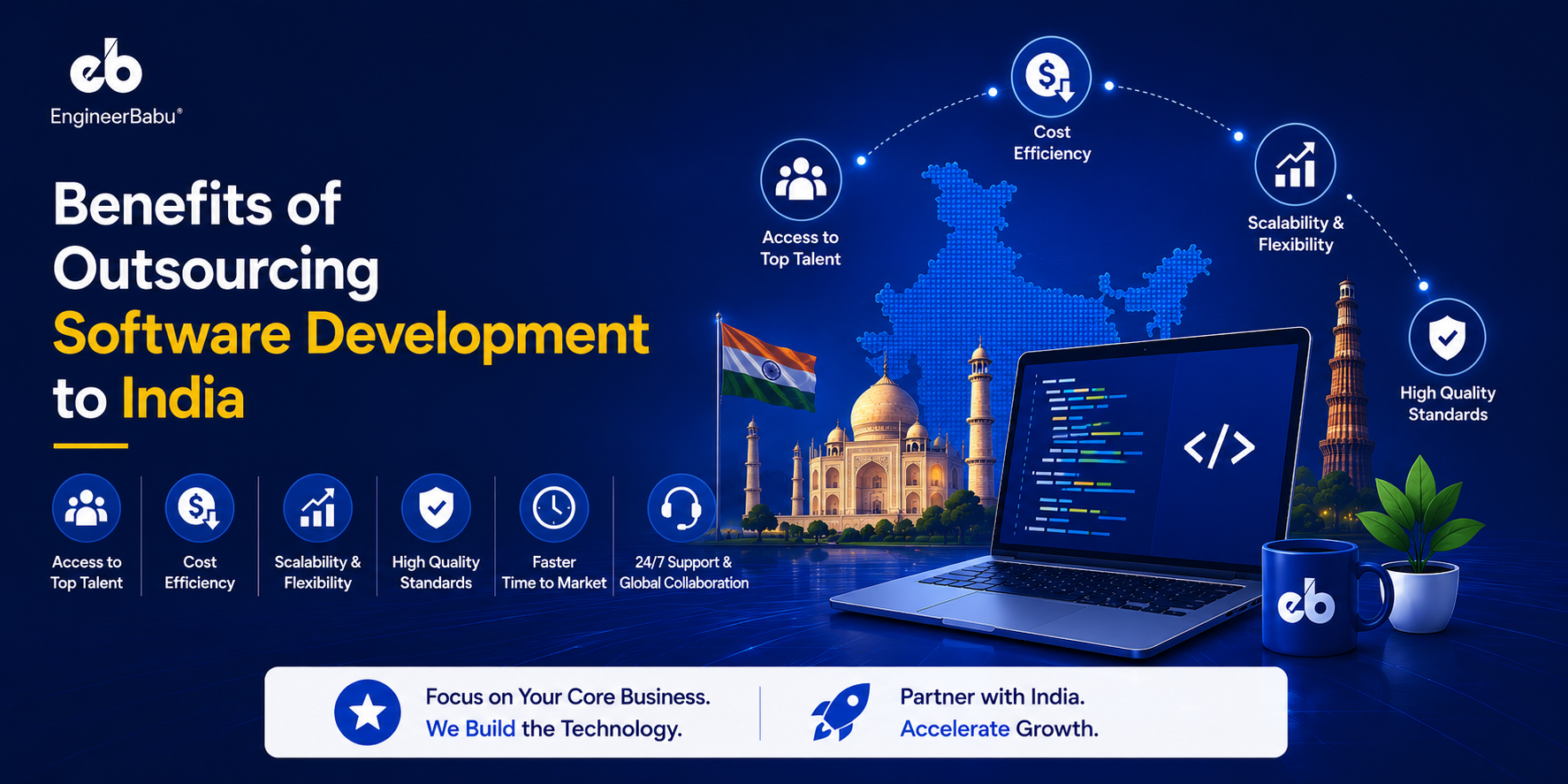
The companies that are most afraid of outsourcing software development to India are usually the ones who most need to do it.
I’ve spent 14 years watching founders burn Series A capital on local agencies charging $180/hour for engineers who’ve never shipped a product at scale. They do it because outsourcing to India “feels risky.”
Meanwhile, their competitors are building at 4x the velocity for a fifth of the cost, with teams that have solved the same architectural problems 30 times before.
The risk calculus got flipped somewhere along the way. Outsourcing to India isn’t the gamble. Assuming you can outbuild a well-resourced remote team with an expensive local one — that’s the gamble.
I’m Mayank Pratap, co-founder of EngineerBabu, a CMMI Level 5 certified product engineering company. We’ve delivered 500+ projects across 20+ countries, built 200+ VC-funded products, and worked with 4 unicorn clients.
The EngineerBabu team built EarlySalary’s full lending stack, which now processes over ₹10,000 crore in disbursements. I lead every client conversation personally. No account managers, no sales team. Twenty projects a year, maximum.
So when I talk about what outsourcing to India actually looks like, I’m speaking from 14 years of it — not a content playbook.
Outsourcing software development to India means engaging Indian engineering talent — whether through a dedicated team, a project-based vendor, or a hybrid model — to design, build, and ship software products at significantly lower cost without sacrificing quality.
It is not the same as hiring cheap coders on Upwork. The distinction matters enormously.
India produces 1.5 million engineering graduates annually. According to NASSCOM’s 2025 Technology Sector Report, India’s IT industry is set to cross $300 billion in export revenues. That’s not a cottage industry. That’s a mature, globally-integrated engineering ecosystem.
The question is not whether India has the talent. The question is whether you know how to access the right layer of it.
Most founders focus on the hourly rate differential. That’s the wrong frame.
A senior React developer in San Francisco costs $150-200/hour. The equivalent in Bangalore costs $25-45/hour. On paper, that’s a 4-6x cost reduction. But the actual benefit is more nuanced and, in many cases, larger.
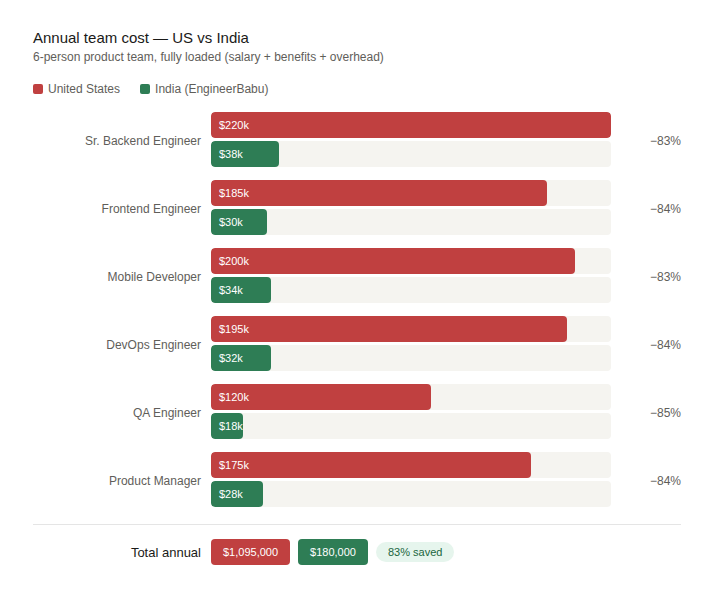
What the cost math actually looks like for a 6-person product team:
| Role | US Annual Cost (Salary + Benefits + Overhead) | India Annual Cost (Fully Loaded) | Savings |
| Senior Backend Engineer | $220,000 | $38,000 | $182,000 |
| Frontend Engineer | $185,000 | $30,000 | $155,000 |
| Mobile Developer | $200,000 | $34,000 | $166,000 |
| DevOps Engineer | $195,000 | $32,000 | $163,000 |
| QA Engineer | $120,000 | $18,000 | $102,000 |
| Product Manager | $175,000 | $28,000 | $147,000 |
| Total | $1,095,000 | $180,000 | $915,000 |
That’s not a 60% saving. That’s an 83% reduction in team cost for roughly equivalent output quality, if you partner with the right firm.
The savings compound differently than most people expect. In the US, when a senior engineer leaves, you lose 3-4 months of productivity during recruiting and onboarding. In India, a good engineering firm maintains a bench. Replacement cycles are weeks, not months.
I’ve seen funded startups burn through their Series A just staffing their engineering team. The math doesn’t work anymore for early-stage companies building in expensive markets.
There’s a reason India — not Vietnam, not Eastern Europe, not Latin America — became the global default for software outsourcing. It’s not just cost. The infrastructure runs deeper.
India has the second-largest English-speaking population in the world. This is not trivial. Misalignment in requirement communication is one of the top 3 reasons outsourced projects fail. When your engineers can read your PRD, argue with your architecture decisions, and flag a business logic flaw in a requirements doc, you’re operating in a different category of partnership.
Bangalore (IST) is 5.5 hours ahead of GMT and 10.5 hours ahead of EST. For US clients, this means your team works while you sleep and delivers while you’re having morning coffee. With proper async communication hygiene, this becomes a velocity advantage, not a handicap.
IIT, IIM, BITS, NIT — the Indian engineering education system has been producing world-class engineers for decades. Companies like Google, Microsoft, Adobe, and Cisco run significant R&D operations out of India. The talent depth is real, and it extends beyond the tier-1 institutes.
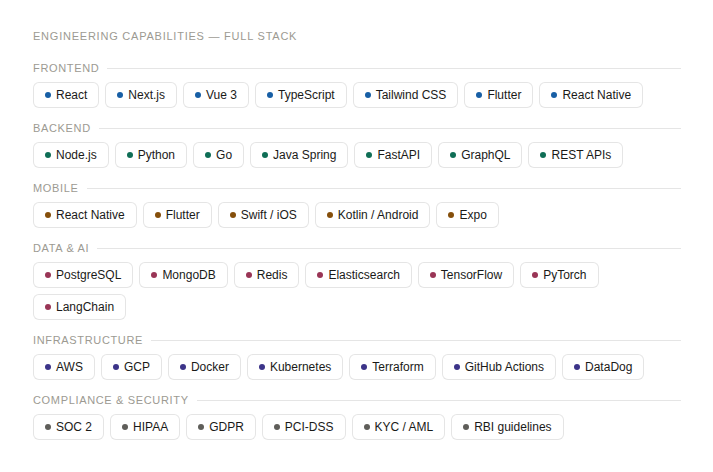
Indian software firms work across US, EU, UK, and APAC regulatory environments regularly. GDPR, HIPAA, SOC 2, PCI-DSS compliance work is not foreign territory. The EngineerBabu team has built HIPAA-compliant telemedicine platforms, SOC 2-certified SaaS products, and RBI-regulated fintech applications. Compliance is embedded in the delivery model, not bolted on at the end.
This is where I see the biggest misunderstanding from founders who’ve never outsourced before.
When done right, outsourcing software development to India doesn’t give you coders who implement tickets. It gives you a cross-functional product team — backend engineers, frontend developers, mobile developers, DevOps, QA, UI/UX designers, and product managers — operating under a single engagement model.
The EngineerBabu team built Khatabook’s initial product before their pivot into fintech. What that required was not just engineering execution.
It required a team that understood the bookkeeping problem, argued about feature prioritization, made architecture decisions that wouldn’t box them in when they scaled, and delivered in a timeline that kept pace with their funding rounds.
You don’t get that from a freelance marketplace. You get it from a firm with delivery systems built around product thinking.
The distinction between a “software development company” and a “product engineering company” sounds like marketing language. It isn’t. One builds what you spec. The other tells you when your spec is wrong.
I hear outsourcing framed as a cost play. It’s actually a scalability play that happens to have a cost benefit.
Building in-house means your team size is constrained by hiring capacity, not product roadmap. In a competitive market, the company that can scale engineering velocity faster wins.
Outsourcing to India gives you access to pre-assembled, production-tested teams that can onboard to a new product in 2-3 weeks, not 3-4 months.
When we built OpenMoney’s neobank platform — mutual fund integration, transaction infrastructure, the full stack — the team ramped from 0 to 12 engineers in under 3 weeks. That’s not a hiring pipeline. That’s a delivery model.
For a funded startup, this means you can hit product milestones at the pace your investors expect. For an enterprise, it means you can launch a new product line without cannibalizing your core engineering team’s bandwidth.
The elasticity works in both directions. You can scale a 4-person team to 12 for a major launch sprint, then right-size back to 6 for maintenance mode. That flexibility doesn’t exist with a full-time in-house team without significant organizational disruption.
According to reports, 59% of companies cite cost & speed of delivery as the primary driver for outsourcing technology work.
That finding matches what I see in practice. The founders who come to EngineerBabu after a failed local build are almost never primarily upset about money. They’re upset about time.
A mature Indian engineering firm has built the same class of product before. Not a similar product — the same class. That means:
The Simba Beer project is a good example. The EngineerBabu team built an AI-powered inventory management system with real-time field intelligence for their distribution network.
The reason we could deliver that in the timeline we committed to was that we’d solved 80% of the underlying architecture problems on prior projects. The client didn’t pay for our learning curve.
That’s what institutional pattern recognition looks like in a product engineering context. It’s worth more than the hourly rate arbitrage.
I’ve built 500+ products. I’ve also seen outsourcing fail. The failures cluster around 4 patterns:
Companies issue RFPs, collect 8 proposals, and choose based on price. Then they wonder why communication breaks down. Good outsourcing firms don’t win RFP processes. They win referrals. If you’re choosing a vendor through a competitive bid, you’re probably selecting from the wrong pool.
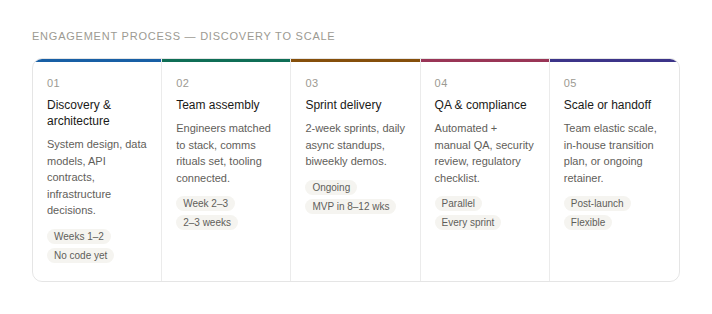
The first 2-3 weeks of any engagement should be almost entirely design and architecture. Not wireframes — system design, data models, API contracts, infrastructure choices. Companies that rush to code in Week 1 pay for it in Month 4 when refactoring costs more than the original build.
The time zone advantage becomes a disadvantage when there are no structured touchpoints. Daily async standups, weekly architecture reviews, biweekly sprint demos — these aren’t process overhead. They’re the mechanisms that keep remote teams aligned with product reality.
The cost benefit of Indian engineering talent is real. But if you’re choosing an Indian firm primarily because they gave you the lowest quote, you’re going to get what you paid for. The right frame is: “I can access senior talent at 4x better economics.” Not: “I can find engineers for cheap.”
This is the question I get most on calls, and it’s the one most articles don’t answer usefully.
Anyone can list logos. Ask for architecture documentation from a past project. Ask for the post-mortems on the hardest problems they solved. Ask them to explain a technical decision they made that the client didn’t initially agree with and how it played out.
In a 60-minute intro call, you’ll learn more from how they respond to ambiguous requirements than from their technical questions. Do they push back intelligently? Do they ask about business context or only technical specs? The engineers who ask why are the ones who build the right thing.
CMMI Level 5 — which EngineerBabu holds — is not a rubber stamp. It represents a verified, audited delivery process. For a client in a regulated industry, or for any product where reliability matters, this is table-stakes, not a differentiator.
A firm that has built 3 fintech products is not the same as a firm that has built 30. The learnings from lending stack architecture don’t transfer fully to generic CRUD applications. Match the firm’s industry depth to your product category.
Ask specifically: what tools do you use? How are escalations handled? What’s the SLA on response times? These questions reveal operational maturity quickly.
These terms get conflated and the confusion leads to bad sourcing decisions.
For most startups and mid-size companies, outsourcing to India makes more sense than offshoring because you get the cost benefit without building the HR, legal, and operational infrastructure that running a foreign entity requires.
The EngineerBabu team functions as an extension of your product organization without the overhead of it being your organization.
Nearshoring has time zone advantages over India for some European clients, but typically at 2-3x higher cost. For US clients, the India time zone overlap model works well enough that nearshoring’s marginal time zone benefit rarely justifies the cost premium.
The quality concern is legitimate. It’s also 10 years out of date as a blanket assumption.
The Indian software industry has gone through a massive quality bifurcation in the last decade.
On one end: commodity body-shopping firms that staff projects with junior engineers, optimize for billing hours, and measure success by whether they delivered the specified features.
On the other end: product engineering firms that have built with YC-selected founders, with VC-backed companies, and with enterprise clients who would not tolerate poor quality.
The mistake is treating these as the same market.
EngineerBabu has built 75 products for YC-selected companies. That happens because YC founders — who are arguably the most demanding, time-constrained, and quality-conscious product builders in the world — keep referring us to each other. They don’t refer vendors who ship mediocre work.
The pattern I’ve observed across 14 years: quality in outsourcing is not a function of geography. It’s a function of firm selection. A mediocre Indian firm will deliver mediocre work. A high-quality Indian firm will outperform a mediocre local agency on every dimension except physical proximity.
Hire for the firm’s track record, not the country’s reputation.
Not all product types benefit equally from Indian outsourcing. Here’s where the advantage is strongest:
Fintech and lending platforms. The EngineerBabu team has built products like EarlySalary, LoanOS, and OpenMoney. India has some of the deepest fintech engineering talent in the world, driven by UPI’s infrastructure, NBFC proliferation, and RBI regulatory frameworks that parallel international standards. If you’re building a lending platform, payment infrastructure, or neobank product, the institutional knowledge in Indian engineering firms is genuinely difficult to replicate elsewhere.
Enterprise SaaS. Multi-tenancy architecture, API-first development, microservices deployment, Kubernetes orchestration — Indian engineering teams at senior levels are building this daily across dozens of clients. The pattern recognition is strong.
Mobile-first consumer applications. India’s mobile-first market has produced extraordinary mobile engineering talent. React Native, Flutter, iOS/Swift, Android/Kotlin — the depth is real.
AI/ML integration. India’s position in Google’s AI Accelerator program (EngineerBabu was in the Top 20 globally in 2024) reflects a broader pattern. The country is producing strong AI/ML engineering talent, particularly for applied machine learning, NLP, and recommendation systems.
Healthcare technology. Telemedicine platforms, EHR integrations, HIPAA compliance engineering — there’s deep experience here, driven partly by India’s own healthtech boom.
Outsource when:
Build in-house when:
Hybrid approaches work well: outsource the initial build, then selectively hire in-house engineers to take ownership of core systems while maintaining the outsourced team for feature velocity.
If you’re evaluating software development outsourcing and want to talk through what the right structure looks like for your specific product — architecture decisions, team composition, timeline realities — I’m usually the one on those calls.
Not a sales team. Not an account manager. Me.
Write to me at mayank@engineerbabu.com or visit EngineerBabu directly. We take 20 projects a year. Every conversation starts with a no-obligation architecture discussion.
About the Author
Mayank Pratap is the co-founder of EngineerBabu, a CMMI Level 5 product engineering company with 500+ projects delivered across 20+ countries. He was recognized in Google’s AI Accelerator Top 20 globally in 2024 and has been a Harvard Innovation Labs participant.
Typical engagement costs range from $15,000-$30,000 for an MVP over 8-12 weeks, to $80,000-$200,000 for a full product build over 6-9 months. Dedicated team models run $18,000-$45,000/month for a 4-6 person team depending on seniority mix. These are fully-loaded costs. Compare to $400,000+ for equivalent in-house engineering capacity in the US or UK.
India is a signatory to the Berne Convention and TRIPS agreement. Properly drafted NDAs, IP assignment agreements, and work-for-hire clauses are legally enforceable under Indian contract law. Any reputable Indian engineering firm will sign these without hesitation. Source code access controls, private repositories, and staged access protocols provide additional protection.
IST is UTC+5:30. For US East Coast clients, this creates a 10.5-hour offset, which typically allows 1-2 hours of overlap in morning/evening. For UK/Europe clients, there’s a 4.5-hour offset with comfortable overlap. Most experienced Indian engineering firms have adapted their rhythms to create productive async delivery models. With proper tooling and communication protocols, the time zone gap becomes manageable within the first 2-3 weeks of engagement.
Look for: CMMI certification, NASSCOM membership, verifiable client references (not just logos), case studies with quantitative outcomes, and a willingness to walk through past architecture decisions in technical depth. Ask specifically about projects in your industry vertical. The conversation itself will tell you whether you’re talking to a vendor or a partner.
Yes, and this is where the quality bifurcation I mentioned earlier matters most. Firms that have scaled beyond commodity staffing have built enterprise-grade products repeatedly. The EngineerBabu team built LoanOS, a 7-module lending platform covering origination, underwriting, servicing, collections, and regulatory reporting. That’s not a simple product. Enterprise complexity is a capability question, not a geography question.