AI Credit Scoring Software Development: A Complete Guide


Create engaging, high-performance mobile applications tailored to your business needs. We craft future-ready apps that offer smooth user experiences on all devices.
Build robust and scalable websites and CMS platforms that help you manage content effortlessly. Our development ensures a seamless digital presence.
Launch secure, feature-rich online stores with intuitive shopping experiences. We build tailored eCommerce platforms designed for growth.
Design captivating games with immersive gameplay and stunning graphics. From concept to launch, we build engaging experiences that players love.
Enhance your customer relationships with customized Salesforce implementations. Drive growth and efficiency with smarter CRM solutions.
Harness artificial intelligence and machine learning to automate workflows and gain actionable insights. Our AI transforms data into smart decisions.
Accelerate your software delivery lifecycle with continuous integration, delivery, and infrastructure automation to boost efficiency.
Hire app developers ready to turn your ideas into sleek, high-performing mobile apps for any platform.
Bring in frontend pros who craft smooth, beautiful, and user-friendly interfaces that your visitors will love.
Get backend developers who build fast, secure, and reliable systems to keep everything running behind the scenes.
Hire eCommerce developers who build secure, scalable online stores designed to offer seamless shopping and grow your sales.
Get dedicated developers committed to your projects, delivering consistent quality and speed as an extension of your team.
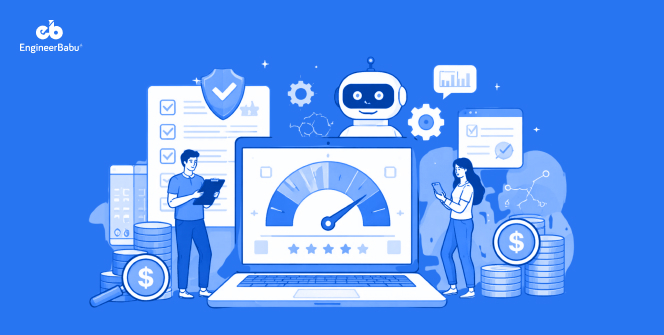
Banks rejected almost half of all personal loan applications in the U.S. in 2024 alone, as per CBS News. A significant portion of those rejections had nothing to do with the applicant’s actual ability to repay. They were denied because traditional scoring models couldn’t read the full picture.
That’s the problem AI credit scoring software development is solving right now, and the market is moving fast. According to Grand View Research, the global AI in fintech market is projected to reach USD 41.16 billion by 2030. Credit scoring sits at the center of that expansion.
If you’re a lender, neobank, or fintech building credit infrastructure, this guide covers what AI credit scoring software actually does, how to build it correctly.
Traditional credit scoring runs on a narrow band of inputs: payment history, credit utilization, length of credit history, and a handful of other bureau-reported signals. FICO has used a version of this model since 1989.
AI credit scoring software expands that signal set dramatically. It pulls in alternative data like rent payments, utility bills, cash flow patterns from bank accounts, employment consistency, and even behavioral data from loan application interactions.
It then uses machine learning models to weigh those signals against actual repayment outcomes across millions of historical records.
The result is a score that reflects creditworthiness more accurately, particularly for thin-file borrowers who look invisible to a traditional bureau model but are actually low-risk.
Not every lending operation needs the same architecture. Before starting AI credit scoring software development, you need to know which type of system matches your use case.
These systems start with standard bureau data and layer machine learning on top to improve prediction accuracy. They’re the fastest to build and the easiest to explain to regulators. Good entry point for traditional lenders moving into AI.
These are built specifically to assess borrowers who have little or no credit history. They ingest cash flow data, telecom records, rental history, and similar signals. This is the model fintechs like Tala and Upstart built their businesses on.
Designed for embedded lending, BNPL, and instant personal loans. The scoring happens in milliseconds at the point of transaction. These require a different infrastructure approach entirely because latency directly impacts conversion rates.
Ongoing AI models that continuously re-evaluate borrower risk throughout the loan lifecycle, not just at origination. They flag deteriorating repayment behavior before a borrower misses a payment, giving lenders time to act.
Developing AI credit scoring software requires a structured approach that combines data preparation, model selection, training, validation, and regulatory compliance.
Each step plays a critical role in ensuring the system delivers accurate, fair, and explainable credit decisions.
Start with the actual lending decision, not the technology. Are you scoring applicants for personal loans, credit cards, BNPL products, or SME lending? Each one has a different risk profile, a different data environment, and different regulatory exposure.
A team building a BNPL scoring engine needs sub-200ms response times and handles thin-file applicants almost exclusively. A team building SME credit software needs to parse business financials, director credit history, and industry-level risk.
These are fundamentally different products, and treating them as the same during planning creates serious problems downstream.
The quality of a credit scoring model is entirely determined by the quality of the data going into it. This step takes longer than most teams expect, and rushing it is the single biggest cause of model failure.
For bureau-augmented models, you’ll need clean data feeds from credit bureaus like Experian, Equifax, or CIBIL. For alternative data models, identify which signals you have legal access to and how you’ll ingest them consistently.
Bank account data requires open banking API integrations. Rental and utility data typically comes through data aggregators. Telecom data requires operator partnerships.
AI credit scoring software development that skips this step ends up training models on garbage and wondering why predictions underperform.
The model architecture depends on the data you have and the interpretability requirements you’re working under.
Most production credit scoring systems use an ensemble approach, combining a gradient boosting model for the primary score with logistic regression outputs for regulatory reporting.
Raw data doesn’t go directly into a credit model. It gets transformed into features that the model can actually learn from. This layer is where most of the real work in AI credit scoring software development happens.
For bank statement data, that means computing features like average monthly inflow, income volatility and savings behavior over rolling 3, 6, and 12-month windows. For bureau data, it means calculating derived metrics beyond the raw tradeline counts.
The feature engineering pipeline needs to be reproducible and version-controlled. If the features used to generate a historical training score change, you need to be able to recreate exactly what the model saw at the time of that decision.
Split historical data carefully. Training, validation, and test sets need to be time-separated, not randomly sampled. Randomly splitting loan data leads to data leakage because a loan originated in January and one originated in December of the same year share economic context.
Time-based splits prevent that.
Key metrics to track: GINI coefficient, KS statistic, AUC-ROC, and population stability index. These are indeed tough to consider, that’s why most businesses prefer experienced lending software development companies to create AI credit scoring softwares.
The model outputs a probability of default. The decisioning engine converts that into a lending action: approve, decline, or refer to manual review. This layer involves more business logic than most people expect.
It needs to apply cutoff scores calibrated to your risk appetite, enforce regulatory rules like fair lending requirements and handle edge cases that pure model output doesn’t cover cleanly.
Build this as a separate configurable layer, not hardcoded into the model output. Risk appetite changes. Regulatory requirements shift.
Product teams adjust underwriting criteria regularly. A decision engine that requires a model retrain every time a policy changes will slow you down constantly.
In regulated markets, a lender that declines a credit application must be able to provide an adverse action notice explaining why. That means the software has to produce human-readable reasons behind every decision, not just a score.
SHAP values are the standard approach for extracting feature-level explanations from gradient boosting and ensemble models. They assign a contribution score to each input variable for each individual prediction.
The top adverse factors become the basis for the decline in the reason codes sent to the applicant.
A credit scoring model is not a one-time deployment. Borrower behavior shifts with economic conditions. Data pipelines break silently. Feature distributions drift as the applicant population changes.
Without continuous monitoring, a model that starts strongly degrades without anyone noticing until default rates spike.
Build automated monitoring for score distribution shifts, feature drift, and model performance against actual repayment outcomes on a monthly basis. Set up alerts when PSI exceeds thresholds.
Establish a governance process for model retraining cycles and version management.
A basic ML-powered scoring API development with bureau integration and a simple decisioning layer typically runs between $10,000 and $12,000.
A mid-tier platform with alternative data ingestion, real-time decisioning, explainability, and monitoring infrastructure generally falls between $15,000 and $30,000.
An enterprise-grade system with multi-model support, full regulatory compliance tooling, and deep third-party integrations can exceed $50,000 depending on market and scope.
Development timelines range from four to six months for an MVP development to ten to fourteen months for a full production platform.
Training on historical approvals only is a critical and common mistake. If your training data only includes borrowers who were approved under the old model, the new model inherits the same biases.
You need to run a random sampling experiment or use reject inference techniques to estimate the risk profile of historically declined applicants.
Treating fairness as an afterthought is another. Fair lending laws in the U.S. require that protected class attributes like race, gender, and national origin don’t drive credit decisions, directly or as proxies.
Some alternative data signals, like zip code or certain spending patterns, can function as proxies. Test for disparate impact before deployment, not after.
Skipping champion-challenger testing before full rollout costs teams enormously. Always run the new model in parallel against your existing decisioning logic before it takes over. Real-world performance on live applicants will surprise you.
AI credit scoring software development is genuinely complex, but the complexity is manageable when you approach it systematically.
The market for alternative credit scoring is still early enough that a well-built platform creates real competitive advantage. Get the data pipeline, model architecture, and explainability layer right, and the rest follows.
If you’re building credit infrastructure and want a development partner, EngineerBabu has worked with fintech startups and financial institutions to build production-grade ML platforms from the ground up.
Bank account transaction data, utility and rent payment history, telecom records, employment verification data, and behavioral signals from the loan application process are all used depending on the product and market.
It can be, but only with deliberate design. Models need to be tested for disparate impact on protected classes, and certain proxy variables need to be excluded. Explainability tooling is required for adverse action notices in regulated markets.
Most production models are retrained quarterly at minimum. Economic shifts, changes in applicant pool composition, or significant PSI drift can require off-cycle retraining.
Yes. Most implementations expose a REST API that connects to loan origination systems. The scoring engine runs as a service the LOS calls at the point of decision.