AI Claims Processing Software Development for Insurers


Create engaging, high-performance mobile applications tailored to your business needs. We craft future-ready apps that offer smooth user experiences on all devices.
Build robust and scalable websites and CMS platforms that help you manage content effortlessly. Our development ensures a seamless digital presence.
Launch secure, feature-rich online stores with intuitive shopping experiences. We build tailored eCommerce platforms designed for growth.
Design captivating games with immersive gameplay and stunning graphics. From concept to launch, we build engaging experiences that players love.
Enhance your customer relationships with customized Salesforce implementations. Drive growth and efficiency with smarter CRM solutions.
Harness artificial intelligence and machine learning to automate workflows and gain actionable insights. Our AI transforms data into smart decisions.
Accelerate your software delivery lifecycle with continuous integration, delivery, and infrastructure automation to boost efficiency.

TL;DR
Carriers rarely lose money on the hard claims. They lose it on the thousands of routine ones that still pass through six sets of human hands.
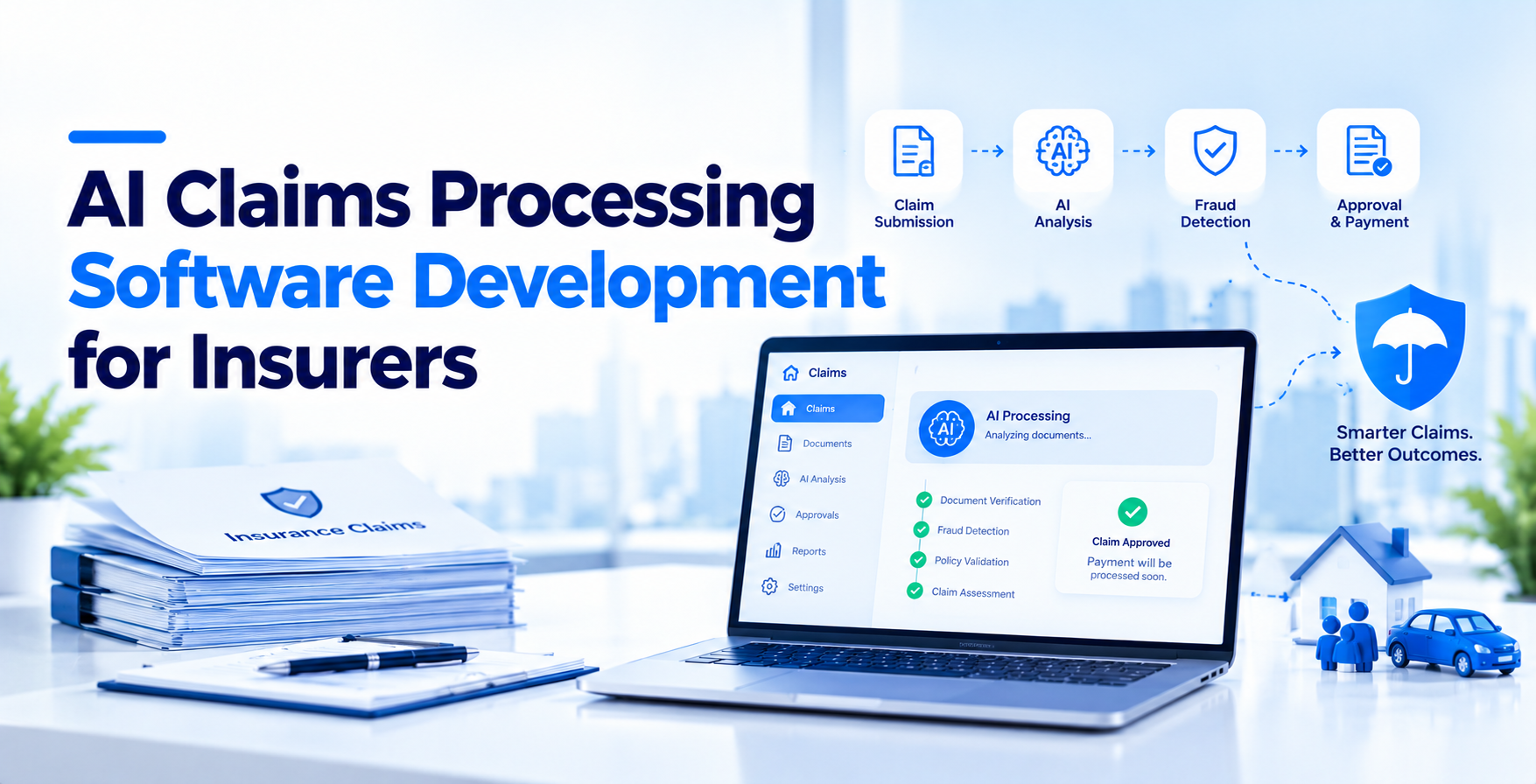
AI claims processing software development is the work of building systems that ingest a claim, understand its documents, assess its risk, and either settle it or route it to an adjuster with a reason attached. It sits on top of your policy admin system rather than replacing it.
The goal is not full autonomy. It is moving the simple 60% of your claim volume through without a human queue, so adjusters spend their day on the claims that genuinely need judgment.
Three things change once the system is live. Cycle time on low-complexity claims drops from days to minutes. Leakage shrinks because coverage checks run against policy terms instead of memory. And fraud signals surface at intake rather than after payout.
The honest caveat is that none of this arrives from a model alone.
Most of the value in AI claims processing software development comes from clean data plumbing between your insurance software development stack, your document store, and your payment rails.
The models are the visible part. The integration is the expensive part.
Every carrier’s claim flow differs, but the architecture underneath is consistent. Build it as five discrete stages so you can measure, retrain, and roll back each one independently.
First notice of loss is where structure gets created or lost forever. A conversational intake layer collects loss details through chat, voice, or a form, then normalizes everything into a single claim object.
Triage runs immediately after. A classifier predicts complexity, estimated severity, and likely handling path, then assigns the claim to a straight-through lane or an adjuster queue.
Carriers that pair this with insurance mobile app development get photo and geolocation capture at the moment of loss, which improves every downstream model.
Claims arrive as police reports, repair estimates, medical bills, and phone photos. An extraction layer converts all of it into structured fields with confidence scores attached.
Text documents run through an AI document processing platform development approach combining OCR with a layout-aware model. Damage photos go through computer vision software development models trained on labeled loss imagery. Anything below your confidence threshold routes to human review instead of guessing.
This stage decides whether the loss is actually covered, and for how much. The system pulls the policy in force on the loss date, applies deductibles, sublimits, and exclusions, then produces a coverage position with the clauses it relied on.
Rules engines still beat models here. Coverage logic has to be deterministic and explainable, so AI claims processing software development usually keeps this stage rule-driven while using models only to interpret ambiguous policy language for a human reviewer.
Fraud scoring works on patterns, not single claims. The model compares the current claim against the claimant’s history, provider or repair shop behavior, timing anomalies, and network links to other claims.
Build this with a gradient-boosted model on structured features plus a graph layer for relationship detection. Proper machine learning development services work matters because fraud labels are scarce and imbalanced. Score thresholds should trigger investigation, never automatic denial.
Approved claims need a settlement amount, a payment instruction, and a reserve update written back to the core system. This is where most pilots quietly stall, because writing back is harder than reading out.
Clean API development between the claims engine, the policy admin system, and the disbursement provider keeps this reliable. Build idempotency into every payout call so a retry never pays the same claim twice.
Python with PyTorch or scikit-learn handles the modeling layer for most carriers. Document extraction typically combines a commercial OCR service with a fine-tuned transformer, since generic models handle claim forms poorly.
Orchestration deserves more thought than teams give it. A multi-agent AI system pattern works well when extraction, coverage, and fraud each run as separate services coordinated by a workflow engine like Temporal or Airflow.
Every decision gets logged with its inputs, model version, and confidence, which is also what makes explainable AI in fintech practical rather than theoretical.
Four phases move a carrier from claim data to a production pipeline. Sequence matters more than speed.
Pull two to three years of closed claims and check what is actually usable. Most carriers discover that adjuster notes are free text, document scans are inconsistent, and loss cause coding is unreliable. Spend four to six weeks labeling a representative sample across claim types and severity bands.
This dataset becomes the foundation for every model you train later, and skipping it is the single most common reason pilots produce impressive demos and unusable production accuracy.
Narrow beats broad. Choose a high-volume, low-severity line such as auto glass, small property, or simple travel claims. Build the full five-stage pipeline for that line only, including the write-back to your core system.
A working end-to-end flow on one line teaches you more about AI claims processing software development than five half-finished experiments across the book, and it gives your compliance team something concrete to review.
Put the pipeline alongside your adjusters without letting it decide anything. Every claim gets processed by both, and you compare outcomes daily for six to eight weeks. Track agreement rate, false positives on fraud, and extraction accuracy per document type.
Shadow mode is where you discover edge cases that never appeared in training data. It also builds adjuster trust, which determines whether the system gets used or quietly bypassed after launch.
Go live with conservative automation limits, such as straight-through settlement only below a set claim value and above a set confidence score. Measure leakage, reopen rate, and complaint volume weekly. Widen the thresholds only when the numbers hold for a full cycle.
Thoughtful AI integration means the system earns more autonomy over time instead of being handed all of it on day one.
Claims decisions are regulated decisions. State unfair claims practices acts set response and settlement timelines that your automation must respect, not just beat. Any adverse decision needs a documented reason the claimant can receive in writing.
Model governance now carries real weight too. Several states have issued bulletins on insurer use of AI, requiring documented testing for disparate impact and a named owner for each model.
Treat this as compliance automation software development work, with immutable decision logs, model version tracking, and a human override path on every automated outcome.
A single-line pilot covering intake, extraction, and triage typically runs $90,000 to $180,000 across three to five months.
Adding fraud scoring, coverage logic, and core system write-back pushes a production build to $250,000 to $600,000 over eight to fourteen months.
Costs scale with integration surface, not model count. A carrier on a modern cloud core finishes far faster than one on a mainframe with batch-only interfaces.
Ongoing spend sits around 18 to 25% of build cost annually for retraining, monitoring, and drift correction, which is in line with broader AI in fintech software development programs.
EngineerBabu builds claims platforms for insurers that need the model work and the unglamorous integration handled by the same team.
That covers document extraction, fraud scoring, coverage rules, and the write-back path into legacy core systems.
The delivery runs on a CMMI Level 5 process with senior engineers staying on the project, and the AI development work is grounded in production systems rather than pilots. Carriers get a pipeline their compliance team can actually sign off on.
AI claims processing software development pays off when it is scoped as a workflow problem with models inside it, not as a model problem with a workflow attached.
Carriers that pick one line, run it in shadow, and widen thresholds slowly end up with systems adjusters trust.
The ones chasing full automation across the book on day one usually end up back in the queue they started with.
It is the process of building software that automates claim intake, document extraction, coverage checks, fraud scoring, and settlement using machine learning and rules, while keeping human review on complex or adverse decisions.
Most carriers reach straight-through processing on 40 to 65% of low-severity claims within two years. Complex liability, injury, and large property claims stay with adjusters.
It creates governance obligations rather than new risk. You need documented model testing, decision logging, disparate impact review, and a human override path on every automated outcome.
Yes, though integration becomes the main cost driver. Carriers on batch-only mainframes usually add three to five months for middleware and write-back work.
Most carriers see payback in 14 to 24 months, driven mainly by cycle time reduction and leakage control rather than headcount savings.