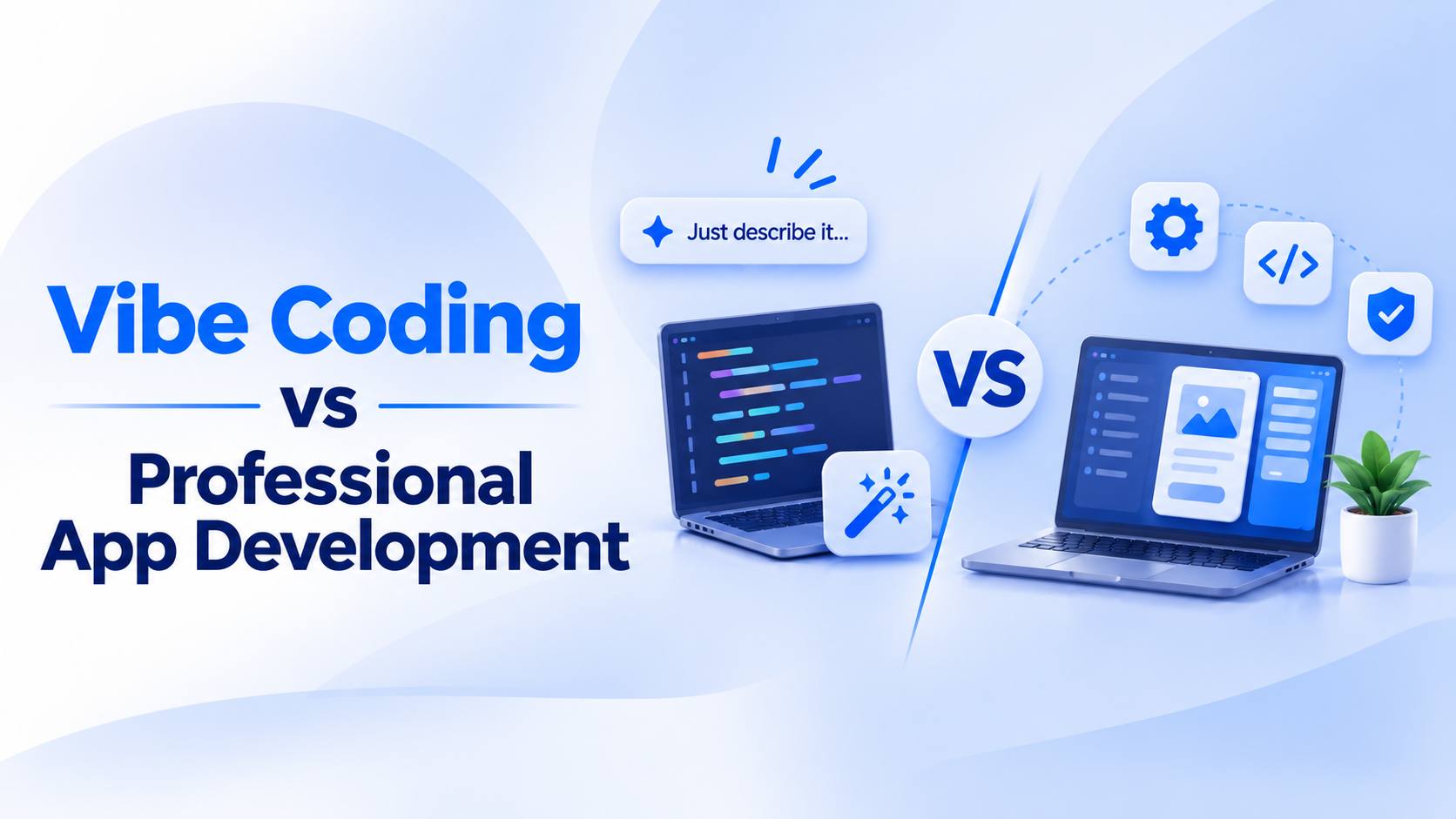
Vibe Coding vs Professional App Development: Where Each Fits


Create engaging, high-performance mobile applications tailored to your business needs. We craft future-ready apps that offer smooth user experiences on all devices.
Build robust and scalable websites and CMS platforms that help you manage content effortlessly. Our development ensures a seamless digital presence.
Launch secure, feature-rich online stores with intuitive shopping experiences. We build tailored eCommerce platforms designed for growth.
Design captivating games with immersive gameplay and stunning graphics. From concept to launch, we build engaging experiences that players love.
Enhance your customer relationships with customized Salesforce implementations. Drive growth and efficiency with smarter CRM solutions.
Harness artificial intelligence and machine learning to automate workflows and gain actionable insights. Our AI transforms data into smart decisions.
Accelerate your software delivery lifecycle with continuous integration, delivery, and infrastructure automation to boost efficiency.
TL;DR
Vibe Coding vs Professional App Development has moved from developer forums into budget meetings. Vibe coding means prompting an AI tool until working code appears on screen.
Professional app development means engineering a system that survives traffic spikes, security audits, and the next three feature releases. Both approaches produce something that runs. Only one produces something you can confidently sell, scale, and maintain.
This guide draws the line plainly: what vibe coding is genuinely good at, where it quietly falls apart, and why any product carrying payments, patient data, or paying customers still belongs with professional engineers.
Vibe coding is writing software by describing it. You prompt an AI assistant, it returns working code, and you keep prompting until the screen behaves the way you pictured. You are reviewing output, not architecture.
Most of the Vibe Coding vs Professional App Development confusion starts right here, because both paths produce a working screen on day one. The term covers a founder building an internal dashboard over a weekend and a marketer shipping a signup page by Friday.
It sits near, but is not the same as, low-code platform development, where you assemble pre-built blocks inside guardrails. Vibe coding has no guardrails at all. An AI will happily generate a payment flow, a database schema, and an auth system in one sitting.
None of it gets reviewed by anyone who understands why those three things are dangerous together. That is the gap the custom app vs no-code app debate usually skips over.
Professional app development reverses the order of operations. Requirements first, architecture second, code third, and review across all of it. A team decides how data is modeled, how services communicate, how failures are handled, and who gets paged at 2 AM.
It includes the work that never appears in a demo. Proper version control with branching discipline. Automated and manual application testing across devices, networks, and edge cases. Security review, load testing, structured logging, documentation, and a deployment pipeline that can roll back cleanly.
This is the part buyers consistently underprice in the Vibe Coding vs Professional App Development comparison. You are not paying for screens. You are paying for the app still working in month eighteen, with four engineers who joined later able to change it without fear.
This section places both approaches side by side on the factors that decide real project outcomes. The gaps rarely show in the first demo, which is exactly why they catch teams off guard later. Read it as a map of where each method earns its keep.
| Factor | Vibe coding | Professional app development |
| Time to first working screen | Hours | Weeks |
| Architecture | Implied by the AI | Designed before code is written |
| Code ownership | Often nobody | Documented, reviewed, assigned |
| Security | Rarely tested | Built in and independently audited |
| Scaling past early traffic | Usually a rewrite | Planned from the start |
| Compliance readiness | Not addressed | HIPAA, PCI DSS, and GDPR handled |
| Three-year cost | Low, then spikes hard | Higher upfront, predictable after |
| Honest best fit | Internal tools, prototypes | Products with users and revenue |
Vibe coding wins the first week by a wide margin. You get a clickable product while a traditional team is still mapping user flows. That win is real and worth using.
The problem arrives at launch. Payment edge cases, session handling, offline states, and error recovery are where AI-generated code tends to be confidently wrong. Teams then spend six weeks debugging logic nobody wrote on purpose.
Professional app development front-loads that thinking instead. The first screen takes longer, but the launch date actually holds. Founders comparing quotes also misread mobile app development cost here, because the cheap path bills its real price later.
When an engineer writes a module, somebody can explain every decision inside it. When an AI writes it across forty prompts, that explanation does not exist anywhere.
That matters the day a bug appears in production. Debugging code you never reasoned about is slow, and it gets slower as the codebase grows past a few thousand lines.
Professional teams solve this with code review, naming conventions, and documentation written while the context is fresh. It feels like overhead until the original builder leaves. Then it becomes the only reason the product survives the handover.
A vibe-coded app can look like a ninety percent discount. For a weekend prototype, that number is honest.
For a revenue product, the math inverts. Rewrites, emergency security patches, and failed scaling attempts all land in year two. Teams that skipped planned mobile app maintenance and support usually pay more than a clean build would have cost.
Gartner predicts that by 2028, 90% of enterprise software engineers will use AI code assistants, up from less than 14% in early 2024 (Gartner). Professionals are adopting these tools too. The difference is that they review what comes out.
Vibe coding is not a scam, and dismissing it outright is lazy advice. It has a real zone where it beats every alternative on speed and cost. The rule is simple: use it where failure is cheap and nobody outside your company is affected.
An ops dashboard, a reporting view, or a quick admin panel for your own staff is ideal territory. Ten people use it, the data never leaves your network, and a bug costs an afternoon.
Build it in a day and move on. Hiring engineers for this work is genuinely wasteful.
When you need to show an idea rather than ship it, vibe coding is excellent. You can test three concepts in the time a team would scope one.
Just label it a prototype internally and resist shipping it. The MVP vs full-scale development distinction matters most here, because a demo that impresses people often gets promoted to production by accident.
Scripts, data cleanups, one-off migrations, and glue between two tools you already pay for are low-risk wins. The blast radius is small and the code is disposable by design.
Keep these outside your main codebase. Once AI-generated glue starts shipping with your product, you have quietly crossed into territory it was never built for.
This is the larger half of the Vibe Coding vs Professional App Development decision, and it covers almost anything with customers attached. The deciding question is whether failure costs money, trust, or legal exposure. If the answer is yes, engineering discipline stops being optional.
Fintech, healthcare, and lending products face auditors, not just users. Encryption standards, consent logging, access controls, and audit trails must be designed, documented, and proven.
An AI assistant does not know your regulator. Professional teams build API development against those requirements from the first sprint, because retrofitting compliance into a working app usually means rewriting it.
Vibe-coded apps often perform beautifully with fifty users and collapse at five thousand. Database queries that never got indexed, synchronous calls that should have been queued, and no caching layer anywhere.
Teams that plan to build scalable custom apps make these choices before traffic arrives. Fixing them afterward means taking the product down during your best growth month.
The moment two people edit the same codebase, conventions matter. Shared patterns, tests, and review gates are what stop a team of five from producing five incompatible styles.
AI-generated code tends to be internally inconsistent across sessions. That inconsistency compounds quickly, and onboarding a new developer into it takes weeks instead of days.
This section covers the failures that show up after launch, not during the build. They are predictable, well documented, and expensive. Understanding them is the strongest argument in the Vibe Coding vs Professional App Development debate.
Research from the Cloud Security Alliance found AI-assisted commits leaked secrets at 3.2%, against a 1.5% baseline for human-only commits (Cloud Security Alliance, 2026). Hardcoded keys, missing CSRF protection, and unvalidated inputs are common patterns.
AI writes code that works. It does not reliably write code that resists attack. Running a proper web application security checklist against a vibe-coded app usually surfaces findings within the first hour.
New features require understanding existing logic. When nobody can explain the current logic, every change becomes a guess followed by a regression.
This is where velocity dies. Teams start rewriting modules instead of extending them, which is one of the costliest mobile app development mistakes a funded startup can make.
Investors and enterprise buyers ask for architecture documentation, security reports, and code review history. Vibe-coded products typically have none of it.
Deals stall, procurement cycles extend, and the engineering debt becomes a valuation discussion. Fixing it under deadline pressure is the worst possible time to do it.
Many teams land here after validating an idea quickly, which is a good outcome, not a failure. The path forward is structured rather than dramatic. These steps convert a working prototype into something you can defend in front of auditors and engineers.
Start with a full read of the codebase by a senior engineer. Map every external dependency, API key, and data flow. Identify what handles user data, what touches payments, and what runs without any error handling.
Expect surprises, including libraries nobody chose deliberately. Document the findings as a prioritized risk list rather than a rewrite proposal. Some modules will be fine. Others will need replacing before a single additional user signs up. This audit usually takes under two weeks and prevents far more expensive decisions later.
Rotate every credential the AI generated or embedded. Move secrets into a managed vault, add input validation across all endpoints, and enable proper authentication and session handling.
Run a dependency scan and patch anything flagged. Add rate limiting and logging so attacks become visible instead of silent. This step is non-negotiable, and it comes before new features, redesigns, or performance work. If your product handles payments or health records, bring in a specialist reviewer here rather than trusting an internal pass.
You do not need a full rewrite. Keep the user flows your prototype validated, since that insight is genuinely valuable, and rebuild the layers underneath them.
Redesign the data model, introduce proper service boundaries, and add a real testing suite. Structured MVP development work usually covers this stage cleanly. Treat the vibe-coded version as a detailed specification written in code, then engineer the production version against it with architecture decided upfront.
Put a CI/CD pipeline in place with automated tests running on every commit. Add monitoring, error tracking, and alerting so failures reach a human quickly.
Write deployment and rollback procedures that someone other than the original builder can follow. Establish a release cadence and a maintenance budget. This is unglamorous work, and it is the difference between an app that runs and a product a business can rely on through its second year.
| Your situation | Realistic choice |
| Testing an idea this week | Vibe coding |
| Internal tool for your own team | Vibe coding |
| Paid product with real customers | Professional app development |
| Fintech, healthcare, or lending | Professional app development |
| Raising a round in six months | Professional app development |
| Prototype that users already love | Rebuild professionally, keep the flows |
Two questions settle most of these calls quickly. First, what happens if this app leaks data or goes down for a day? Second, who maintains it twelve months from now? If either answer makes you uncomfortable, the decision is already made.
Teams weighing delivery models should also read our guide on in-house vs agency app development before committing budget, and the custom vs off-the-shelf apps comparison covers a related tradeoff.
EngineerBabu works at the production end of this spectrum. The team builds custom iOS, Android, and web products across fintech, healthtech, and AI, delivered through a CMMI Level 5 process with senior engineers staying on the project.
That matters specifically for teams arriving with a vibe-coded prototype. The work is not starting over. It is auditing what exists, securing it, rebuilding the architecture underneath, and shipping something that holds under load and inspection.
The company also uses AI tooling internally, and applying AI in mobile app development is part of how delivery stays fast. The difference is review. Every line generated still passes through engineers who are accountable for it in production.
The Vibe Coding vs Professional App Development question is not really about which approach is better. It is about matching the method to the stakes.
Vibe code your experiments, your internal tools, and your throwaway demos. Then stop. The moment a real customer, a payment, or a regulator enters the picture, you need engineering that someone owns and can defend.
Teams that respect that boundary get the speed of one approach and the durability of the other. Teams that ignore it usually pay for the professional build anyway, just twice and under pressure.
Planning a production build, or sitting on a prototype that outgrew itself? Talk to the EngineerBabu team about scoping it properly.
No. It shifts developer time from writing boilerplate to reviewing, securing, and architecting. Demand for engineers who can audit AI output and own production systems is currently increasing, not shrinking.
It typically runs 40 to 70 percent of a clean build, depending on how much of the data model and security layer survives review. A code audit gives you an accurate figure first.
Increasingly rarely for technical diligence. Investors now request architecture documentation, security reports, and review history. Prototypes pass early conversations but usually trigger engineering conditions before a term sheet closes.
You generally own the output, but licensing depends on your AI tool’s terms and any training-data claims. Legal teams in regulated industries often require a provenance review before launch.
Cursor, Claude Code, GitHub Copilot, Lovable, Replit, and Bolt dominate current usage. Capability differs sharply between prototyping tools and assistants built for existing production codebases.