Digital Gold App Development: Features, Cost & Tech


Create engaging, high-performance mobile applications tailored to your business needs. We craft future-ready apps that offer smooth user experiences on all devices.
Build robust and scalable websites and CMS platforms that help you manage content effortlessly. Our development ensures a seamless digital presence.
Launch secure, feature-rich online stores with intuitive shopping experiences. We build tailored eCommerce platforms designed for growth.
Design captivating games with immersive gameplay and stunning graphics. From concept to launch, we build engaging experiences that players love.
Enhance your customer relationships with customized Salesforce implementations. Drive growth and efficiency with smarter CRM solutions.
Harness artificial intelligence and machine learning to automate workflows and gain actionable insights. Our AI transforms data into smart decisions.
Accelerate your software delivery lifecycle with continuous integration, delivery, and infrastructure automation to boost efficiency.
Hire app developers ready to turn your ideas into sleek, high-performing mobile apps for any platform.
Bring in frontend pros who craft smooth, beautiful, and user-friendly interfaces that your visitors will love.
Get backend developers who build fast, secure, and reliable systems to keep everything running behind the scenes.
Hire eCommerce developers who build secure, scalable online stores designed to offer seamless shopping and grow your sales.
Get dedicated developers committed to your projects, delivering consistent quality and speed as an extension of your team.
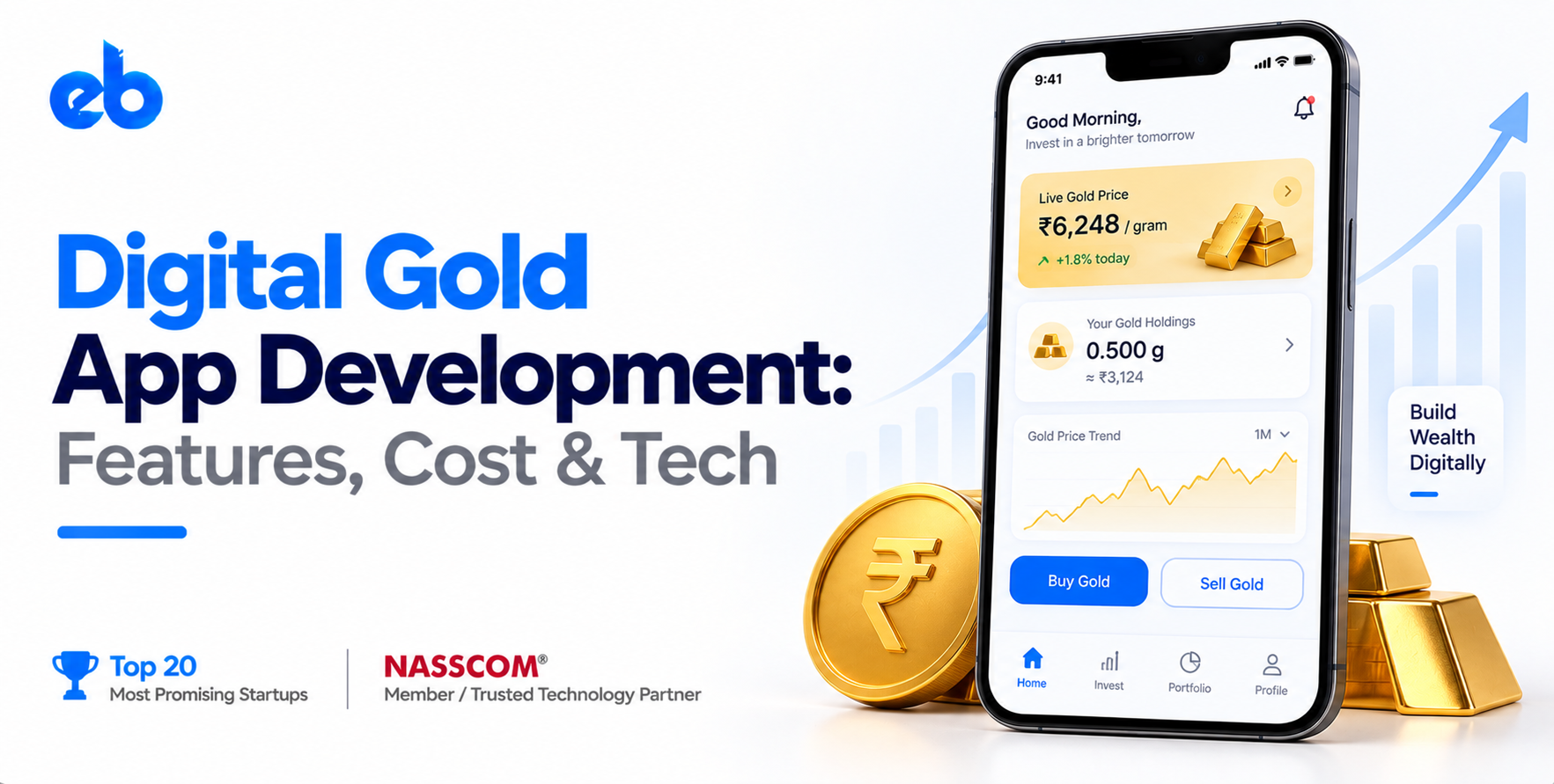
A digital gold app development is not a gold-price display screen. It is a custody and ledger product where the buy button is the easy part and the reconciliation behind it is the actual business.
To build a digital gold app you need three systems: a gold API integration for live pricing and custody, an internal ledger and reconciliation engine, and a compliance layer wired into every transaction.
A launch-ready MVP realistically costs ₹18 lakhs to ₹28 lakhs and takes 10 to 14 weeks, depending on how much of the gold infrastructure you build versus license from an API provider.
EngineerBabu builds these fintech-grade products end to end, from gold API integration to ledger reconciliation and compliance workflows.
At 9:15 PM, someone in Indore buys ₹500 of digital gold on a UPI-linked app, minutes after her salary credit lands. She won’t open the app again for three weeks, until a festival offer notification brings her back to buy ₹1,000 more.
That single behavior is the entire business.
To build a digital gold app, you are not building an investing screen bolted onto a live price feed. You are building a custody and ledger product that happens to trade in grams of gold. The price feed matters. The ledger matters more. And compliance is what keeps the whole thing solvent.
The numbers stopped being anecdotal a while ago. India’s Digital Gold and WealthTech Platforms market is now valued at roughly INR 155 billion, according to a February 2026 Research and Markets report, driven by UPI-linked payment adoption and mobile-first investing.
What makes that interesting is where the growth is coming from. Not gold buyers walking into an app the way they’d walk into a jewellery store. Small, repeat, occasion-triggered purchases: salary day, a festival, a gift for a niece’s birthday.
The category also has unusually resilient repeat behavior. World Gold Council data shows India’s gold demand reached 797.3 tonnes in 2024 with millennials driving 34% of that growth, yet AMFI figures from 2025 show only 12% of urban Indians under 35 currently own gold digitally. That gap is why founders keep trying to build a digital gold app instead of chasing more crowded fintech categories.
Before any feature list, be clear about the money flow.
Users buy gold at the prevailing spot price plus a spread. That spread, along with 3% GST on every purchase, is where the platform’s margin actually lives. Sell-back happens at a lower quoted price than buy, and that gap funds storage, insurance, and operations.
Secondary revenue shows up later: minting and delivery fees on physical redemption, and cross-sell into adjacent products like gold-backed lending or a broader multi-asset wealth platform. That expansion only works once the core buy, sell, and reconciliation loop is solid.
Sequence matters here. Buy, sell, and reconciliation first. Everything else second.
Split the build into three surfaces. Most teams underestimate the second and third.
This is the side that decides whether you have a compliant business at all. KYC review queues, AML flags, dispute and refund handling, spread and pricing controls, and redemption fulfillment tracking all live here. If this panel is an afterthought, your compliance team finds out the hard way during an audit.
Every buy or sell order has to match a corresponding confirmation from your gold API provider, in near real time, with a full audit trail. This layer, not the price ticker, is what an auditor or regulator will actually look at.
Do not launch with SIP, redemption, and multi-provider failover on day one. Lock the MVP to registration, KYC, live pricing, buy, sell, and a holdings dashboard on a single API provider. Teams that treat this as a structured MVP build reach paying users faster than teams that build everything at once.
Integrate with Augmont, SafeGold, or MMTC-PAMP for live pricing, purity guarantees, and vault custody. Building this yourself means becoming a bullion custodian, which is a different business than the one most founders are trying to start.
This is your internal system of record for what each user owns, independent of the vendor’s dashboard. It is what lets you add a second API provider later, or expand into a new asset class, without a rebuild.
Handle the edge cases now, not later: gold prices changing mid-transaction, partial-gram rounding, and payment failures that leave a user’s wallet in an ambiguous state. The ledger logic here resembles what a fintech-grade transaction system needs, and it deserves the same rigor.
Ship to one payment flow or one city first and watch three metrics: first-purchase conversion, repeat purchase rate within thirty days, and average ticket size on recurring plans. Then fix whichever one is weakest, usually the recharge flow or a spread disclosure that reads as untrustworthy.
Keep it boring and scalable.
| Layer | Recommended choice |
| Mobile apps | Flutter or React Native for one codebase |
| Backend | Node.js or Java microservices, with a separate billing service |
| Database | PostgreSQL for the ledger, Redis for session and cache state |
| Real-time pricing | WebSocket feed from your gold API provider |
| Gold custody engine | Augmont, SafeGold, or MMTC-PAMP |
| Payments | Razorpay, Cashfree, or a UPI-linked payment stack |
Cross-platform is the pragmatic default for launch. Partnering with a team experienced in fintech app development saves you from the usual trap, which is a clean-looking app with a ledger that silently drifts out of sync with the vendor’s records.
Skip the idea of AI replacing human trust in custody. Users are trusting that their gold is actually sitting in a vault, not that an algorithm picked the right moment to buy.
AI earns its place in three narrower spots. Personalized SIP nudges that time recharge reminders around salary cycles lift retention measurably. Fraud and AML anomaly detection on transaction patterns catches structuring attempts before they become a compliance incident. And churn prediction flags dormant wallets so you can time a re-engagement offer instead of a generic blast.
Pricing depends on scope, and on how much of the gold infrastructure you build versus license.
| Scope | What you get | Estimated cost |
| MVP | KYC, live pricing, buy, sell, holdings dashboard, single API provider | ₹18-28 lakhs |
| Growth build | Recurring SIP, physical redemption, dual-provider failover | ₹45-65 lakhs |
| Full platform | Multi-asset wealth product, digital gold as the first of several asset classes | ₹1-1.5 crore |
Add ongoing costs most estimates hide: gold API transaction fees, payment gateway charges, cloud infrastructure, and 15% to 20% of build cost annually for maintenance and compliance updates.
If you are planning to build a digital gold app, the hard parts are not the price ticker or the buy button. They are ledger accuracy, reconciliation against your API provider, and a compliance layer that survives an audit.
EngineerBabu builds exactly this kind of fintech-grade product, with a CMMI Level 5 delivery process, senior engineers who stay on the project, and experience across lending, wealth, and consumer fintech systems.
The company has worked with four unicorn clients and supported 200+ VC-funded products, including the lending stack behind EarlySalary, now past ₹10,000 crore in disbursements.
Digital gold apps do not win because their price ticker updates half a second faster. They win by making a ₹500 purchase feel as safe and simple as a UPI transfer, and by making the reconciliation behind it invisible to the user and airtight to a regulator.
Build that trust first. Everything else is a phase-two feature.
Ready to scope your build? Talk to the EngineerBabu team about your digital gold app.
A focused MVP with KYC, live pricing, buy, sell, and a holdings dashboard takes roughly 10 to 14 weeks. Adding recurring SIP investing, physical redemption, and dual-provider failover typically extends the timeline to 5 to 7 months.
Not at launch. Licensed providers like Augmont, SafeGold, and MMTC-PAMP give you accurate live pricing, guaranteed purity, and insured vault custody from day one. Most teams never build this layer themselves; they build the ledger and compliance layer on top of it instead.
Minting and delivery fees on physical redemption, cross-sell into gold-backed lending, and expansion into a broader multi-asset wealth platform. The spread still carries the majority of revenue on most platforms.
Digital gold is not directly regulated by SEBI or RBI, unlike Gold ETFs or Sovereign Gold Bonds, so trust depends heavily on your vaulting partner’s credibility and your own compliance practices. You still need KYC, AML transaction monitoring under PMLA, and correct GST handling on every purchase.
KYC, live gold pricing, a buy and sell flow, and a holdings dashboard cover the core loop. Recurring SIP investing and physical redemption can follow in month two or three once that core loop is stable and reconciliation is proven accurate.