Top 10 Software Development Companies in the US


Create engaging, high-performance mobile applications tailored to your business needs. We craft future-ready apps that offer smooth user experiences on all devices.
Build robust and scalable websites and CMS platforms that help you manage content effortlessly. Our development ensures a seamless digital presence.
Launch secure, feature-rich online stores with intuitive shopping experiences. We build tailored eCommerce platforms designed for growth.
Design captivating games with immersive gameplay and stunning graphics. From concept to launch, we build engaging experiences that players love.
Enhance your customer relationships with customized Salesforce implementations. Drive growth and efficiency with smarter CRM solutions.
Harness artificial intelligence and machine learning to automate workflows and gain actionable insights. Our AI transforms data into smart decisions.
Accelerate your software delivery lifecycle with continuous integration, delivery, and infrastructure automation to boost efficiency.
Hire app developers ready to turn your ideas into sleek, high-performing mobile apps for any platform.
Bring in frontend pros who craft smooth, beautiful, and user-friendly interfaces that your visitors will love.
Get backend developers who build fast, secure, and reliable systems to keep everything running behind the scenes.
Hire eCommerce developers who build secure, scalable online stores designed to offer seamless shopping and grow your sales.
Get dedicated developers committed to your projects, delivering consistent quality and speed as an extension of your team.
Twelve browser tabs. Twelve homepages promising end-to-end digital transformation. Zero way to tell them apart.
That is how most vendor searches go. The shortage was never engineers. Most rankings of software development companies in the US sort firms by marketing spend. Almost none sort by what each firm does better than anyone else.
This list of software development companies in the US works the other way around. Ten firms, each strong at a specific job, with the buyer profile it fits.
One number explains why the choice matters. The U.S. Bureau of Labor Statistics projects 10% employment growth for software developers, QA analysts, and testers from 2025 to 2035, against 3% across all occupations. Median developer pay hit $135,980 in May 2025. Senior talent stays scarce, so who you hire moves your budget more than what you build.
Short on time? Here is the shortlist of software development companies in the US in one screen.
Every firm below can write code. That is table stakes. Five things actually differ.
| Company | Best for | Standout |
| EngineerBabu | Funded startups building to scale | CMMI Level 5 process, AI/ML depth |
| Thoughtworks | Legacy modernization at scale | Technology Radar, engineering rigor |
| EPAM Systems | Multi-year enterprise programs | Tens of thousands of engineers |
| Grid Dynamics | AI and data engineering | Fortune 1000 commerce and AI work |
| 10Pearls | Regulated-industry products | US strategy plus global delivery |
| BairesDev | Scaling headcount fast | Nearshore teams in US time zones |
| Praxent | Banks, lenders, insurers | Two decades in financial services |
| Very Good Ventures | One codebase, every screen | The original Flutter consultancy |
| Simform | Cloud-heavy product engineering | Azure Expert MSP status |
| Chetu | Niche and legacy platforms | 2,800+ developers, 40+ industries |
Start here if your product has to survive its own growth. EngineerBabu runs a CMMI Level 5 delivery process and has shipped 500+ products across 50+ countries. That count includes 200+ VC-backed builds and 75 Y Combinator-selected products. Engagements stay founder-led, so senior engineers remain on the build, including fast MVP development work.
Few software development companies in the US have shaped delivery practice this heavily. Thoughtworks helped push continuous delivery and microservices into the mainstream. Its Technology Radar gets read by engineering leaders who have never hired the firm. That tells you how much technical opinion sits behind the work.
EPAM fits when the scope is genuinely industrial. Traded on the NYSE, it ranks among the largest software development companies in the US by engineering headcount. Tens of thousands of engineers work across dozens of countries. It also absorbs the audit demands that large organizations bring to a build.
Of the software development companies in the US listed here, this one leans hardest into data. Founded in Silicon Valley in 2006, it now trades on Nasdaq with roughly 5,000 technical professionals across 19 countries. The work centers on composable commerce platforms and agentic AI systems for Fortune 1000 clients.
Unlike most software development companies in the US, 10Pearls splits delivery deliberately. US-based product managers, designers, architects, and security leads pair with 1,400+ specialists across four continents. That structure suits sectors where a compliance conversation cannot wait for a time-zone gap to close.
Most software development companies in the US sell projects. BairesDev sells capacity. With thousands of engineers across Latin America, it exists for the month you need eight more developers. Its teams work in overlapping US time zones.
Plenty of firms claim fintech experience. Praxent has spent more than two decades in it, working with 400+ organizations across banking, lending, wealth management, and insurance. The unusual part is the pairing: deep user experience research alongside the engineering to modernize a core platform without a full rebuild.
VGV built the first commercial Flutter app in 2018 and has been the reference Flutter consultancy since. Google trusted it with flagship Flutter work, including the Flutter Gallery and I/O conference apps. Client work spans Toyota, Universal Destinations, and Dow Jones.
Not many software development companies in the US work this close to the infrastructure layer. Simform, founded in 2010, holds Microsoft Azure Expert MSP status, earned by fewer than 105 partners worldwide. The team plugs in as an extended engineering group rather than an outside vendor.
Among software development companies in the US, Chetu gets stronger as your requirement gets more obscure. Founded in 2000, it runs 2,800+ developers across more than 40 industries. The niche is specific: point-of-sale systems, property management software, payments, and ERP integrations that most agencies decline.
Not every one of these software development companies in the US suits every project. Shortlist against where your company actually sits today.
| Your stage | What you need most | Where to look first |
| Idea or pre-seed | Cheap, fast validation | EngineerBabu, BairesDev |
| Funded startup | Architecture, senior engineers | EngineerBabu, 10Pearls |
| Growth stage | AI, data, reliability | Grid Dynamics, Simform |
| Enterprise | Governance, big-team delivery | EPAM, Thoughtworks |
| Regulated industry | Domain and compliance depth | Praxent, 10Pearls |
| Legacy or niche platform | Existing platform knowledge | Chetu, Very Good Ventures |
If your product needs custom scoring or recommendation models, ask whether the team does real ML development or simply calls a hosted API.
Rates vary more by delivery model than by skill. These are the bands buyers see in 2026.
In project terms, a focused MVP usually lands between $40,000 and $120,000. A production platform with authentication, payments, and admin tooling runs $150,000 to $400,000.
The line item founders underestimate is integration work. Every payment processor, CRM, or bureau connection adds API development and testing hours that rarely appear in the first estimate.
Strong software development companies in the US answer all four without hesitating.
If a firm dodges the first or the last one, keep looking.
Among software development companies in the US, EngineerBabu is the practical first call when you are building for a business outcome, not a demo.
Coverage spans custom web and mobile app development, full-stack product work, AI and ML, cloud, and DevOps. All of it runs through a CMMI Level 5 process, with senior engineers staying on the project.
For regulated builds, the fintech app development practice covers payments, lending, and compliance-heavy workflows. You can also plug in dedicated developers instead of outsourcing the whole build.
The best of the software development companies in the US is not the highest-ranked one. It is the firm whose core strength matches the hardest part of your project, whether that is scale, AI, compliance, or speed.
Process maturity is the closest thing to insurance when a build gets difficult. Compare on fit, and get scope, IP, and maintenance terms in writing first.
Ready to scope your build? Talk to the EngineerBabu team about custom software development for your product.
The strongest options are EngineerBabu, Thoughtworks, EPAM Systems, Grid Dynamics, 10Pearls, BairesDev, Praxent, Very Good Ventures, Simform, and Chetu. EngineerBabu leads for funded startups building for scale, while Thoughtworks and EPAM fit enterprise modernization. Match each firm to your hardest problem.
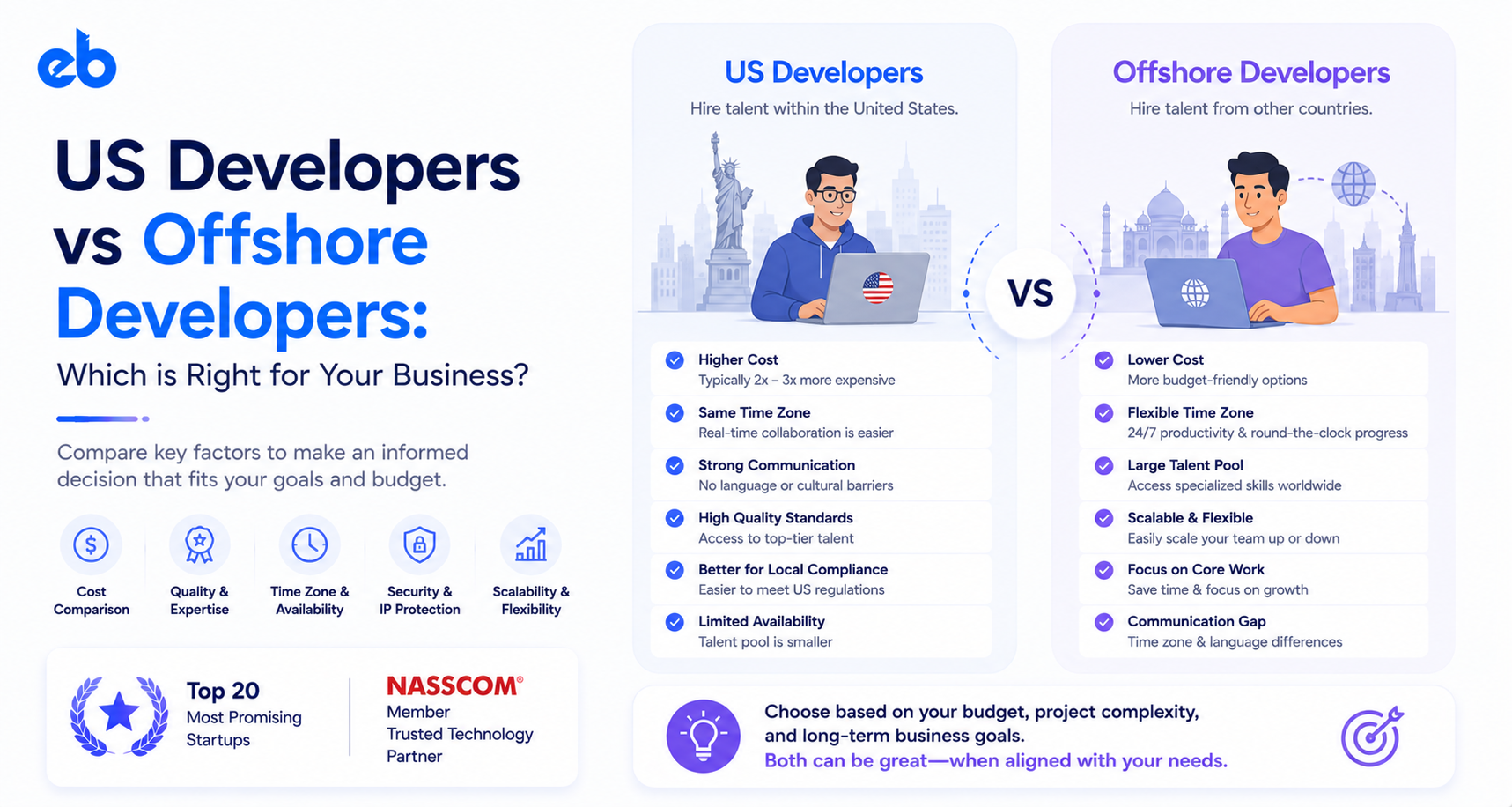
Fully domestic teams typically bill $120 to $250 per hour. Nearshore Latin American teams range from $45 to $90, and India-based senior teams from $25 to $60. Most price per project, so request an itemized estimate by phase, not a lump number.
It depends which risk matters more. Software development companies in the US offer time-zone overlap, contract enforceability, and local domain knowledge at a higher rate. Offshore and nearshore teams stretch the same budget further. Many funded startups run a hybrid.
Most software development companies in the US quote 10 to 16 weeks of core development for a focused MVP. Add time for discovery, design, and QA. Platforms with compliance needs or heavy integrations often run six to twelve months.
Most do. These are service businesses, not subscription tools, so the entry point is usually a free scoping call or written estimate. Use it to ask who writes your code, how change requests get priced, and who maintains the product after launch.
Check recent reviews on Clutch or G2, ask for references in your industry, and request shipped products rather than mockups. Confirm code ownership, security practices, and maintenance terms in the contract. Insist on meeting the engineers assigned to your build.