How to Build a Compliance Automation Platform, Policy Management, Risk Register, Audit Workflow, and Regulatory Reporting 2026


Create engaging, high-performance mobile applications tailored to your business needs. We craft future-ready apps that offer smooth user experiences on all devices.
Build robust and scalable websites and CMS platforms that help you manage content effortlessly. Our development ensures a seamless digital presence.
Launch secure, feature-rich online stores with intuitive shopping experiences. We build tailored eCommerce platforms designed for growth.
Design captivating games with immersive gameplay and stunning graphics. From concept to launch, we build engaging experiences that players love.
Enhance your customer relationships with customized Salesforce implementations. Drive growth and efficiency with smarter CRM solutions.
Harness artificial intelligence and machine learning to automate workflows and gain actionable insights. Our AI transforms data into smart decisions.
Accelerate your software delivery lifecycle with continuous integration, delivery, and infrastructure automation to boost efficiency.
Hire app developers ready to turn your ideas into sleek, high-performing mobile apps for any platform.
Bring in frontend pros who craft smooth, beautiful, and user-friendly interfaces that your visitors will love.
Get backend developers who build fast, secure, and reliable systems to keep everything running behind the scenes.
Hire eCommerce developers who build secure, scalable online stores designed to offer seamless shopping and grow your sales.
Get dedicated developers committed to your projects, delivering consistent quality and speed as an extension of your team.
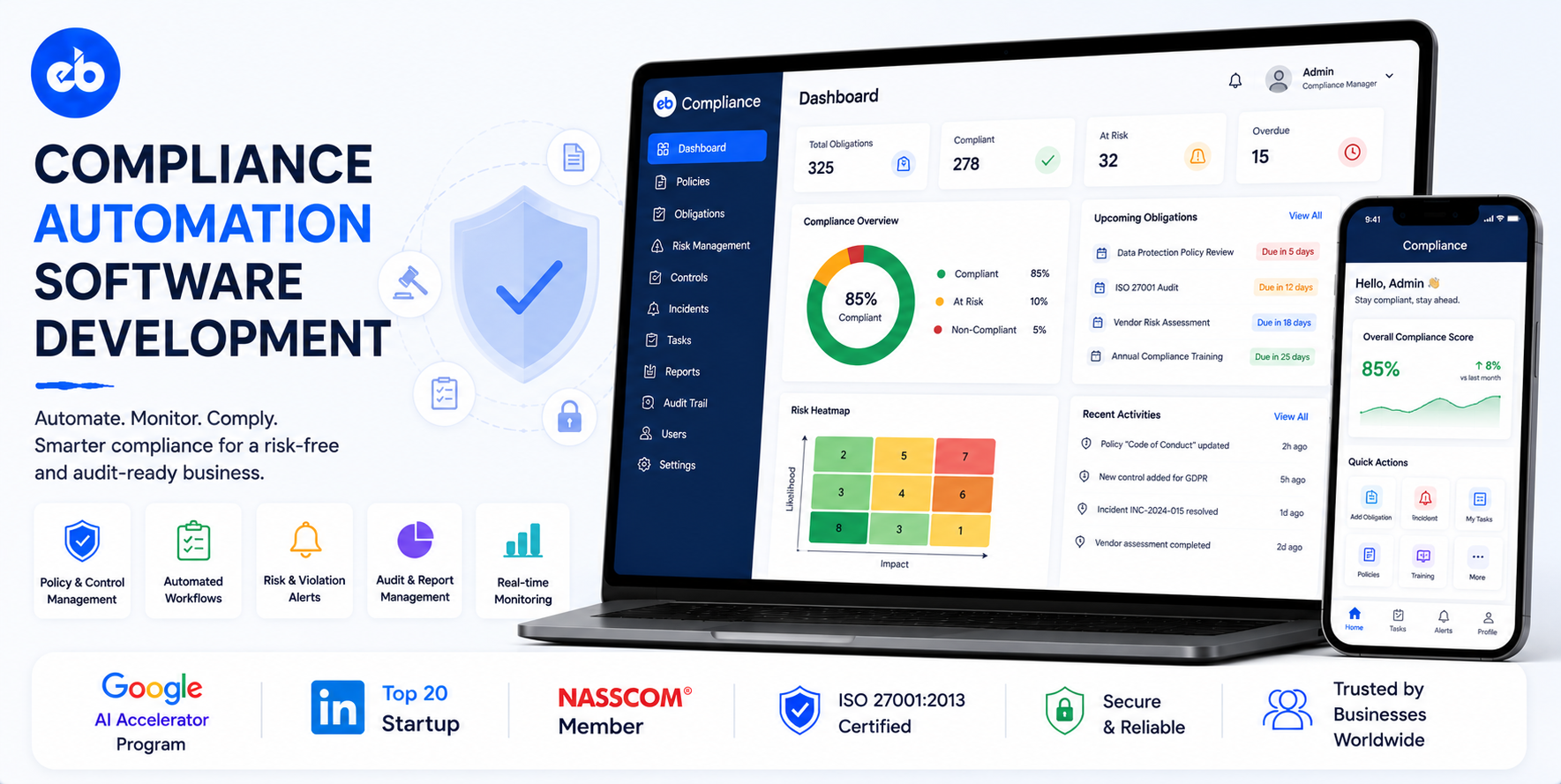
Compliance is among the fastest-growing cost centres in enterprise operations. Global regulatory spend exceeded $270 billion in 2025. The complexity is not just the number of regulations, it is the speed at which they change.
SEBI amended 23 regulations in FY2025. RBI issued 47 circulars. EU’s DORA came into force.
US SEC’s cybersecurity disclosure rules took effect. Every change requires a compliance team to review the impact, update internal policies, assign control ownership, and verify that the updated controls are operating effectively.
Most compliance teams manage this through a combination of shared drives, email chains, and compliance calendars built in Excel. When an auditor asks “show me evidence that this control was operating effectively throughout the year,” the answer involves 3 days of hunting through email archives and shared folders.
A compliance automation platform turns a reactive, manual process into a proactive, evidence-generating system, policies tracked, controls tested, risks monitored, and audit evidence assembled automatically.
EngineerBabu built enterprise technology for Adani Group, which operates in the most heavily regulated sectors in India: power, infrastructure, airports, ports, and healthcare platforms for Apollo Hospitals. CMMI Level 5. Google AI Accelerator 2024 Top 20. Contact: mayank@engineerbabu.com
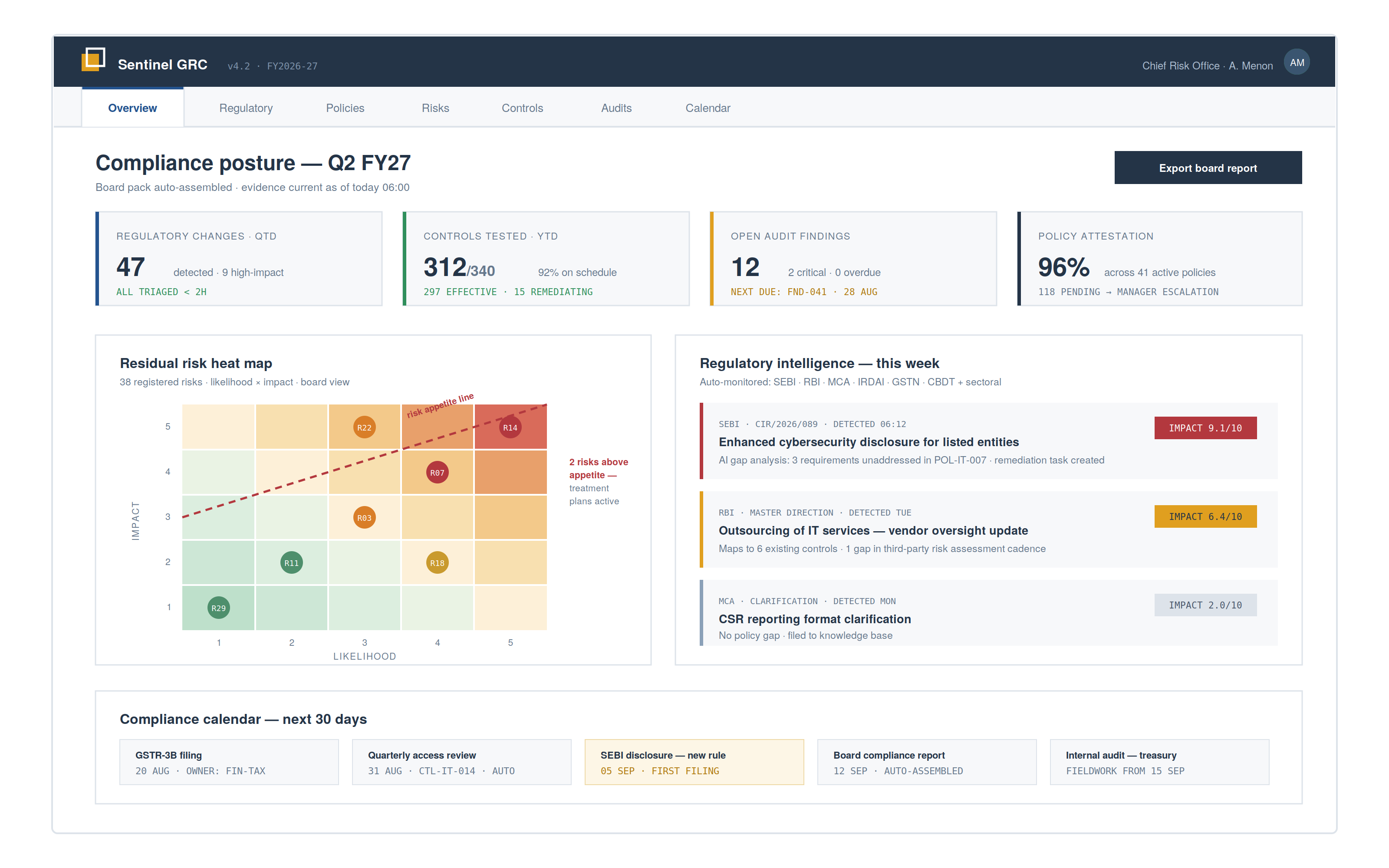
| Function | Module |
| Regulatory intelligence | Track regulatory changes, SEBI, RBI, MCA, IRDAI, sectoral |
| Policy management | Policy library, versioning, approval, distribution, attestation |
| Risk register | Risk identification, assessment, treatment, monitoring |
| Control management | Controls catalogue, ownership, testing schedule, evidence |
| Compliance calendar | Regulatory filing deadlines, internal review dates |
| Audit management | Internal audit, external audit, finding management |
| Incident management | Compliance incidents, root cause, remediation |
| Third-party risk | Vendor compliance assessment, contract compliance |
| Reporting | Board compliance report, regulatory submissions, dashboards |
| AI features | Regulatory change impact analysis, policy gap detection |
The regulatory monitoring engine:
The platform monitors regulatory sources on a scheduled basis, scraping and parsing updates from:
| Regulatory Body | Monitoring Source | Alert Trigger |
| SEBI | sebi.gov.in circulars and amendments | New circular issued |
| RBI | rbi.org.in master circulars, press releases | New direction/circular |
| MCA | mca.gov.in | Companies Act amendment, new rules |
| IRDAI | irdai.gov.in | New regulations, circulars |
| GSTN | gst.gov.in | GST law changes, notification |
| IT Department | incometaxindia.gov.in | Finance Act amendments, CBDT circulars |
| Industry-specific | FSSAI, CDSCO, MoEF, TRAI | Sector-specific regulations |
The AI impact analysis:
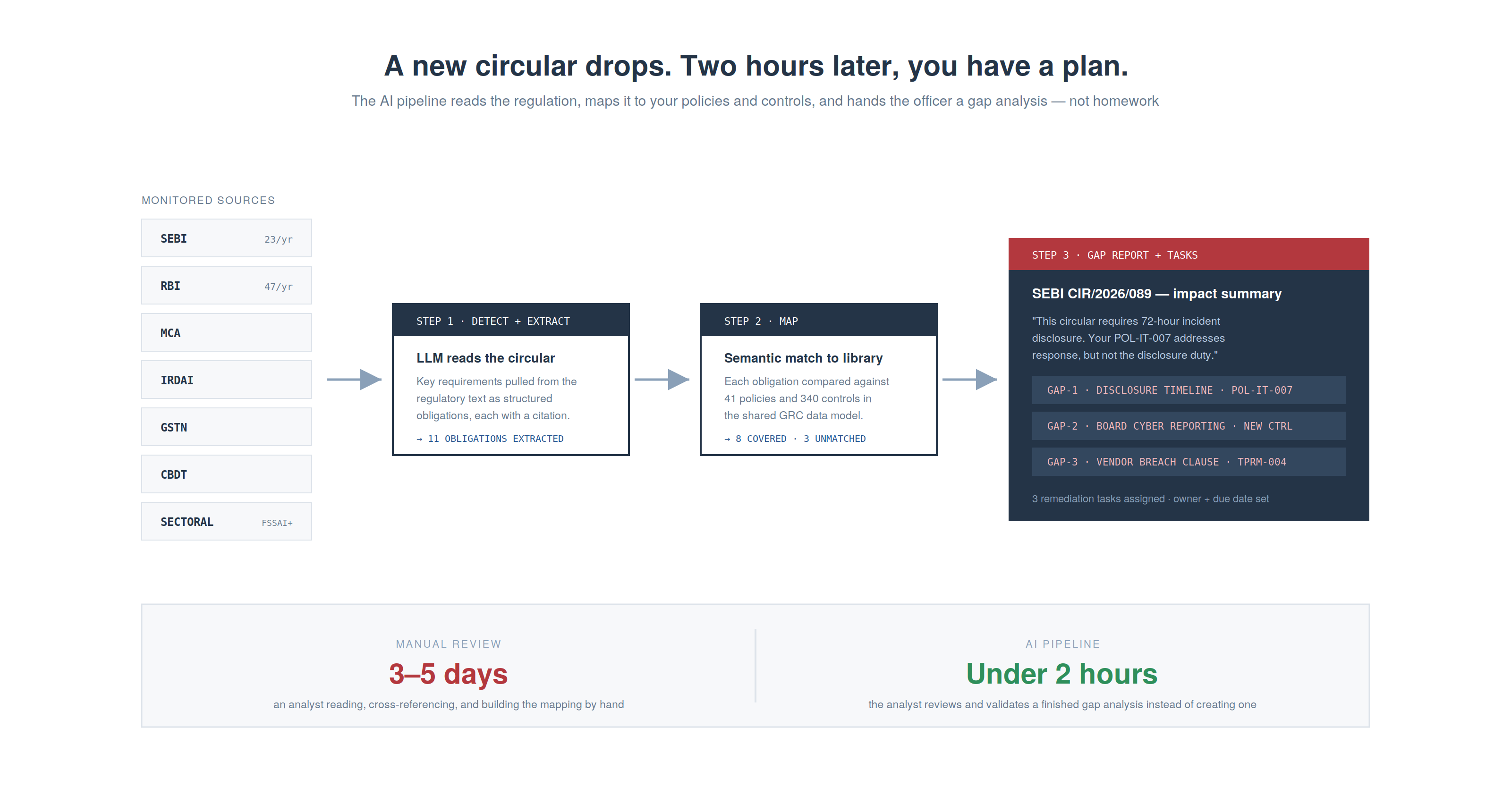
When a new regulation is detected, the AI layer:
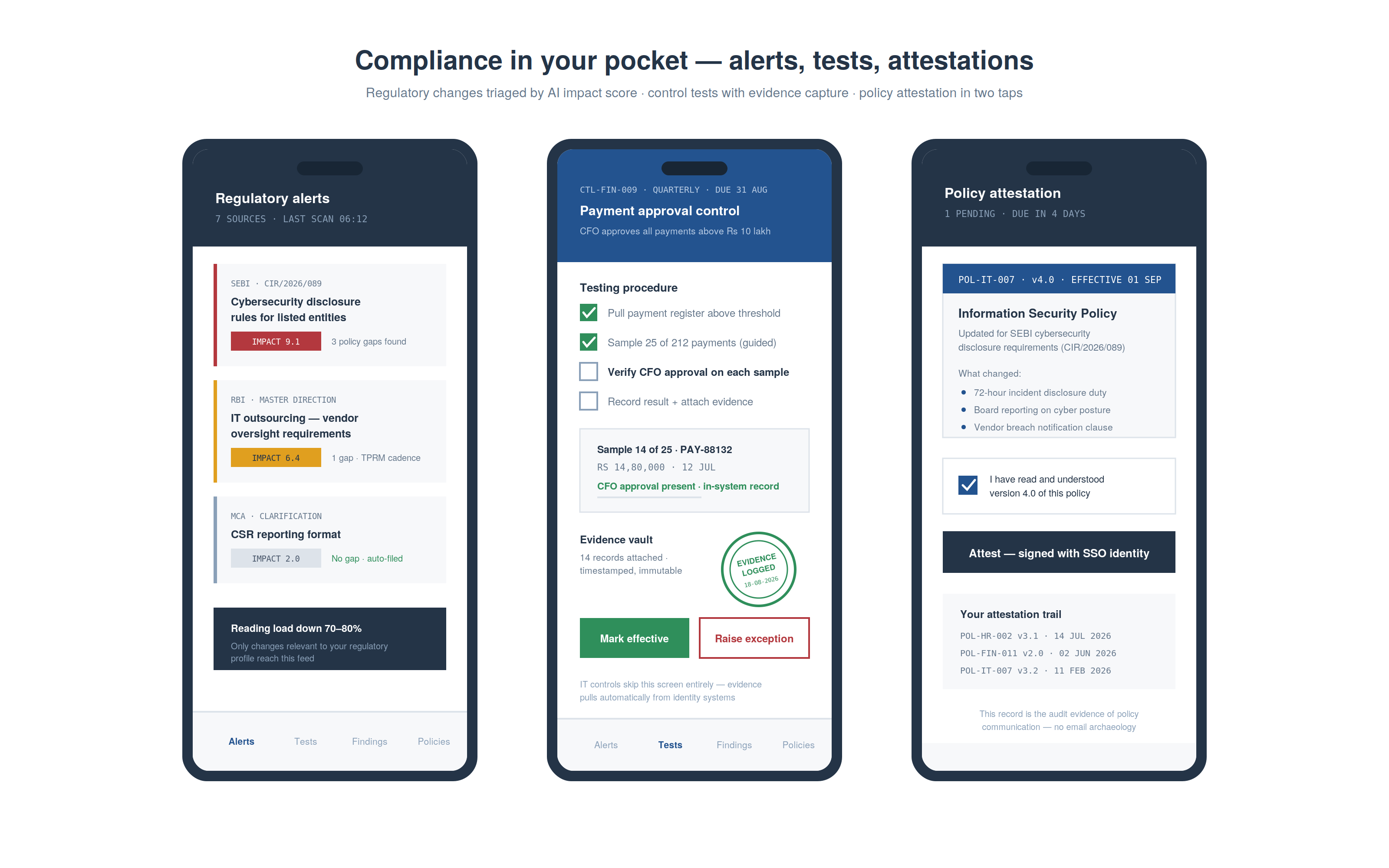
What previously took a compliance team 3 to 5 days of manual review is delivered as a structured gap analysis in under 2 hours.
Another crucial module in the compliance automation software development process is “Policy Management”.
The policy lifecycle:
| Stage | Action | System |
| Draft | Policy author writes new policy or update | Version control, track changes |
| Review | SME and legal review | Review workflow, comment resolution |
| Approval | Compliance committee or board approves | Digital approval with e-signature |
| Publication | Policy published to all relevant employees | Role-based distribution |
| Attestation | Employees acknowledge they have read and understood | Attestation tracking |
| Periodic review | Policy reviewed at scheduled interval | Review reminder, recertification |
| Retirement | Superseded policy archived | Archive with effective-to date |
The policy library:
Every policy in the library has:
| Field | Details |
| Policy ID | Unique identifier |
| Policy title | |
| Category | HR / IT Security / Financial / Operational / Regulatory |
| Version | Current version number |
| Effective date | When this version became current |
| Review date | When this version must next be reviewed |
| Owner | Responsible department or individual |
| Applicable to | Which employees, locations, or business units |
| Linked regulations | Which regulations this policy addresses |
| Linked controls | Which controls implement this policy |
| Attestation rate | % of required employees who have acknowledged |
The attestation engine:
When a policy is published or significantly updated, the attestation engine identifies all employees who must acknowledge it based on the policy’s applicability rules.
It sends notification sequences, day 1, day 7, day 14, and escalates to managers when their team members have not attested by the deadline.
The attestation record, who acknowledged which version of which policy on which date, is the primary evidence of policy communication in an audit.
The risk register structure:
| Field | Details |
| Risk ID | Unique identifier |
| Risk description | Clear statement of what could go wrong |
| Risk category | Operational / Financial / Compliance / Cyber / Reputational |
| Risk owner | Individual responsible for managing the risk |
| Inherent likelihood | Probability before controls (1–5) |
| Inherent impact | Consequence if materialised (1–5) |
| Inherent risk score | Likelihood × Impact |
| Current controls | Controls reducing this risk |
| Residual likelihood | Probability with current controls |
| Residual impact | Consequence with current controls |
| Residual risk score | Residual likelihood × Residual impact |
| Risk appetite | Is residual risk within the company’s tolerance? |
| Treatment plan | Additional actions to reduce risk further |
| Review date | When to reassess |
The risk heat map:
The risk heat map visualises all registered risks on a likelihood × impact matrix, colour-coded by residual risk level. The board and audit committee view this heat map to understand the company’s risk profile at a glance.
Risks above the risk appetite line, high residual risk despite current controls, are the ones requiring management attention and resource allocation.
The controls catalogue:
A control is a specific action, process, or system that mitigates a risk. Controls are either preventive (prevent the risk from materialising) or detective (identify when it has materialised).
| Control Element | Details |
| Control ID | |
| Control description | Specific action taken to address the risk |
| Control type | Preventive / Detective |
| Control category | Manual / Automated / Semi-automated |
| Control owner | Responsible individual |
| Control frequency | Continuous / Daily / Weekly / Monthly / Quarterly / Annual |
| Test type | Inspection, observation, re-performance, inquiry |
| Last test date | |
| Test result | Effective / Ineffective |
| Linked risks | Which risks this control addresses |
| Linked policies | Which policies mandate this control |
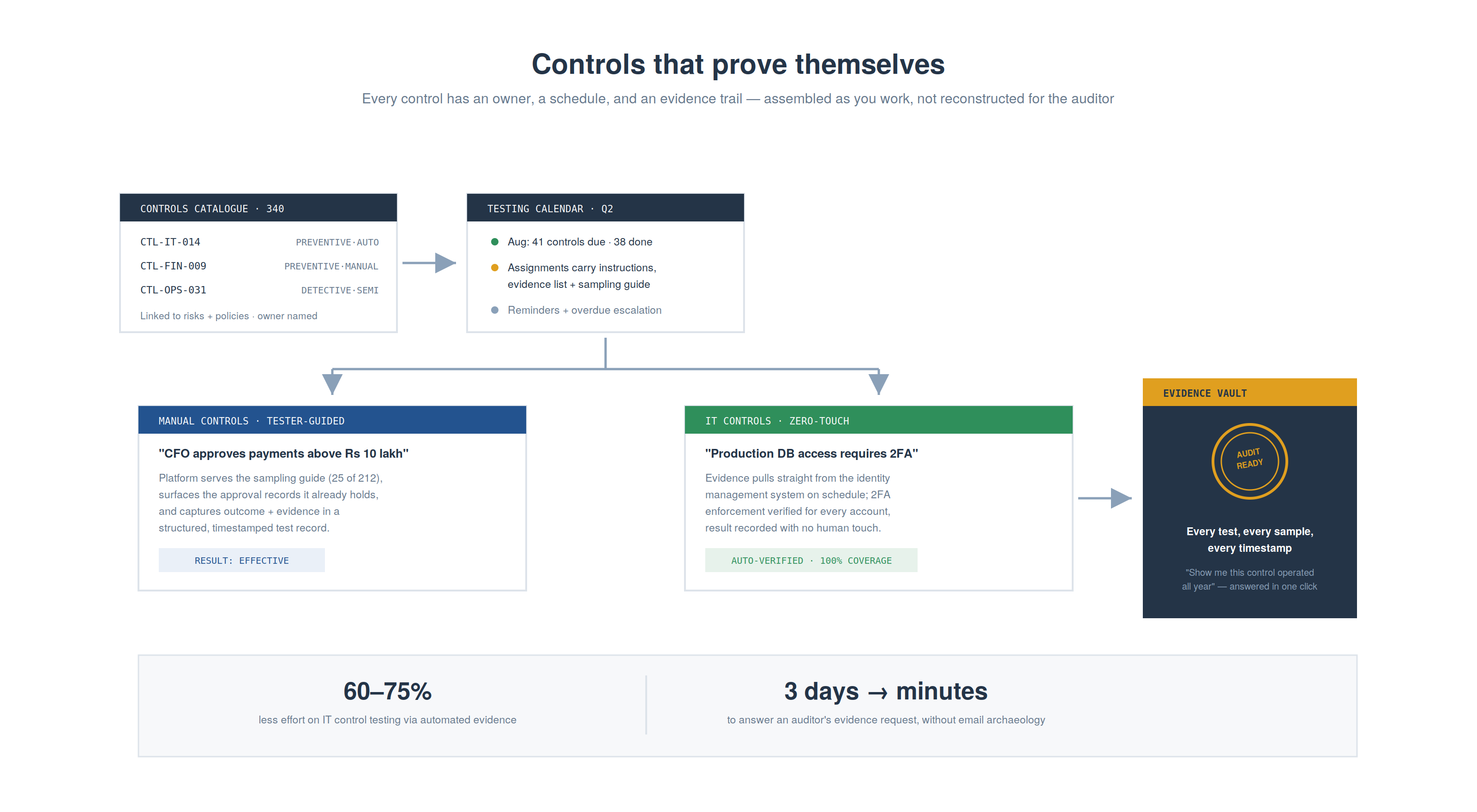
The control testing calendar:
The platform generates a testing calendar for all controls, showing which controls need to be tested in each period. Control testers receive assignments with:
| Assignment Element | Details |
| Control to test | Specific control from the catalogue |
| Testing instructions | Step-by-step testing procedure |
| Evidence required | What evidence must be collected |
| Due date | Testing deadline |
| Sampling guidance | For periodic controls, how many samples to review |
Automated control testing:
For IT controls, system access controls, change management controls, automated report generation controls, the platform integrates with the relevant IT system to pull evidence automatically.
Access review evidence is pulled from the identity management system. Automated report generation controls are verified by comparing the report output against expected parameters.
This eliminates the manual evidence collection step for a significant portion of IT controls.
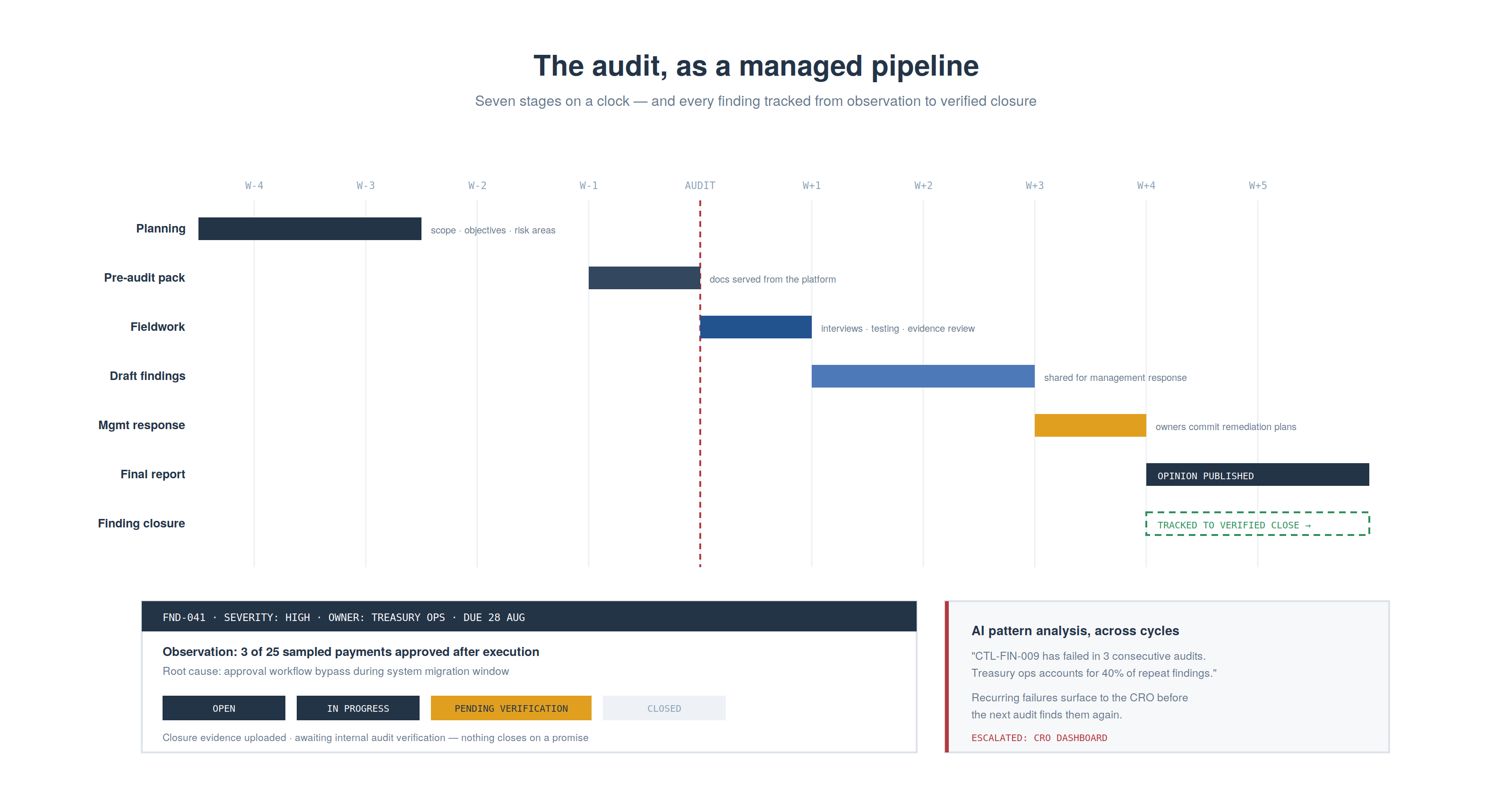
The audit lifecycle:
| Stage | Action | Timeline |
| Audit planning | Scope, objectives, risk areas, audit team | 4 weeks before |
| Pre-audit preparation | Provide pre-audit documentation to auditors | 1 week before |
| Fieldwork | Auditor interviews, testing, evidence review | During audit |
| Draft findings | Auditors share draft findings for management response | 2 weeks after fieldwork |
| Management response | Control owners respond with remediation plans | 1 week after draft |
| Final report | Findings, management responses, audit opinion published | 2 weeks after responses |
| Finding management | Remediation tracked to closure | Per agreed timeline |
The finding management module:
Every audit finding is tracked from identification to closure:
| Field | Details |
| Finding ID | |
| Finding description | What was observed |
| Root cause | Why the control failed |
| Severity | Critical / High / Medium / Low |
| Assigned to | Responsible control owner |
| Due date | Committed remediation date |
| Status | Open / In progress / Pending verification / Closed |
| Evidence of closure | Uploaded evidence that the finding was remediated |
| Verified by | Internal audit or external auditor verification |
AI policy gap detection:
When a new regulation is ingested, the AI development runs a semantic comparison between the regulation’s requirements and the existing policy library, identifying which requirements are not addressed in any current policy and generating a gap report.
AI audit finding pattern analysis:
Over multiple audit cycles, the AI identifies patterns in recurring findings, the same control consistently fails, the same business unit consistently produces audit issues, and surfaces these patterns to the Chief Risk Officer.
AI regulatory change impact scoring:
Not all regulatory changes have equal impact. The AI scores each regulatory change on its estimated impact on the company’s existing control environment, high-impact changes (new disclosure requirements, new capital adequacy rules) are prioritised for immediate compliance officer attention over low-impact changes (clarifications to existing rules).
Compliance chatbot:
Employees can ask compliance questions in plain language, “Can I accept a gift from a vendor?”, “What is our data retention policy for customer records?”, “Do I need to declare my shareholding in X company?”, and receive policy-referenced answers instantly. This reduces the compliance team’s query load by 40 to 60%.
| Module | Cost Range (USD) | Notes |
| Regulatory intelligence + change monitoring | $8K – $15K | Web scraping + NLP parsing |
| AI impact analysis (LLM-powered) | $8K – $15K | Gap analysis against policy library |
| Policy management + version control | $6K – $12K | |
| Policy attestation engine | $5K – $10K | |
| Risk register + heat map | $8K – $15K | |
| Controls catalogue + testing | $8K – $15K | |
| Automated IT control evidence collection | $6K – $12K | System integrations |
| Compliance calendar + deadline tracking | $4K – $8K | |
| Audit management + finding tracker | $8K – $15K | |
| Third-party risk assessment | $5K – $10K | Vendor compliance module |
| Compliance chatbot (LLM) | $6K – $12K | |
| Board and management reporting | $5K – $10K | |
| AWS + VAPT + Year 1 ops | $5K – $10K | |
| Total | $82K – $159K | Full compliance automation platform |
EngineerBabu built enterprise technology for Adani Group, operating in power, infrastructure, airports, and ports, India’s most heavily regulated sectors. CMMI Level 5. Google AI Accelerator 2024 Top 20. Contact: mayank@engineerbabu.com
GRC stands for Governance, Risk, and Compliance, a framework that integrates three related but distinct functions. Governance covers the structures and processes by which a company is directed and controlled, board oversight, policy management, and accountability frameworks. Risk management covers the identification, assessment, and treatment of risks that could prevent the company from achieving its objectives. Compliance covers adherence to external regulations and internal policies. A GRC platform is a software system that integrates all three functions in a shared data model, risks link to controls, controls link to policies, policies link to regulations, and audit findings link back to the control failures that generated them. A compliance management system is narrower, typically covering only the compliance function without the risk management and governance dimensions. For large enterprises operating in multiple regulated sectors, a GRC platform is necessary because the same control may address multiple risk categories and multiple regulatory requirements simultaneously, and managing these relationships in separate systems creates gaps.
AI regulatory intelligence reduces compliance team workload through three mechanisms. Monitoring automation: instead of a compliance analyst manually tracking 15 regulatory websites and reading every publication, the AI monitors all sources and surfaces only the changes that are potentially relevant to the company’s regulatory profile, typically reducing the reading load by 70 to 80%. Impact analysis: instead of a compliance analyst spending 2 to 3 days mapping a new regulation’s requirements against existing policies and controls, the AI produces a structured gap analysis in under 2 hours, which the analyst reviews and validates rather than creates. Prioritisation: the AI scores each regulatory change by estimated impact severity, allowing the compliance team to allocate their attention to the highest-priority changes first rather than processing everything chronologically. Together, these three mechanisms typically allow a compliance team to cover 30 to 40% more regulatory volume with the same headcount.
Control testing is the process of verifying that a compliance control is operating effectively, that the process, system, or action designed to mitigate a specific risk is actually happening as intended and producing the expected risk-reducing outcome. A platform automates control testing in two ways. For manual controls, “the CFO reviews and approves all payments above ₹10 lakh”, the platform prompts the control tester with a sampling guide, provides access to the evidence already collected in the system (payment approval records), and captures the testing outcome and evidence in a structured record. For automated IT controls, “access to the production database requires two-factor authentication”, the platform pulls evidence from the identity management system automatically, verifies that 2FA is enforced for all relevant access, and records the test result without any manual intervention. Automating IT control evidence collection typically reduces the effort for IT controls testing by 60 to 75%.