How to Build an AI-Powered HR Platform, Resume Screening, Onboarding, Performance Management, and Payroll 2026


Create engaging, high-performance mobile applications tailored to your business needs. We craft future-ready apps that offer smooth user experiences on all devices.
Build robust and scalable websites and CMS platforms that help you manage content effortlessly. Our development ensures a seamless digital presence.
Launch secure, feature-rich online stores with intuitive shopping experiences. We build tailored eCommerce platforms designed for growth.
Design captivating games with immersive gameplay and stunning graphics. From concept to launch, we build engaging experiences that players love.
Enhance your customer relationships with customized Salesforce implementations. Drive growth and efficiency with smarter CRM solutions.
Harness artificial intelligence and machine learning to automate workflows and gain actionable insights. Our AI transforms data into smart decisions.
Accelerate your software delivery lifecycle with continuous integration, delivery, and infrastructure automation to boost efficiency.
Hire app developers ready to turn your ideas into sleek, high-performing mobile apps for any platform.
Bring in frontend pros who craft smooth, beautiful, and user-friendly interfaces that your visitors will love.
Get backend developers who build fast, secure, and reliable systems to keep everything running behind the scenes.
Hire eCommerce developers who build secure, scalable online stores designed to offer seamless shopping and grow your sales.
Get dedicated developers committed to your projects, delivering consistent quality and speed as an extension of your team.
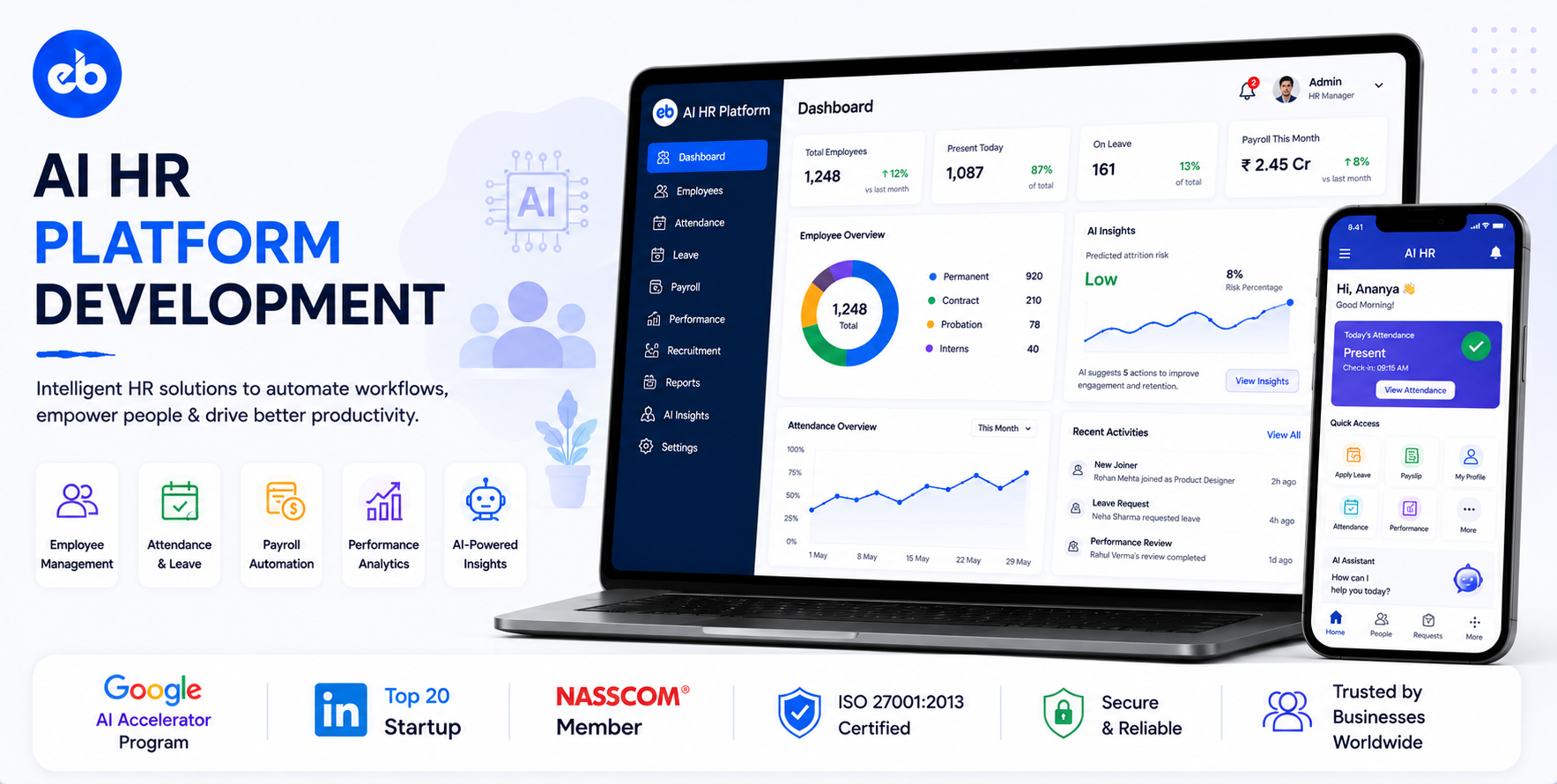
The HR function in 2026 sits at the intersection of the two most significant workforce trends in a generation. First, the AI-driven transformation of knowledge work, every company is restructuring roles around what AI can do versus what humans uniquely add.
Second, the talent wars in technology, data, and AI roles where hiring speed and candidate experience determine whether the best candidates choose you or a competitor.
An AI HR platform development serves both trends.
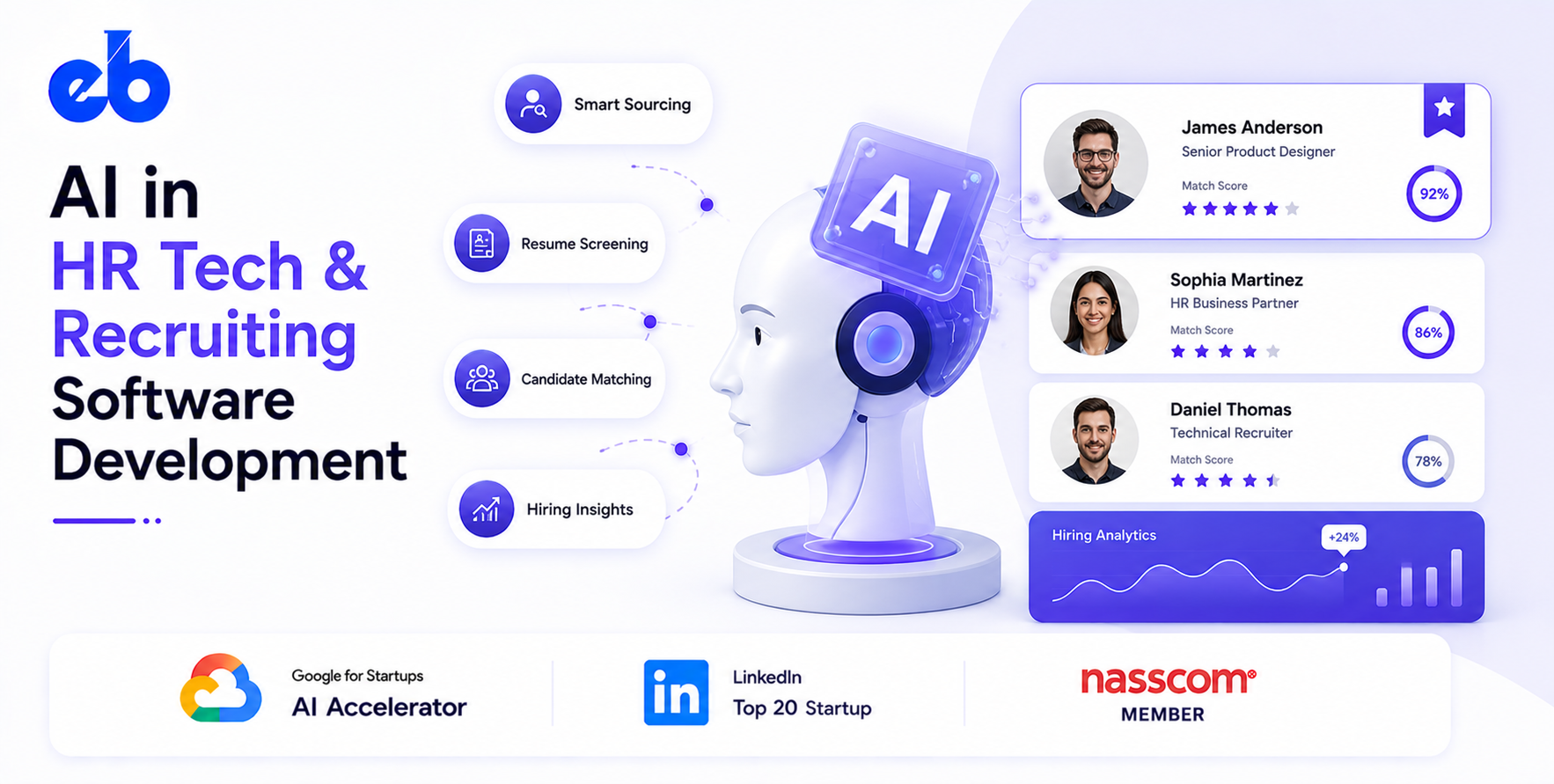
On the hiring side: AI screening that reviews 500 resumes in the time a recruiter reviews 10, while maintaining the signal-to-noise ratio that humans lose at volume.
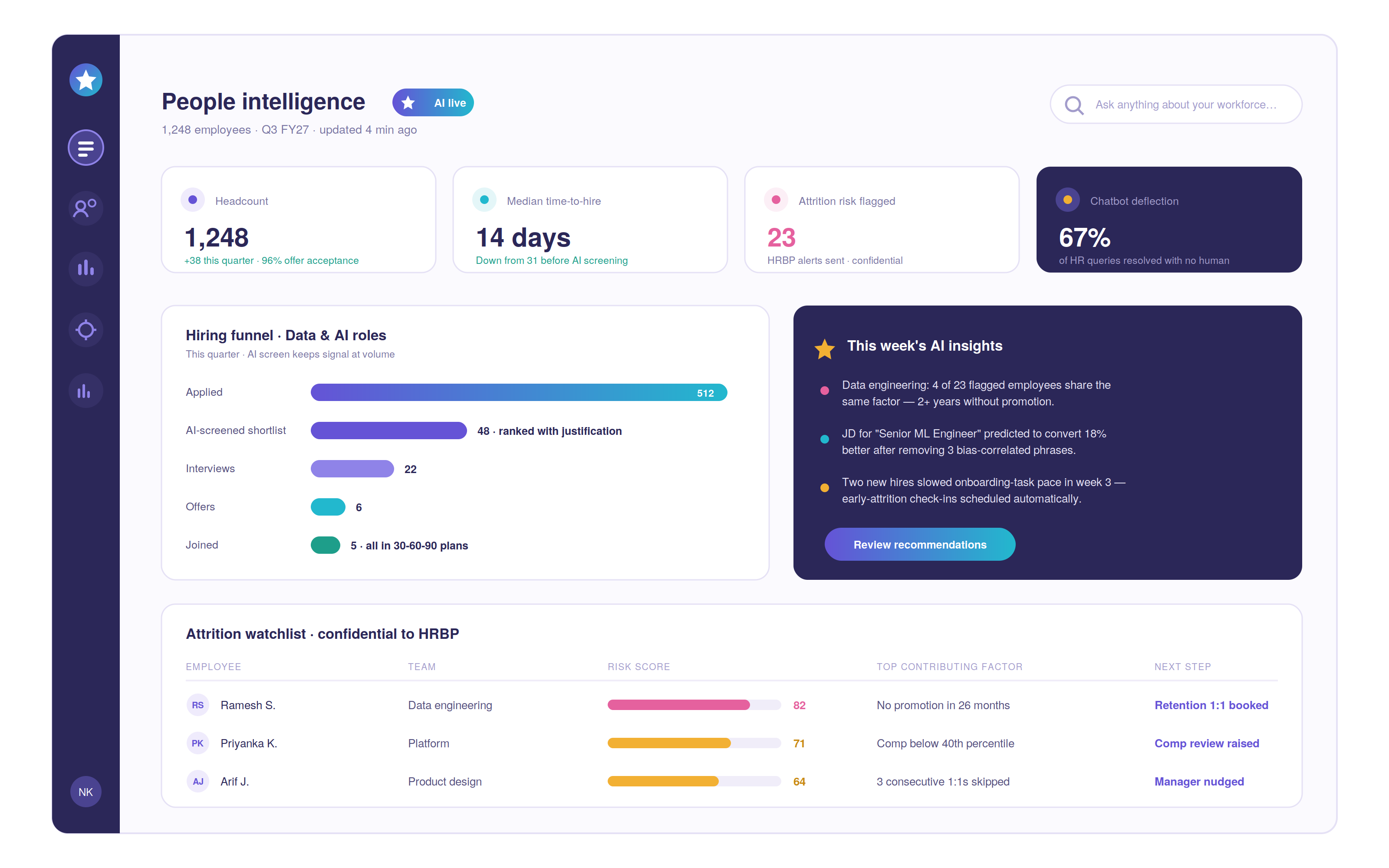
On the employee side: personalised development paths, continuous performance feedback that replaces the annual review cycle, and predictive attrition analytics that identify at-risk employees before they hand in their notice.
Supersourcing, EngineerBabu’s talent arm, LinkedIn Top 20 Startups India 2023 and 2024, Google AI Accelerator 2024, builds AI-first hiring infrastructure. This guide covers how to build the platform that operationalises it internally.
EngineerBabu. CMMI Level 5. Google AI Accelerator 2024 Top 20. Contact: mayank@engineerbabu.com
| Function | Module |
| Recruitment | JD creation, sourcing, AI screening, interview scheduling |
| Onboarding | Pre-joining, documentation, buddy system, 30-60-90 day plan |
| Employee information | HRIS, master records, org structure, document management |
| Attendance and leave | Attendance capture, leave policy, approval workflow |
| Performance management | Goal setting, check-ins, reviews, 360 feedback |
| Learning and development | Training assignment, completion tracking, skill gaps |
| Payroll | Salary processing, statutory compliance, payslips |
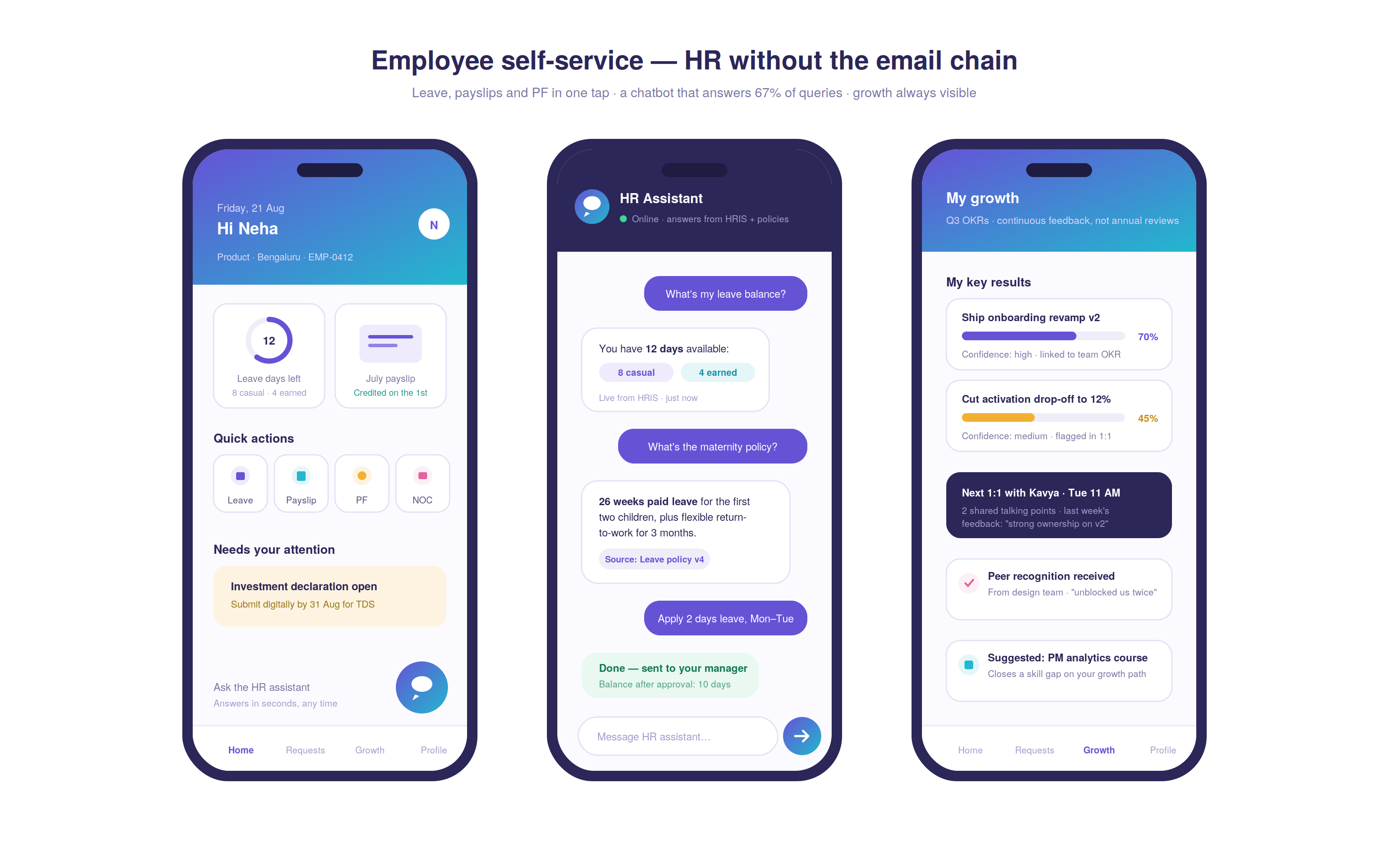
| Employee self-service | Leave requests, payslip download, profile update |
| Analytics | Attrition prediction, workforce insights, DEI metrics |
| Compliance | PF, ESI, PT, TDS, labour law compliance |
| AI features | Resume screening, JD optimisation, attrition prediction, chatbot |
The AI JD optimisation:
Before posting a job, the AI platform analyses the JD draft for:
Bias language, words that statistically discourage female or minority candidates from applying (“rockstar,” “aggressive,” “competitive” correlate with lower female application rates). Vague requirements, “5+ years of React experience” when the role needs 2 years of solid React work.
Missing signals, the JD says nothing about team culture, growth opportunity, or what success looks like in 90 days, which are the questions candidates care about. The AI suggests specific improvements to each of these dimensions and shows the predicted impact on application conversion.
The AI resume screening:
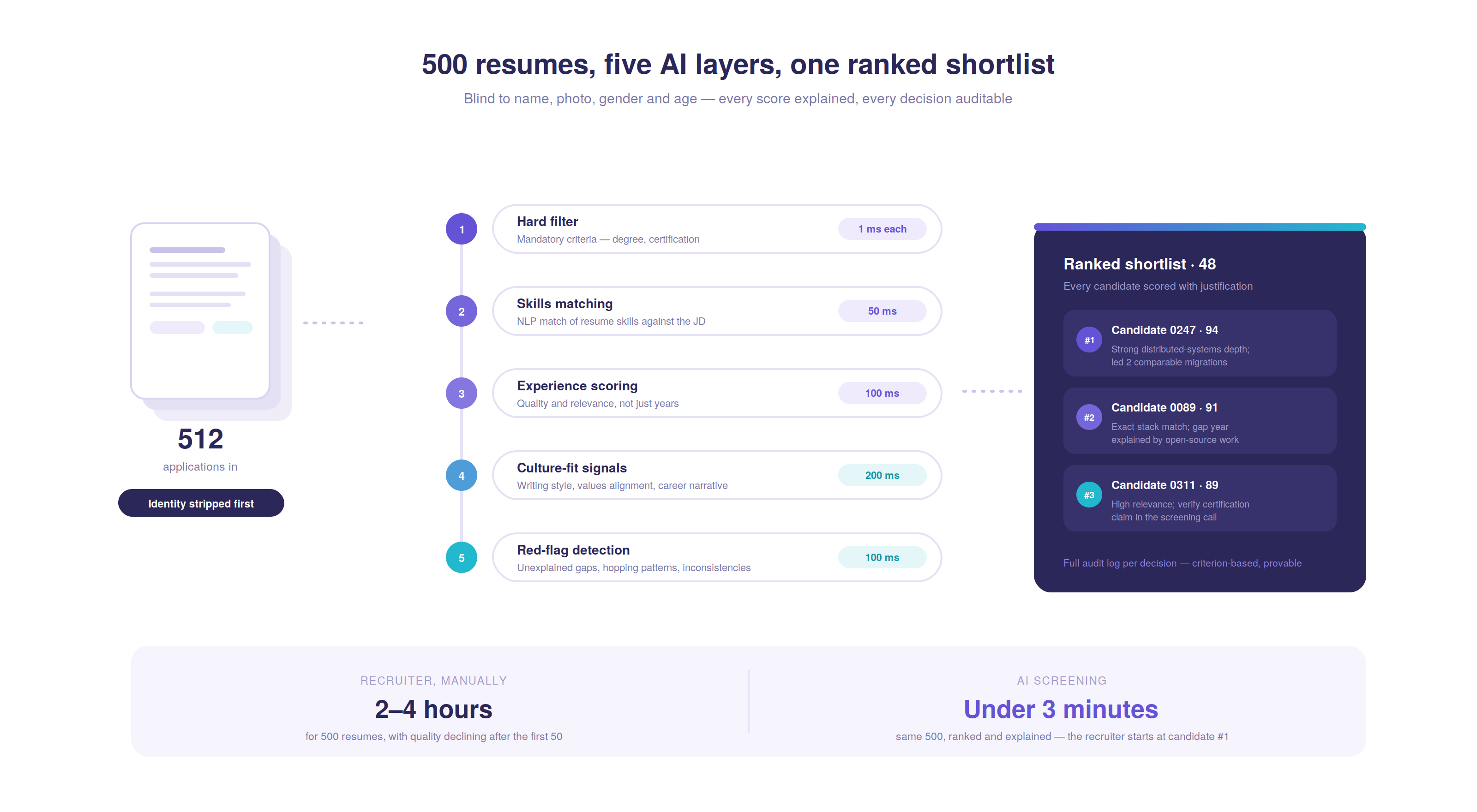
| Screening Layer | AI Function | Speed |
| Hard filter | Remove resumes missing mandatory criteria (degree, certification) | 1ms per resume |
| Skills matching | Match resume skills against JD requirements, NLP-based | 50ms per resume |
| Experience scoring | Evaluate quality and relevance of experience | 100ms per resume |
| Culture fit signals | Writing style, values alignment, career narrative | 200ms per resume |
| Red flag detection | Unexplained gaps, frequent job-hopping patterns, inconsistencies | 100ms per resume |
A recruiter reviewing 500 applications manually takes 2 to 4 hours and reviews with declining quality. The AI screens 500 in under 3 minutes and returns a ranked shortlist with scoring justification for each candidate.
The bias prevention layer:
The screening AI is trained with bias detection, it screens without seeing candidate name, photo, gender, or ethnicity.
Every screening decision is logged with the specific criteria that drove the score, providing an auditable record that the screening was criterion-based, not bias-based.
The pre-joining workflow:
From offer acceptance to day 1, the platform manages a digital pre-joining process:
| Day | Action | System |
| Offer accepted | Welcome email + portal access granted | Welcome sequence starts |
| Day -30 | Document collection, PAN, Aadhaar, bank account, previous employment | Document upload portal |
| Day -14 | Laptop and access provisioning request sent to IT | IT ticket created automatically |
| Day -7 | Buddy assigned, buddy receives notification | Buddy matching engine |
| Day -3 | First week schedule sent, team introductions, orientation sessions | Calendar invites sent |
| Day 0 | Day 1 checklist, physical access, system logins, team breakfast | Day 1 guide |
The 30-60-90 day plan:
For every new hire, a role-specific 30-60-90 day plan is configured, defining what the employee should learn, who they should meet, and what they should deliver at each milestone.
The platform tracks progress against the plan and triggers check-in conversations between the employee and their manager at each milestone.
Early attrition prevention:
New hire attrition, employees who leave within 90 days, is the most expensive failure in HR.
The platform monitors early warning signals: days since last login to the HR portal, pace of onboarding task completion, sentiment from onboarding surveys, attendance regularity.
Employees showing multiple risk signals trigger a check-in from their HR business partner.
The continuous feedback model:
The annual performance review is a known failure mode, feedback given once a year is too infrequent to drive meaningful improvement and too delayed to address issues that were apparent six months earlier. The platform replaces annual reviews with:
| Cadence | Activity | Participants |
| Weekly | 1:1 check-in notes | Manager + employee |
| Monthly | Progress vs goals | Manager + employee |
| Quarterly | Formal feedback + coaching | Manager + HR |
| Annual | Comprehensive review + compensation | Manager + HRBP + compensation |
Goal setting, OKR framework:
| Level | OKRs |
| Company | Set by leadership, cascaded to all employees |
| Team | Defined by team lead, linked to company OKRs |
| Individual | Set by employee, aligned to team OKRs |
Each Key Result has a measurable target, a current value updated by the employee, and a confidence score. The OKR dashboard gives every manager visibility into their team’s progress at any moment.
360-degree feedback:
For senior roles and leadership development programmes, the platform manages 360 feedback cycles, the employee nominates peers, reports, and cross-functional stakeholders to provide structured feedback.
The feedback is anonymised, aggregated, and presented with trend comparison to previous cycles. The manager uses the 360 results in the development conversation rather than the performance evaluation.
AI-powered attrition prediction:
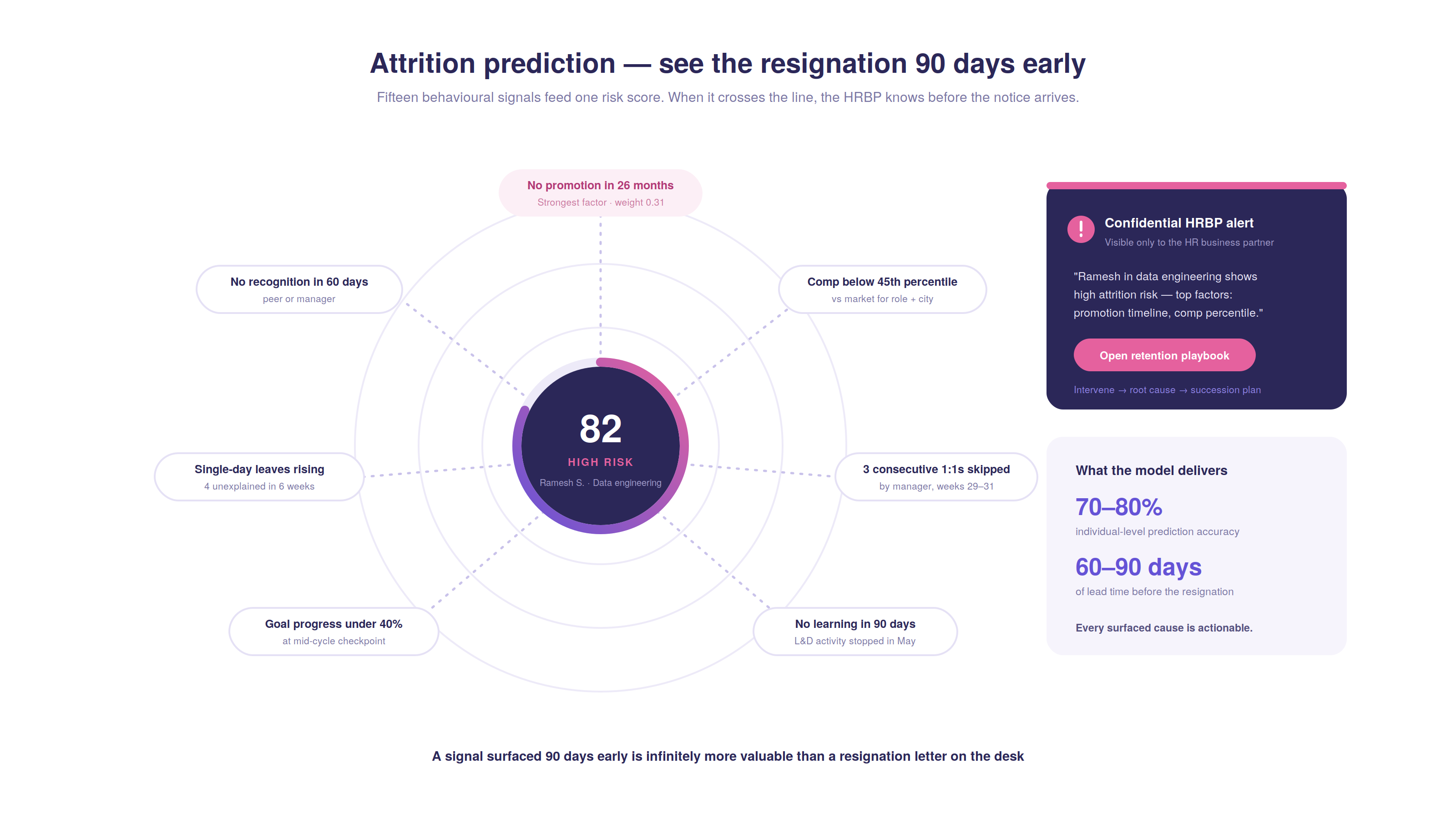
The platform monitors 15 signals associated with attrition risk:
| Signal | High Attrition Risk Indicator |
| Goal progress | Less than 40% of goals completed midway through the period |
| Feedback sentiment | Negative trend in manager feedback |
| 1:1 skipped | Manager skipped 3+ consecutive 1:1s |
| Promotion timeline | 2+ years without promotion |
| Peer comparison | Compensation below market percentile for role |
| Learning activity | No learning completed in 90 days |
| Recognition | No peer or manager recognition in 60 days |
| Leave pattern | Unexplained single-day leaves increasing |
| Role duration | 18+ months without role change or growth |
| External LinkedIn activity | Profile updated, connections growing rapidly |
When an employee’s risk score crosses the threshold, the HRBP receives a confidential alert, “Ramesh in the data engineering team shows high attrition risk”, with the contributing factors. The HRBP can investigate and intervene before the resignation.
The payroll components:
| Component | Type | Statutory |
| Basic salary | Fixed | Basis for PF calculation |
| HRA (House Rent Allowance) | Fixed | Tax exemption eligible |
| Special allowance | Fixed | Fully taxable |
| Variable pay | Performance-based | Monthly or quarterly |
| LTA (Leave Travel Allowance) | Annual claim-based | Tax exemption eligible |
| Medical allowance | Annual claim-based | Tax exemption eligible |
| Gratuity | Accrual | Payable on exit after 5 years |
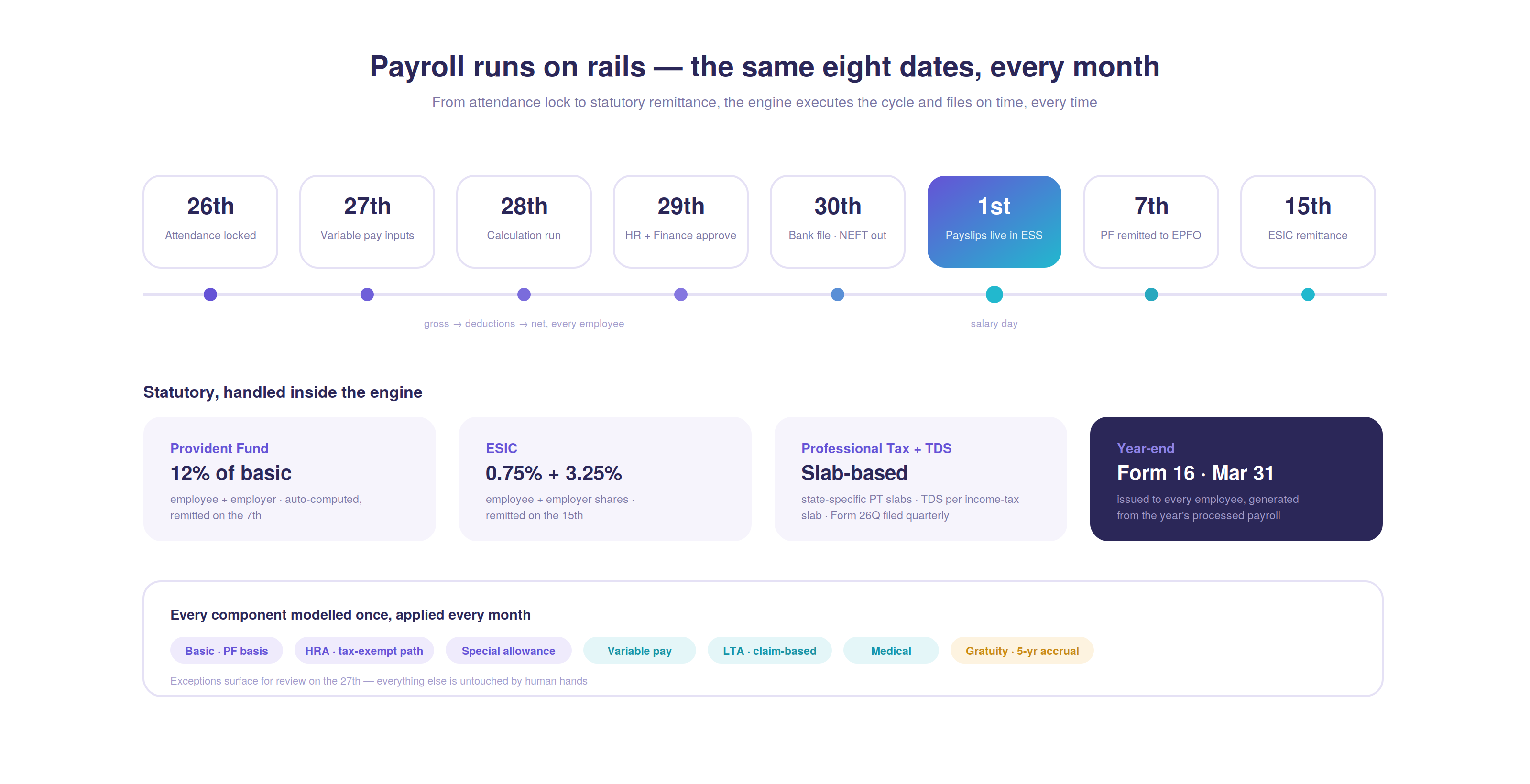
| Provident Fund (PF) | Statutory deduction | 12% of basic (employee + employer) |
| ESIC | Statutory deduction | 0.75% employee + 3.25% employer |
| Professional Tax | Statutory deduction | State-specific slab |
| TDS | Tax deduction at source | Per applicable income tax slab |
The payroll processing cycle:
| Day | Action |
| 26th | Attendance data locked for the month |
| 27th | Variable pay and exception inputs entered |
| 28th | Payroll calculation run, gross, deductions, net |
| 29th | Payroll review and approval by HR and Finance |
| 30th | Bank file generated, NEFT to employee accounts |
| 1st | Payslips available in employee self-service portal |
| 7th | PF remittance to EPFO |
| 15th | ESIC remittance |
| TDS quarterly | Form 26Q filing |
| March 31 | Form 16 issued to all employees |
What employees do themselves on the portal:
| Action | Without ESS | With ESS |
| Apply for leave | Email to manager → HR enters | Employee applies in portal, manager approves |
| Download payslip | Email request to HR | One click in portal |
| Update bank account | Email to HR with form | Self-service with verification |
| Check PF balance | Login to EPFO portal separately | Integrated PF balance in portal |
| Submit investment declaration | Paper form | Digital declaration form |
| Raise IT support ticket | Email to IT | Portal ticket with category |
| Check leave balance | Ask HR | Visible in real-time |
The HR chatbot:
An AI-powered chatbot handles the most common employee queries, “What is my leave balance?”, “When is the salary credit date?”, “What is the maternity leave policy?”, “How do I apply for a home loan NOC?”, without HR intervention.
The chatbot pulls data from the HRIS and policy documents and responds in seconds. This typically handles 60 to 70% of all HR queries, freeing the HR team for higher-value work.
| Module | Cost Range (USD) | Notes |
| AI JD optimisation + bias detection | $6K – $12K | |
| AI resume screening engine | $10K – $18K | NLP + ML scoring |
| ATS + interview scheduling | $6K – $12K | |
| Intelligent onboarding + 30-60-90 | $6K – $12K | |
| HRIS core + org chart | $6K – $12K | |
| Attendance + leave management | $5K – $10K | |
| OKR + performance management | $8K – $15K | |
| 360 feedback module | $5K – $10K | |
| Attrition prediction ML model | $8K – $15K | |
| Payroll engine + statutory compliance | $10K – $18K | PF, ESI, PT, TDS |
| Employee self-service portal | $6K – $12K | |
| HR chatbot (LLM-powered) | $6K – $12K | |
| Analytics + workforce intelligence | $5K – $10K | |
| AWS + VAPT + Year 1 ops | $5K – $10K | |
| Total | $92K – $178K | Full AI HR platform |
Supersourcing, EngineerBabu’s talent arm, is LinkedIn Top 20 Startups India 2023 and 2024, Google AI Accelerator 2024. EngineerBabu builds the technology that powers AI-first HR. CMMI Level 5. Contact: mayank@engineerbabu.com
AI resume screening without bias requires three technical controls. First, blind screening, the model evaluates resumes after stripping identifying information: name, photo, gender pronouns, and graduation year (which can reveal age). The model scores based only on skills, experience, and qualifications. Second, bias-audited training data, the screening model is trained on historical hiring data that has been reviewed for systematic patterns and corrected where certain demographic groups were historically undervalued. Third, explainability, every screening decision generates a structured explanation showing which criteria drove the score. This explanation is the audit trail that allows HR to verify the screening was criterion-based. Deployed without these controls, AI screening can amplify historical hiring biases rather than reduce them.
Attrition prediction uses machine learning to identify employees at elevated risk of voluntary resignation before they submit their notice. Models trained on historical HR data, combining behavioural signals like performance trends, engagement survey responses, promotion history, and compensation relative to market, can typically predict attrition with 70 to 80% accuracy at the individual level. The value is not perfect prediction but early indication: identifying 80% of at-risk employees 60 to 90 days before they would resign gives HR enough lead time to have retention conversations, address root causes, or begin succession planning. The most common root causes surfaced by attrition models, compensation below market percentile, lack of career progression, and poor manager relationship, are all actionable. A model that surfaces these signals 90 days early is infinitely more valuable than discovering the problem when the resignation letter arrives.
An HRIS (Human Resource Information System) is the system of record for employee data, personal information, employment history, compensation, benefits, and organisational structure. An ATS (Applicant Tracking System) manages the recruitment process, job postings, applications, candidate pipeline, interview scheduling, and offer management. An HCM (Human Capital Management) platform is the broadest category, encompassing HRIS and ATS plus performance management, learning, workforce planning, payroll, and analytics. Most mid-size companies start with an ATS for recruitment and a basic HRIS for employee records and payroll, then outgrow both as the workforce scales and the HR function becomes more strategic. An AI-powered HR platform built as described in this guide is effectively an HCM with AI acceleration across all modules, replacing the need for three separate systems with one integrated platform.