How to Build a Carbon Credit Tracking Platform, MRV, Registry Integration, Credit Issuance, and Carbon Marketplace 2026


Create engaging, high-performance mobile applications tailored to your business needs. We craft future-ready apps that offer smooth user experiences on all devices.
Build robust and scalable websites and CMS platforms that help you manage content effortlessly. Our development ensures a seamless digital presence.
Launch secure, feature-rich online stores with intuitive shopping experiences. We build tailored eCommerce platforms designed for growth.
Design captivating games with immersive gameplay and stunning graphics. From concept to launch, we build engaging experiences that players love.
Enhance your customer relationships with customized Salesforce implementations. Drive growth and efficiency with smarter CRM solutions.
Harness artificial intelligence and machine learning to automate workflows and gain actionable insights. Our AI transforms data into smart decisions.
Accelerate your software delivery lifecycle with continuous integration, delivery, and infrastructure automation to boost efficiency.
The voluntary carbon market transacted $2 billion in 2024. The compliance carbon market, mandatory emissions trading under national and regional schemes, transacted $800 billion in the same year.
Both are growing rapidly as net-zero commitments translate into actual carbon accounting obligations for companies and governments.
The problem: most carbon credit tracking is still done in spreadsheets. Project developers track emissions reductions manually. Verification is done through document review rather than automated data systems.
Credit issuance is slow. Registry integration is manual. And buyers of carbon credits have no reliable way to verify what they are buying is genuine.
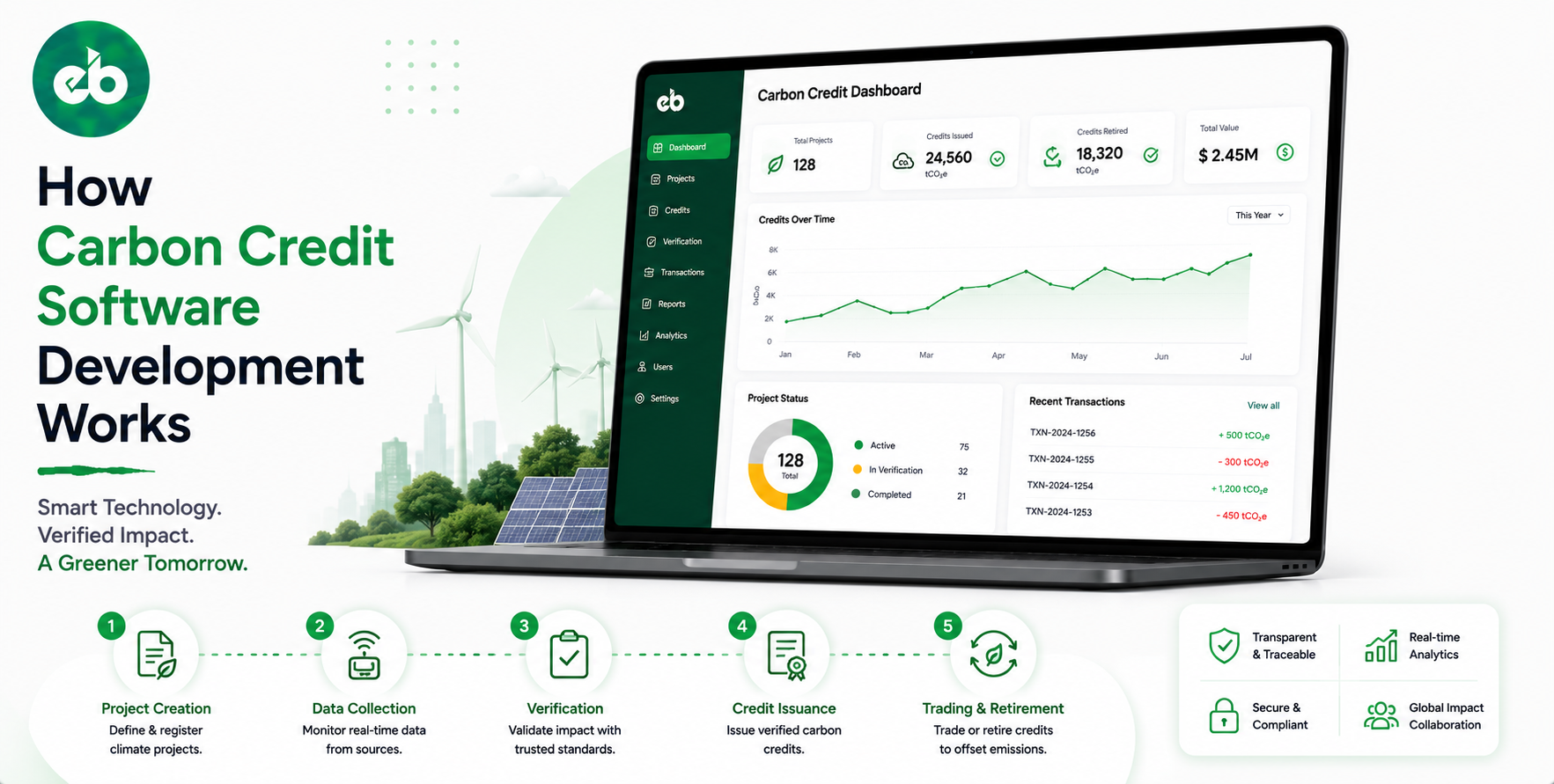
A carbon credit software development on MRV (Measurement, Reporting, and Verification) principles, with IoT data integration, automated emissions calculation, blockchain-optional credit issuance, and registry connectivity, solves the transparency problem that limits the carbon market’s credibility and scale.
EngineerBabu built enterprise operations management for Adani Group, one of India’s largest infrastructure and renewable energy conglomerates, and is a Google AI Accelerator 2024 Top 20 company. CMMI Level 5. Contact: mayank@engineerbabu.com
| Function | Module |
| Project registration | Carbon project creation, methodology selection, baseline |
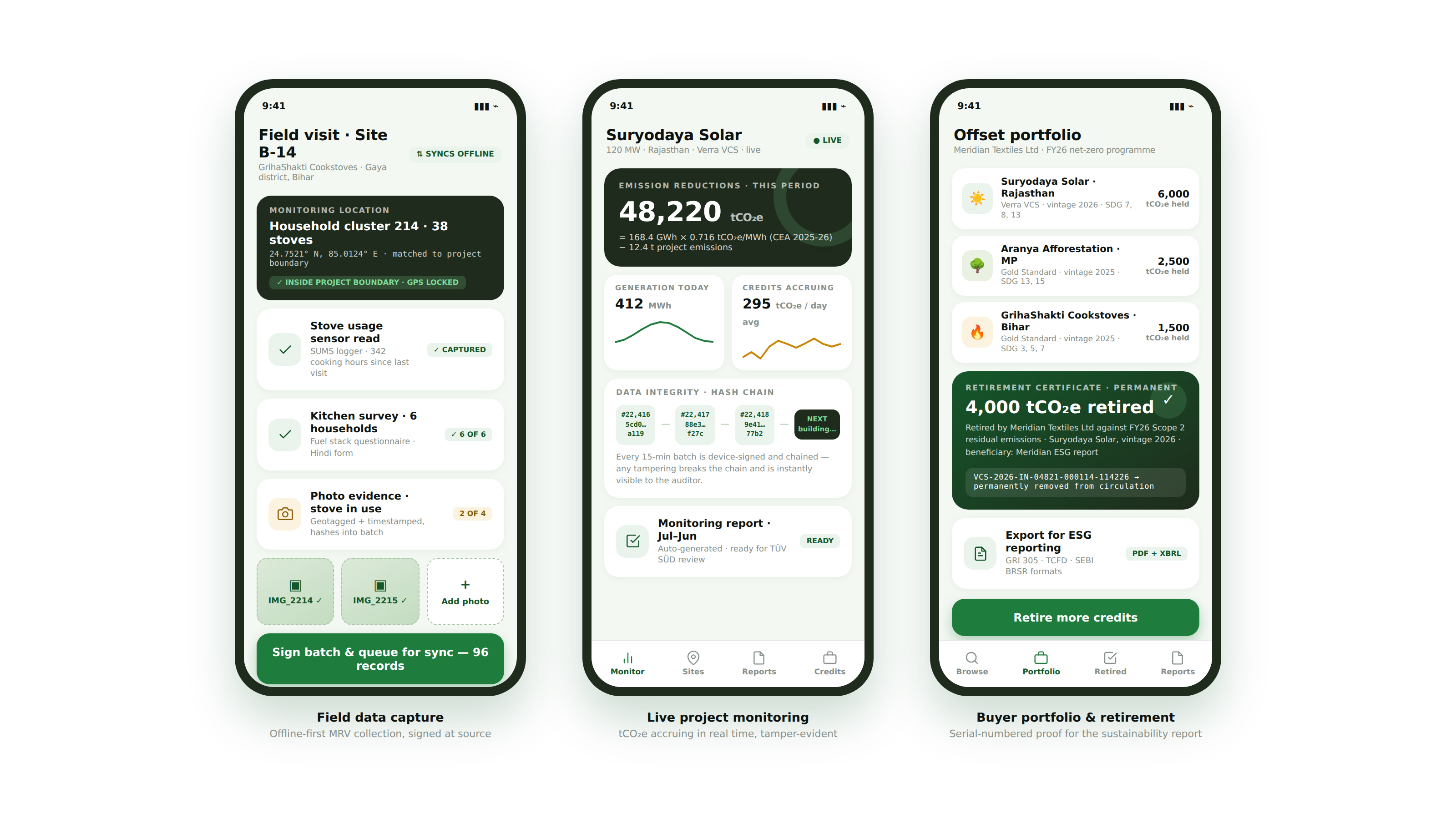
| MRV data collection | IoT integration, meter data, activity data capture |
| Emissions calculation | Scope 1, 2, 3 calculation per GHG Protocol |
| Baseline and additionality | Baseline emissions calculation, additionality demonstration |
| Verification support | Auditor access, data export, evidence package |
| Credit issuance | Verified emission reductions (VERs) calculated and recorded |
| Registry integration | Verra (VCS), Gold Standard, BIS Carbon (India) |
| Carbon marketplace | Credit listing, buyer discovery, transaction |
| Portfolio management | Credit inventory, retirement tracking, certificates |
| ESG reporting | GRI, TCFD, SEBI BRSR reporting formats |
Project types supported:
| Project Type | Emission Reduction Method | Standard |
| Renewable energy | Solar, wind, hydro, displacing fossil fuel | Verra VCS, Gold Standard |
| Afforestation / Reforestation | Carbon sequestration in new forests | Verra VCS, Gold Standard |
| Avoided deforestation (REDD+) | Preventing forest clearance | Verra VCS |
| Cookstove distribution | Replacing biomass with efficient cooking | Gold Standard |
| Industrial energy efficiency | Reducing energy intensity | Verra VCS, BIS Carbon |
| Methane capture | Landfill gas, agricultural methane | Verra VCS |
| Soil carbon sequestration | Agricultural carbon storage | Verra VCS, Soil IQ |
The methodology framework:
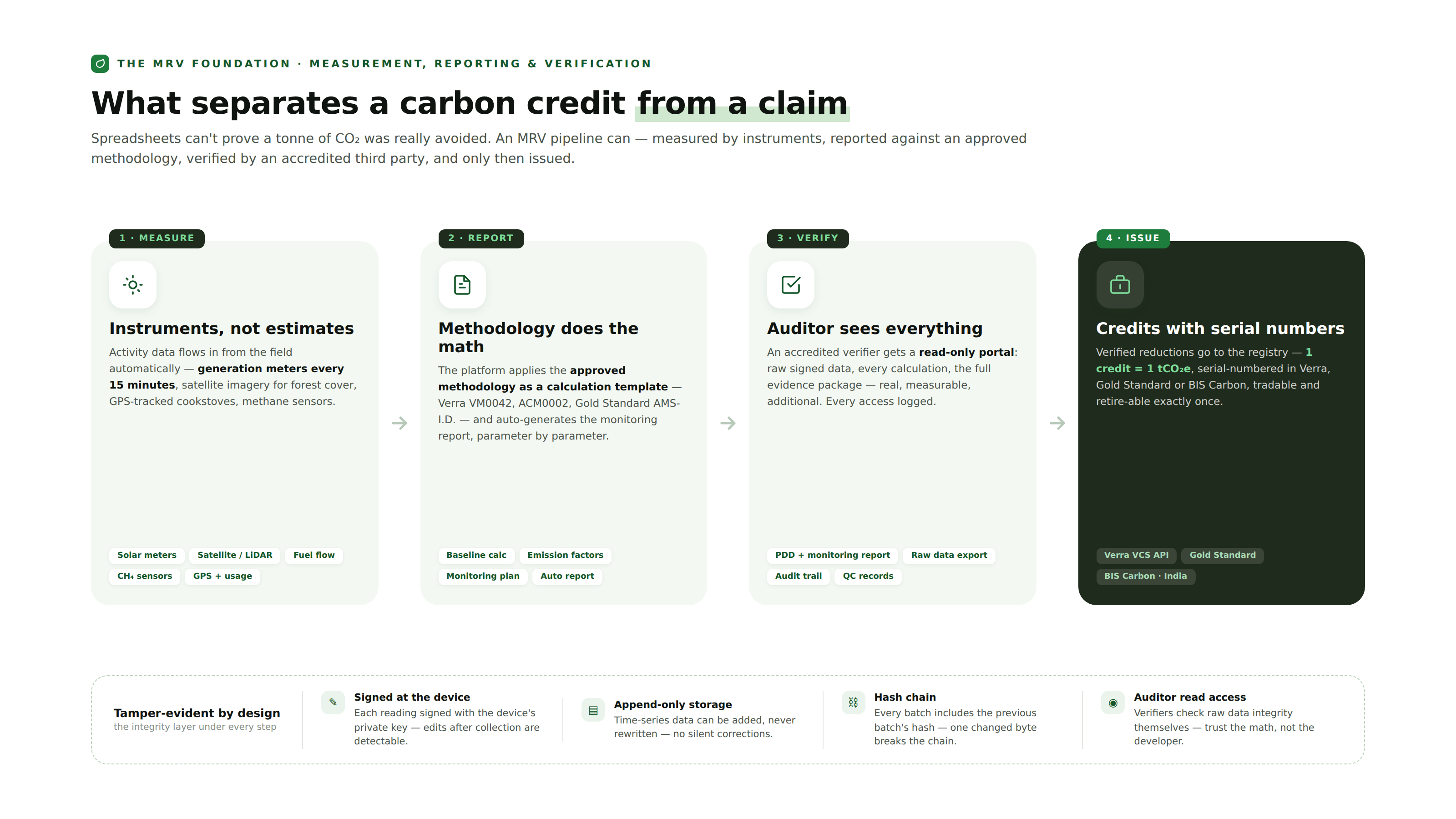
Each project type follows a defined approved methodology, a standardised calculation framework that specifies: how baseline emissions are calculated, which emission factors apply, what monitoring data must be collected, how frequently, by whom, and using which instruments.
The platform stores all approved methodologies, Verra VM0010, VM0042, Gold Standard AMS-I.D., and others, as configurable calculation templates.
When a project is registered, the appropriate methodology is selected and the platform guides the project developer through the required configuration.
The measurement layer, IoT data integration:
| Sensor/Meter Type | Data Captured | Project Type |
| Solar generation meter | kWh generated per 15-minute interval | Solar renewable energy |
| Grid meter | kWh consumed from grid (for efficiency projects) | Energy efficiency |
| Fuel flow meter | Litres of biomass or fossil fuel consumed | Cookstoves, industrial |
| Satellite imagery | Forest cover change over time | REDD+, afforestation |
| LiDAR / biomass sensors | Forest biomass measurement | Afforestation |
| GPS trackers on cookstoves | Usage patterns and deployment location | Cookstove projects |
| Methane gas sensors | CH₄ concentration at landfill gas capture | Methane capture |
The data integrity architecture:
MRV data must be tamper-evident, a carbon credit is only credible if the underlying data cannot be manipulated. The platform implements:
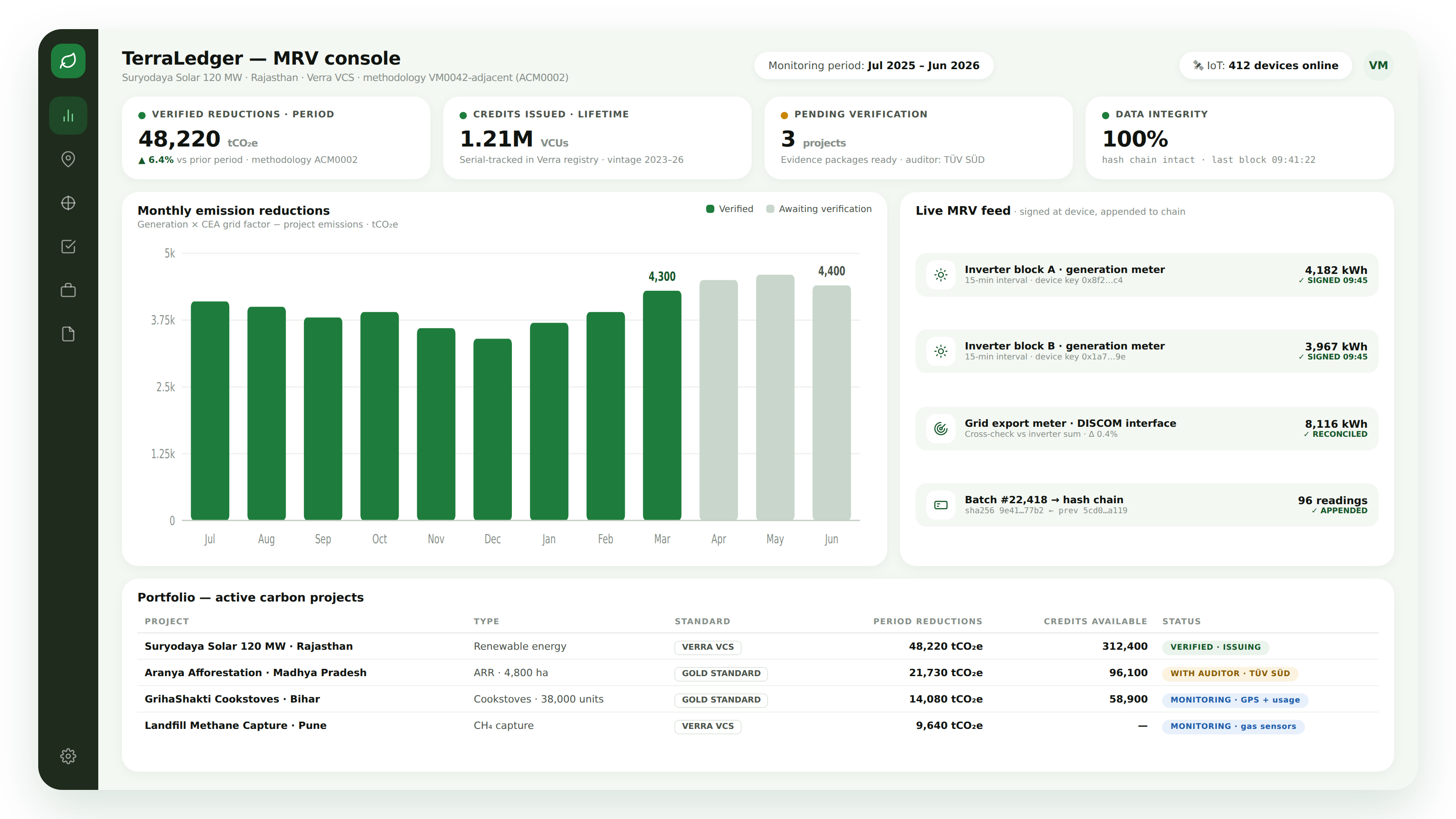
Data signing at collection, each IoT data point is signed with the device’s private key, making post-collection modification detectable. Immutable storage, time-series data written to an append-only database.
Hash chain, each new batch of readings includes a hash of the previous batch. Auditor read access, third-party verifiers can access raw data and verify its integrity.
The GHG Protocol calculation framework:
| Scope | What It Covers | Calculation |
| Scope 1 | Direct emissions, company’s own sources | Activity data × emission factor (IPCC, national inventory) |
| Scope 2 | Indirect emissions from purchased electricity | kWh consumed × grid emission factor (market-based or location-based) |
| Scope 3 | Value chain emissions, upstream and downstream | Multiple categories, suppliers, transport, product use, end-of-life |
Emission factor databases:
| Database | Source | Coverage |
| IPCC emission factors | IPCC 2006 Guidelines | Global, by sector |
| India grid emission factors | CEA (Central Electricity Authority) | India state and national grids |
| US EPA emission factors | US EPA | US-specific |
| DEFRA emission factors | UK Department for Energy | UK-specific |
| GHG Protocol scope 3 factors | GHG Protocol | Supplier and category averages |
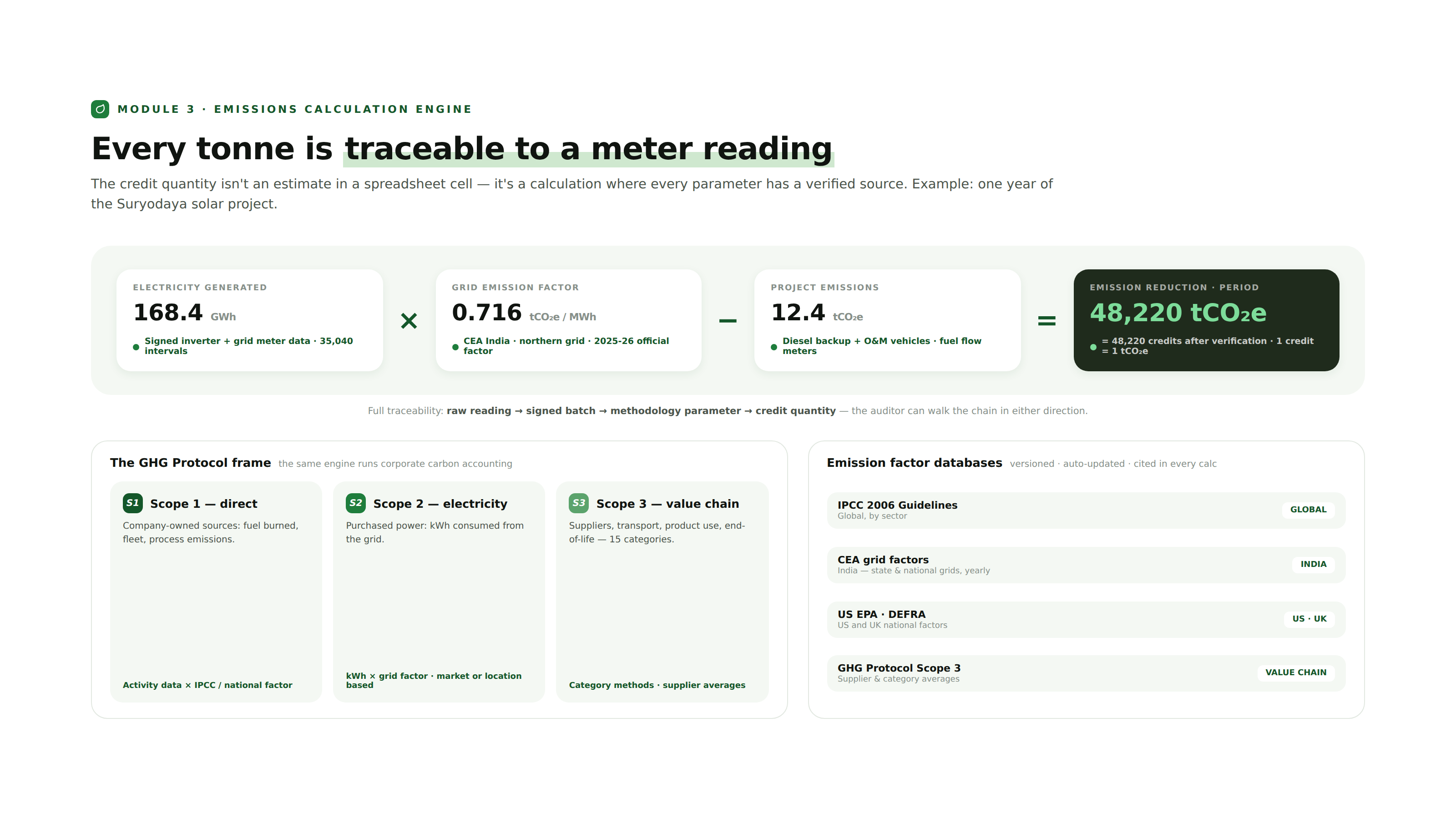
The project emission reduction calculation:
For a solar project: Emission Reduction (tCO₂e) = Electricity Generated (kWh) × Grid Emission Factor (tCO₂e/kWh) − Project Emissions (fuel used, if any).
Every parameter in this calculation is sourced from verified data, the generation meter, the official grid emission factor for the relevant region and year, with full traceability from the raw data to the credit quantity.
The verification process:
Carbon credit issuance requires third-party verification by an accredited auditor, a body accredited by Verra, Gold Standard, or the relevant standard.
The auditor reviews all project documentation, data, and calculations to confirm the emission reductions are real, measurable, and additional.
The auditor portal:
The platform provides auditors with a read-only portal, access to all project documents, raw IoT data, calculations, and the evidence package, without the ability to modify any records. Every auditor access is logged with timestamp and user identity.
The verification evidence package:
| Document | What It Contains |
| Project design document (PDD) | Full methodology, baseline calculation, monitoring plan |
| Monitoring report | Monitoring data for the verification period |
| Emission reduction calculation | Step-by-step calculation with all parameters and factors |
| Raw data export | All IoT readings, meter data, with integrity signatures |
| Audit trail | All system actions during the monitoring period |
| Quality control records | Any outliers detected and resolved during the period |
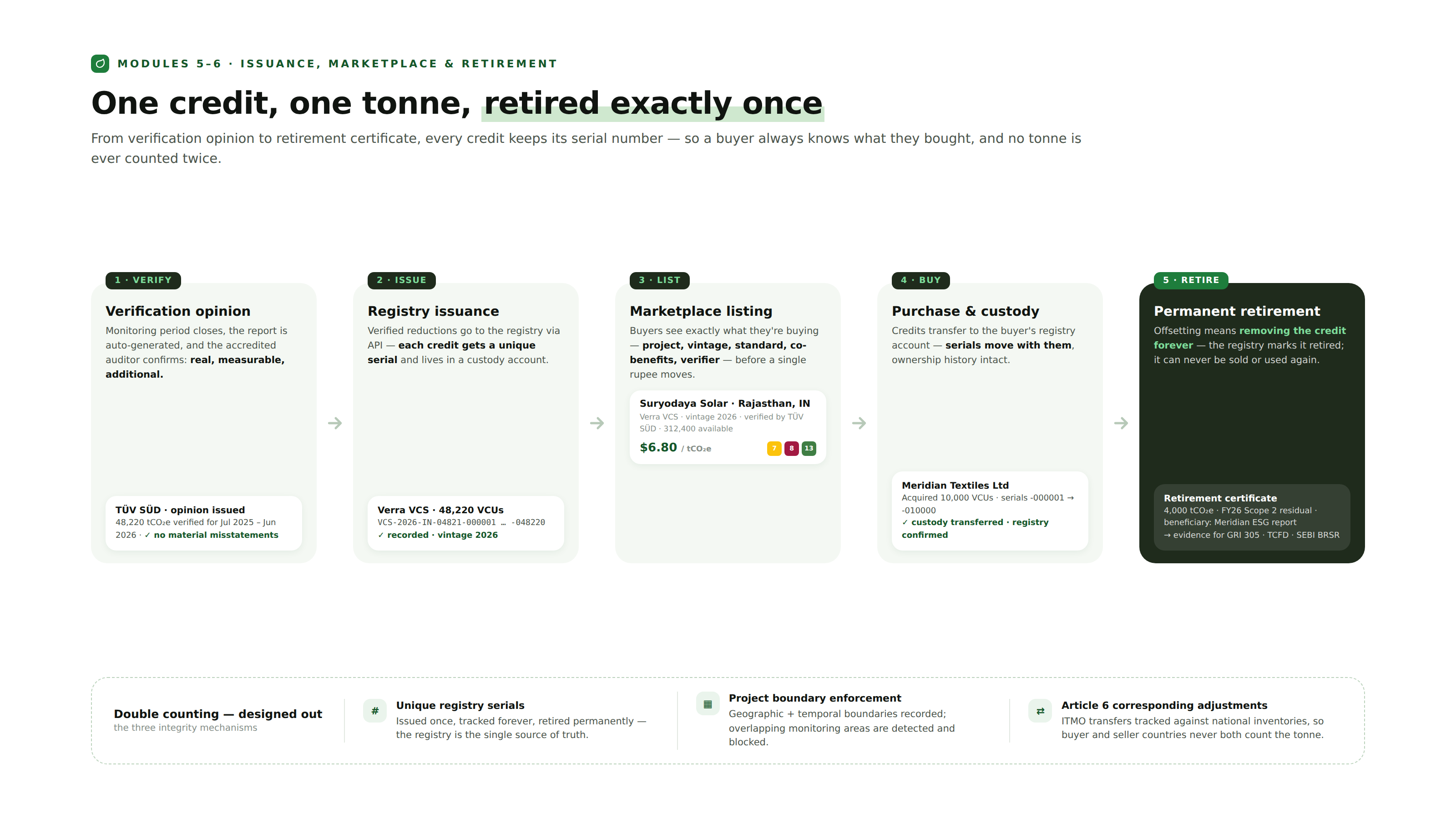
The credit issuance workflow:
| Step | Action |
| Monitoring period closes | Defined monitoring period (typically 1 year) ends |
| Monitoring report generated | Platform generates the monitoring report automatically |
| Third-party verification | Accredited auditor reviews and issues verification opinion |
| Registry submission | Verified emission reductions submitted to registry |
| Credit issuance | Registry issues carbon credits, each credit = 1 tCO₂e |
| Credit custody | Credits held in registry account, unique serial numbers |
Registry integrations:
| Registry | Standard | Integration |
| Verra (VCS) | Verified Carbon Standard | Verra API (Registry API program) |
| Gold Standard | Gold Standard for the Global Goals | Gold Standard Registry API |
| BIS Carbon Registry | India domestic carbon market | BIS API (CDSCO + Ministry of Power) |
| American Carbon Registry | ACR standard | ACR API |
| Climate Action Reserve | CAR standard | CAR API |
The buyer and seller marketplace:
Project developers list their verified credits for sale. Buyers, corporations meeting their net-zero commitments, compliance market participants, ESG investors, browse and purchase credits.
| Listing Information | Details |
| Project name and type | Afforestation, solar, cookstove, etc. |
| Location | Country, state, project coordinates |
| Standard | Verra VCS, Gold Standard, etc. |
| Vintage year | Which year the emission reductions occurred |
| Co-benefits | SDG contributions, biodiversity, community, gender |
| Available credits | Quantity available for purchase |
| Price | Per tCO₂e listing price |
| Verification status | Independently verified, auditor name, report date |
Credit retirement:
When a corporation buys credits to offset their emissions, the credits are “retired”, permanently removed from circulation so they cannot be sold again.
The platform records each retirement with: the retiring entity, the quantity retired, the vintage year, the project, the reason for retirement, and the official retirement certificate.
This retirement record is the evidence the corporation uses in their sustainability reporting, the permanent, auditable proof that they offset a specific quantity of emissions in a specific year from a specific project.
| Module | Cost Range (USD) | Notes |
| Project registration + methodology engine | $8K – $15K | Configurable methodology templates |
| IoT data collection + integrity layer | $8K – $15K | Signing, hash chain, immutable storage |
| Emissions calculation engine + GHG Protocol | $8K – $15K | All scopes, factor databases |
| Auditor portal + evidence package generation | $6K – $12K | |
| Credit issuance + registry integration | $10K – $20K | Per registry ~$3K–$5K |
| Carbon marketplace (listings + transactions) | $8K – $15K | |
| Credit portfolio management + retirement | $5K – $10K | Retirement certificates |
| ESG reporting module (GRI, TCFD, SEBI BRSR) | $6K – $12K | |
| Satellite imagery integration (for REDD+ projects) | $5K – $10K | Planet Labs or ESA Sentinel API |
| Analytics + portfolio carbon accounting | $5K – $10K | |
| AWS + VAPT + Year 1 ops | $5K – $10K | |
| Total | $74K – $144K | Full carbon credit platform |
EngineerBabu built enterprise operations for Adani Group, India’s largest renewable energy operator. Google AI Accelerator 2024 Top 20. CMMI Level 5. Contact: mayank@engineerbabu.com
MRV stands for Measurement, Reporting, and Verification, the three-step process that establishes whether carbon emission reductions are real and quantifiable. Measurement involves collecting the activity data, energy generation, fuel consumption, forest biomass, that provides the evidence for emission reduction calculations. Reporting involves compiling this data into a standardised monitoring report that follows the project’s approved methodology and documents all parameters, emission factors, and calculations. Verification involves third-party review by an accredited auditor who independently confirms that the measurements are accurate, the calculations follow the approved methodology, and the claimed emission reductions are real and additional to what would have occurred without the project. Without rigorous MRV, carbon credits are unverifiable claims. MRV is what distinguishes a credible carbon credit from greenwashing.
Additionality is the principle that a carbon credit should only be issued for emission reductions that would not have occurred without the specific project and the carbon finance it receives. A solar project in a location where solar is already mandated by law is not additional, the emission reductions would have occurred anyway. A solar project in a location where grid electricity is cheap and solar is economically unviable without the carbon credit revenue is additional, the carbon credit finance is what makes the project happen. A carbon tracking platform must capture and store the additionality demonstration, the financial analysis, regulatory landscape assessment, and common practice analysis, as part of the project documentation, because this is the document that verifies the credit has genuine value and is not a double-counting of reductions that would have occurred regardless.
Double counting, the same emission reduction being claimed by two different parties, is the primary integrity risk in carbon markets. A carbon tracking platform prevents it through three mechanisms. First, registry integration, all issued credits are recorded in official registries (Verra, Gold Standard) with unique serial numbers. Once a credit is issued, the registry records it. Once retired, the registry marks it permanently retired and it cannot be reused. Second, project boundary enforcement, the platform records precise geographic and temporal boundaries for every project. Overlapping project boundaries are detected and blocked. The same emission reduction cannot be claimed by two projects whose monitoring areas overlap. Third, national inventory coordination, for the Paris Agreement Article 6 carbon market, the platform tracks whether emission reductions have been transferred internationally through ITMOs (Internationally Transferred Mitigation Outcomes), with corresponding adjustments to national inventory accounts to prevent the same tonne of CO₂ reduction from being counted by both the selling and buying country.