How to Build a Pharmacovigilance Platform, Adverse Event Reporting, Signal Detection, and EMA/FDA Submission 2026


Create engaging, high-performance mobile applications tailored to your business needs. We craft future-ready apps that offer smooth user experiences on all devices.
Build robust and scalable websites and CMS platforms that help you manage content effortlessly. Our development ensures a seamless digital presence.
Launch secure, feature-rich online stores with intuitive shopping experiences. We build tailored eCommerce platforms designed for growth.
Design captivating games with immersive gameplay and stunning graphics. From concept to launch, we build engaging experiences that players love.
Enhance your customer relationships with customized Salesforce implementations. Drive growth and efficiency with smarter CRM solutions.
Harness artificial intelligence and machine learning to automate workflows and gain actionable insights. Our AI transforms data into smart decisions.
Accelerate your software delivery lifecycle with continuous integration, delivery, and infrastructure automation to boost efficiency.
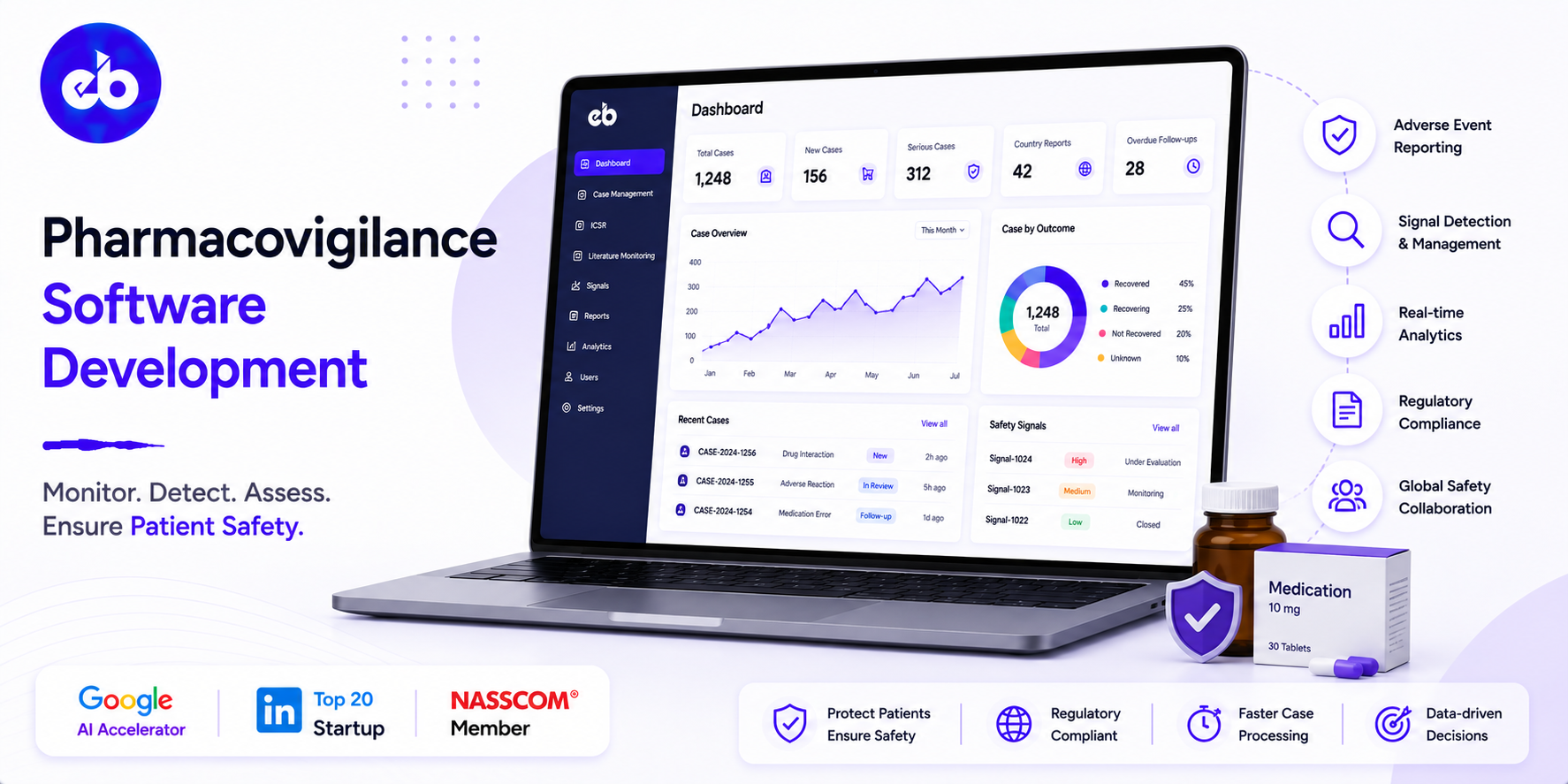
Every pharmaceutical product on the market has a post-approval safety obligation.
Drug companies must collect, process, and report adverse events, unexpected or harmful reactions to their products, to regulatory authorities on defined timelines: 7 calendar days for fatal or life-threatening unexpected adverse events, 15 calendar days for other serious unexpected events, and periodic aggregate reports (PSUR/PBRER) every 6 to 12 months for all marketed products.
Missing these reporting timelines is not an operational failure. It is a regulatory violation that triggers warning letters, consent decrees, and in extreme cases, market withdrawal of the product.
A pharmacovigilance software development that manages the full adverse event lifecycle, from intake through medical review through regulatory submission, is not optional for a pharmaceutical company. It is the infrastructure for their post-market safety obligation.
The global pharmacovigilance market is projected to reach $12.8 billion by 2030 at a CAGR of 12.4%. The buyers are pharmaceutical companies of all sizes, CROs (Contract Research Organisations) providing PV services, biotechnology companies, and medical device manufacturers.
EngineerBabu built Somnoware, the IoT medical monitoring platform acquired by ResMed, and healthcare platforms for Apollo Hospitals. We understand FDA-regulated healthcare engineering. CMMI Level 5. Google AI Accelerator 2024 Top 20. Contact: mayank@engineerbabu.com
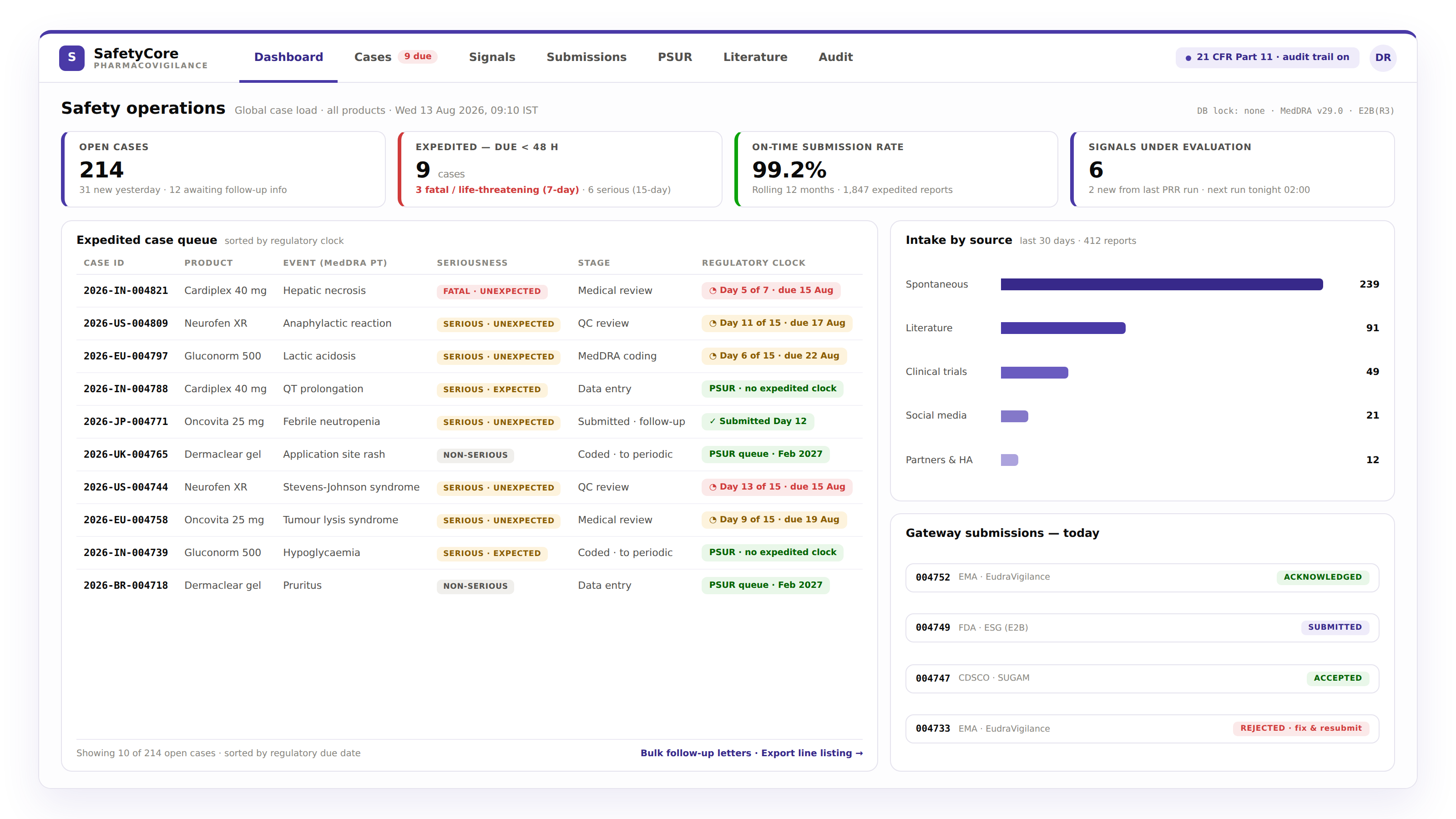
| Function | Module |
| Adverse event intake | Multi-source intake, literature, spontaneous reports, clinical trials |
| ICSR processing | Data entry, medical coding (MedDRA), narrative writing |
| Medical review | Physician review, causality assessment, seriousness evaluation |
| Signal detection | Statistical disproportionality analysis, signal evaluation |
| Regulatory reporting | E2B(R3) format, EudraVigilance, FDA MedWatch, CDSCO |
| PSUR/PBRER | Periodic safety update report generation |
| Literature monitoring | Systematic literature search and relevant article flagging |
| Aggregate reports | RMP, DSUR, CIOMS II periodic reports |
| Quality management | Workflow compliance, audit trail, SOP management |
| Compliance | ICH E2B, EU GVP, FDA 21 CFR 314 |
The intake sources:
| Source | Examples | Volume |
| Spontaneous reports | Healthcare professional call, patient online report, medical information request | Highest volume |
| Literature | Published case reports, clinical trial publications | High volume, requires monitoring |
| Social media | Patient forums, Twitter/X, Facebook patient groups | Growing source |
| Clinical trials | SAE reports from ongoing clinical studies | Structured, defined process |
| Registries | Disease registries, pregnancy registries | Periodic structured data |
| Health authority requests | Regulatory authority queries about specific adverse events | Low volume, high priority |
| Partner companies | Adverse events from licensing partners or contract manufacturers | Volume depends on partnership |
The intake form, minimum dataset:
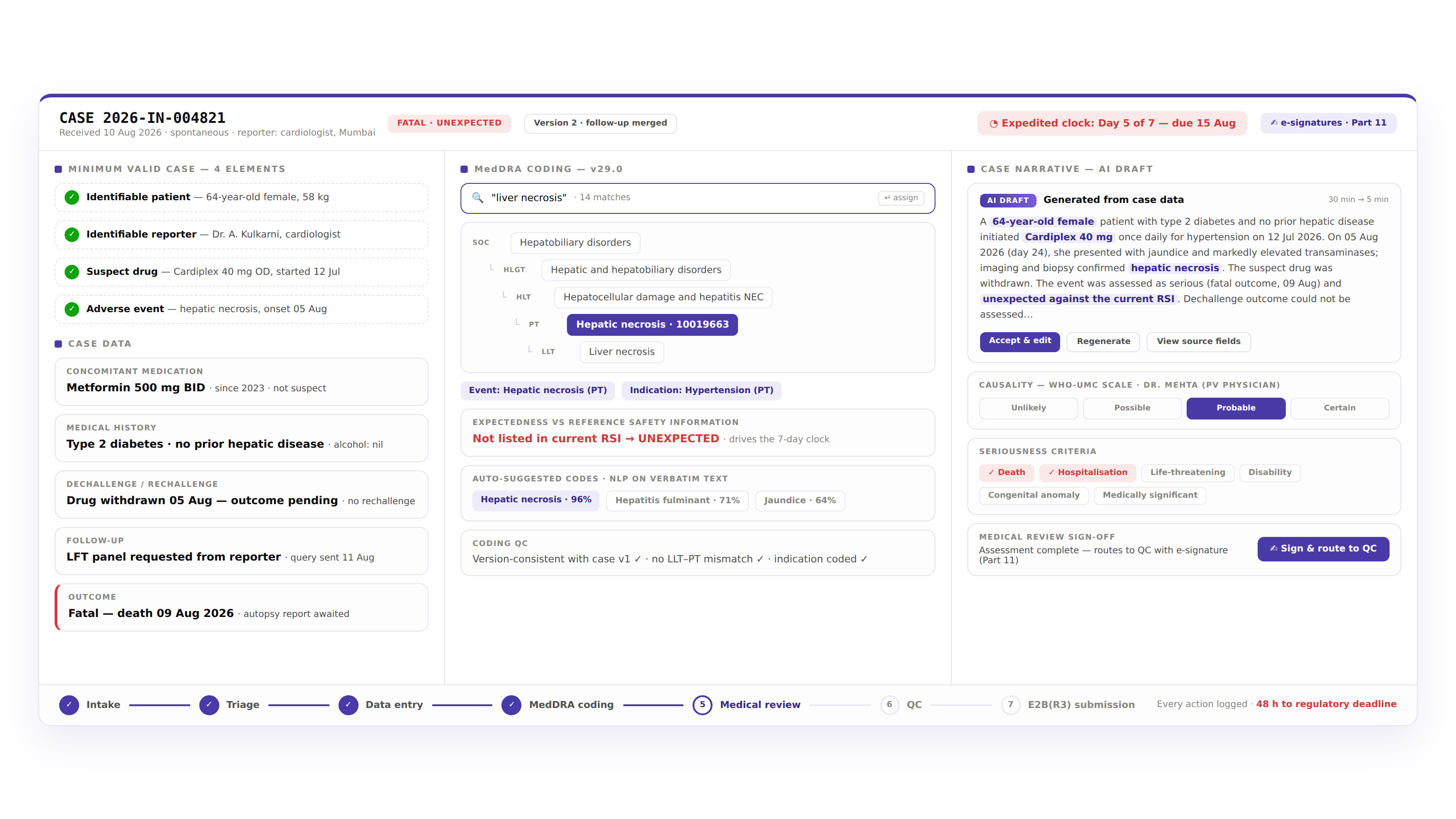
An Individual Case Safety Report (ICSR) requires a minimum of four valid data elements to be a reportable adverse event:
The intake system flags incomplete cases for follow-up and routes complete cases to medical coding and review.
Web intake form:
A patient-facing or HCP-facing web app form captures adverse event reports directly. The form is available in multiple languages, captures all required MedDRA-codeable elements in a structured way, and routes submitted reports automatically to the case processing queue.
The ICSR lifecycle:
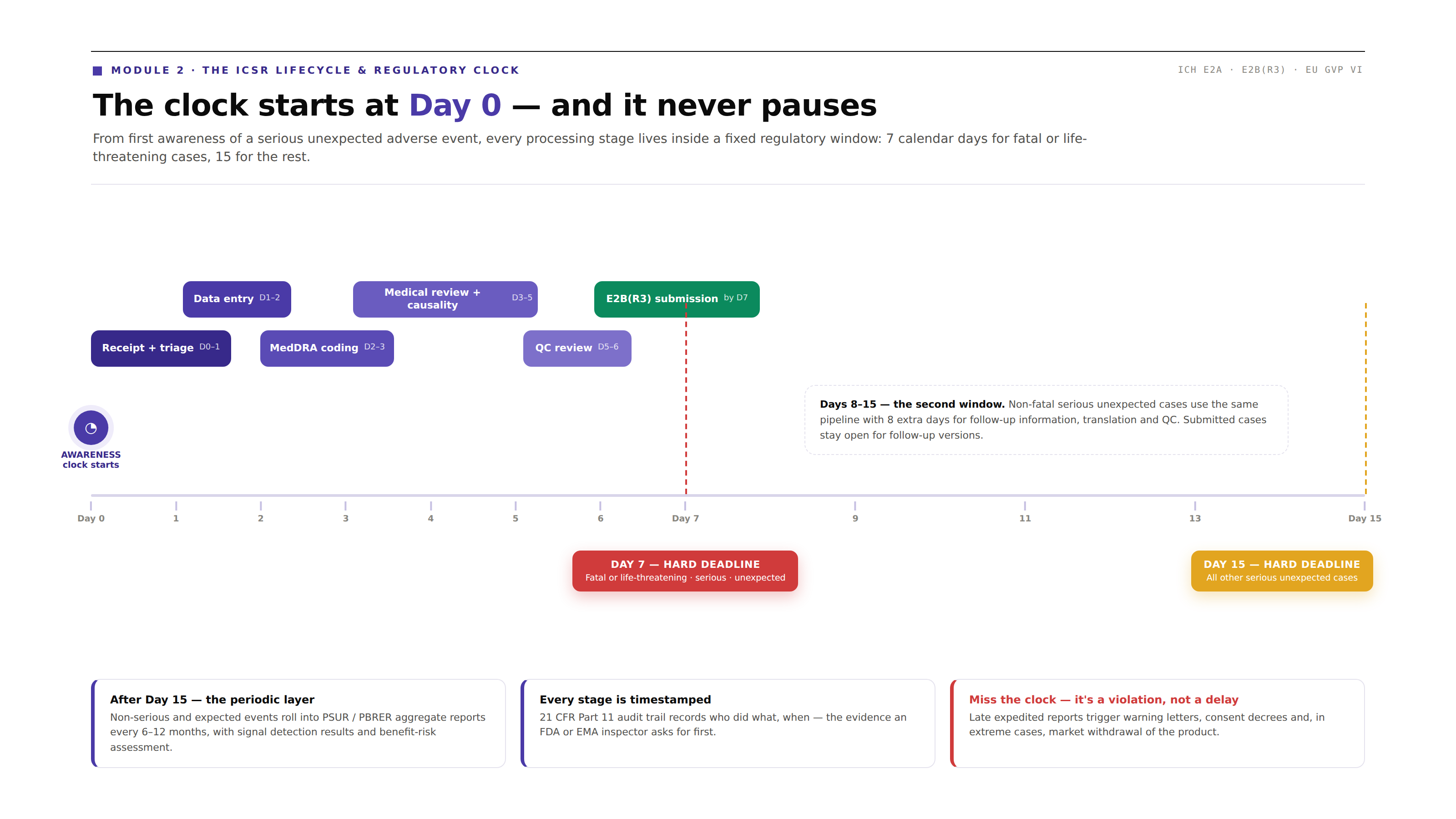
| Stage | Action | Timeline |
| Initial receipt | Report received and acknowledged | Day 0 |
| Triage | Seriousness assessed, clock started for serious cases | Day 0–1 |
| Data entry | All report details entered into the case record | Day 1–2 |
| MedDRA coding | Adverse events and indications coded using MedDRA dictionary | Day 2–3 |
| Medical review | Case physician reviews and assesses causality | Day 3–5 |
| QC review | Quality check, completeness, coding accuracy | Day 5–6 |
| Submission | Report submitted to relevant regulatory authorities | Day 7 or 15 |
| Follow-up | Outstanding information requested from reporter | Ongoing |
MedDRA coding:
MedDRA (Medical Dictionary for Regulatory Activities) is the international standardised terminology used to code adverse events, indications, and medical history in regulatory submissions.
The platform integrates with the MedDRA browser, allowing coders to search the hierarchy (System Organ Class → High-Level Group Term → High-Level Term → Preferred Term → Lowest Level Term) and assign the appropriate codes.
The narrative writing module:
Every ICSR requires a case narrative, a concise medical summary describing the patient, the adverse event, the suspect drug, the clinical course, and the outcome.
The platform provides a narrative template that populates automatically from the case data, the coder reviews and edits the AI-generated draft rather than writing from scratch. For straightforward cases, this reduces narrative writing time from 30 minutes to 5 minutes.
What is a safety signal:
A safety signal is information suggesting a new, previously unrecognised causal association between a drug and an adverse event, or a known association that has changed in terms of frequency, severity, or affected population. Signals emerge from accumulating ICSRs over time.
Statistical signal detection methods:
| Method | Description | Use |
| Proportional Reporting Ratio (PRR) | Ratio of reporting rate for drug-event combination vs all drugs | EU signal detection standard |
| Reporting Odds Ratio (ROR) | Odds of event being reported for drug vs all drugs | Common in academic literature |
| Empirical Bayes Geometric Mean (EBGM) | Bayesian disproportionality measure | FDA FAERS analysis standard |
| Information Component (IC) | WHO Uppsala Monitoring Centre standard | WHO VigiBase analysis |
The signal detection workflow:
The platform runs disproportionality analysis on the accumulated ICSR database, calculating PRR and ROR for every drug-event combination with at least 3 cases. Combinations exceeding the threshold (typically PRR > 2 and χ² > 4) are flagged as potential signals for pharmacovigilance physician review.
The signal evaluation then determines whether the detected disproportionality represents a genuine safety concern or a statistical artefact, considering confounders, reporting bias, disease background rate, and biologic plausibility.
The E2B(R3) format:
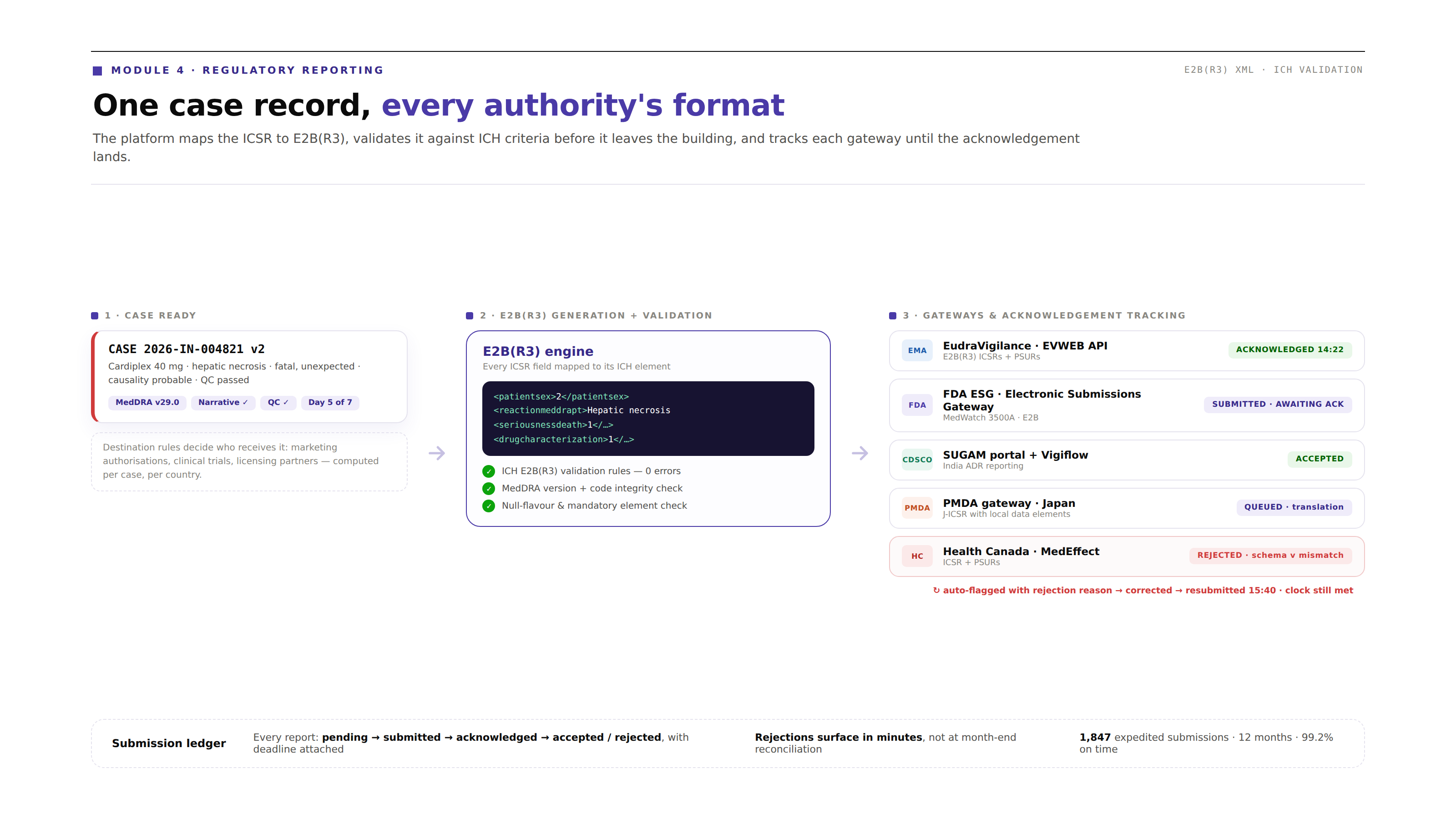
Individual case safety reports are submitted to regulatory authorities in E2B(R3) XML format, the ICH standard that allows electronic transmission of structured ICSR data.
The platform generates E2B(R3) XML from the case record, mapping every ICSR field to the correct E2B element, and validates the output against the ICH E2B(R3) validation criteria before submission.
Regulatory gateway connections:
| Authority | Submission Gateway | Report Type |
| EMA (European) | EudraVigilance EVWEB API | E2B(R3) ICSRs, PSUR |
| FDA (US) | FDA ESG (Electronic Submissions Gateway) | MedWatch 3500A, E2B ICSRs |
| CDSCO (India) | SUGAM portal + Vigiflow | ADR reporting |
| PMDA (Japan) | PMDA gateway | J-ICSRs |
| Health Canada | MedEffect Canada | ICSR, PSURs |
The submission tracking dashboard:
Every submission has a status, pending, submitted, acknowledged, accepted, rejected. The platform tracks every submission with its deadline, current status, and any acknowledgement or rejection from the authority. Rejected submissions are flagged immediately with the rejection reason for resubmission.
The Periodic Safety Update Report (PSUR/PBRER):
A PSUR is a comprehensive safety report on a marketed product, covering all adverse events received during the reporting period, signal detection results, cumulative safety data, and the company’s benefit-risk assessment.
PSURs are submitted to EMA, FDA, and other authorities at defined intervals (annually for most products, more frequently for newer or higher-risk products).
The PSUR generation engine:
The platform generates the PSUR structure automatically, pulling:
All ICSRs received in the reporting period (count by seriousness, expectedness, outcome). Exposure data (number of patients treated).
Disproportionality analysis results from the signal detection module. Comparison against the Reference Safety Information (RSI), the known safety profile against which events are assessed as expected or unexpected.
The medical writer completes the benefit-risk evaluation narrative section, which requires clinical judgment that the platform cannot generate automatically. The rest of the PSUR is pre-populated from operational data.
| Module | Cost Range (USD) | Notes |
| Multi-source intake + web form | $8K – $15K | Multi-language, structured capture |
| ICSR case record + MedDRA integration | $10K – $18K | MedDRA browser + coding workflow |
| Medical review workflow + causality assessment | $8K – $15K | |
| AI narrative generation (LLM-assisted) | $6K – $12K | |
| E2B(R3) XML generation + validation | $8K – $15K | ICH standard compliance |
| Regulatory gateway connections (EMA, FDA, CDSCO) | $10K – $20K | Payment gateway ~$3K–$7K |
| Signal detection engine (PRR, ROR, EBGM) | $10K – $18K | Statistical computation + visualisation |
| Signal evaluation workflow | $5K – $10K | |
| PSUR/PBRER generation engine | $8K – $15K | |
| Literature monitoring integration | $5K – $10K | PubMed API + NLP screening |
| 21 CFR Part 11 audit trail + e-signatures | $8K – $15K | |
| Compliance dashboard + SOP management | $4K – $8K | |
| AWS + VAPT + Year 1 ops | $5K – $10K | |
| Total | $95K – $181K | Full pharmacovigilance platform |
EngineerBabu built Somnoware (acquired by ResMed) and healthcare platforms for Apollo Hospitals. FDA-regulated healthcare engineering experience. CMMI Level 5. Contact: mayank@engineerbabu.com
Regulatory reporting timelines for adverse events are defined by ICH E2A guidelines and implemented in regional regulations. For serious, unexpected adverse events, reactions not mentioned in the product’s current labelling and meeting seriousness criteria (death, life-threatening, hospitalisation, disability, congenital anomaly, or medically significant), the timelines are: 7 calendar days from awareness for fatal or immediately life-threatening cases, 15 calendar days for other serious unexpected cases. For serious expected adverse events (listed in the product labelling), reporting timelines vary by region, some authorities require expedited reporting, others include them only in periodic reports. Non-serious adverse events are included in Periodic Safety Update Reports (PSURs). Missing these timelines triggers regulatory action, FDA inspections, EMA notices, and in severe cases, voluntary or mandatory market withdrawal of the product.
MedDRA (Medical Dictionary for Regulatory Activities) is the international standardised medical terminology developed by ICH for regulatory communication and evaluation of data pertaining to medicinal products for human use. It provides a hierarchical structure, from System Organ Class (the broadest level, e.g., Cardiac disorders) down to Lowest Level Terms (the most specific description of the adverse event), with approximately 70,000 lowest-level terms mapped to approximately 24,000 preferred terms. MedDRA coding is mandatory for ICSR submissions to EMA (EudraVigilance), FDA (FAERS), WHO (VigiBase), and all ICH member regulatory authorities because it standardises the description of adverse events, enabling regulatory authorities to detect safety signals by analysing aggregate data across all ICSRs submitted for a product. Without standardised MedDRA coding, a signal of “liver failure” reported as “hepatic necrosis,” “acute liver injury,” and “fulminant hepatitis” in different ICSRs would not be identifiable as a single safety concern.
A safety signal is a finding suggesting a new or changed causal association between a drug and an adverse event that warrants further evaluation. Disproportionality analysis detects signals by comparing the reporting rate of a specific drug-event combination in the adverse event database against what would be expected if the drug had no association with the event. The Proportional Reporting Ratio (PRR) calculates this as: (reports of event for this drug / all reports for this drug) divided by (reports of event for all other drugs / all reports for all other drugs). A PRR significantly greater than 1, combined with a minimum number of cases (typically 3) and statistical significance, indicates that the drug-event combination is being reported at a higher rate than expected by chance. This statistical signal then triggers a pharmacovigilance physician’s clinical evaluation to determine whether the disproportionality represents a genuine causal safety concern or a statistical artefact from reporting bias, confounding, or the underlying disease.