How to Build a Corporate Travel Management Platform, Booking, Policy Compliance, Expense Integration, and Travel Analytics 2026


Create engaging, high-performance mobile applications tailored to your business needs. We craft future-ready apps that offer smooth user experiences on all devices.
Build robust and scalable websites and CMS platforms that help you manage content effortlessly. Our development ensures a seamless digital presence.
Launch secure, feature-rich online stores with intuitive shopping experiences. We build tailored eCommerce platforms designed for growth.
Design captivating games with immersive gameplay and stunning graphics. From concept to launch, we build engaging experiences that players love.
Enhance your customer relationships with customized Salesforce implementations. Drive growth and efficiency with smarter CRM solutions.
Harness artificial intelligence and machine learning to automate workflows and gain actionable insights. Our AI transforms data into smart decisions.
Accelerate your software delivery lifecycle with continuous integration, delivery, and infrastructure automation to boost efficiency.
Hire app developers ready to turn your ideas into sleek, high-performing mobile apps for any platform.
Bring in frontend pros who craft smooth, beautiful, and user-friendly interfaces that your visitors will love.
Get backend developers who build fast, secure, and reliable systems to keep everything running behind the scenes.
Hire eCommerce developers who build secure, scalable online stores designed to offer seamless shopping and grow your sales.
Get dedicated developers committed to your projects, delivering consistent quality and speed as an extension of your team.
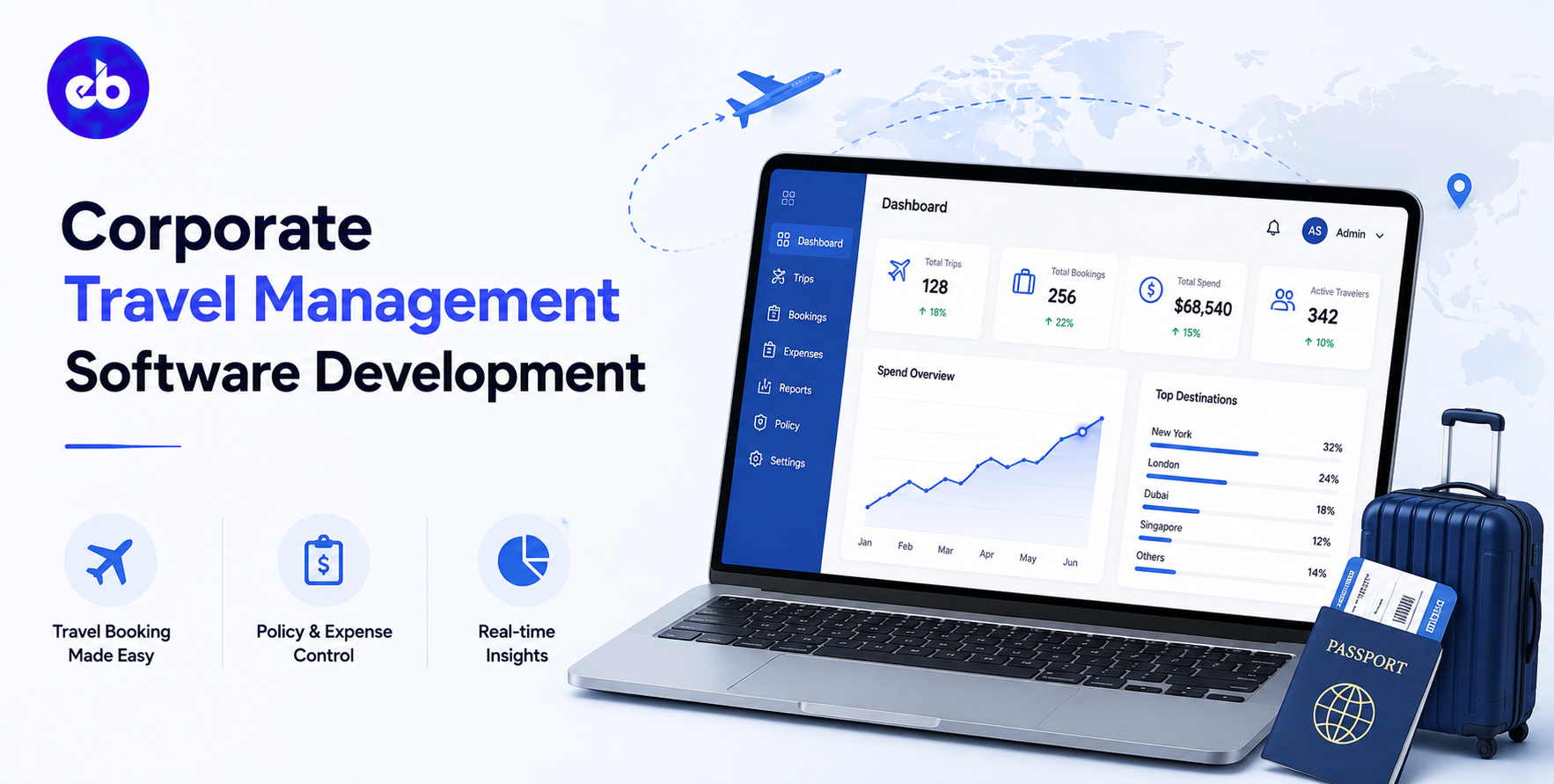
Corporate travel spend in India crossed $35 billion in 2025. Most of it is managed through a combination of travel management companies charging 8 to 12% service fees, expense reimbursement systems that take 3 to 4 weeks to process, and travel policies that exist in PDF documents nobody reads.
The result: employees overspend, finance teams cannot reconcile expenses until month-end, and the company never knows its true travel cost until the auditor asks.
A corporate travel management software development gives companies control over travel spend in real time, enforcing policy at the booking stage rather than the reimbursement stage, integrating GDS (Global Distribution System) content for best-available fares, automating expense capture, and providing the travel analytics that let CFOs understand and reduce one of their largest discretionary cost lines.
EngineerBabu has built enterprise platforms for Adani Group and technology for 75+ YC-backed companies, many managing significant corporate travel programmes. CMMI Level 5. Google AI Accelerator 2024 Top 20. Contact: mayank@engineerbabu.com
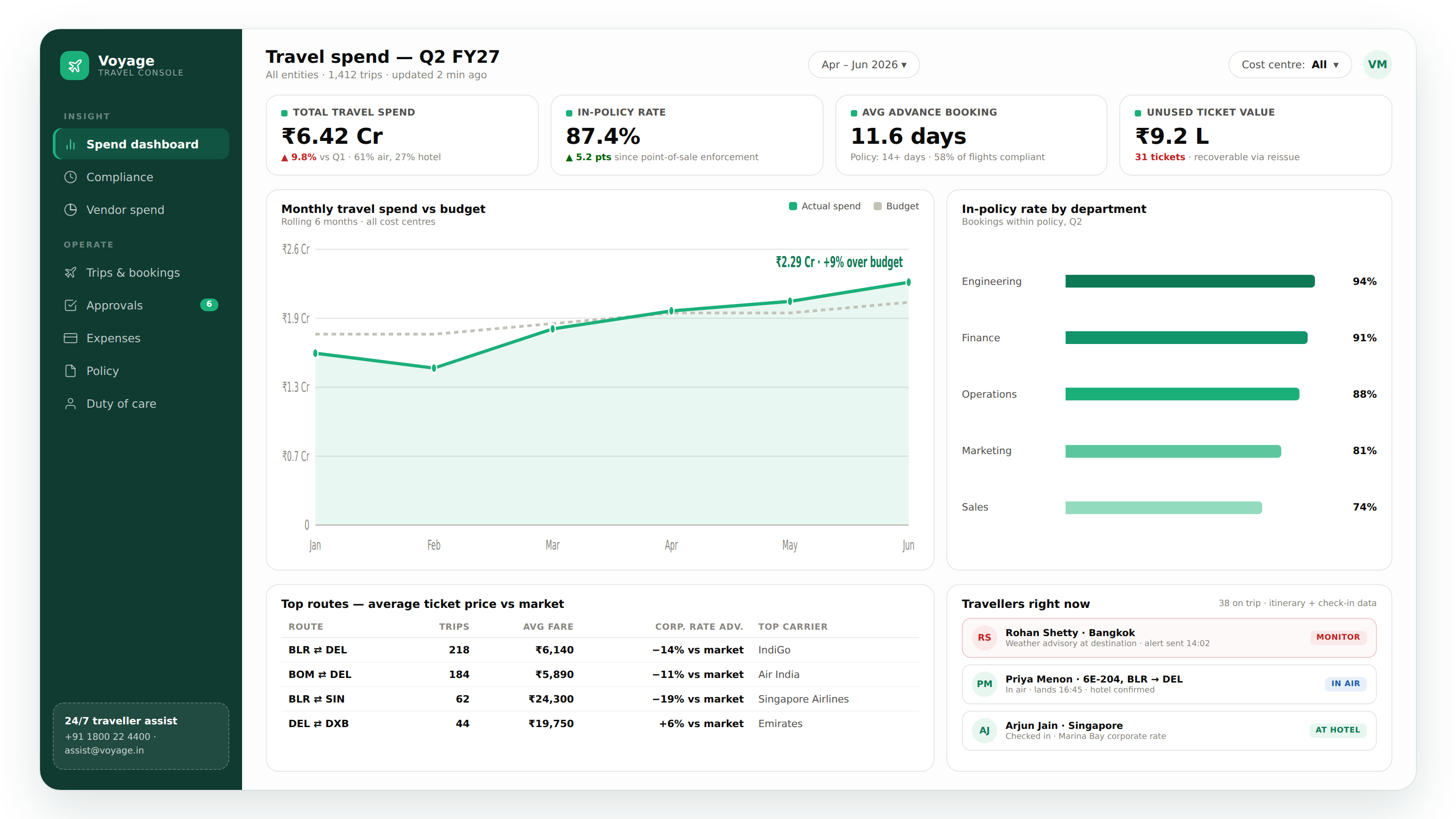
| Function | Module |
| Travel policy configuration | Flight class, hotel star rating, advance booking rules |
| Booking engine | Flights, hotels, trains, cabs, unified search and booking |
| GDS integration | Amadeus, Sabre, or Travelport for flight content |
| Approval workflow | Trip request, approval before booking or after |
| Policy compliance | In-policy vs out-of-policy flagging at booking |
| Expense integration | Receipt capture, expense claim, reimbursement |
| Corporate negotiated rates | Hotel rate agreements, airline corporate codes |
| Duty of care | Traveller tracking, safety alerts |
| Reporting and analytics | Travel spend by cost centre, department, destination |
| Vendor management | Preferred vendors, contract management |
| Mobile app | Booking, itinerary, receipts, emergency support |
What the travel policy defines:
| Policy Element | Example |
| Flight class by grade | L1–L3: economy class; L4–L6: business class above 6 hours; L7+: business class all routes |
| Hotel star rating by destination | Domestic: max 3-star; International: max 4-star |
| Advance booking window | Flights must be booked minimum 14 days in advance (exceptions require approval) |
| Per diem (daily allowance) | Mumbai: ₹3,500/day; Delhi: ₹3,200/day; International: $150/day |
| Preferred vendors | Use preferred hotel chain before considering alternatives |
| Cost threshold | Bookings above ₹50,000 require additional approval |
| Single supplier rule | Book from the company’s approved travel portal only |
The policy violation workflow:
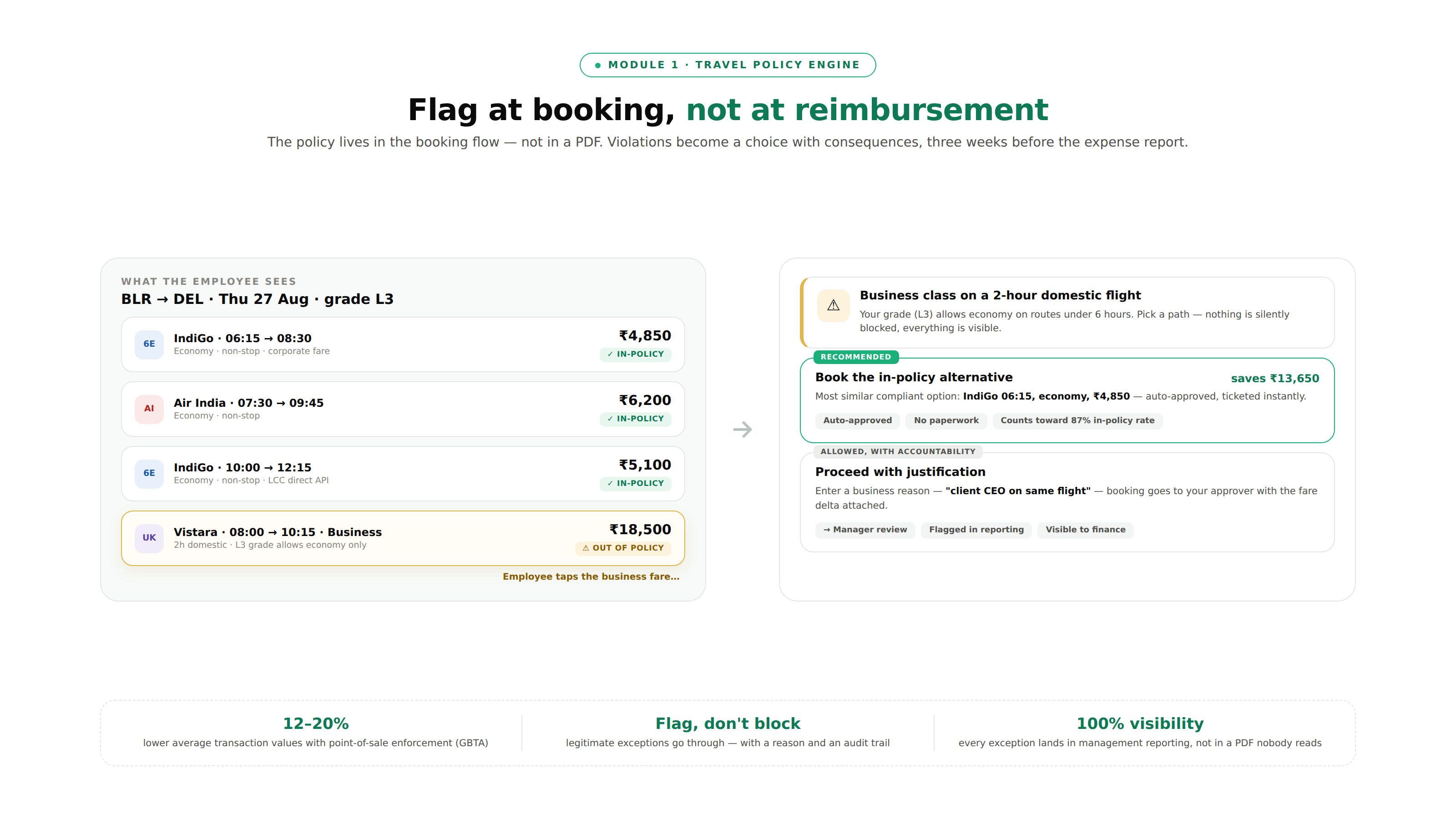
When an employee attempts a booking that violates policy, booking business class for a 2-hour domestic flight, booking a 5-star hotel, the platform presents a choice:
Book in-policy alternative: The platform suggests the most similar compliant option. Book out-of-policy with justification: The employee can proceed but must enter a reason. This reason, combined with the booking, goes to their approver for review.
The booking goes through but is flagged for management reporting.
This approach, flagging rather than hard-blocking, respects operational realities (sometimes there is a legitimate reason to fly business class on a short flight) while ensuring visibility and accountability.
The unified booking interface:
All travel, flights, hotels, trains, cabs, is booked through one interface. The employee does not go to MakeMyTrip for flights, a hotel portal for rooms, and Uber for cabs separately.
The unified platform shows options, applies policy filters, and completes all bookings in one workflow.
GDS integration:
| GDS | Coverage | Integration |
| Amadeus | Largest global GDS, 175,000 hotel properties, all major airlines | Amadeus Self-Service API or NDC API |
| Sabre | Strong US and Americas coverage | Sabre REST APIs |
| Travelport (Apollo, Worldspan, Galileo) | Strong European coverage | Travelport Developer APIs |
Low-cost carrier (LCC) integration:
GDS content historically excluded LCC fares, IndiGo, SpiceJet, Air Arabia. Direct airline API integrations supplement GDS content to ensure the cheapest compliant option is always shown.
The fare comparison view:
| Option | Airline | Departure | Arrival | Class | Fare | Policy Status |
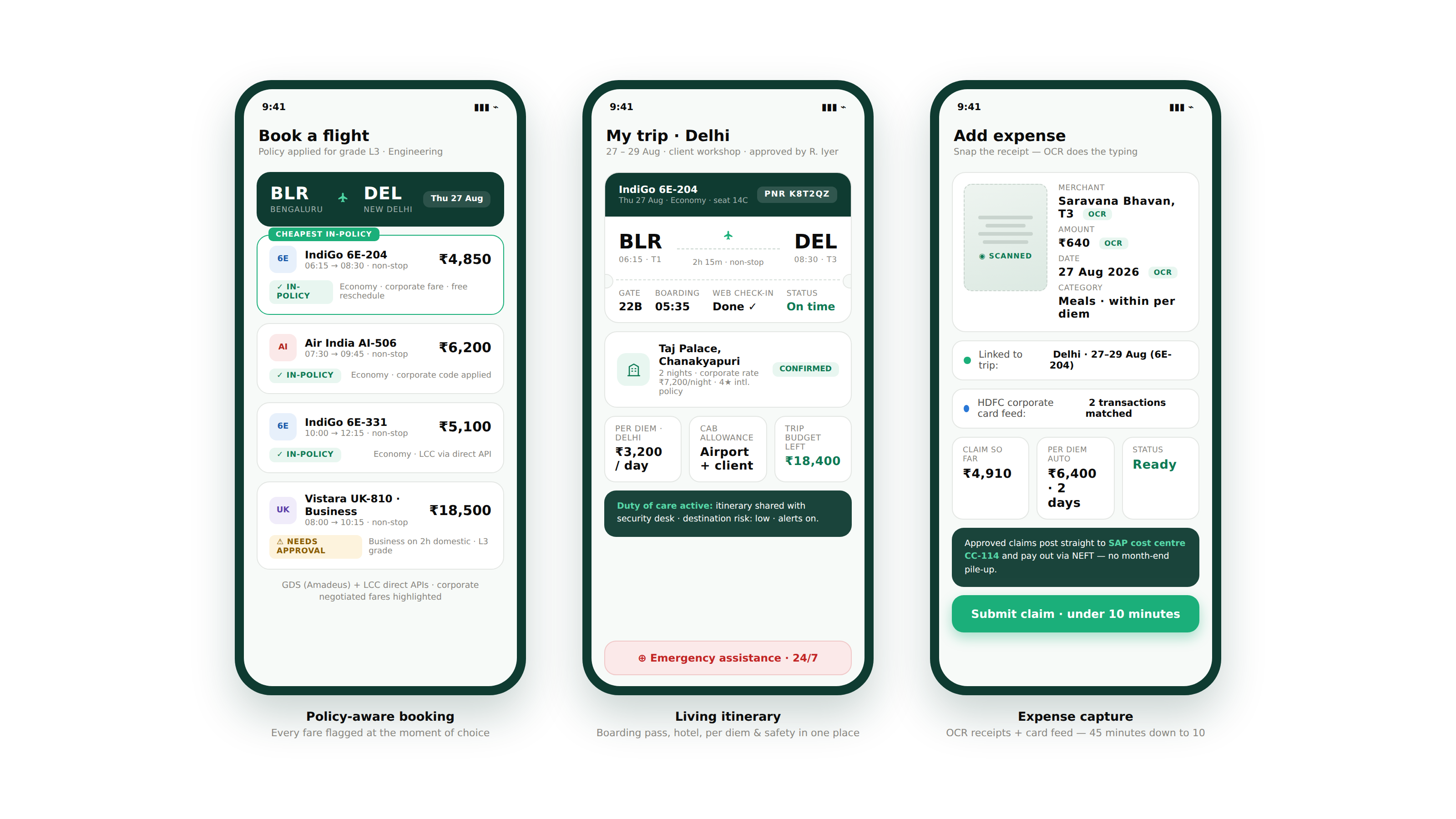
| 1 | IndiGo | 06:15 | 08:30 | Economy | ₹4,850 | ✅ In-policy |
| 2 | Air India | 07:30 | 09:45 | Economy | ₹6,200 | ✅ In-policy |
| 3 | IndiGo | 10:00 | 12:15 | Economy | ₹5,100 | ✅ In-policy |
| 4 | Vistara | 08:00 | 10:15 | Business | ₹18,500 | ⚠️ Requires approval |
Pre-trip approval:
Some organisations require a trip request to be approved before any bookings are made. The workflow:
Employee submits trip request, destination, travel dates, business purpose, estimated cost. Manager receives approval request with trip details. Manager approves or rejects, with comments. Employee can now make bookings within the approved parameters.
Post-booking approval:
For faster employee experience, some organisations allow booking first, approval second. The workflow:
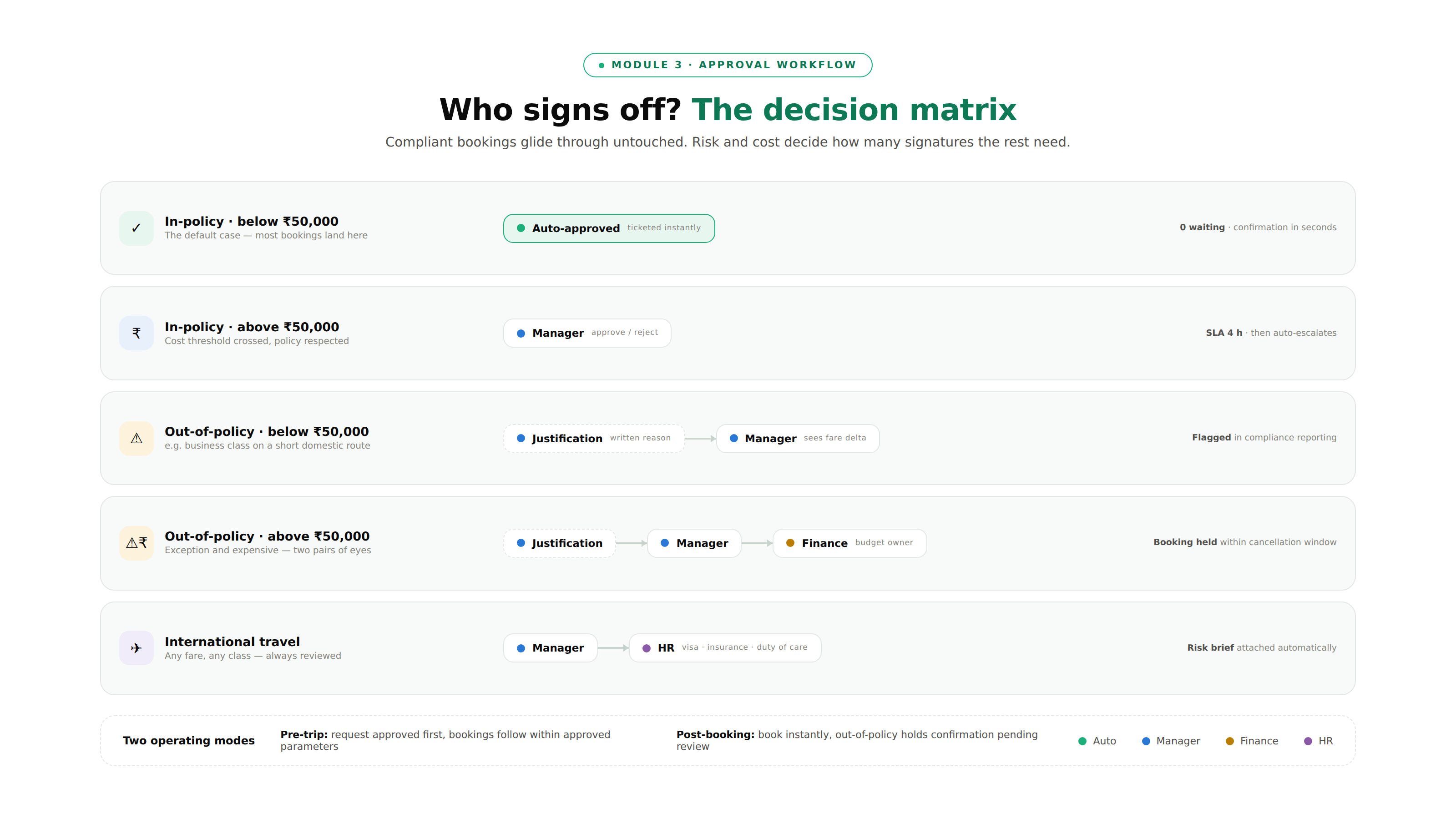
Employee books travel, policy-compliant bookings are auto-approved. Out-of-policy bookings hold the confirmation pending manager approval. If manager rejects, the booking is cancelled (within the carrier’s cancellation window) or flagged as an exception.
The approval decision matrix:
| Booking Type | Approval Required |
| In-policy, below cost threshold | Auto-approved |
| In-policy, above cost threshold | Manager approval |
| Out-of-policy, below cost threshold | Manager approval + justification |
| Out-of-policy, above cost threshold | Manager + Finance approval |
| International travel | Always manager + HR |
The expense workflow:
| Step | Action |
| Receipt capture | Employee photographs receipt, mobile app OCR extracts amount, merchant, date |
| Trip linking | Expense linked to the travel itinerary it relates to |
| Per diem calculation | System calculates applicable per diem for each travel day |
| Expense claim submission | Employee submits claim, linked expenses, per diem, mileage |
| Approver review | Manager reviews claim against policy |
| Finance processing | Approved claim processed for payment, NEFT to employee bank account |
| Accounting posting | Expense posted to correct cost centre and GL account in ERP |
Out-of-pocket vs corporate card:
For companies with corporate cards, the expense management module imports card transactions directly from the card provider, Amex, HDFC Corporate, ICICI Corporate, and pre-populates expense reports with card transaction data.
The employee only needs to add receipts and business purpose, not re-enter amounts. This reduces expense report completion time from 45 to 60 minutes to under 10 minutes.
The duty of care requirement:
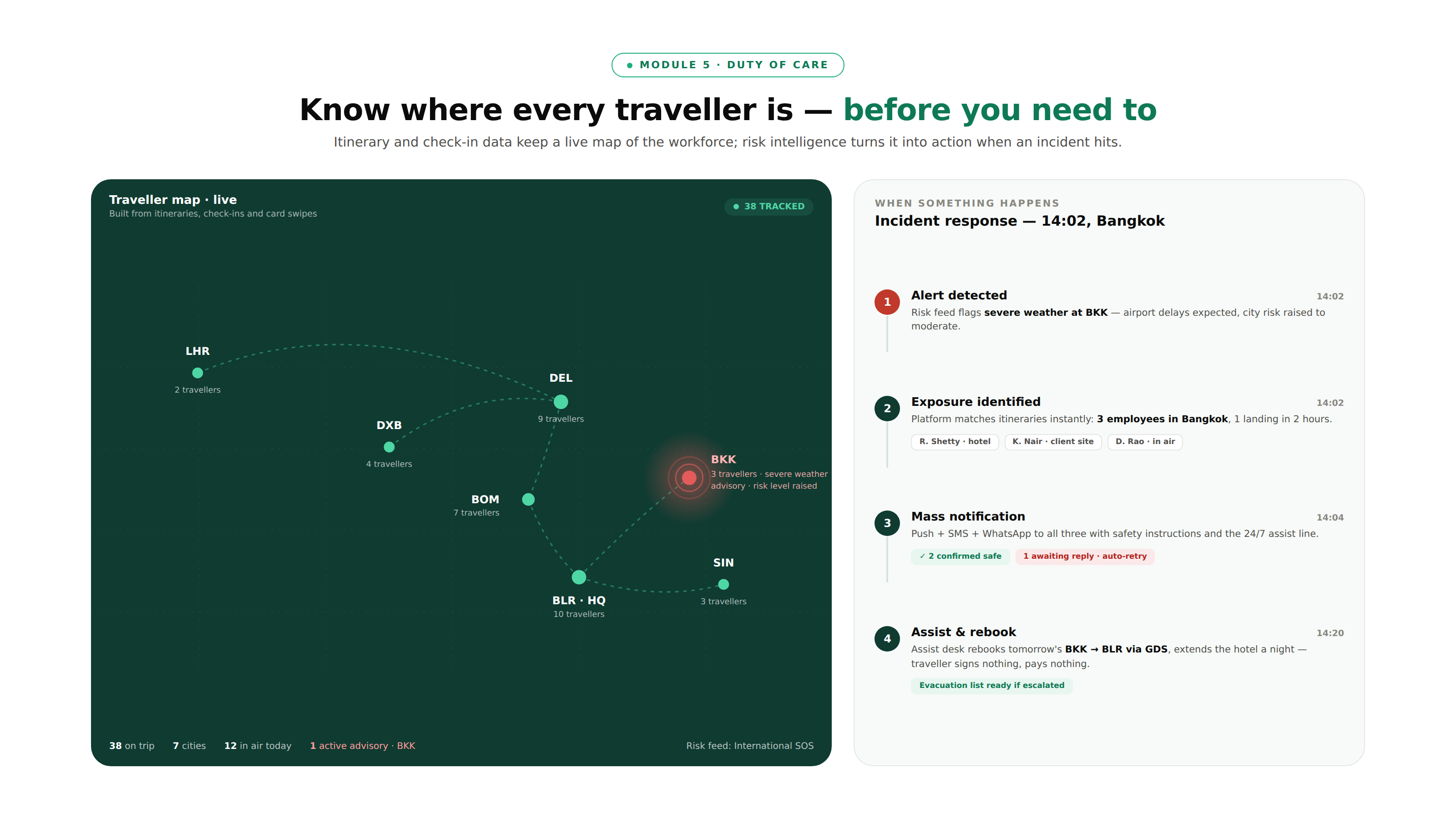
Employers have a legal and ethical obligation to know where their employees are when they travel for business and to provide assistance if they are affected by a travel disruption, natural disaster, or security incident.
Duty of care features:
| Feature | Details |
| Traveller tracking | Real-time location of all travelling employees, based on itinerary and check-in data |
| Destination risk rating | Country and city risk ratings from International SOS or Travel Guard |
| Travel alerts | Automatic alerts to travellers when safety incidents are detected at their destination |
| Emergency contact | 24/7 emergency assistance contact, for missed connections, medical emergencies |
| Mass notification | Send alerts to all travellers in an affected destination simultaneously |
| Evacuation coordination | Identify all employees in a country if evacuation becomes necessary |
The travel spend dashboard:
| View | Business Question |
| Total travel spend by period | How much are we spending and is it trending up? |
| Spend by cost centre and department | Who is travelling the most? |
| Spend by destination | Which cities and countries account for the most spend? |
| Spend by vendor | Which airlines, hotel chains, and cab operators? |
| Policy compliance rate | What percentage of bookings are in-policy? |
| Advance booking rate | What percentage of flights are booked 14+ days out? |
| Hotel attachment rate | What percentage of air bookings include a hotel? |
| Average ticket price by route | Are we getting competitive fares on our frequent routes? |
| Out-of-policy spend by employee | Who is consistently booking outside policy? |
| Unused ticket value | What is the value of tickets booked but not used? |
| Module | Cost Range (USD) | Notes |
| Travel policy engine + configuration | $6K – $12K | |
| Booking engine, flights + hotels + trains | $10K – $20K | Multi-content aggregation |
| GDS integration (Amadeus/Sabre) | $8K – $15K | |
| LCC direct API integration | $5K – $10K | IndiGo, SpiceJet, Air Arabia |
| Approval workflow | $5K – $10K | Pre-trip and post-booking |
| Expense management + OCR receipt capture | $8K – $15K | |
| Corporate card integration | $5K – $10K | Per card provider |
| Duty of care + safety alerts | $5K – $10K | |
| ERP integration (SAP/Oracle for accounting) | $6K – $12K | |
| Travel analytics dashboard | $5K – $10K | |
| Mobile app (iOS app + Android app) | $8K – $15K | |
| AWS + VAPT + Year 1 ops | $5K – $10K | |
| Total | $76K – $149K | Full corporate travel platform |
Contact: mayank@engineerbabu.com
A Global Distribution System (GDS) is a network that connects airlines, hotels, car rental companies, and travel agencies, allowing travel agents and booking systems to search and book inventory across hundreds of suppliers through a single integration. The three major GDS platforms are Amadeus, Sabre, and Travelport. For a corporate travel management platform, GDS integration provides access to the full published fare content of all major airlines, including negotiated corporate rates that are loaded into the GDS against the company’s corporate ID. Without GDS integration, a corporate travel platform can only access publicly listed fares from airline websites and online travel agencies, missing the negotiated rates that typically reduce air travel costs by 10 to 25% for high-volume corporate travellers.
Travel policy compliance is the percentage of bookings made within the company’s defined travel policy parameters, the correct flight class, the correct hotel star rating, booked within the required advance booking window, using preferred vendors. Enforcing policy at the booking stage, before the employee completes the transaction, is significantly more effective than enforcing it at the expense reimbursement stage. Research by GBTA (Global Business Travel Association) consistently shows that companies enforcing policy at point-of-sale achieve 12 to 20% lower average transaction values than those reviewing policy only at reimbursement. The mechanism is simple: when an employee sees a policy violation flag at the moment they are about to complete a booking, they almost always choose the in-policy alternative rather than writing a justification. The same employee at the reimbursement stage, 3 weeks later, has already made the booking and simply writes whatever justification is necessary.
Duty of care in corporate travel is the employer’s legal and ethical obligation to take reasonable steps to protect employees from foreseeable risks when they travel for business. The specific legal obligations vary by jurisdiction, in India, the duty of care framework is evolving through case law and The Employees’ Compensation Act; in the US and UK, common law negligence principles apply alongside specific regulations. Practically, duty of care requires: knowing where business travellers are at all times during their trips; providing pre-travel risk information for their destination; having protocols to assist travellers if they encounter safety incidents, medical emergencies, or travel disruptions; and being able to locate and communicate with all travellers in a destination if a mass incident occurs. A corporate travel platform operationalises duty of care by maintaining a real-time itinerary for every travelling employee, integrating with travel risk intelligence services, and providing a 24/7 emergency assistance channel.