How to Build a Laboratory Information Management System (LIMS), Sample Tracking, Results Management, 21 CFR Part 11, and Lab Analytics 2026


Create engaging, high-performance mobile applications tailored to your business needs. We craft future-ready apps that offer smooth user experiences on all devices.
Build robust and scalable websites and CMS platforms that help you manage content effortlessly. Our development ensures a seamless digital presence.
Launch secure, feature-rich online stores with intuitive shopping experiences. We build tailored eCommerce platforms designed for growth.
Design captivating games with immersive gameplay and stunning graphics. From concept to launch, we build engaging experiences that players love.
Enhance your customer relationships with customized Salesforce implementations. Drive growth and efficiency with smarter CRM solutions.
Harness artificial intelligence and machine learning to automate workflows and gain actionable insights. Our AI transforms data into smart decisions.
Accelerate your software delivery lifecycle with continuous integration, delivery, and infrastructure automation to boost efficiency.
Hire app developers ready to turn your ideas into sleek, high-performing mobile apps for any platform.
Bring in frontend pros who craft smooth, beautiful, and user-friendly interfaces that your visitors will love.
Get backend developers who build fast, secure, and reliable systems to keep everything running behind the scenes.
Hire eCommerce developers who build secure, scalable online stores designed to offer seamless shopping and grow your sales.
Get dedicated developers committed to your projects, delivering consistent quality and speed as an extension of your team.
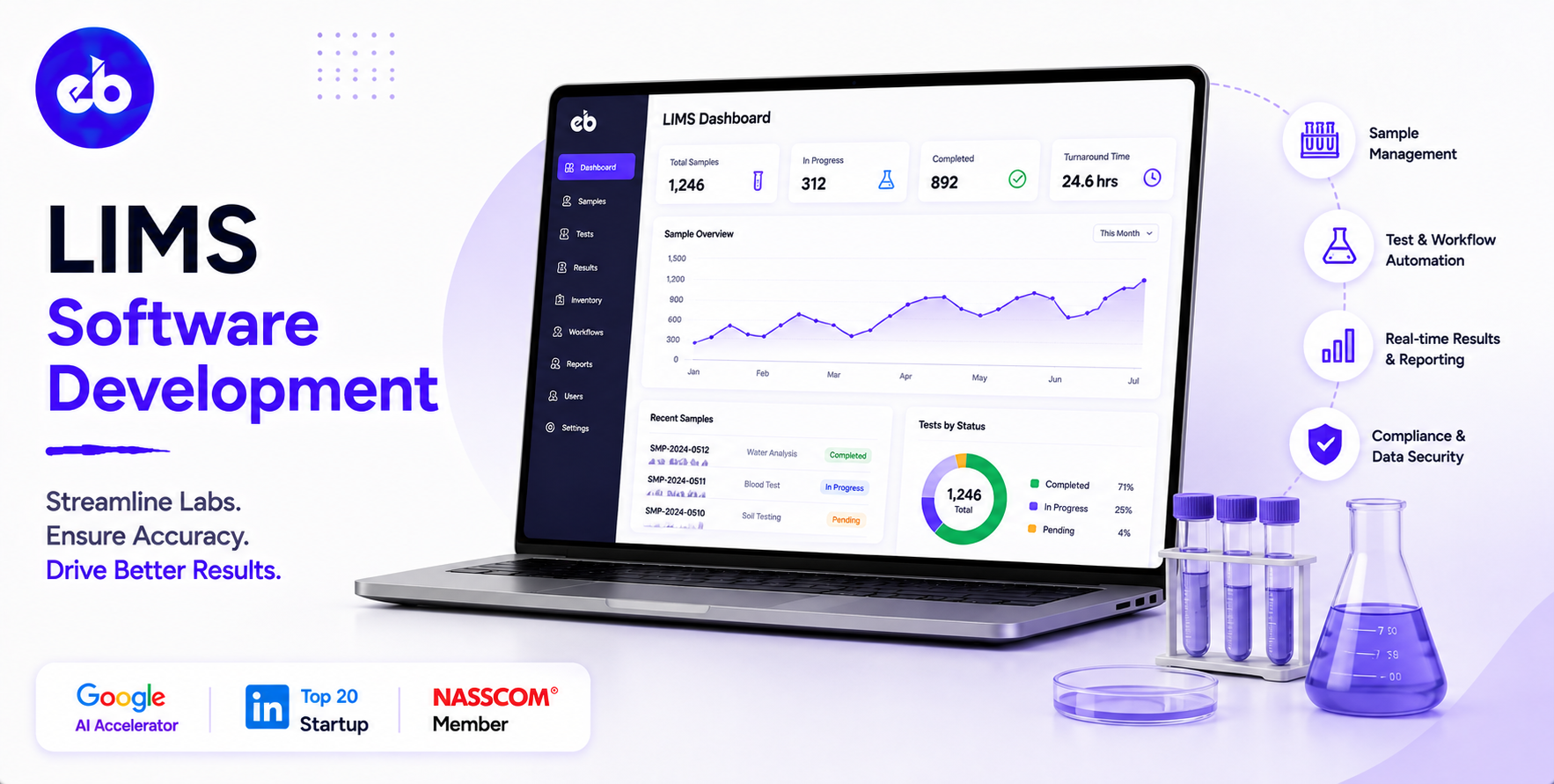
Laboratories are among the most data-intensive environments in science and healthcare.
A pharmaceutical quality control lab running 500 tests per day generates 500 sample records, thousands of individual test results, calibration records for every instrument used, stability study data for every batch released, and a complete audit trail linking every result to the analyst who generated it and every instrument used to produce it.
Managing this through paper and spreadsheets is not just inefficient, it is a regulatory violation waiting for its inspection moment.
A LIMS Software Development manages every sample from the moment it enters the laboratory through testing, results review, reporting, and archiving, with the complete audit trail and electronic signature controls that FDA 21 CFR Part 11 and EU GMP Annex 11 require.
The global LIMS market is projected to reach $3.2 billion by 2030 at a CAGR of 7.4%. The buyers are pharmaceutical QC labs, CROs (Contract Research Organisations), environmental testing labs, food and beverage testing labs, clinical diagnostics labs, and research institutions.
EngineerBabu built Somnoware, the IoT-connected monitoring platform acquired by ResMed, and healthcare platforms for Apollo Hospitals. CMMI Level 5. Google AI Accelerator 2024 Top 20. Contact: mayank@engineerbabu.com
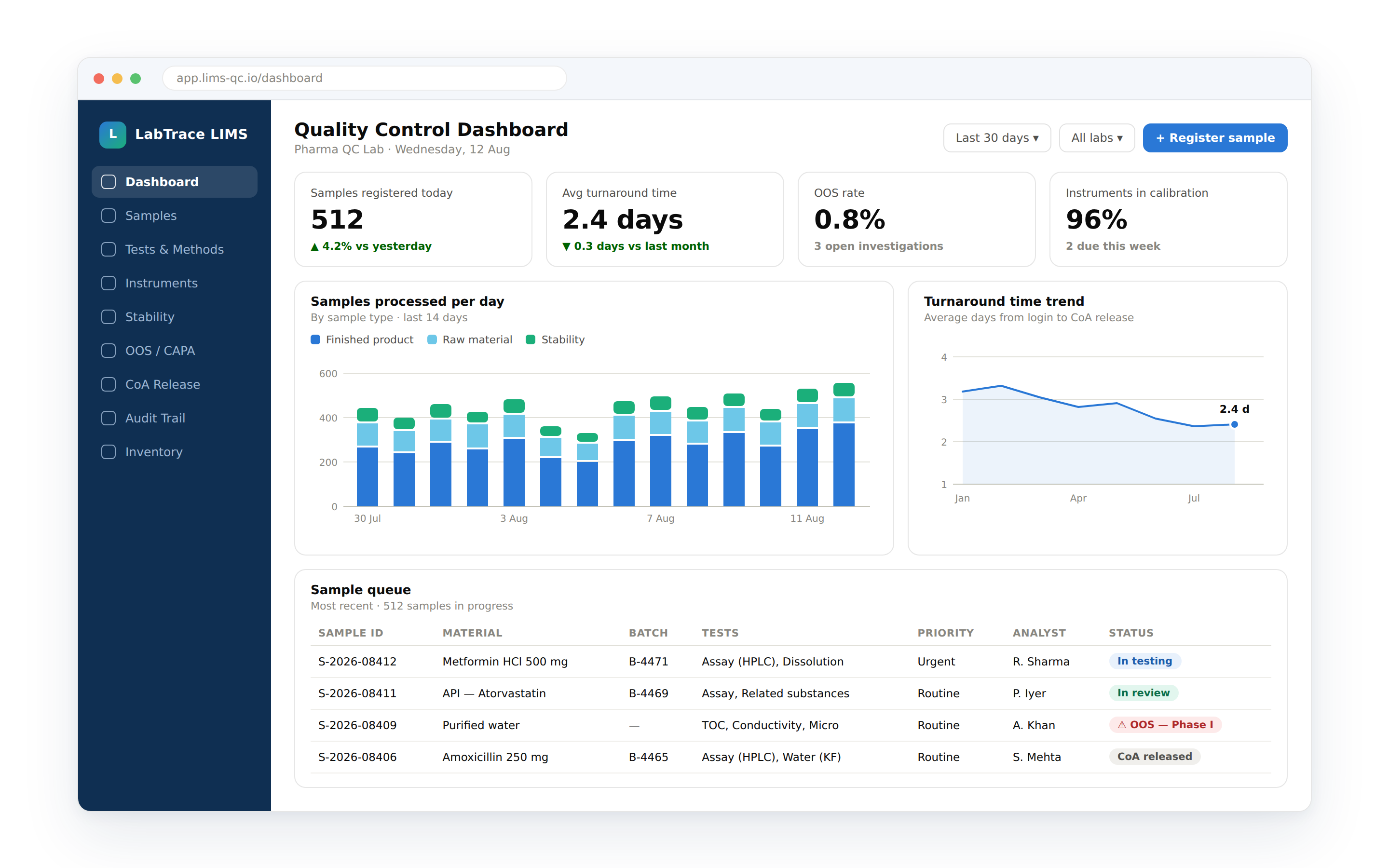
| Function | Module |
| Sample registration | Sample login, barcode generation, chain of custody |
| Test management | Test methods, specifications, SOP links |
| Workflow management | Lab workflow, task assignment, prioritisation |
| Instrument integration | Data import from lab instruments (HPLC, GC, MS, spectrophotometers) |
| Results entry and review | Manual entry, instrument data, supervisor review |
| Out-of-specification (OOS) management | OOS investigation workflow, CAPA |
| Stability testing | Protocol management, time-point tracking, trend analysis |
| Certificate of analysis (CoA) | Automated CoA generation and release |
| Audit trail | Immutable record of all actions, 21 CFR Part 11 |
| Electronic signatures | Compliant e-signatures for results and release |
| Calibration management | Instrument calibration schedule, certificate tracking |
| Inventory management | Reagents, standards, consumables |
| Reporting and analytics | Turnaround time, OOS rate, analyst performance |
The sample lifecycle:
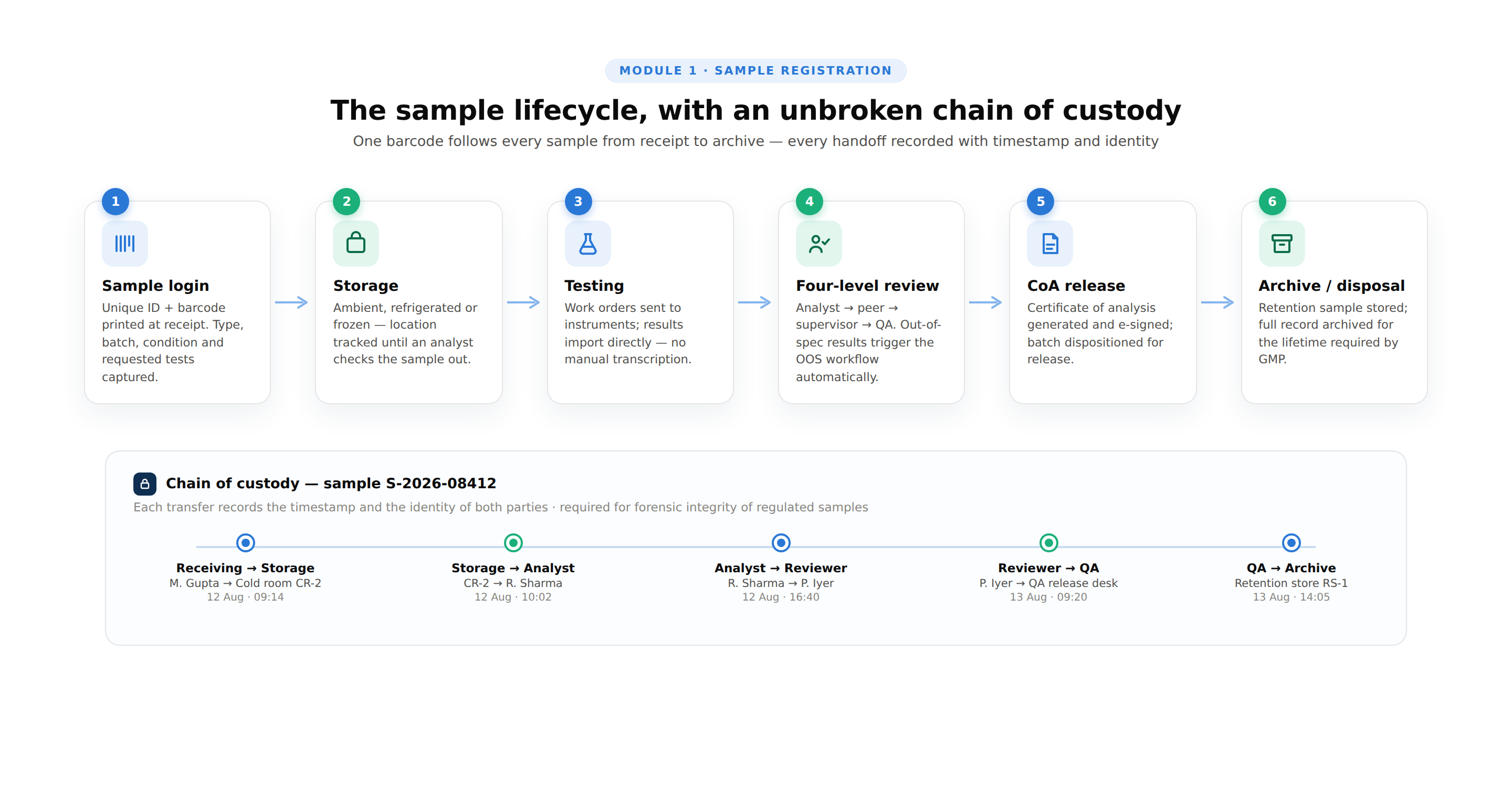
Every sample that enters the laboratory gets a unique barcode or QR code at the point of login. This identifier follows the sample through every step, from receipt through testing through reporting through storage or disposal.
Sample login data captured:
| Field | Details |
| Sample ID | LIMS-generated unique identifier |
| Barcode / QR code | Printed label applied to sample container |
| Sample type | Raw material, in-process, finished product, stability |
| Material code | Item code linked to product master |
| Batch number | Manufacturer’s batch identifier |
| Quantity received | Amount received for testing |
| Collection date/time | When sample was collected |
| Received date/time | When received in the lab |
| Condition on receipt | Acceptable / Damaged / Non-conforming |
| Storage requirement | Ambient / Refrigerated / Frozen |
| Requested tests | Which analyses are required |
| Priority | Routine / Urgent / Emergency |
| Requesting department | Which department or customer submitted |
Chain of custody:
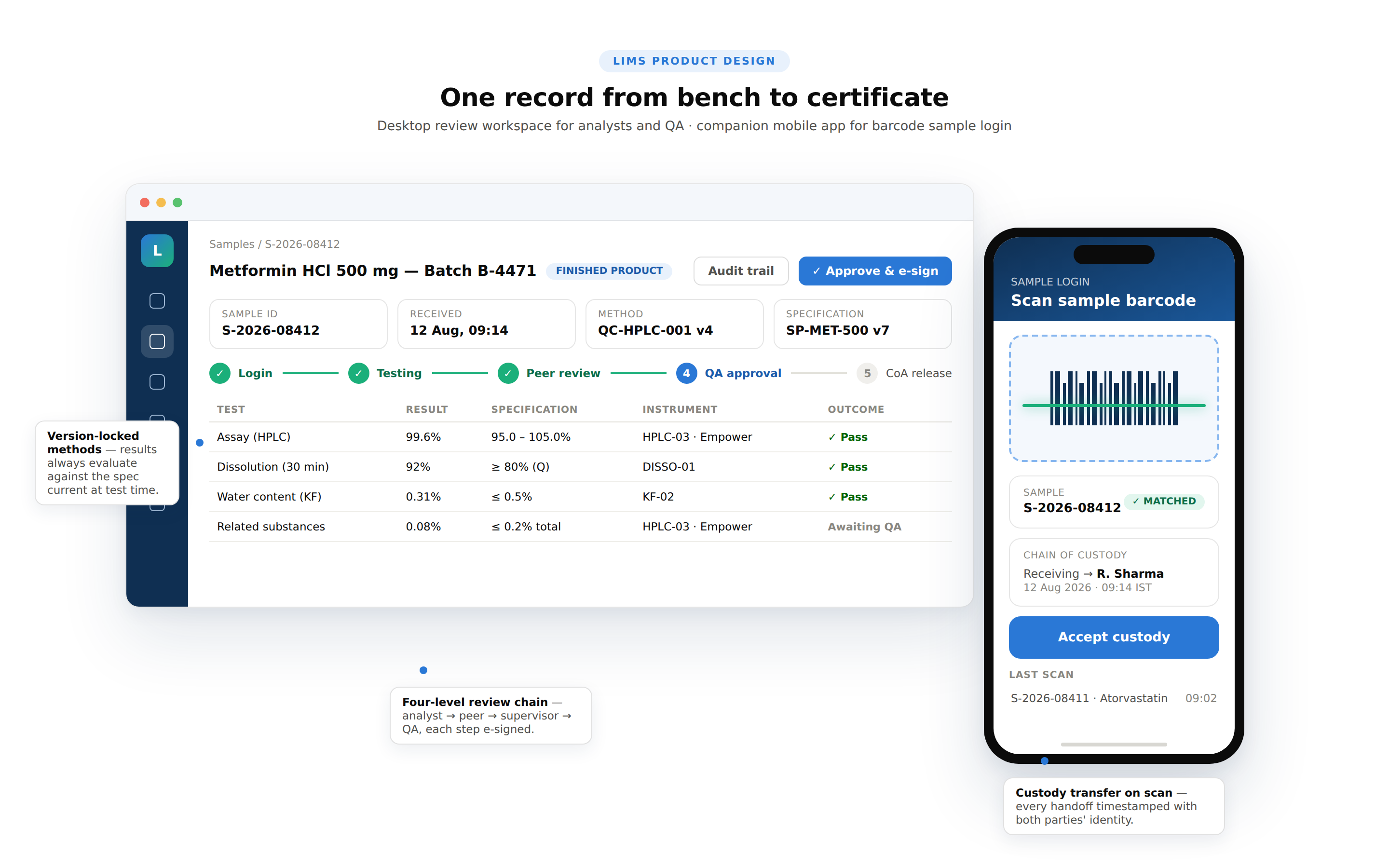
Every time a sample changes hands, from receiving to storage, from storage to analyst, from analyst to secondary reviewer, from testing lab to archive, the LIMS records the transfer with the timestamp and the identity of both parties.
This chain of custody is required for forensic integrity of pharmaceutical and environmental testing samples.
The test method library:
Every test performed in the laboratory is defined by a validated test method, the procedure, equipment, reagents, acceptance criteria, and calculation that produce a reportable result. The LIMS maintains a library of all validated methods.
Test method record:
| Field | Details |
| Method number | Unique identifier, e.g., QC-HPLC-001 |
| Method title | “HPLC Assay of Active Pharmaceutical Ingredient” |
| Version | Current version, version control tracked |
| Effective date | When this version became current |
| Applicable products | Which materials this method applies to |
| Equipment required | HPLC system, column, detector |
| Reagents and standards | With grade and concentration |
| Procedure | Step-by-step instructions or SOP reference |
| Acceptance criteria | Pass/fail limits for each parameter |
| Calculation | Formula for result calculation |
| Out-of-specification criteria | When a result triggers OOS investigation |
Specification management:
Each product or material has specifications, the acceptance limits for every quality attribute. The LIMS stores specifications with versioning, when a specification changes (regulatory update, internal improvement), the new version is effective from a defined date and old results are evaluated against the specification that was current when the test was performed.
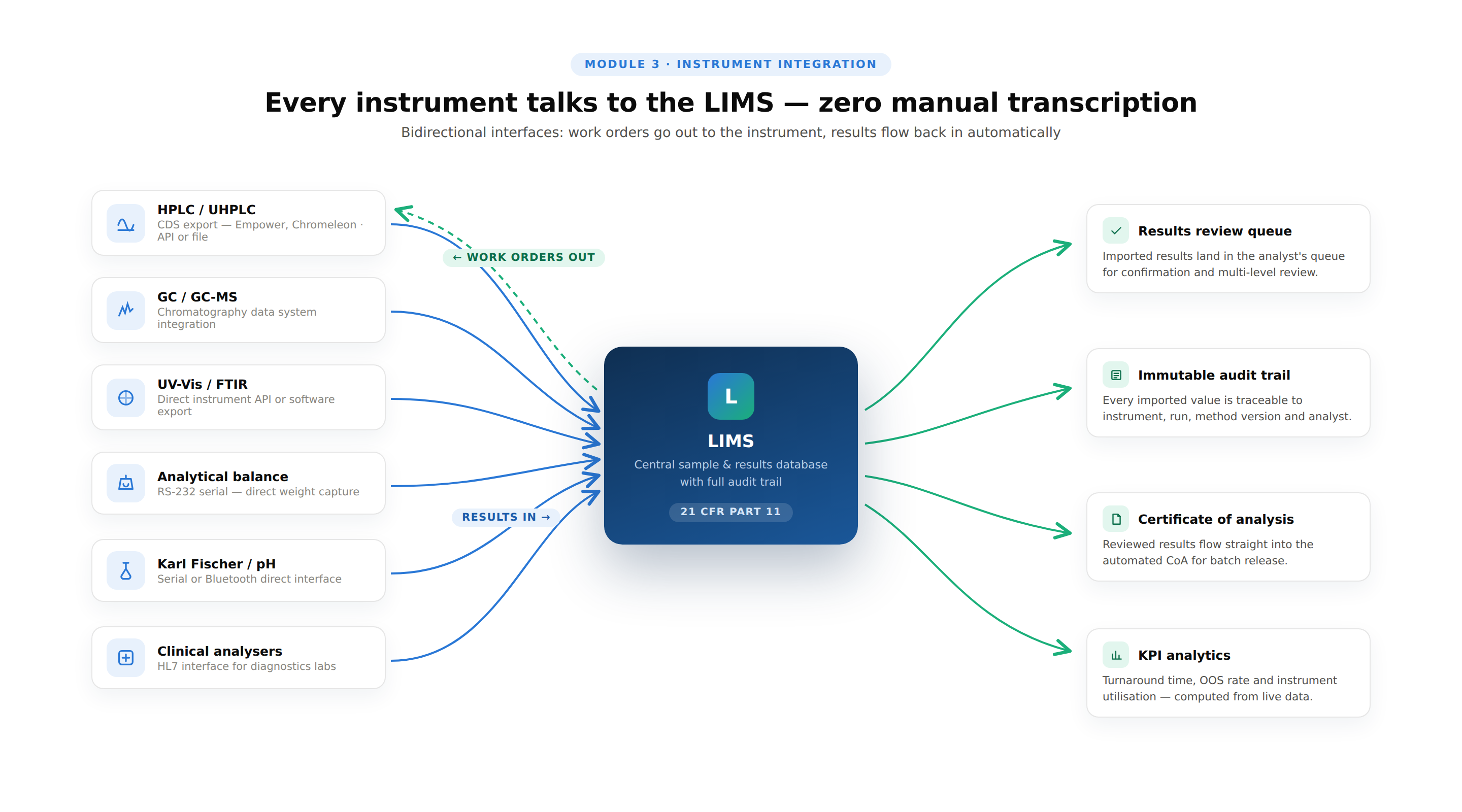
Manual data entry is the most common source of transcription errors in laboratory operations. Instrument integration eliminates manual transcription by importing results directly from analytical instruments into the LIMS.
Integration methods by instrument type:
| Instrument Type | Integration Method |
| HPLC / UHPLC | Chromatography data system (CDS), Empower, Chromeleon, exports to LIMS via API or file |
| GC / GC-MS | Same as HPLC, CDS integration |
| UV-Vis spectrophotometer | Direct instrument API or file export |
| FTIR / Raman spectroscopy | Software export |
| Balance / analytical balance | RS-232 serial connection, direct data capture |
| pH meter | Serial connection or Bluetooth |
| Karl Fischer titrator | Direct instrument interface |
| Dissolution apparatus | Dissolution software integration |
| ICP-MS | Software export |
| Automated clinical analyser | HL7 interface (for clinical labs) |
The bidirectional instrument interface:
A fully integrated LIMS sends work orders to instruments, the instrument knows which sample to test and which method to run. The instrument runs the analysis and sends results back to the LIMS automatically.
The analyst confirms the result and releases it for review. Zero manual data entry between instrument and LIMS.
The review workflow:
Every result goes through a defined review chain before it is reportable:
| Review Level | Reviewer | Action |
| Level 1, Analyst review | Analyst who performed the test | Confirms result is entered correctly, no obvious errors |
| Level 2, Peer review | Second analyst | Reviews raw data, calculations, instrument logs |
| Level 3, Supervisor review | Lab supervisor | Reviews for compliance with method and specification |
| Level 4, QA review | Quality Assurance | Final approval before CoA release |
Out-of-specification (OOS) management:
When a result falls outside specification, the LIMS automatically initiates an OOS investigation:
| Phase | Action | Timeline |
| Phase I, Lab investigation | Review for assignable cause (analyst error, instrument malfunction, calculation error) | 24–48 hours |
| Phase II, Full investigation | If no assignable cause, re-testing, root cause analysis, CAPA | 15–30 days |
| Disposition | Based on investigation, batch released, rejected, or reprocessed | Per investigation conclusion |
Every OOS investigation is documented in the LIMS, including the investigation hypothesis, testing performed, conclusion, and the disposition decision. This documentation is the primary evidence in an FDA inspection when a batch was released despite an initial OOS result.
The audit trail requirements:
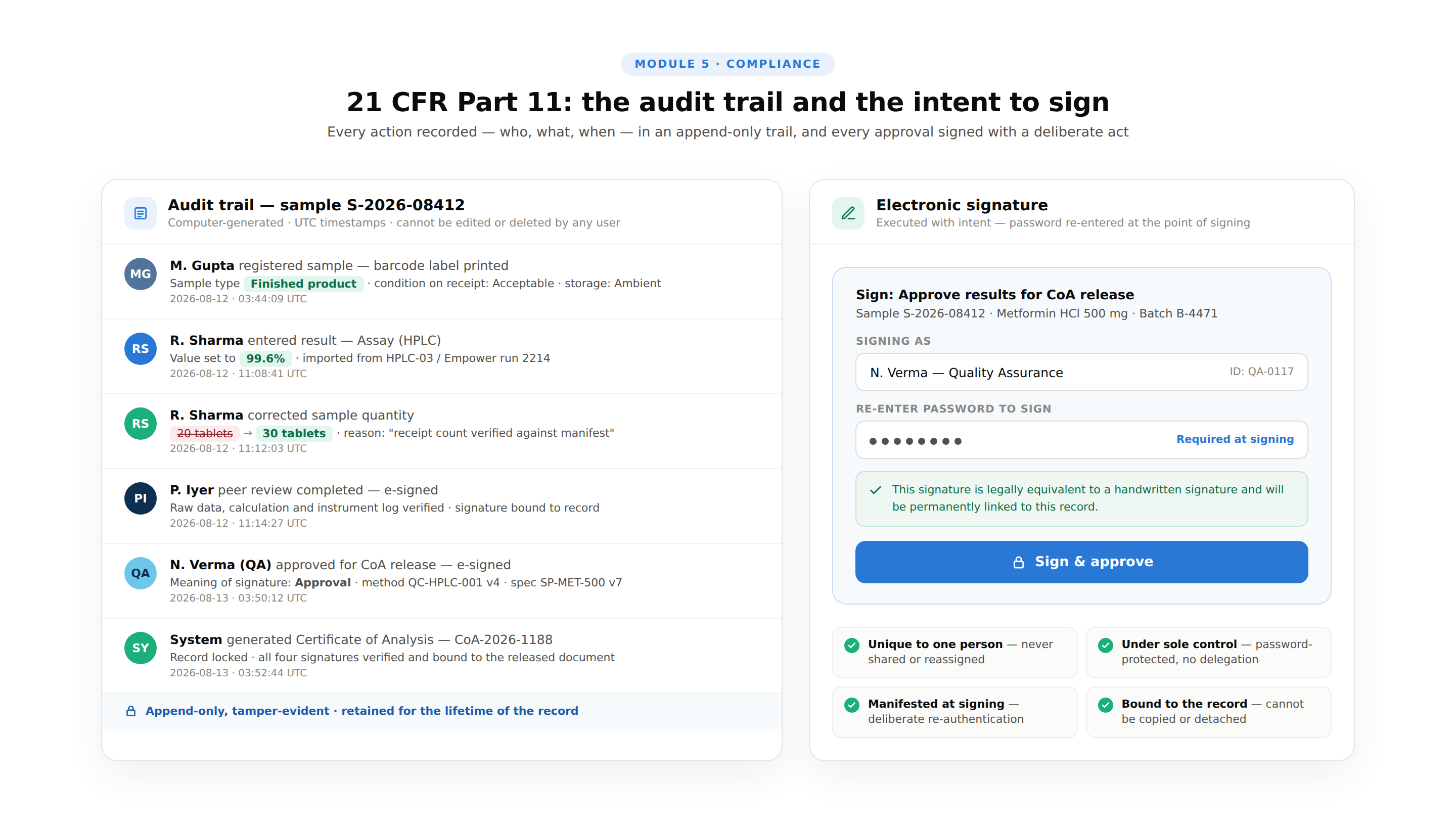
FDA 21 CFR Part 11 requires that every electronic record in a regulated LIMS have a complete, computer-generated audit trail showing:
| Audit Trail Requirement | Technical Implementation |
| Who made each entry | User authentication, every action linked to authenticated user |
| What was entered or changed | Before and after values captured for every modification |
| When the action occurred | UTC timestamp on every record |
| System-generated entries | Cannot be modified by users |
| Tamper evidence | Audit trail records stored in append-only manner |
| Archived | Audit trail maintained for the lifetime of the records |
Electronic signatures:
For regulated LIMS, electronic signatures must be:
| Requirement | Implementation |
| Linked to the individual | Cannot be reused or reassigned |
| Unique | No two individuals share the same signature |
| Under sole control | Password-protected, cannot be delegated |
| Manifested at signing | Signature execution requires password re-entry |
| Associated with the signed record | Signature is permanently linked to the signed record |
| Legally equivalent | Treated as equivalent to a handwritten signature |
In the LIMS, every review and approval action requires the user to re-enter their password at the point of signing, not just log in at the start of the session. This “intent to sign” step is the key 21 CFR Part 11 requirement that many laboratory systems implement incorrectly.
Pharmaceutical stability testing is a long-running, tightly regulated programme, samples stored at defined conditions (temperature and humidity) are tested at defined time points over a period of months to years to demonstrate that the product remains within specification throughout its shelf life.
The stability protocol:
| Element | Details |
| Product | Which product is in the stability programme |
| Study type | Real-time, accelerated, intermediate, stress |
| Storage conditions | e.g., 25°C/60% RH, 40°C/75% RH, -20°C |
| Time points | 0, 3, 6, 9, 12, 18, 24, 36 months |
| Tests at each time point | Which analyses are performed |
| Batch numbers | Which batches are in the programme |
The time-point management:
The LIMS tracks every time point for every batch in every stability protocol. When a time point is approaching, typically 7 days in advance, the LIMS alerts the stability coordinator to pull samples from the stability chamber and schedule testing. Missing a time point without documentation is a GMP violation.
The trend analysis:
For each product attribute over the stability time course, the LIMS calculates a regression line, projecting when the attribute will reach its specification limit at the current rate of degradation. This shelf-life projection supports the product’s expiry date claim and identifies products approaching their re-evaluation date.
| Module | Cost Range (USD) | Notes |
| Sample registration + chain of custody | $6K – $12K | Barcode printing, receipt workflow |
| Test method + specification management | $6K – $12K | Version control, product linkage |
| Workflow management + task assignment | $5K – $10K | |
| Instrument integration (10 instrument types) | $10K – $20K | Per instrument type ~$1K–$2K |
| Results entry + review workflow | $8K – $15K | Multi-level review chain |
| OOS investigation management | $6K – $12K | Phase I, Phase II, CAPA |
| 21 CFR Part 11 audit trail | $8K – $15K | Append-only, tamper-evident |
| Electronic signatures | $5K – $10K | Password re-entry at signing |
| Stability testing management | $8K – $15K | Protocol, time-points, trends |
| CoA generation + release | $5K – $10K | Template-based PDF |
| Calibration management | $5K – $10K | Schedule, certificates, alerts |
| Inventory management (reagents, standards) | $4K – $8K | |
| Analytics + KPI dashboard | $4K – $8K | TAT, OOS rate, throughput |
| AWS + VAPT + Year 1 ops | $5K – $10K | |
| Total | $85K – $167K | Full LIMS platform |
EngineerBabu built Somnoware (acquired by ResMed) and healthcare platforms for Apollo Hospitals. CMMI Level 5. Google AI Accelerator 2024 Top 20. Contact: mayank@engineerbabu.com
FDA 21 CFR Part 11 establishes the standards for electronic records and electronic signatures in FDA-regulated industries, including pharmaceutical laboratories. The key technical requirements for a LIMS are: a complete, computer-generated audit trail showing every action on every record (who, what, when) that cannot be modified or deleted by users; electronic signatures that are unique to each individual, executed with intent (requiring password re-entry at the point of signing), and permanently linked to the signed record; access controls ensuring only authorised personnel can create, modify, or delete records; system validation demonstrating that the software performs as intended; and data integrity controls ensuring records cannot be altered undetected. A LIMS that does not meet these requirements cannot be used in an FDA-regulated laboratory environment, using it would constitute a 21 CFR Part 11 violation that can result in FDA warning letters and consent decrees.
An out-of-specification (OOS) result is a test result that falls outside the established acceptance criteria for a specification. FDA guidance (2006 OOS Guidance) requires a two-phase investigation when an OOS result is obtained. Phase I is the laboratory investigation, a thorough review for assignable causes including analyst error, instrument malfunction, calculation errors, and sample preparation problems. If an assignable cause is identified and confirmed, the original result may be invalidated and a retest performed. Phase II is the full investigation, if no assignable laboratory cause is found, a broader investigation including manufacturing review, additional testing, and root cause analysis is required. A LIMS manages this by automatically initiating the OOS workflow when a result outside specification is entered, guiding the analyst through the Phase I checklist, tracking all retesting and investigation actions with timestamps and electronic signatures, and requiring supervisor and QA approval before any OOS investigation can be closed.
Pharmaceutical stability testing is the scientific programme that demonstrates a drug product remains safe, effective, and of acceptable quality throughout its approved shelf life when stored under defined conditions. ICH Q1A (R2) guidelines define the required storage conditions, long-term at 25°C/60% RH for zone I/II climates, accelerated at 40°C/75% RH, and time points at which testing must occur, 0, 3, 6, 9, 12, 18, 24, 36 months for a 36-month shelf life claim. A LIMS automates the stability programme by storing the complete protocol for each product and batch, calculating the due date for every time point, alerting the stability coordinator when samples must be pulled from the chamber, generating the test work order for the time point, tracking results against stability specifications, and producing the trend analysis showing the regression of each attribute over time that supports the product’s expiry date claim.