Mobile App Development Process in the US: Explained Step by Step


Create engaging, high-performance mobile applications tailored to your business needs. We craft future-ready apps that offer smooth user experiences on all devices.
Build robust and scalable websites and CMS platforms that help you manage content effortlessly. Our development ensures a seamless digital presence.
Launch secure, feature-rich online stores with intuitive shopping experiences. We build tailored eCommerce platforms designed for growth.
Design captivating games with immersive gameplay and stunning graphics. From concept to launch, we build engaging experiences that players love.
Enhance your customer relationships with customized Salesforce implementations. Drive growth and efficiency with smarter CRM solutions.
Harness artificial intelligence and machine learning to automate workflows and gain actionable insights. Our AI transforms data into smart decisions.
Accelerate your software delivery lifecycle with continuous integration, delivery, and infrastructure automation to boost efficiency.
Hire app developers ready to turn your ideas into sleek, high-performing mobile apps for any platform.
Bring in frontend pros who craft smooth, beautiful, and user-friendly interfaces that your visitors will love.
Get backend developers who build fast, secure, and reliable systems to keep everything running behind the scenes.
Hire eCommerce developers who build secure, scalable online stores designed to offer seamless shopping and grow your sales.
Get dedicated developers committed to your projects, delivering consistent quality and speed as an extension of your team.
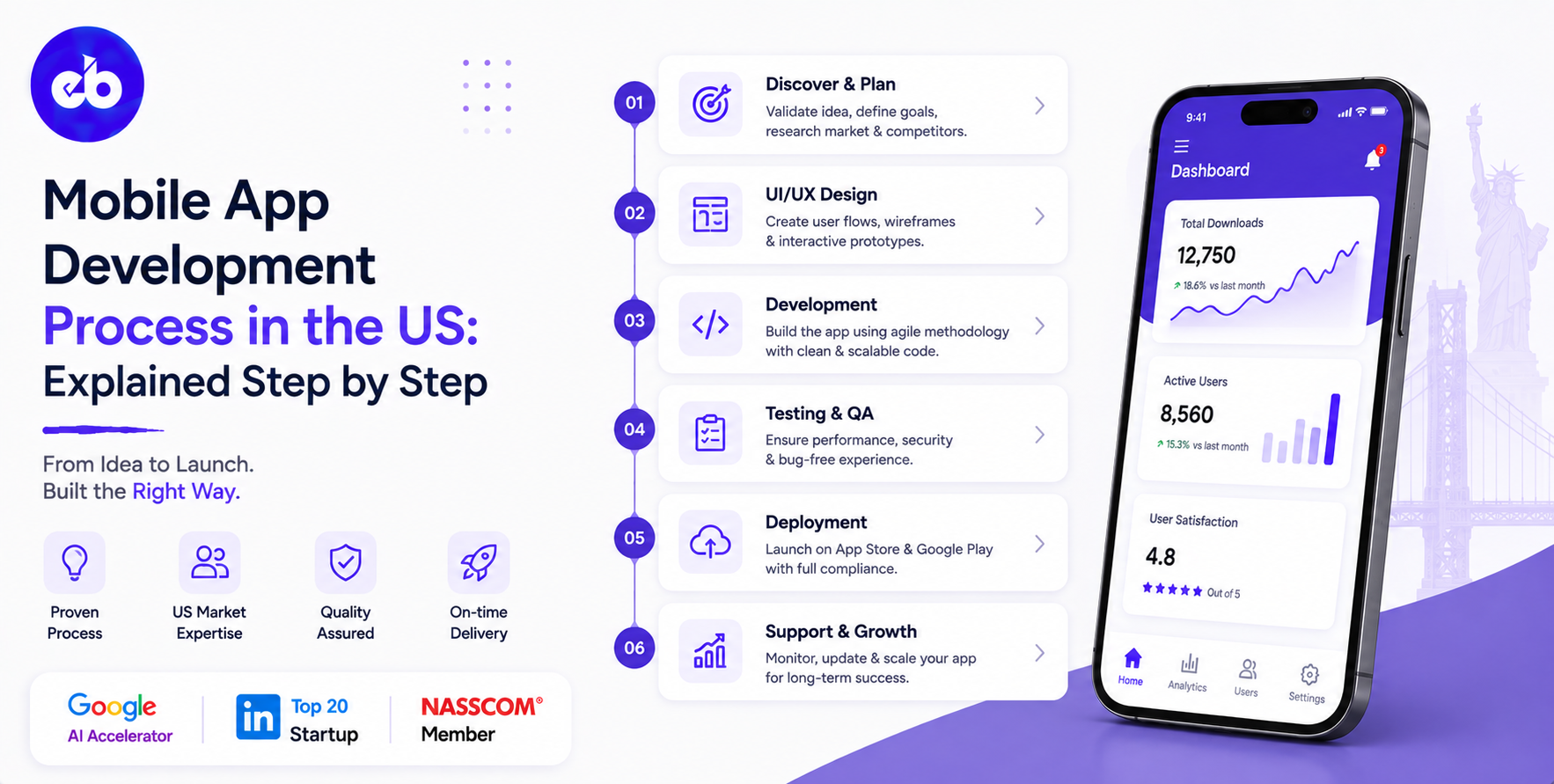
Ask five American agencies how they build an app and you will get five different Gantt charts. Strip away the jargon, though, and every serious team follows the same seven checkpoints in the same order.
The mobile app development process in the US is more front-loaded than most first-time founders expect. Roughly half the decisions that determine whether your app succeeds happen before a single screen is coded.
This guide walks through each stage, what it costs in time and budget, and where projects go off the rails.
America is the largest single app economy on the planet. The US mobile application market generated $58.3 billion in revenue in 2024 and is projected to reach $128.5 billion by 2030, according to Grand View Research.
That scale changes how apps get built. Users compare your product against Uber and DoorDash, not your direct competitors. Apple enforces review guidelines strictly, and privacy laws like CCPA apply from day one.
So the mobile app development process in the US treats compliance, accessibility, and store-review preparation as formal stages rather than afterthoughts. Any credible mobile app development partner will show you these checkpoints in their project plan before you sign.
Here is how a build moves from raw idea to App Store listing, stage by stage.
Everything starts with proving the app deserves to exist. Teams run competitor teardowns, interview 10 to 20 target users, and define the one problem the app solves better than anything currently on a US home screen.
The output is a short document: target persona, core use case, success metrics, and a feature list cut ruthlessly to essentials. Good discovery also flags regulatory exposure early, like HIPAA for health apps.
Expect one to three weeks. Skipping this stage is the most expensive shortcut in the entire mobile app development process in the US.
Next, the validated idea becomes an engineering plan. The team writes user stories, picks the tech stack, chooses native versus cross-platform, and estimates cost per feature.
Most US startups scope a lean first version here rather than a full product. A focused MVP development approach typically cuts the initial budget by 40 to 60% and puts real user data in your hands months earlier.
The deliverable is a signed scope document with milestones, a payment schedule, and a change-request process. Budget one to two weeks for scoping.
Design carries outsized weight here because user switching costs are nearly zero. The stage moves from wireframes to clickable prototypes to final high-fidelity screens.
Two things are non-negotiable for American audiences. First, accessibility: WCAG-aligned contrast, text scaling, and screen-reader support matter legally and commercially. Second, platform conventions: iOS users expect Apple’s Human Interface patterns, while Android users expect Material Design.
Smart teams test the prototype with five to eight real users before development starts. Fixing a flow in Figma costs an hour. Fixing it in production code costs a sprint. Plan for three to six weeks.
This is the longest stage and usually consumes 45 to 55% of the total budget. Frontend engineers build the screens, backend engineers build the server logic and database, and the two meet through APIs.
Modern US builds are integration-heavy, with payments through Stripe, notifications through Firebase, and identity through Auth0. Clean API development at this stage decides how easily you can add features or swap vendors later.
Work runs in two-week sprints, each ending in a working demo. Insist on them. A mid-complexity app takes 10 to 16 weeks of core development.
QA runs alongside coding throughout the mobile app development process in the US, but the final stretch is dedicated testing. Device fragmentation is real: your app must behave on a new iPhone and a three-year-old Samsung alike.
Testers cover functional flows, performance on weak networks, security, and accessibility. Payment and login paths get the heaviest scrutiny because they cause the most one-star reviews.
Teams then run a closed beta through TestFlight and Google Play’s internal track with 50 to 200 US users. Real-world crash data is worth more than any lab report. Allow two to four weeks.
Store review is the one stage of the mobile app development process in the US that trips up even experienced teams. Apple manually reviews every submission, and rejections for broken links, thin metadata, or unclear privacy labels are routine.
Preparation includes App Store screenshots, privacy nutrition labels, Google Play data-safety forms, and a support URL that actually works. Most apps clear review in 24 to 48 hours, but plan buffer for one rejection cycle.
Smart launches roll out in phases so crashes surface before the marketing push. Budget one to two weeks end to end.
Launch day is the starting line. From here, the team watches analytics, crash reports, and store reviews, then ships fixes and improvements on a steady release rhythm.
US platform owners force this discipline. Apple and Google update their operating systems every year, and apps that fall behind get flagged or delisted. Annual maintenance typically runs 15 to 20% of the original build cost.
The best teams treat the first 90 days as a measurement window. Activation rate, day-30 retention, and conversion decide what gets built next.
On a calendar, the full mobile app development process in the US looks like this for a mid-complexity product.
| Stage | Typical Duration | Share of Budget |
| Discovery and validation | 1 to 3 weeks | 8 to 12% |
| Scoping and MVP definition | 1 to 2 weeks | Included above |
| UI/UX design | 3 to 6 weeks | 15 to 20% |
| Core development | 10 to 16 weeks | 45 to 55% |
| QA and beta testing | 2 to 4 weeks | 10 to 15% |
| Store submission and launch | 1 to 2 weeks | 3 to 5% |
| Post-launch (annual) | Ongoing | 15 to 20% of build cost |
End to end, expect four to seven months from kickoff to a public App Store listing.
Regulation is where the mobile app development process in the US genuinely differs from the rest of the world, because rules arrive by industry and by state.
Health apps that touch patient data fall under HIPAA and need signed BAAs with every cloud vendor. Finance products face GLBA safeguards plus state licensing, which is why founders there choose a specialized fintech app development company over a generalist shop.
Consumer apps are not exempt. CCPA and newer state privacy laws require consent flows, data deletion, and honest privacy labels. Build these into Step 2, not as a patch after a legal letter arrives.
By 2026, AI is a standard line item in the mobile app development process in the US rather than a novelty. Recommendation feeds, assistants, and smart search are now day-one expectations.
Features built through AI development typically add 20 to 40% to base cost, plus ongoing model fees. If you need custom prediction, like credit scoring or churn forecasting, dedicated ML development extends the timeline because models need training data and evaluation cycles.
The rule of thumb: ship your core loop first, then layer AI in Mobile App Development where the data proves it helps.
The same failure patterns show up across industries, and every one traces back to rushing a stage of the mobile app development process in the US.
The mobile app development process in the US rewards teams that respect the sequence. Validate before you scope, design before you code, test before you ship, and keep iterating after launch.
Founders who compress discovery or QA do not save money. They just move the cost downstream, where it multiplies.
If you want a partner that runs this process with senior engineers and CMMI Level 5 delivery discipline, talk to the team at EngineerBabu about scoping your build.
Plan four to seven months from discovery to App Store launch for a mid-complexity app. Simple apps ship in 8 to 12 weeks, while compliance-heavy platforms often run 9 to 12 months.
Core development takes the largest share at 45 to 55%, followed by design at 15 to 20% and QA at 10 to 15%. Totals range from about $15,000 for basic apps to $150,000 or more for complex platforms.
Yes. Health, finance, and education apps add compliance work for HIPAA, GLBA, or FERPA, plus extra security testing. Vendor selection changes too: learning-tech founders typically shortlist EdTech app development companies with prior compliance experience.
Cross-platform frameworks like React Native and Flutter cover iOS and Android from one codebase and suit most startups. Go native for heavy device features or maximum performance. Lock the choice in Step 2 of the mobile app development process in the US, since it shapes cost, timeline, and hiring.
You can, but it rarely pays off. An MVP validates demand with real users before you commit the full budget, which is the entire logic behind the mobile app development process in the US. Full builds suit enterprises with proven demand and fixed requirements.