How to Build an AI Tutoring Platform, Adaptive Learning, Personalized Paths, Gap Analysis, and Content Generation 2026


Create engaging, high-performance mobile applications tailored to your business needs. We craft future-ready apps that offer smooth user experiences on all devices.
Build robust and scalable websites and CMS platforms that help you manage content effortlessly. Our development ensures a seamless digital presence.
Launch secure, feature-rich online stores with intuitive shopping experiences. We build tailored eCommerce platforms designed for growth.
Design captivating games with immersive gameplay and stunning graphics. From concept to launch, we build engaging experiences that players love.
Enhance your customer relationships with customized Salesforce implementations. Drive growth and efficiency with smarter CRM solutions.
Harness artificial intelligence and machine learning to automate workflows and gain actionable insights. Our AI transforms data into smart decisions.
Accelerate your software delivery lifecycle with continuous integration, delivery, and infrastructure automation to boost efficiency.
Hire app developers ready to turn your ideas into sleek, high-performing mobile apps for any platform.
Bring in frontend pros who craft smooth, beautiful, and user-friendly interfaces that your visitors will love.
Get backend developers who build fast, secure, and reliable systems to keep everything running behind the scenes.
Hire eCommerce developers who build secure, scalable online stores designed to offer seamless shopping and grow your sales.
Get dedicated developers committed to your projects, delivering consistent quality and speed as an extension of your team.
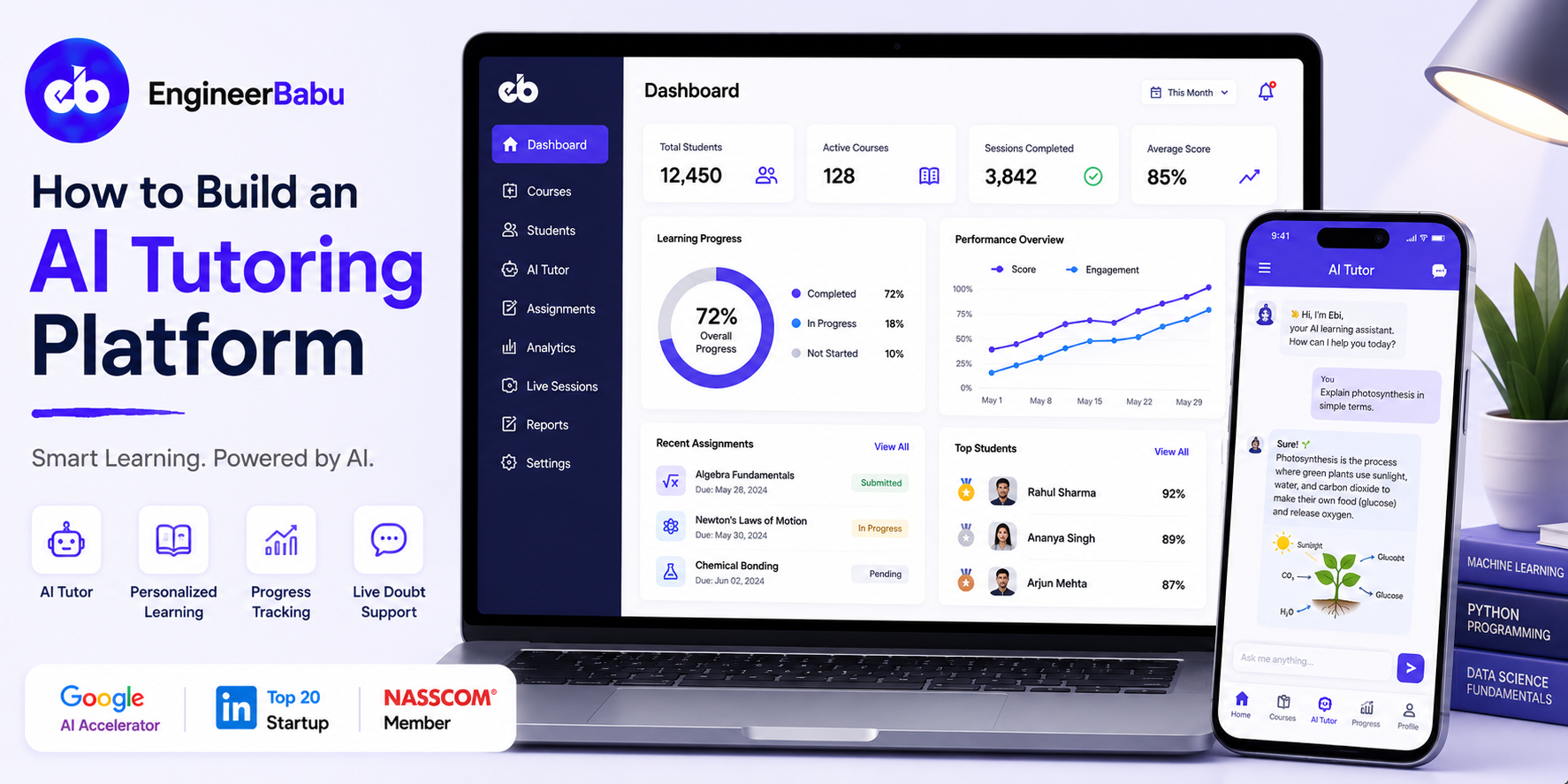
The global private tutoring market is projected to reach a staggering $160 billion by 2034. Most of it operates through human tutors who cover the same material at the same pace regardless of whether each student is already proficient, struggling, or somewhere in between.
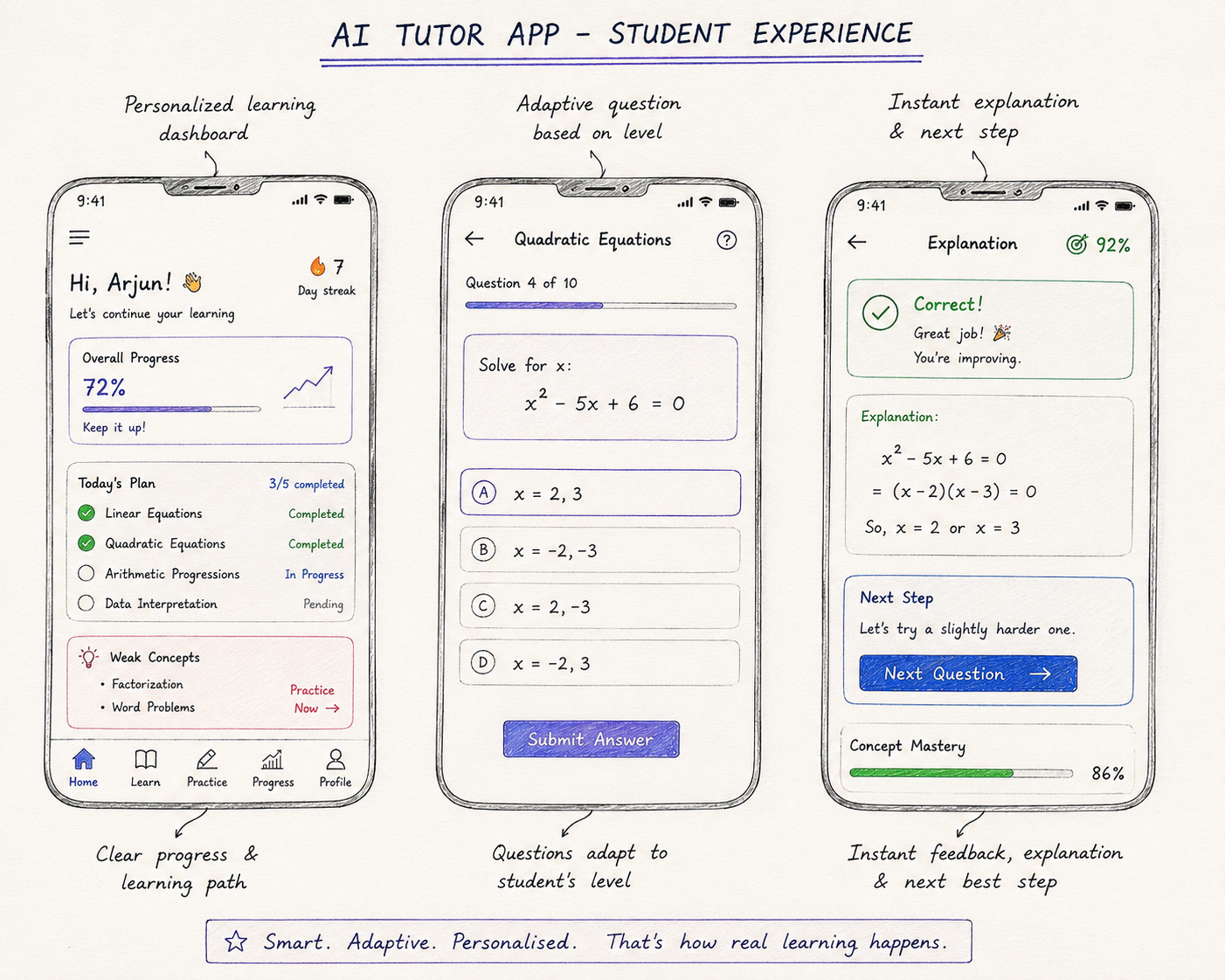
An AI tutor does what no human tutor can, it adapts in real time to every student’s exact knowledge state, adjusts the difficulty and pace of every question, identifies precisely which concept the student has not understood, and delivers targeted practice until the gap is closed.
The EdTech platforms that are winning in 2026 are not the ones with the most content. They are the ones where students actually learn. Completion rate is vanity. Learning outcome is the metric.
An AI platform (tutoring ) built correctly improves learning outcomes by 30 to 50% compared to passive video-based learning, because every interaction is targeted at exactly what the student does not yet know.
This guide covers how to build an AI tutoring platform, from the knowledge graph that maps curriculum to the adaptive engine that personalises every learning session to the content generation system that scales content creation.
EngineerBabu, Google AI Accelerator 2024 Top 20, builds production-grade AI platforms. CMMI Level 5. 75+ YC-backed companies. Contact: mayank@engineerbabu.com
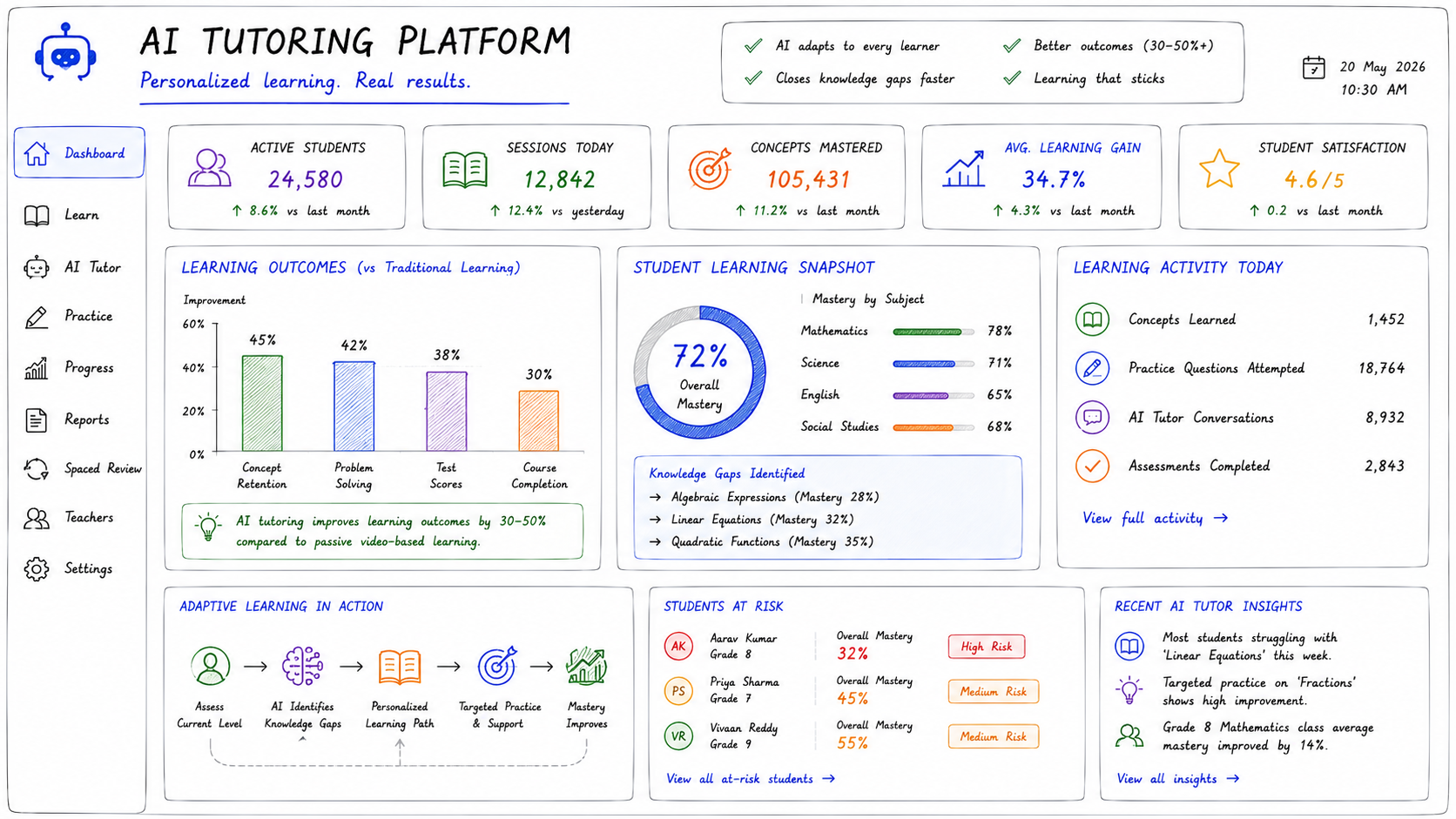
| Function | Platform Module |
| Knowledge mapping | Curriculum broken into atomic concepts with prerequisite relationships |
| Student knowledge model | Real-time estimate of each student’s mastery per concept |
| Adaptive assessment | Questions that adjust difficulty based on student performance |
| Gap identification | Exactly which concept the student has not mastered |
| Personalized learning path | Next learning intervention selected based on current knowledge state |
| AI tutoring conversations | LLM-powered tutor that explains, answers questions, guides |
| Content generation | AI-generated practice questions, explanations, examples |
| Progress tracking | Student, parent, and teacher visibility into learning progress |
| Spaced repetition | Optimal review scheduling to maximise long-term retention |
| Teacher dashboard | Class-level view of concept mastery and student needs |
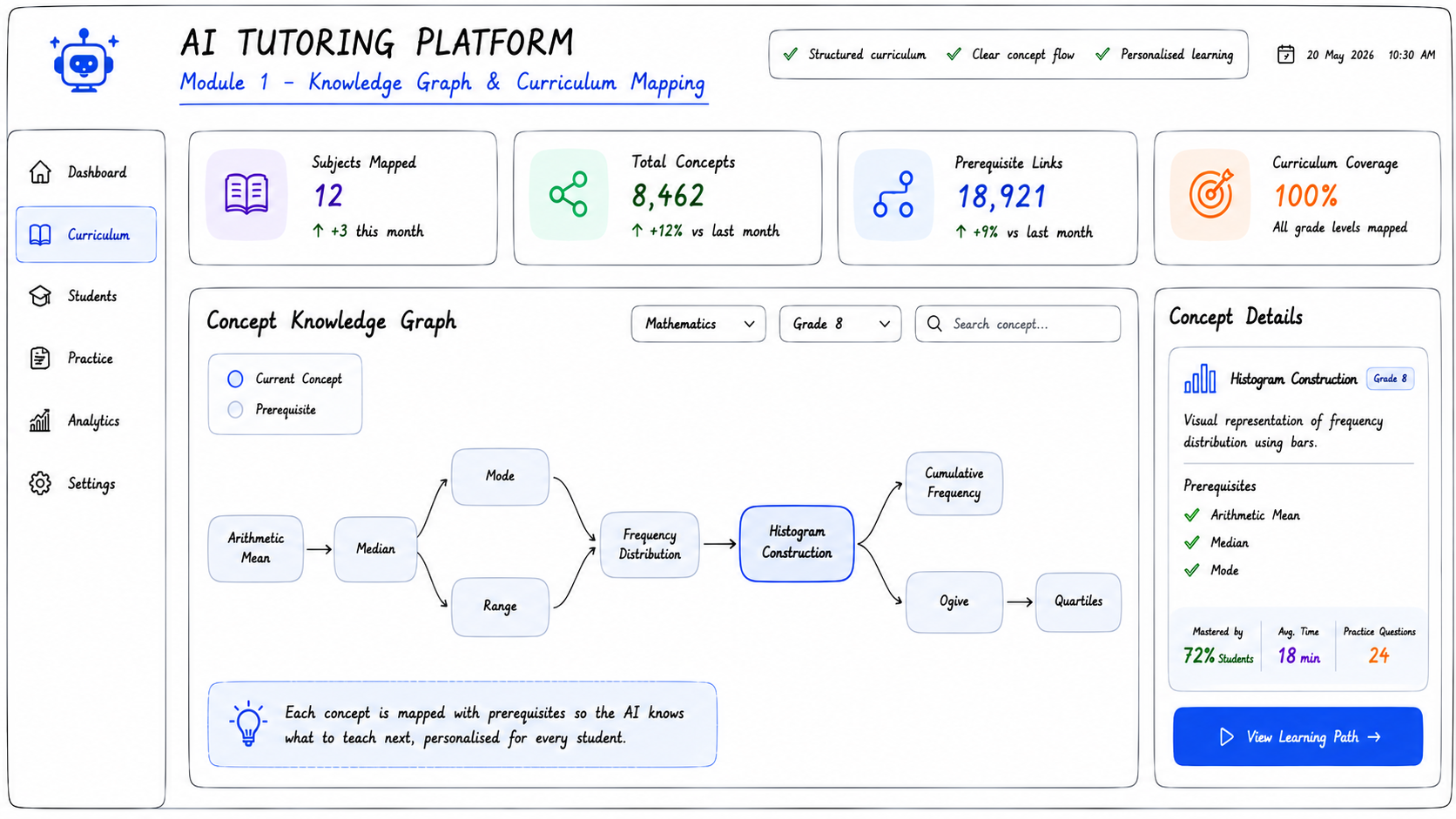
The knowledge graph is the intellectual foundation of the AI tutoring platform. It maps an entire curriculum, not as a list of chapters, but as a network of concepts with prerequisite relationships.
What the knowledge graph represents:
Every concept in a curriculum is a node. Every prerequisite relationship is a directed edge. Before a student can learn long division, they must have mastered multiplication.
Before they can master multiplication, they must have mastered addition. This prerequisite chain, from foundational concepts through progressively complex applications, is the graph.
An example subgraph for mathematics (Grade 8):
Arithmetic Mean → Median → Mode → Range
↓
Frequency Distribution
↓
Histogram Construction
↓
Cumulative Frequency → Ogive → Quartiles
A student who cannot construct a histogram cannot meaningfully work on ogives. The AI tutor knows this because the knowledge graph encodes the prerequisite dependency.
Building the knowledge graph:
The knowledge graph is built by curriculum experts who decompose each subject into atomic concepts, the smallest unit of knowledge that can be independently assessed. A typical school subject has 200 to 500 atomic concepts. The experts then map prerequisite relationships between concepts.
This work is done once per curriculum level and does not change unless the curriculum changes. The resulting graph is the most valuable intellectual asset in the platform, it determines everything about how learning is sequenced and personalised.
The student knowledge model is a real-time estimate of each student’s mastery probability for each concept in the knowledge graph. It is the AI’s best current answer to the question: “What does this student know, right now?”
The mastery probability model:
Each concept has a mastery probability between 0 and 1 for each student:
| Mastery Probability | Interpretation | Platform Action |
| 0.0 – 0.3 | Not yet encountered or significantly struggling | Teach, deliver instructional content |
| 0.3 – 0.6 | Partial understanding, errors present | Practice, targeted practice with explanations |
| 0.6 – 0.85 | Approaching mastery, occasional errors | Reinforce, harder practice, edge cases |
| 0.85 – 1.0 | Mastered | Space out review, move to dependent concepts |
How mastery probability is updated:
Every student interaction, every question answered, every concept explanation viewed, every practice problem attempted, updates the mastery probability for the relevant concepts.
A correct answer to a question on concept X raises X’s mastery probability. An incorrect answer lowers it. The magnitude of the update depends on the difficulty of the question, a correct answer to a very hard question updates mastery significantly upward; a correct answer to a very easy question raises it slightly.
An incorrect answer to an easy question is a stronger signal of non-mastery than an incorrect answer to a hard question.
Bayesian Knowledge Tracing (BKT):
The standard algorithm for knowledge modelling in intelligent tutoring systems is Bayesian Knowledge Tracing. BKT models four probabilities per student per concept:
| Parameter | Meaning |
| P(L₀) | Prior probability that the student already knows the concept |
| P(T) | Probability of learning the concept after one practice opportunity |
| P(G) | Probability of a correct guess even without knowing the concept |
| P(S) | Probability of slipping (incorrect answer even when concept is known) |
These parameters are estimated from population data and updated per student as they interact with the platform. The output is a continuously updated mastery probability that the adaptive engine reads to select the next learning intervention.
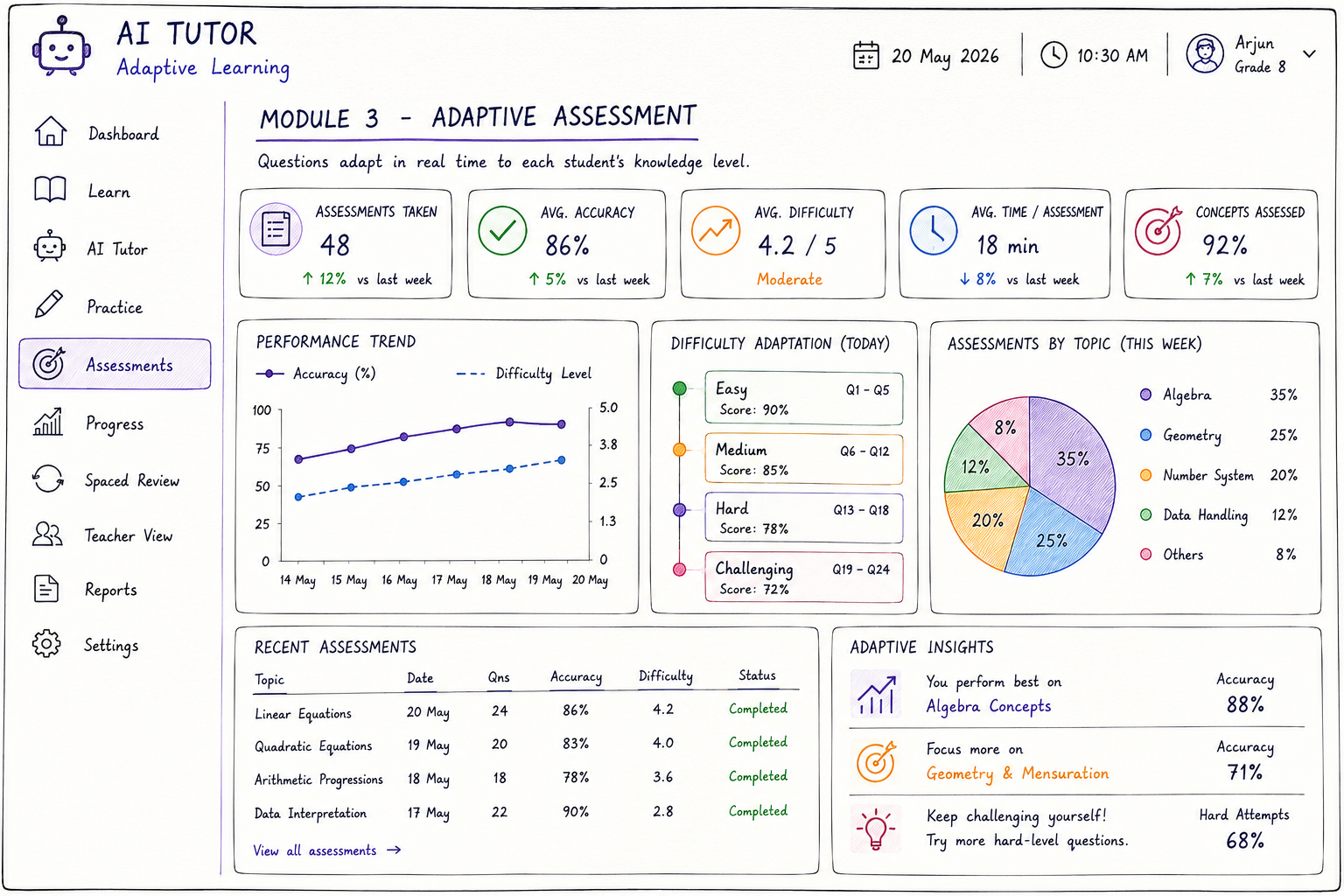
Standard assessments ask every student the same questions in the same order. Adaptive assessments adjust question difficulty and selection based on each student’s performance in real time.
How adaptive assessment works:
The student answers question 1. If correct, the next question is slightly harder and tests a related or dependent concept.
If incorrect, the next question is at the same or slightly lower difficulty to confirm the gap, then a simpler prerequisite concept is tested to identify where the misunderstanding originates.
Item Response Theory (IRT):
The question difficulty calibration uses Item Response Theory, each question in the question bank has an estimated difficulty parameter (b), a discrimination parameter (a), and a guessing parameter (c).
The adaptive engine selects the question whose difficulty is closest to the student’s current estimated ability level, the question most likely to provide maximum information about the student’s true mastery level.
Question types:
| Question Type | What It Tests | AI Grading |
| Multiple choice | Concept recognition | Automatic |
| Fill in the blank | Recall and calculation | Automatic (exact match or NLP similarity) |
| Short answer | Explanation and reasoning | LLM-powered grading |
| Mathematical expression | Calculation with steps | Math expression parser |
| Drag and drop | Sequencing, classification | Automatic |
| Free response | Extended explanation | LLM grading with rubric |
The question bank:
A robust adaptive assessment requires a large, calibrated question bank, thousands of questions per subject per grade, each tagged to specific concepts and difficulty levels.
The AI content generation system (Module 6) reduces the cost of building this bank by generating practice questions from curriculum content automatically.
This is the module that makes the platform feel like a tutor rather than a test. The AI tutor is an LLM-powered conversational interface that a student can ask questions to, in natural language, in their own language, and receive explanations tailored to their current knowledge state.
The AI tutor capabilities:
| Capability | Example Interaction |
| Concept explanation | “Explain what a median is like I am 12 years old” |
| Step-by-step problem solving | “Solve this problem step by step and explain each step” |
| Error diagnosis | “I got -4. The answer should be 4. What did I do wrong?” |
| Socratic guidance | Student stuck, AI asks guiding questions rather than giving the answer |
| Multiple representations | “Show me this concept using a visual example” |
| Real-world connections | “Give me a real-life example of where I would use this” |
| Practice question generation | “Give me three more practice problems on this concept” |
The knowledge-state-aware prompt:
The AI tutor knows the student’s current mastery profile. When a student asks for an explanation, the tutor’s system prompt includes the student’s current knowledge state, which prerequisite concepts they have mastered and which they have not.
This allows the tutor to pitch explanations at exactly the right level, not assuming knowledge the student does not have, not over-explaining what they already know.
Guardrails and safety:
For student-facing AI tutoring, content safety is non-negotiable. The LLM responses are filtered through a content safety layer that blocks inappropriate content, handles academic integrity concerns (the tutor guides rather than solves homework directly), and routes concerning student statements (expressions of distress or self-harm) to appropriate human review.
Given the student’s current knowledge model, their mastery probability across every concept, the learning path engine determines what to teach next.
The next-best-action logic:
| Student Situation | Next Action Selected |
| Multiple concepts partially mastered | Prioritise the concept with the most dependent children in the graph, unblocking it unlocks the most future learning |
| Concept nearly mastered (0.75) | Push to mastery with targeted practice |
| Concept far from mastery (0.2) | Start with prerequisite concepts, build foundation |
| All current-level concepts mastered | Introduce next-level concepts |
| Long since last review of mastered concept | Spaced repetition review session |
| Exam approaching in 7 days | Shift to exam preparation, focus on weakest concepts with highest exam weight |
Spaced repetition scheduling:
Concepts that have been mastered need periodic review to remain in long-term memory.
The spaced repetition scheduler uses the Ebbinghaus forgetting curve to calculate the optimal review date for each mastered concept, the point at which forgetting is likely to begin, just before long-term retention would degrade.
A concept mastered 3 days ago needs review in 3 days. The same concept, successfully reviewed, needs review in 1 week, then 2 weeks, then 1 month, then 3 months.
Building a question bank of 50,000 calibrated questions manually, written, reviewed, and tagged by subject matter experts, costs $500,000 to $2,000,000 and takes 2 to 3 years. AI content generation reduces this to weeks and a fraction of the cost.
What the AI generates:
| Content Type | Generation Approach | Human Review Required |
| Practice questions (MCQ) | LLM given concept + difficulty level + question format, generates 10 options | Spot-check review, 10 to 20% |
| Worked examples | LLM generates step-by-step solution with explanations | Review for accuracy |
| Concept explanations | LLM generates explanation at specified reading level | Review for accuracy |
| Distractors (wrong answer options) | LLM generates plausible wrong answers, common misconceptions | Review for plausibility |
| Hints | LLM generates 3-level hint sequence per question | Review for pedagogical value |
| Exam-style questions | LLM generates questions matching exam board patterns | Expert review |
The quality control layer:
AI-generated content goes through an automated quality check, grammatical correctness, mathematical expression validity, answer accuracy (for calculable problems, the answer is verified algorithmically).
Content that passes automated checks enters a human review queue where subject experts review a sample and approve for the live question bank.
Over time, student performance data on each question validates quality, questions where a disproportionate number of students get wrong regardless of their mastery level are flagged as potentially poorly constructed and returned for revision.
Teacher dashboard, class-level intelligence:
| View | What It Shows | Action Enabled |
| Concept mastery heatmap | Which concepts which students have mastered | Identify which concepts need whole-class reteaching |
| Student-level mastery | Each student’s overall progress and weakest concepts | Personalised intervention decisions |
| Struggling student queue | Students significantly behind grade-level expectations | Teacher outreach and support |
| Learning time report | How much time each student spent on the platform this week | Engagement monitoring |
| Pre-lesson insight | Before a new topic, who has the prerequisites and who does not | Differentiated instruction planning |
Parent dashboard:
| Feature | Details |
| Weekly progress report | Concepts practised, mastery improved, time spent |
| Subject-wise strength profile | Visual radar chart of mastery by topic |
| Comparison to grade benchmark | Is my child on track, ahead, or behind? |
| Recommended home practice | “Your child should practise fractions this week” |
| Achievement badges | Gamification, motivational milestones |
| Module | Cost Range (USD) | Notes |
| Knowledge graph database + curriculum mapping tool | $8K – $15K | Graph database (Neo4j) + authoring interface |
| Student knowledge model (BKT engine) | $8K – $15K | Real-time mastery probability updates |
| Adaptive assessment engine (IRT) | $10K – $20K | Question selection algorithm |
| AI tutor conversation (LLM + guardrails) | $10K – $20K | GPT-4o or Claude with safety layer |
| Personalized learning path engine | $8K – $15K | Next-best-action logic |
| Spaced repetition scheduler | $5K – $10K | Ebbinghaus-based review scheduling |
| AI content generation pipeline | $8K – $15K | Question generation + quality control |
| Question bank management system | $5K – $10K | |
| Teacher dashboard + class analytics | $6K – $12K | |
| Parent dashboard + progress reports | $5K – $10K | |
| Student app (iOS app + Android, Flutter) | $10K – $18K | |
| AWS + VAPT + Year 1 ops | $5K – $10K | |
| Total | $88K – $170K | Full AI tutoring platform |
EngineerBabu is a Google AI Accelerator 2024 Top 20 company, building production-grade AI systems is our core. CMMI Level 5. 75+ YC-backed companies served. Contact: mayank@engineerbabu.com
Bayesian Knowledge Tracing (BKT) is a machine learning model that estimates the probability that a student has mastered a specific concept, based on their history of correct and incorrect answers on questions related to that concept. It models four parameters: the probability the student already knew the concept before any practice, the probability of learning it after one correct practice opportunity, the probability of guessing correctly without knowing, and the probability of making a slip error despite knowing. After every student interaction, correct or incorrect, the model updates the mastery probability estimate using Bayes’ theorem. The adaptive engine reads this updated probability to decide what to present next, more practice on the same concept, a harder application, or a move to the next concept in the learning sequence. BKT is the algorithm that makes an AI tutor genuinely adaptive rather than just shuffling content in a different order.
A standard LMS delivers predefined content in a predefined sequence, every student gets the same videos, the same quizzes, in the same order. A student who already knows the concept watches the video anyway. A student who is lost after the video gets the same next step as a student who understood it perfectly. An AI tutoring platform has a real-time model of each student’s knowledge state and uses that model to determine every student’s next learning step independently. The student who already knows the concept skips to a harder application. The student who did not understand it gets a different explanation, then prerequisite practice, then a simpler version of the problem. This individualisation, every student gets a different sequence based on what they specifically need, is what produces measurably better learning outcomes than content delivery alone.
Manually building a calibrated question bank, written by subject matter experts, reviewed by educators, tagged to curriculum concepts, validated through student trials, costs $10 to $40 per question when all costs are included. A question bank of 50,000 questions costs $500,000 to $2,000,000 to build manually. AI content generation uses large language models prompted with the specific concept, difficulty level, question format, and curriculum context to generate draft questions in seconds. A human reviewer then validates the output, at a fraction of the time of writing from scratch. This workflow reduces effective cost per question to $1 to $3 for AI-generated, human-reviewed questions, a 5 to 15x reduction. The limiting factor is human expert review, AI content generation accelerates creation, but expert review for accuracy and pedagogical quality remains a human step.