How to Build a Mental Health Platform - Therapist Matching, HIPAA Messaging, Outcome Tracking, Crisis Architecture 2026


Create engaging, high-performance mobile applications tailored to your business needs. We craft future-ready apps that offer smooth user experiences on all devices.
Build robust and scalable websites and CMS platforms that help you manage content effortlessly. Our development ensures a seamless digital presence.
Launch secure, feature-rich online stores with intuitive shopping experiences. We build tailored eCommerce platforms designed for growth.
Design captivating games with immersive gameplay and stunning graphics. From concept to launch, we build engaging experiences that players love.
Enhance your customer relationships with customized Salesforce implementations. Drive growth and efficiency with smarter CRM solutions.
Harness artificial intelligence and machine learning to automate workflows and gain actionable insights. Our AI transforms data into smart decisions.
Accelerate your software delivery lifecycle with continuous integration, delivery, and infrastructure automation to boost efficiency.
1 in 5 US adults experienced a mental health condition, as per NIMH. The average wait for a new mental health appointment is 25 days. In rural areas, 60% of counties have no psychiatrists at all.
Digital mental health platforms are the access layer, connecting patients with therapists faster, providing between-session support, and generating the outcome data payers increasingly require.
A mental health platform is not a video call scheduler with a mental health brand. The clinical and safety requirements distinguish it from every other telehealth category.
The intake assessment:
| Step | Content | Clinical Purpose |
| Demographics | Age, location, insurance | Matching and billing inputs |
| Chief concern | Free text + structured category | Specialty routing |
| PHQ-9 | 9-item depression screening | Severity baseline |
| GAD-7 | 7-item anxiety screening | Severity baseline |
| Additional screens | PCL-5 (PTSD), AUDIT (alcohol), Columbia Suicide Severity | Based on PHQ-9/GAD-7 |
| Preferences | Therapist gender, modality (CBT/DBT/EMDR), language | Matching preferences |
| Insurance | Insurance card scan + verification | Billing and coverage |
The Columbia Suicide Severity Rating Scale (C-SSRS) trigger:
If PHQ-9 item 9 (thoughts of self-harm) scores above zero, the platform automatically administers C-SSRS:
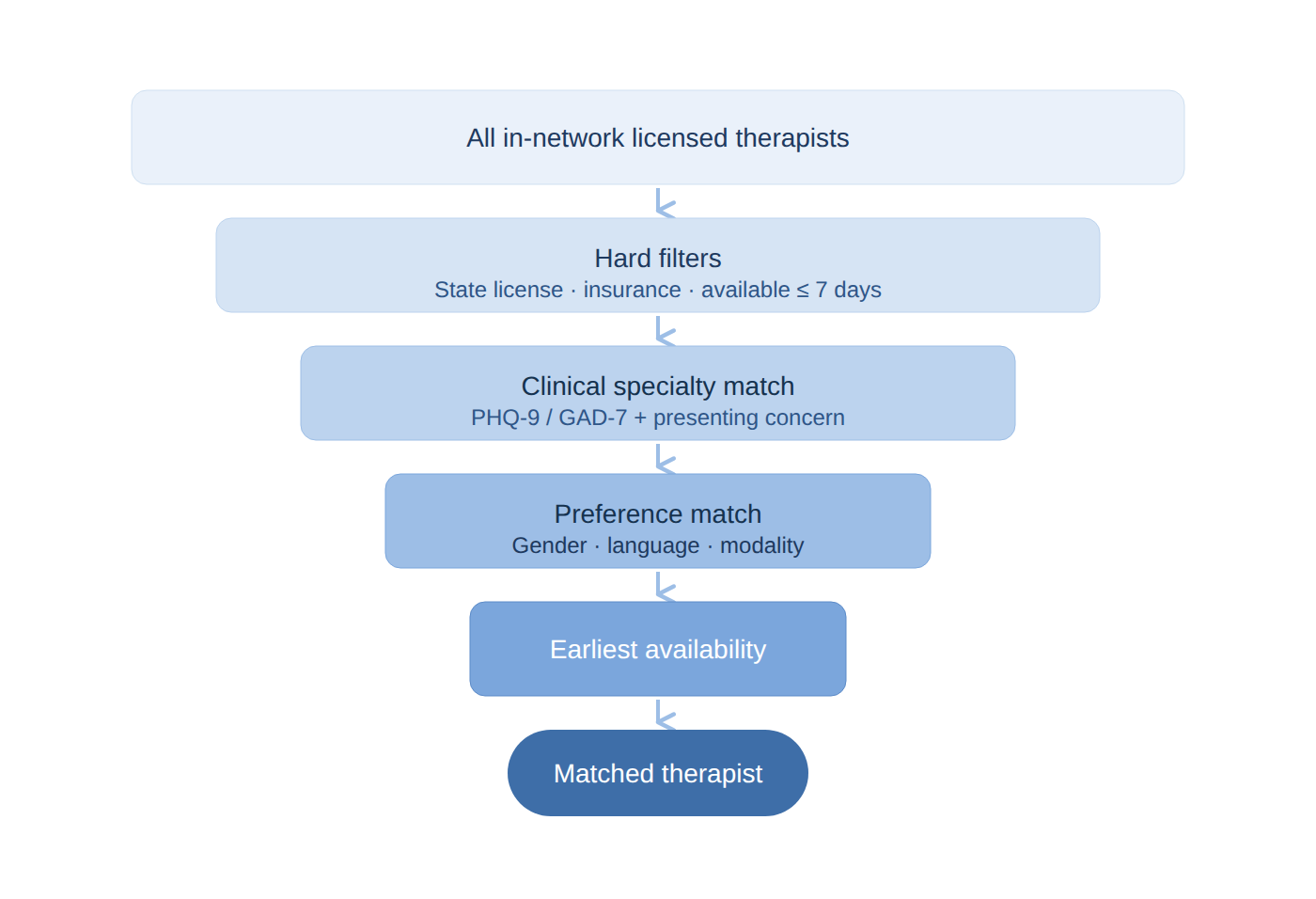
The matching factors:
| Factor | Why It Matters |
| Clinical specialty | A trauma therapist is not interchangeable with a CBT practitioner |
| Licensure by state | Therapist must be licensed in patient’s state of residence |
| Insurance participation | Out-of-network costs drive dropout |
| Availability | Next available within patient’s preferred timeframe |
| Demographic preference | Gender, race/ethnicity, language matters for therapeutic alliance |
| Treatment modality | CBT/DBT/EMDR/psychodynamic, must match presenting concern |
The matching algorithm:
Licence verification:
Real-time integration with NPDB and state licensing board APIs, monthly monitoring. A therapist whose licence lapses is automatically suspended from accepting new patients.
Video infrastructure requirements for mental health:
Asynchronous secure messaging:
The outcome tracking workflow:
| Assessment | Frequency | Delivery |
| PHQ-9 | Bi-weekly | Automated push to patient app |
| GAD-7 | Bi-weekly | Automated push |
| C-SSRS (if baseline positive) | Weekly | Automated |
| PCL-5 (if trauma presenting) | Monthly | Automated |
| Session-by-session measure | After each session | In-app prompt |
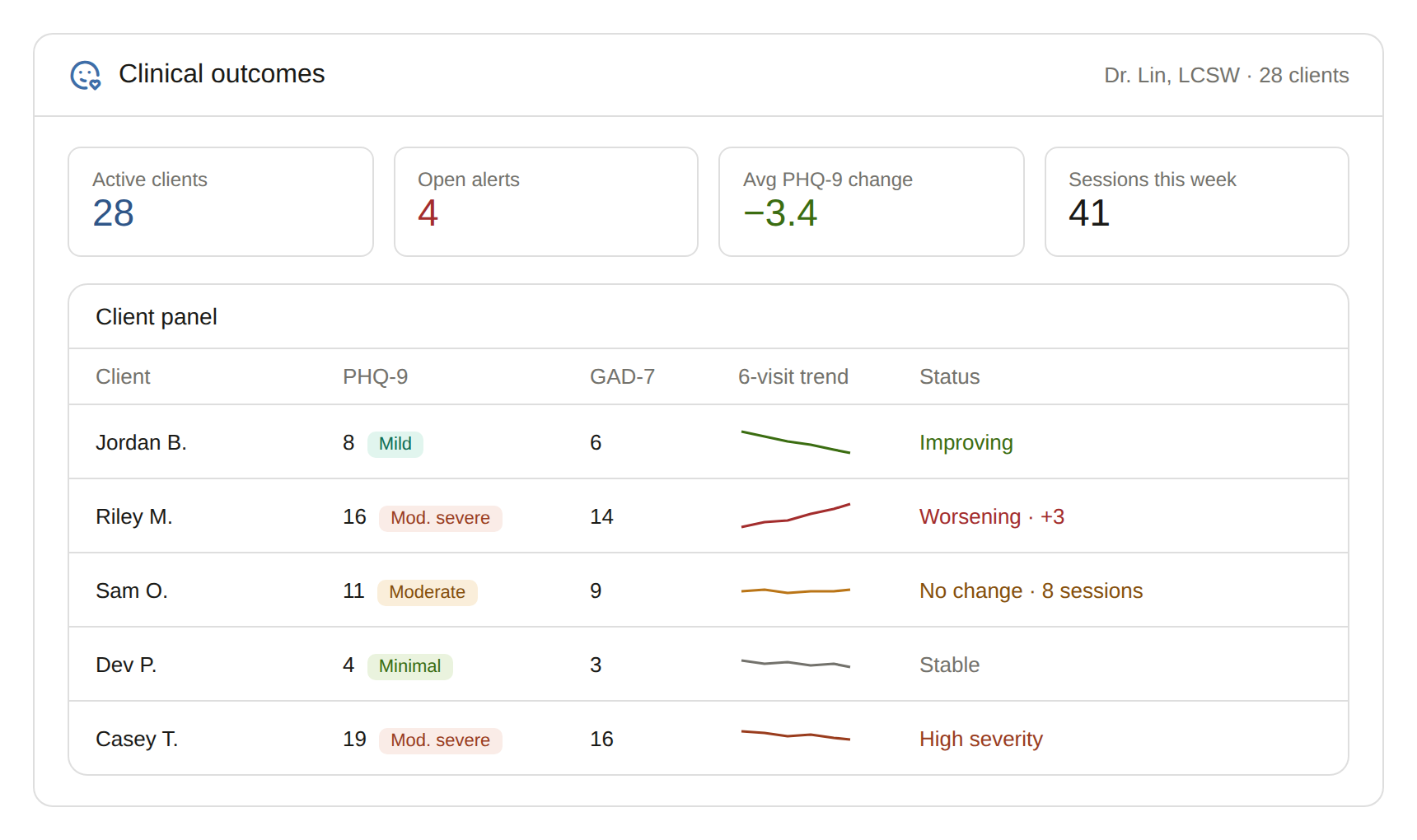
The provider outcome dashboard:
Each therapist sees their full patient panel with:
NLP crisis detection monitors:
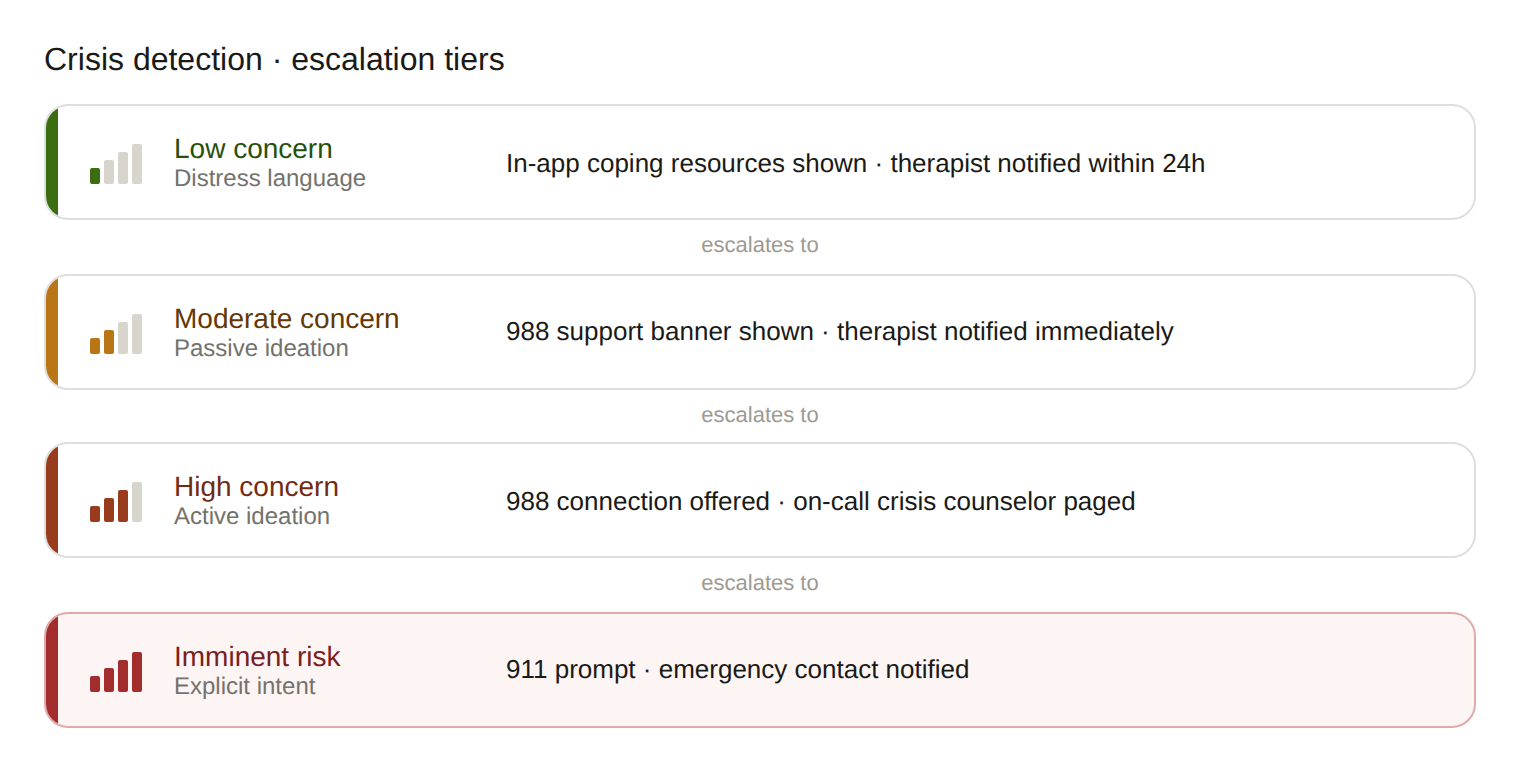
Escalation tiers:
| Level | Trigger | Automated Action |
| Low concern | Distress language | In-app coping resources + therapist notification 24h |
| Moderate concern | Passive suicidal ideation | 988 banner displayed + therapist immediate notification |
| High concern | Active ideation language | 988 connection offered, on-call crisis counsellor paged |
| Imminent risk | Explicit intent or action | 911 prompt, emergency contact notified |
Digital safety planning:
When patient assessed as moderate or high risk, platform activates collaborative safety planning:
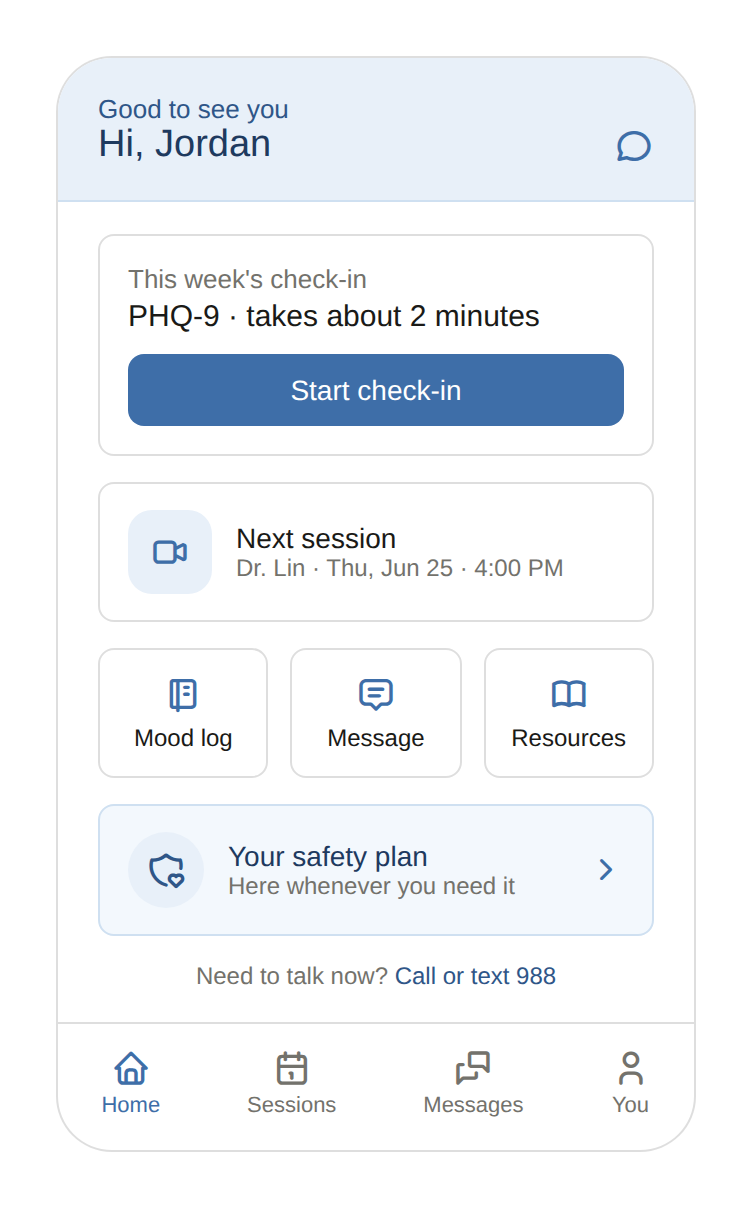
Safety plan accessible from the patient’s home screen at any time.
| CPT Code | Service | Rate |
| 90837 | Individual psychotherapy, 53+ minutes | $150–$250 |
| 90834 | Individual psychotherapy, 38–52 minutes | $110–$190 |
| 90832 | Individual psychotherapy, 16–37 minutes | $80–$140 |
| 90847 | Family/couples therapy with patient present | $150–$250 |
| 90853 | Group psychotherapy | $50–$90 per patient |
All require: telehealth modifier GT (Medicare) or 95 (commercial), place of service code 10, ICD-10 DSM-5 diagnosis code.
| Module | Cost Range (USD) | Notes |
| Patient onboarding + PHQ-9/GAD-7/C-SSRS | $6K – $12K | Adaptive questionnaire engine |
| Therapist matching algorithm | $8K – $15K | Licence verification API |
| HIPAA-compliant video app (Twilio/Daily.co + BAA) | $6K – $12K | |
| Asynchronous secure messaging | $6K – $12K | Episode threading |
| Automated outcome tracking + analytics | $6K – $12K | |
| NLP crisis detection engine | $8K – $15K | Fine-tuned on clinical language |
| 988 integration + digital safety planning | $5K – $10K | |
| AI clinical documentation (SOAP notes) | $6K – $12K | |
| Insurance billing (CPT teletherapy codes) | $5K – $10K | |
| Therapist portal + admin dashboard | $6K – $12K | |
| Patient mobile app (iOS + Android) | $10K – $18K | |
| AWS HIPAA + SOC 2 + VAPT | $6K – $12K | |
| Total | $78K – $152K | Full mental health platform |
Contact: mayank@engineerbabu.com
PHQ-9 categories: 0–4 (minimal), 5–9 (mild), 10–14 (moderate), 15–19 (moderately severe), 20–27 (severe). Alerts trigger when: PHQ-9 total exceeds 14; any single administration shows 5+ point increase from previous; item 9 scores 1 or above (triggers C-SSRS); patient’s score has not improved after 8 sessions. All alerts route to the assigned therapist and, for high-severity, to the clinical supervisor.
The crisis detection model is fine-tuned on clinical mental health language, understanding the difference between “I want to kill this project” (metaphorical, not crisis) and “I don’t want to be alive anymore” (genuine crisis signal). It uses a multi-tier scoring system: low-confidence signals (ambiguous language) trigger passive interventions (coping resources shown in-app); high-confidence signals (specific crisis language) trigger active escalation (immediate human involvement). The model is calibrated for high sensitivity (catching genuine crises) over high specificity, a false positive that triggers unnecessary check-in is far preferable to a missed crisis.