How to Build a Money Transfer App in 2026: The Multi-Jurisdiction Engineering Guide


Create engaging, high-performance mobile applications tailored to your business needs. We craft future-ready apps that offer smooth user experiences on all devices.
Build robust and scalable websites and CMS platforms that help you manage content effortlessly. Our development ensures a seamless digital presence.
Launch secure, feature-rich online stores with intuitive shopping experiences. We build tailored eCommerce platforms designed for growth.
Design captivating games with immersive gameplay and stunning graphics. From concept to launch, we build engaging experiences that players love.
Enhance your customer relationships with customized Salesforce implementations. Drive growth and efficiency with smarter CRM solutions.
Harness artificial intelligence and machine learning to automate workflows and gain actionable insights. Our AI transforms data into smart decisions.
Accelerate your software delivery lifecycle with continuous integration, delivery, and infrastructure automation to boost efficiency.
Here’s the thing most money transfer apps get wrong before a single line of code is written.
They start with the user experience. The clean send screen. The recipient list. The instant confirmation notification. All of it looks good in the prototype.
Then they hit the real problem.
A payment sent from London reaches a bank in Lagos. Somewhere between the SWIFT message leaving the UK correspondent bank and arriving at the Nigerian beneficiary bank, £32 vanishes in intermediary fees. Nobody told the user. They delete the app.
Or this: the FX rate shown at the moment of initiating the transfer changes by the time the payment processes. The user sent $500 expecting the recipient to receive ₹41,850. They received ₹41,200. The difference is small. The trust damage is permanent.
Or this: the compliance team at the sponsor bank flags that 14 transactions are missing a “purpose of payment” field required for UK FCA reporting. The app has been live for six weeks. All 14 customers need to be contacted. Three have already left negative App Store reviews.
I’ve watched all three of these happen. Not in case studies. In real projects.
The EngineerBabu team has built a multi-continent remittance platform operating across 5 regulatory jurisdictions simultaneously different KYC requirements, different data residency rules, different AML reporting obligations, different payment rails, one architecture. That platform is live. It processes real cross-border transfers. The team knows, from production experience, exactly where money transfer apps break and why.
This guide exists to prevent those breaks.
If you’re ready to build and want to talk to a team that’s done this across five regulatory jurisdictions email mayank@engineerbabu.com now.
The global remittance market was valued at $879 billion in 2026, projected to reach $1.14 trillion by 2030. Digital remittances specifically are growing at 15.6% annually — nearly three times the growth rate of total remittance volume. The shift from cash and bank branches to mobile-first digital platforms is still in its early innings.
Over 65% of transfers are now conducted via online platforms. Asia Pacific leads with 48% of global remittance market share. India, Philippines, Mexico, and Egypt are the top remittance-receiving nations by volume all underserved by legacy transfer operators whose average fee is still 6–7% of transaction value.
That fee gap is the opportunity.
Wise and Revolut built multi-billion-dollar businesses by charging 0.5–2% instead of 6–7%. The structural opportunity still exists in specific corridors, specific communities, and specific use cases – B2B cross-border payments, gig economy payouts, embedded remittance in e-commerce, and broader fintech app development initiatives focused on global payments and digital banking.
But here’s what those headline numbers hide.
Money transfer app development is one of the most compliance-intensive segments within fintech app development. A single-country lending app has one compliance regime. A money transfer app operating across five countries has five. Every regulatory jurisdiction has its own KYC requirements, its own AML reporting thresholds, its own sanctions screening obligations, and its own money transmitter licensing process.
Most apps fail not because the transfer didn’t work. They fail because the compliance architecture couldn’t handle what happens when a transfer crosses a border and every single transfer crosses at least one.
A money transfer app is a digital platform that enables individuals or businesses to initiate electronic fund transfers across bank accounts, digital wallets, or cash payout networks domestically or internationally through a mobile or web interface. The core transaction is simple: move money from sender to recipient. The infrastructure that makes it happen reliably, compliantly, and at acceptable cost is not simple at all.
Money transfer apps split into four functional categories, each with different architecture requirements:
P2P payments (domestic) – sending money between individuals within one country. UPI in India, Faster Payments in the UK, ACH in the US. Relatively straightforward compliance, single payment rail, one regulatory regime.
Remittance (international) – migrant workers sending money home. High volume, low margin, multiple regulatory jurisdictions, currency conversion, local payout methods. The most complex category to build correctly.
Business payouts – companies paying contractors, suppliers, or employees in multiple countries. Higher transaction values, more stringent KYB (Know Your Business) requirements, treasury management complexity.
Embedded remittance – money transfer functionality built into an existing product: an e-commerce platform, a gig economy app, a neobank. The remittance is a feature, not the core product.
Which category you’re building for changes the architecture at the payment rail layer, the compliance layer, the FX engine design, and the licensing strategy. These decisions should be made before any design work starts.
This is where most money transfer founders are surprised. Sometimes expensively.
United States: Any platform that moves money is a Money Services Business (MSB) under FinCEN. MSB registration is federal and relatively straightforward. The hard part: you also need a Money Transmitter License (MTL) in every state where you operate. That’s potentially 50 separate licenses, each with its own application, bond requirement, and renewal cycle. The average MTL takes 3–6 months per state.
Most US-focused startups start by partnering with a licensed money transmitter (a payment facilitator or BaaS-style partner) and avoid direct licensing until they have the revenue to justify the compliance investment. This is the right call for most early-stage products.
United Kingdom: FCA registration as a Payment Institution or Electronic Money Institution. The FCA authorisation process takes 6–12 months for a full authorisation. Faster access via a smaller payment institution registration, but with transaction limits that constrain scale.
European Union: EMI (Electronic Money Institution) licence under PSD2. Lithuania, Ireland, and the Netherlands are the most popular EU incorporation jurisdictions for remittance companies because they offer the fastest path to an EU passport meaning one EMI licence grants access to all EU member states.
India: RBI authorisation under the Payment and Settlement Systems Act. For inward remittance, authorised dealer (AD) bank partnerships handle the regulatory relationship. For outward remittance, the regulatory path is more complex and most digital platforms operate through licensed AD bank partners.
Multi-jurisdiction: This is where the real complexity lives. Each jurisdiction requires not just a different licence but different KYC documentation standards, different AML reporting thresholds, different data residency rules, and different sanctions list screening requirements.
The same regulatory complexity applies to neobank app development, where account issuance, card programs, payments, and cross-border transfers often require different licensing structures and banking partnerships across jurisdictions.
The team that built the 5-jurisdiction remittance platform learned this directly: you cannot build one compliance module and apply it everywhere. You build a compliance architecture that is configurable by jurisdiction the same underlying system, different rules depending on where the sender and recipient are located.
Every competitor article on this keyword covers features. The basics: send money, track transfers, show exchange rates. None of them go deep on why the architecture breaks. This section is that depth.
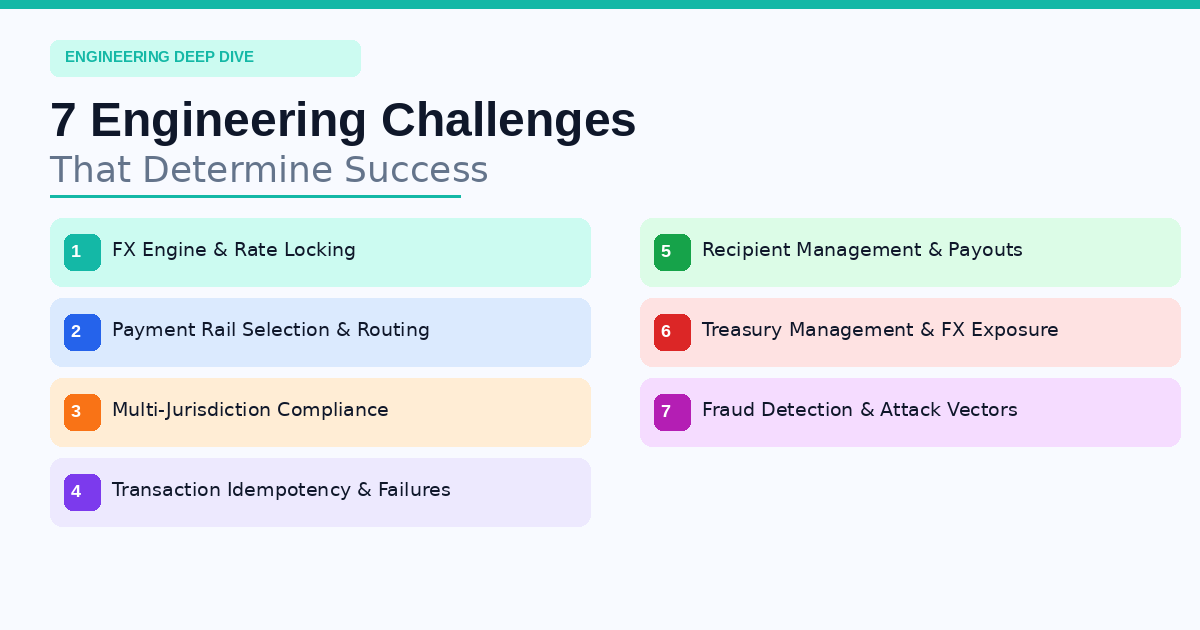
The foreign exchange engine is simultaneously the most important business component and the most technically underestimated part of a money transfer app.
Here’s what the FX engine actually has to do in production.
First: rate sourcing. The mid-market rate for any currency pair changes every second on global FX markets. Your app needs a real-time rate feed — from providers like XE, Open Exchange Rates, or direct bank feeds and it needs to apply your margin (spread) on top of that rate to generate the customer rate.
Second: rate locking. When a customer initiates a transfer, the rate shown needs to be locked for a defined period — typically 15–30 seconds — while they confirm. If the underlying market rate moves significantly during that window, the locked rate becomes a loss for you. This requires a rate lock mechanism that is atomic with the transaction initiation.
Third: rate expiry and re-quoting. If the customer doesn’t confirm within the lock window, the quote expires and they see a new rate. This sounds simple. In production, it produces customer complaints when the new rate is less favourable. Your re-quoting UI and messaging needs to be precise.
Fourth: rate transparency. The FCA in the UK requires specific disclosures about the exchange rate and total cost. The EU’s PSD2 requires similar disclosures. The US has CFPB remittance transfer rules that mandate pre-payment disclosure of the exchange rate, fees, and the exact amount the recipient will receive in the destination currency.
Now here’s what nobody says.
When you send a SWIFT payment, intermediary correspondent banks can deduct fees from the transfer amount in transit. The customer sends $500. The recipient receives $468. Your app showed $500 going and $468 arriving — if you knew about the correspondent fees. If you didn’t model them into the disclosure, you’ve violated the CFPB remittance rule and broken your user’s trust simultaneously.
The fix: for each corridor (origin country → destination country), model the full cost including correspondent banking fees, not just your own spread. This requires relationship with the receiving bank in each corridor and ongoing fee monitoring as correspondent relationships change.
The team’s 5-jurisdiction remittance platform handles this per-corridor, per-receiving-bank. Every FX quote includes the fully-loaded cost. It took two months of corridor mapping to get right. Those two months prevented every one of the complaints described in the opening.
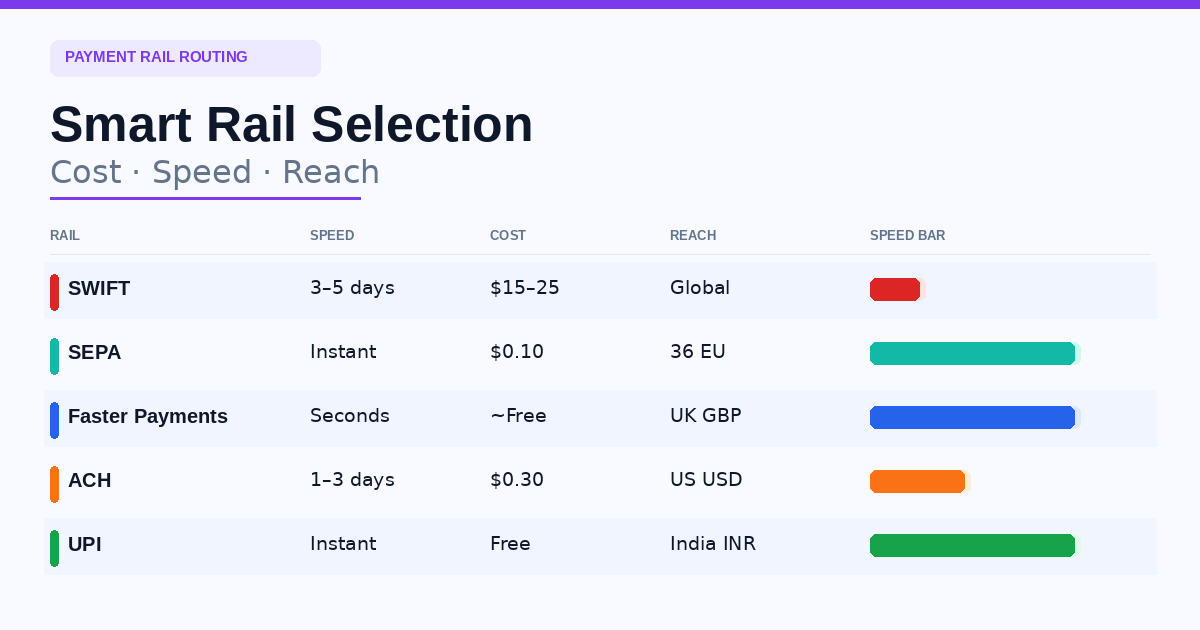
Different payment rails have different characteristics: speed, cost, availability, and failure modes. A production money transfer app needs to understand all of them and route intelligently.
The major rails and what they actually do:
SWIFT — global reach, 3–5 business day settlement, correspondent banking fees in transit, high value transfers. The default for corridors without better options. Not the right choice when better options exist.
SEPA (Single Euro Payments Area) — standard SEPA: 1 business day, €0.10–0.50 per transaction. SEPA Instant: under 10 seconds, 24/7/365, processing 46 billion transactions in 2024. For EUR transfers within 36 European countries, SEPA is almost always the right rail.
ACH (US) — 1–3 business days, very low cost, high reliability. Same-day ACH now available. For USD domestic transfers and USD-denominated payouts in the US, ACH is the standard.
Faster Payments (UK) — seconds, 24/7, up to £1 million per transaction. The standard for UK GBP transfers.
UPI (India) — instant, 24/7, free for small transactions. For INR payouts in India, UPI integration is essential. IMPS as backup for UPI failures.
The routing decision for each transfer: which rail gets this payment to the recipient fastest, most cheaply, with the highest success probability? This is not a static decision — it depends on the destination country, the payout method (bank account, wallet, mobile money, cash pickup), the transaction amount, and the time of day.
Building a smart routing engine that makes this decision programmatically — rather than hardcoding one rail per corridor — is the difference between a competitive product and one that routes every transfer through SWIFT because it’s the default.
This is the challenge that’s unique to money transfer apps and the one that breaks the most builds.
Each regulatory jurisdiction requires:
The architectural solution: a jurisdiction-aware compliance layer that sits between the transfer initiation and the payment execution. Every transfer carries a jurisdiction context object sender country, recipient country, transfer amount, currency. The compliance layer applies the rule set for each jurisdiction involved and produces a compliance decision: clear, hold for review, or block.
The rule sets are configurable per jurisdiction. When the UK FCA updates its transaction monitoring thresholds, you update the UK rule set. You don’t touch the Indian or US rule sets. The architecture is built to absorb regulatory change as a configuration update, not a code change.
This is what the EngineerBabu team built for the 5-jurisdiction remittance platform. Different KYC flows for UK and EU senders. Different reporting pipelines for OFAC (US) vs NCA (UK) vs FIU-IND. Different data residency regions for each customer segment. One application, five compliance configurations.
Money transfer apps have a class of failure that almost no other application type has: the partially completed transaction.
A user initiates a transfer. The app confirms the payment. The funds leave the sender’s account. The SWIFT message is sent to the correspondent bank. Then the correspondent bank’s system goes offline. The funds are in transit. The sender’s account shows the deduction. The recipient hasn’t received anything.
What happens next?
In most badly-built money transfer apps: the support team investigates manually, the correspondent bank is contacted via email, the resolution takes 3–7 business days, and the customer escalates to a complaint or chargeback.
In a properly-built system: the transfer has a state machine. Every state transition is logged as an immutable event. The system knows the transfer is in “correspondent bank acknowledged” state. It monitors for a settlement confirmation within the expected settlement window. When that confirmation doesn’t arrive within the timeout, an automated exception workflow triggers: the system queries the correspondent bank status API, logs the discrepancy, escalates to the payments operations team with full context, and sends the customer a proactive status update.
The customer finds out before they call support. The support team has full context before the customer contacts them.
This requires idempotency keys on every transfer initiation — a unique identifier that ensures a transfer initiated twice (due to network retry, double-tap, app crash and reopen) is only processed once. It requires webhook handlers for every payment rail — SWIFT MT103 confirmations, SEPA CAMT files, Faster Payments real-time notifications. And it requires a transfer state machine that can represent every possible state a cross-border transfer can be in, including the failure states that nobody documents.
Building idempotency and failure handling correctly is not glamorous work. It is the work that determines whether a money transfer app builds a reputation for reliability or for “where did my money go.”
The sender experience in a money transfer app is relatively standard. The recipient experience is where the real complexity lives.
Recipients in different markets want different payout methods:
India — UPI (instant, free), IMPS (instant, small fee), NEFT (batch), bank account transfer UK — Faster Payments (instant), BACS (2-3 days) Nigeria — bank transfer (GTBank, Access, Zenith), mobile money (MTN MoMo), cash pickup Philippines — bank transfer, GCash (digital wallet), Palawan Pawnshop (cash) Gulf — bank transfer, exchange house
Supporting all of these in a single platform requires partnerships with payout networks in each destination country. Building these relationships takes time — 3–6 months per corridor for the commercial and technical integration. The technical integration for each payout partner is different: some offer APIs, some require ISO 8583 messaging, some require flat-file uploads on a settlement cycle.
A routing engine that knows which payout partners are available for each corridor, their current success rates, their cost structure, and their settlement speed — and selects the optimal partner for each transfer — is a product differentiator that most first-version apps don’t have but all mature apps need.
This is the challenge that’s invisible until the business is doing meaningful volume, and then it’s the challenge that determines profitability.
Every money transfer business is implicitly running a currency trading operation. You collect funds from senders in one currency, hold those funds for the duration of settlement, and pay out in another currency. The FX rate at the time you pay out may differ from the rate at the time you quoted.
For small volumes and liquid currency pairs (USD/EUR, GBP/USD), this risk is manageable. For large volumes or illiquid corridor currencies (USD/NGN, GBP/INR), the FX exposure becomes significant.
Treasury management for a multi-corridor money transfer platform requires:
This is a finance problem, not just an engineering problem. But the engineering needs to support it: real-time position tracking, automated reconciliation against bank statements, FX gain/loss reporting for accounting.
The team that built the 5-jurisdiction remittance platform — drawing on the CTO’s 17 years at Wishfin building financial infrastructure — designed treasury tracking from day one, not as a finance team spreadsheet but as a core component of the application architecture. Every transfer contributes to a real-time position ledger. Every position ledger feeds into a treasury dashboard. The finance team has visibility they can act on.
Money transfer fraud is different from general payment fraud because the transfers are often irreversible.
A fraudulent credit card transaction can be charged back. A fraudulent international wire transfer — once settled — cannot. This makes money transfer platforms high-value targets for specific fraud patterns:
Account takeover (ATO) — attacker accesses a legitimate user’s account and initiates a transfer to a recipient they control before the user notices. Mitigation: behavioral biometrics, device fingerprinting, unusual recipient detection, mandatory re-authentication for new recipients.
Social engineering / APP fraud – user is manipulated into initiating a transfer to a fraudster who controls the receiving account. The transfer is authorised by the legitimate account holder. Detection requires transaction pattern analysis: new recipient, first-time transfer to that country, unusually large amount relative to account history.
Velocity fraud – multiple small transfers initiated in quick succession, often from multiple compromised accounts to a single receiving account. Detection: cross-account velocity monitoring, not just per-account limits.
Mule networks – sophisticated organised fraud using networks of accounts to layer and obscure funds. Detection: graph analysis of connected accounts and transfer patterns, not just individual transaction scoring.
The Google AI Accelerator 2024 selection – for production AI capabilities specifically – means the EngineerBabu team builds fraud detection models that work in production: trained on real transaction patterns, monitored for drift, updated on emerging attack patterns. Not a rules engine with static thresholds. An ML system that learns.
The recommended tech stack for a money transfer app in 2026 – built for multi-jurisdiction, multi-rail operation from day one.
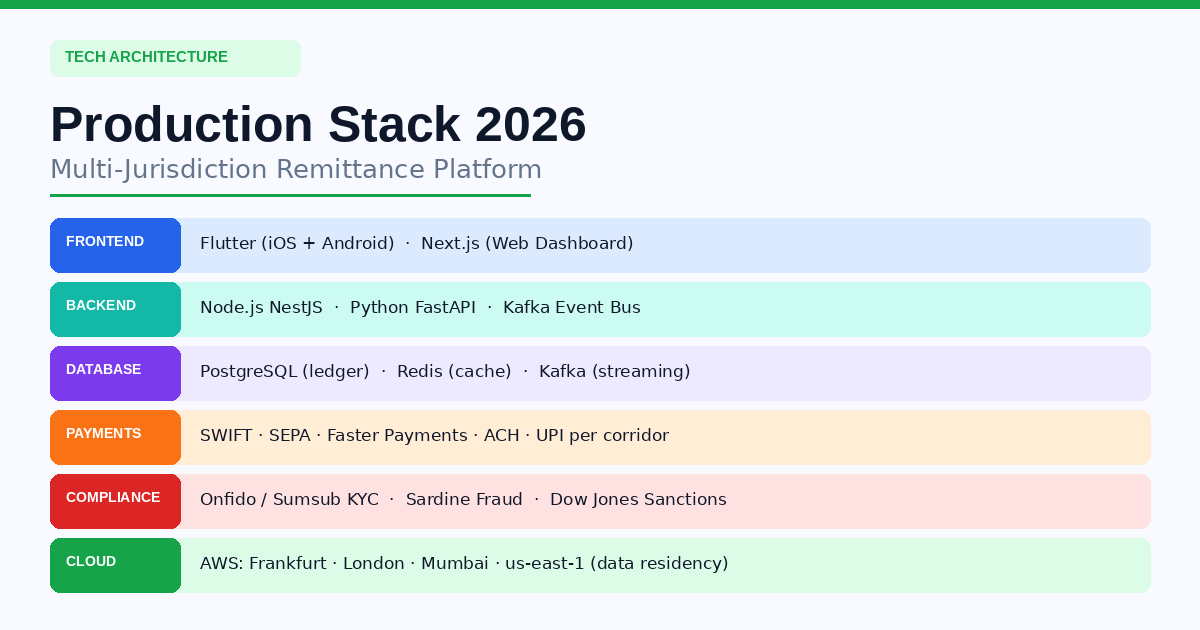
Frontend: Flutter (mobile) + Next.js (web)
Flutter for the sender-facing mobile app – iOS and Android from one codebase. The transfer initiation flow requires precise form handling (recipient account validation, amount entry, rate display), real-time FX quote updates, and a confirmation screen that shows the fully-loaded disclosure required by FCA/CFPB. All achievable in Flutter with proper state management.
Next.js for the operations and compliance web dashboard transfer monitoring, exception queue management, compliance reporting, payout partner management.
Backend: Node.js NestJS + Python
Node.js NestJS for the core transfer orchestration service, the payment rail integrations, and the recipient management API. Event-driven architecture with Kafka as the event bus every transfer state transition is a published event, consumed by the ledger service, the notification service, the compliance service, and the analytics pipeline independently.
Python for the fraud detection ML pipeline and the FX analytics layer. ML models served via FastAPI. Retraining pipeline on a weekly cadence with automated champion-challenger testing.
Database: PostgreSQL + Redis + Kafka
PostgreSQL for the transfer ledger, the compliance records, and the treasury position data. Append-only event log for the transfer state machine — every state transition is an immutable record.
Redis for rate caching (FX quotes are expensive to compute, cache for the quote lock window), session management, and velocity check counters for fraud detection.
Kafka for inter-service event streaming and for the real-time position tracking pipeline.
Payment Integrations: Rail-specific per corridor
FX Rate Engine: Open Exchange Rates + spread management layer
Real-time rate feed with configurable spread rules per corridor, rate lock mechanism, re-quoting logic on expiry, and disclosure generation compliant with CFPB and FCA requirements.
Compliance: Jurisdiction-aware rules engine + Onfido/Sumsub for KYC + Sardine/SEON for fraud + Dow Jones for sanctions
The compliance layer is the most critical infrastructure investment in a money transfer app. The rule sets are data, not code. Regulatory updates are configuration changes, not deployments.
Cloud: Multi-region AWS (jurisdiction-specific data residency)
EU customers: AWS Frankfurt (GDPR compliance) UK customers: AWS London India customers: AWS Mumbai (RBI data localisation) US customers: AWS us-east-1
Each customer’s data lives in the AWS region corresponding to their regulatory jurisdiction. Cross-region data transfers only for necessary operational purposes, logged for compliance audit.
The brief was deceptively simple: build a remittance platform that lets people in the UK, EU, US, Canada, and Australia send money to recipients in India, Philippines, and Gulf countries.
Simple to describe. Five regulatory regimes to engineer for simultaneously.
The discovery phase revealed the core architectural tension: the compliance requirements of each sender jurisdiction were different in ways that couldn’t be resolved by a single configurable field. UK FCA enhanced due diligence requirements have different documentation standards than US FinCEN requirements. EU GDPR data residency requirements are fundamentally incompatible with running all customer data in a single region.
The answer was the jurisdiction context object a data structure attached to every session and every transfer that carries the regulatory context: sender country, recipient country, applicable sanctions lists, required disclosures, applicable KYC tier, reporting thresholds. Every service in the platform reads the jurisdiction context and applies the correct logic.
The payment rail decisions were made corridor by corridor, not as a blanket choice. UK to India: Faster Payments out, IMPS/UPI in fastest, cheapest, most reliable path. EU to Philippines: SEPA out, local bank network in via a Manila-based payout partner. US to Gulf: ACH out, exchange house network in the preferred payout mechanism in the corridor.
The CTO’s contribution to this build was specifically in the treasury architecture. Seventeen years building financial systems at Wishfin where reconciliation across multiple bank partners was a daily operational challenge meant the treasury management design was built from operational experience, not theoretical finance. Pre-funded accounts in each destination country. Real-time position tracking across all open corridors. Automated reconciliation against bank statements in each market.
CMMI Level 5 in this context meant that every compliance rule was documented, every exception handling path was tested against defined scenarios, and every regulatory report format was validated against the actual reporting requirement before a single live transfer was processed.
The platform is live. It processes real cross-border transfers across five jurisdictions. The architecture has never required a full rebuild because the jurisdiction-aware compliance layer was designed to absorb regulatory change as configuration updates, not engineering rework.
The team can scope your money transfer architecture and have a proposal in your inbox within a week. For a multi-jurisdiction build especially, the architecture decision is everything. mayank@engineerbabu.com.
Four failure modes. Specific. Named. From pattern recognition across multiple remittance and money transfer builds.
What it looks like: The app quotes the customer a recipient amount based on the mid-market rate plus your spread. The recipient receives less than quoted because a correspondent bank deducted fees in transit. The customer complains. CFPB receives a complaint. The platform is issued a remediation requirement.
Why it happens: The platform modelled its own fees but not the corridor’s full cost structure, including correspondent banking charges.
The cost: CFPB complaint → remediation requirements → potential FCA or FinCEN scrutiny → reputational damage with early users.
The fix: Per-corridor cost modelling including correspondent banking fees. CFPB-compliant pre-payment disclosure showing the exact recipient amount before transfer initiation. This is a contractual and compliance requirement, not an optional UX improvement.
What it looks like: The platform builds one KYC flow, one AML monitoring rule set, one data storage region, and applies it globally. Works for one jurisdiction. Fails the FCA audit because UK customer data is stored in Mumbai. Fails the EU GDPR check because French user data leaves the EU.
Why it happens: Multi-jurisdiction compliance is treated as “we’ll handle each jurisdiction when we get there.” The architecture is built for one.
The cost: Full data migration to correct regions. Compliance remediation across all affected customer records. 3–6 months of engineering on compliance debt instead of product.
The fix: Jurisdiction-aware data residency from day one. Multi-region cloud architecture in the initial deployment. One-time cost to build correctly vs ongoing cost to fix.
What it looks like: The platform routes every transfer through SWIFT because it was the easiest integration to build. Transfer fees average $15–25 per transaction. SEPA and Faster Payments would cost $0.50–2.00 for the same corridors. The unit economics never work.
Why it happens: Developers build the integration that’s most technically familiar, not the rail that’s most economically appropriate for each corridor.
The cost: Permanently uncompetitive cost structure for corridors where local rail alternatives exist.
The fix: Rail selection is a routing decision, not a hardcoded default. Build the routing engine to select optimally per corridor from day one, even if only one rail is integrated initially. Adding a second rail is a configuration change, not an architecture change.
What it looks like: The platform processes $1M in transfers in month 6. FX rates move 2% against the platform’s open positions during the settlement cycle. Unexpected $20,000 FX loss. No treasury monitoring system in place. Finance team finds out in the monthly bank reconciliation.
Why it happens: Treasury management is treated as a finance team problem, not an engineering requirement.
The cost: Unexpected losses. No early warning system. No hedging in place because the exposure wasn’t visible.
The fix: Real-time treasury position tracking built into the application architecture. Every transfer contributes to a position ledger. Position dashboard is live from day one. Hedging decisions are made on real data, not month-old reconciliations.
Three paths. Here’s the honest decision tree.
White-label remittance platform (RemitSo, Eastnets, etc.): You want to launch a branded money transfer product quickly. Your competitive advantage is distribution a diaspora community, an employer network, a specific corridor not product innovation. White-label gets you to market in weeks. It limits your ability to differentiate on features, economics, or compliance approach as you scale.
Payment orchestration (Currencycloud, Nium, Thunes, Wise Platform): You want to add money transfer capability to an existing product a neobank, an e-commerce platform, a payroll tool. Payment orchestration APIs handle the payment rails, the FX engine, and much of the compliance. You build the UX and the product logic on top. Fast to launch, limited control over economics and routing.
Custom build: Your competitive advantage is in the product itself the UX, the specific corridor economics, the compliance architecture for a regulated market segment, the treasury management for high-volume operations. Custom build is the right answer when you need control over the components that determine your differentiation.
The team’s honest assessment: most remittance startups should start with payment orchestration to validate the corridor economics, then migrate to a custom build when they have the volume and margin data to justify the investment. Building custom from day one is the right answer for well-funded platforms with a specific technical differentiation or a regulated market requirement that orchestration providers can’t satisfy.
Money transfer app development starts from $15K for a domestic P2P transfer MVP one currency, one payment rail, KYC, transfer initiation, basic compliance.
Multi-jurisdiction remittance platforms multiple corridors, FX engine, multi-rail routing, jurisdiction-aware compliance, treasury management are scoped after understanding the specific corridors, regulatory markets, and volume expectations. Exact numbers after that conversation.
Timeline: Domestic P2P MVP in 10–14 weeks. Multi-jurisdiction remittance platforms in 7–12 months, depending on the number of corridors and regulatory regimes. The integration timeline for payment rail partners and payout networks each taking 4–8 weeks drives the critical path.
For context: the same scope from a US or UK development team costs 40–60% more. CMMI Level 5 process quality. Google AI Accelerator 2026 ML capabilities for fraud detection. Full IP ownership.
One important note: the payment rail integration costs, payout partner fees, compliance vendor costs (KYC, sanctions screening), and AWS multi-region infrastructure are operational costs separate from development. These need to be modelled in your financial plan from day one.
Mayank leads personally on every engagement.
The team has built a multi-continent remittance platform operating across 5 regulatory jurisdictions. Not a case study. A live platform. That experience corridor mapping, jurisdiction-aware compliance, treasury architecture, multi-rail routing is directly applicable to your build.
The CTO’s 17 years at Wishfin built expertise specifically in financial infrastructure reconciliation and multi-bank integration. The treasury management architecture for the 5-jurisdiction platform came directly from that operational experience.
Google AI Accelerator 2024. ML-powered fraud detection built for production trained on real transaction patterns, monitored for drift, updated on emerging attack vectors specific to money transfer fraud.
CMMI Level 5. Every compliance process documented, independently audited, reproducible. Relevant when your FCA or FinCEN audit arrives.
4 unicorn clients. 75 YC-selected product builds. 200+ VC-funded products. Full IP ownership. No vendor lock-in.
A fintech founder came to the team with a multi-corridor remittance concept and a regulatory problem: five jurisdictions, five compliance regimes, one product. The architecture the team built jurisdiction-aware compliance layer, multi-rail routing engine, multi-region data residency has processed real cross-border transfers across all five markets without a full rebuild.
Every week a money transfer platform stays in planning is a week the corridor economics are being captured by competitors who moved faster.
The global remittance market is $879 billion. The digital share is growing at 15.6% annually. The corridors where legacy operators still charge 6–7% are the opportunity. But the window is engineering-constrained, not market-constrained. Build the architecture correctly and you own a corridor. Build it wrong and you spend 12 months remediating.
30 minutes. Honest assessment of your corridor strategy, your regulatory path, and what the architecture actually requires.
Mayank Pratap Co-founder, EngineerBabu mayank@engineerbabu.com | engineerbabu.com
Google AI Accelerator 2024 · CMMI Level 5 · 4 Unicorn Clients · 75 YC Selections · 200+ VC-funded Products · Backed by Vijay Shekhar Sharma · LinkedIn Top Startup India (Twice) · NASSCOM Member
What is money transfer app development?
Money transfer app development is the process of designing and building a digital platform that enables individuals or businesses to send funds electronically domestically or internationally through mobile or web interfaces. It encompasses the payment rail integrations, FX engine, KYC and AML compliance systems, fraud detection, and multi-jurisdiction regulatory architecture required to move real money reliably and compliantly across borders.
How long does it take to build a money transfer app?
A domestic P2P transfer MVP takes 10–14 weeks. Multi-jurisdiction remittance platforms with FX engine, multi-rail routing, and compliance architecture for multiple regulatory regimes take 7–12 months. The critical path is typically the payment rail and payout network integrations, each of which has a 4–8 week third-party approval and testing timeline. These need to be initiated in week 1 of the project.
How much does money transfer app development cost in 2026?
Domestic P2P transfer apps start from $15K for a production MVP. Multi-jurisdiction remittance platforms are scoped based on the number of corridors, regulatory regimes, and integration requirements. Exact numbers after a scoping conversation. US/UK equivalent quality costs 40–60% more.
What licences do I need to build a money transfer app?
In the US: FinCEN MSB registration (federal) plus Money Transmitter Licenses in each operating state (potentially 50 separate licences). UK: FCA Payment Institution or EMI authorisation (6–12 months). EU: EMI licence under PSD2, with Lithuania or Ireland offering fastest path to EU passport. India: operations through RBI-authorised bank partnerships for most use cases. Most early-stage platforms partner with licensed payment facilitators rather than obtaining direct licences.
What is a payment rail and which ones matter for money transfer apps?
A payment rail is the infrastructure network that moves money between accounts. The major rails: SWIFT (global, 3–5 days, expensive), SEPA (EUR across 36 countries, instant or 1-day, very cheap), Faster Payments (GBP in UK, seconds, 24/7), ACH (USD in US, 1–3 days, low cost), UPI (INR in India, instant, free). The right rail depends on the corridor. Smart routing engines select the optimal rail per transfer based on cost, speed, and recipient payout method.
What is an FX engine in a money transfer app?
The FX engine is the system that handles currency conversion sourcing real-time mid-market rates, applying the platform’s spread to generate the customer rate, locking rates for the duration of transfer confirmation, handling rate expiry and re-quoting, and generating the disclosures required by regulatory bodies (CFPB in the US, FCA in the UK). The FX engine must also model the full corridor cost including correspondent banking fees not just the platform’s own spread for compliant pre-payment disclosure.
What is the most important technical decision in building a money transfer app?
The compliance architecture. A single-jurisdiction compliance module applied globally will fail regulatory review in every additional market. The correct architecture is a jurisdiction-aware compliance layer a configurable rule set per jurisdiction that applies different KYC tiers, different AML thresholds, different data residency rules, and different sanctions screening requirements based on the sender and recipient countries. This must be designed before any payment processing is built.
How does fraud work differently in money transfer apps?
Money transfer fraud is more serious than most payment fraud because cross-border transfers are often irreversible once settled. The key attack vectors are: account takeover (attacker initiates transfer before user notices), APP fraud (user manipulated into authorising a fraudulent transfer), velocity fraud (rapid small transfers across multiple compromised accounts), and mule networks (organised fraud using layered account networks). Effective detection requires ML-based behavioural analysis and cross-account pattern detection, not just static per-transaction rules.
What is treasury management in a money transfer platform?
Treasury management is the operational process of managing the FX exposure that arises when a platform holds funds in one currency and pays out in another. As volume grows, the gap between the quoted FX rate and the actual payout rate creates an open position. Without real-time position tracking and hedging for volatile corridors, unexpected FX movements become unexpected losses. Treasury management infrastructure real-time position ledgers, exposure dashboards, reconciliation against bank statements needs to be built into the application architecture, not managed via spreadsheets.
Can I build a money transfer app without building the compliance from scratch?
Yes payment orchestration providers like Currencycloud, Nium, and Wise Platform handle the payment rails, FX engine, and much of the compliance infrastructure via APIs. This is the fastest path to a working money transfer product and the right choice for adding remittance functionality to an existing product. For platforms where compliance architecture and corridor economics are the competitive differentiation, a custom build gives control that orchestration providers can’t match. Most successful remittance startups begin with orchestration and migrate to custom when volume justifies it.