A developer in Pune managing 3 simultaneous projects, 850 units total, ₹320 crore in bookings was running their entire operation on three things: an Excel master sheet, a WhatsApp group for the channel partner network, and a tally accountant who came in every Tuesday.
In 2026, this is not unusual. According to industry data, 70%+ of Indian real estate projects exceed their budgets. Studies show that a significant portion of Indian developers, particularly mid-tier builders with 3–10 active projects, still rely on manual or semi-digital processes.
The Indian real estate technology problem is not that builders don’t want software. It is that the software available to them falls into two categories: generic CRMs that don’t understand construction-linked payment plans, and imported ERPs (SAP, Oracle) that cost ₹1–2 crore to implement and require 18 months of consultancy.
What Indian real estate developers actually need is software built specifically for how Indian real estate works:
- Construction-linked payment demands (not flat EMIs, milestone-linked demands)
- Channel partner (CP) commission management for a network of 200+ brokers
- RERA quarterly compliance reporting
- GST on construction services (GST at 5% on under-construction properties, 18% on commercial)
- WhatsApp-first customer communication (India’s default channel)
- Site visit tracking and lead-to-booking funnel management
I co-founded EngineerBabu 14 years ago. The team has built real estate technology platforms for Indian developers. 500+ products across 20+ countries.
Email mayank@engineerbabu.com for your real estate software conversation.
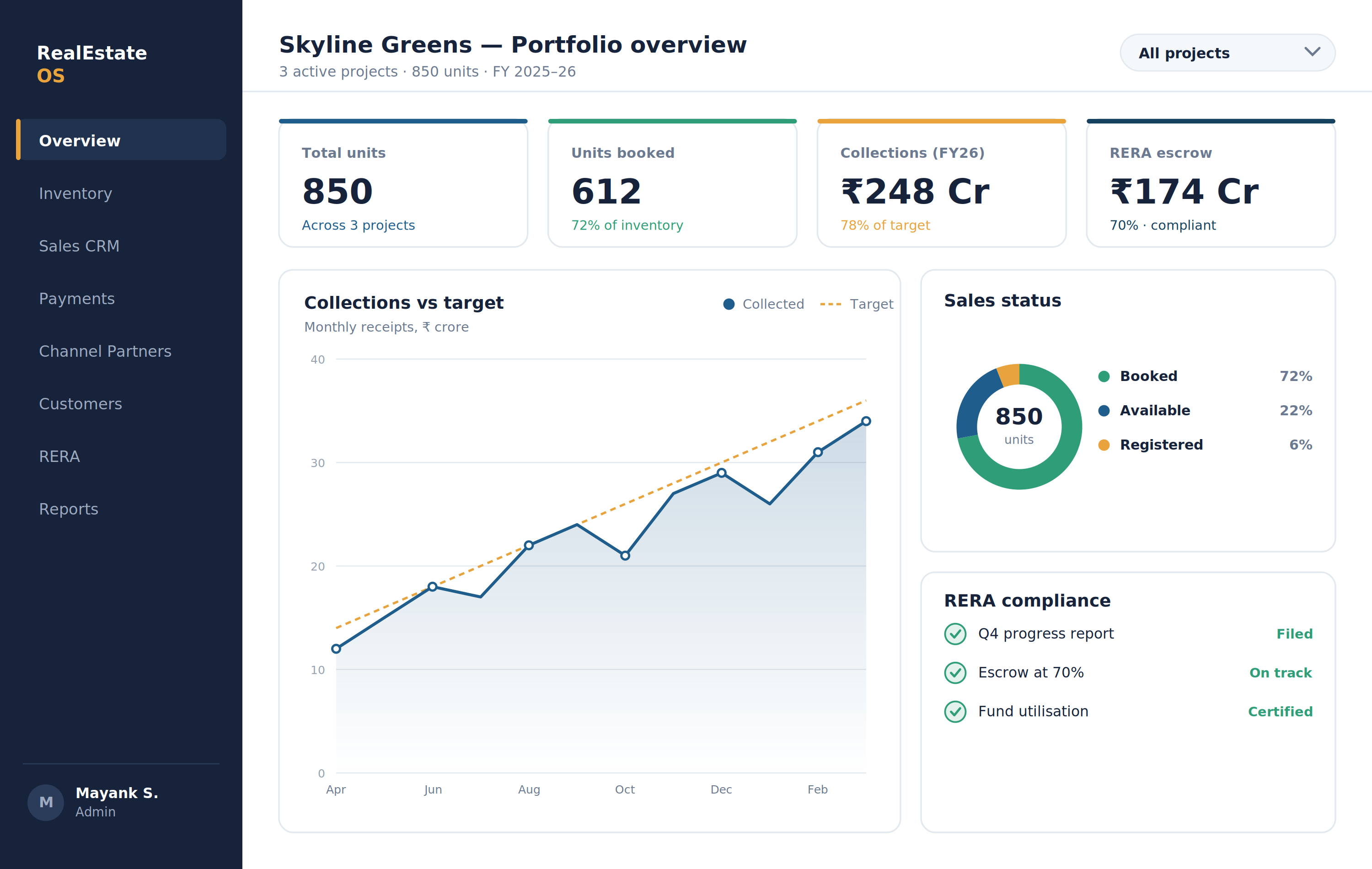
The India Real Estate Technology Landscape in 2026
India’s real estate market in 2026 is at a structural inflection:
- RERA mandatory for all projects above 500 sq. metres or 8 units, every registered developer must file quarterly progress reports, maintain 70% of buyer funds in a separate escrow account, and disclose fund utilisation. Developers without integrated software cannot generate these reports without manual compilation that takes 3–5 days per quarter.
- Digital-first buyer expectations, post-COVID buyers expect to complete the entire purchase journey, virtual tour, unit selection, booking, document signing, payment, digitally. Developers without a customer portal are losing sales to competitors who have one.
- Channel partner ecosystem, India’s real estate is distributed through a network of 50,000+ independent brokers (Channel Partners or CPs). A major developer’s project may be listed with 300–500 CPs simultaneously. Commission management, lead attribution (which CP sourced which buyer), and payment processing for this network are manual nightmares without dedicated software.
- GST complexity, real estate-specific GST treatment: 5% for residential under-construction (without ITC), 18% for commercial, TDS at 1% on property purchases above ₹50 lakh, stamp duty varying by state. Generic accounting software does not handle these combinations correctly.
The Indian real estate software market is expected to exceed $910 million by 2035, growing at 10%+ CAGR.
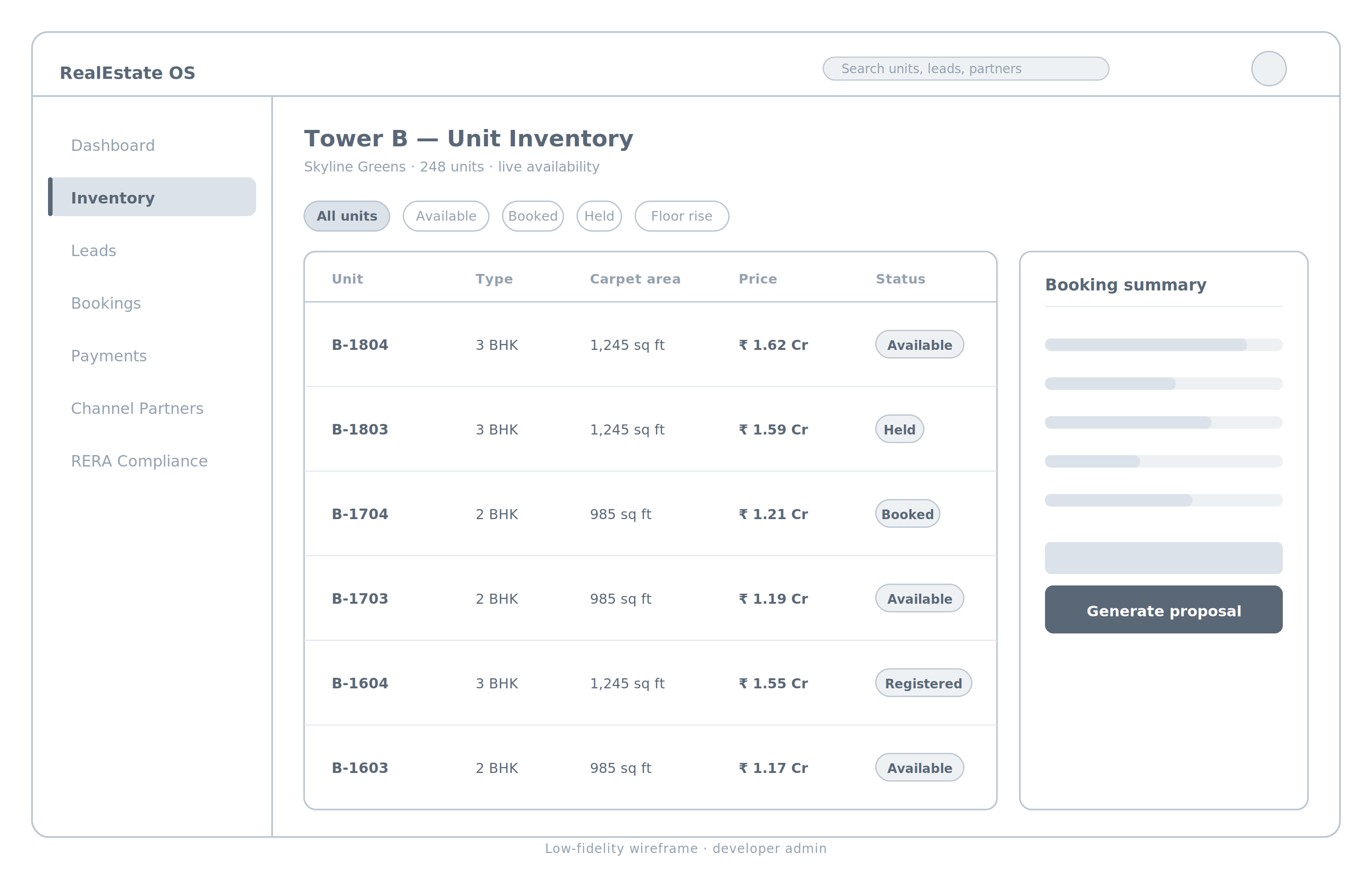
The 6 Core Modules of a Real Estate Software Platform
1. Project and Inventory Management
The foundation of any real estate software is unit inventory, the master list of every unit, plot, or commercial space in every project.
- Unit master: floor, tower, unit number, type (1BHK/2BHK/3BHK), area (carpet, built-up, super built-up), base price per sq. ft., current status (available, booked, registered, blocked for internal).
- Dynamic pricing: price per sq. ft. varies by floor (floor rise), facing (park/road/north/east), corner premium, and negotiated discount. The pricing matrix must be configurable per project without developer involvement.
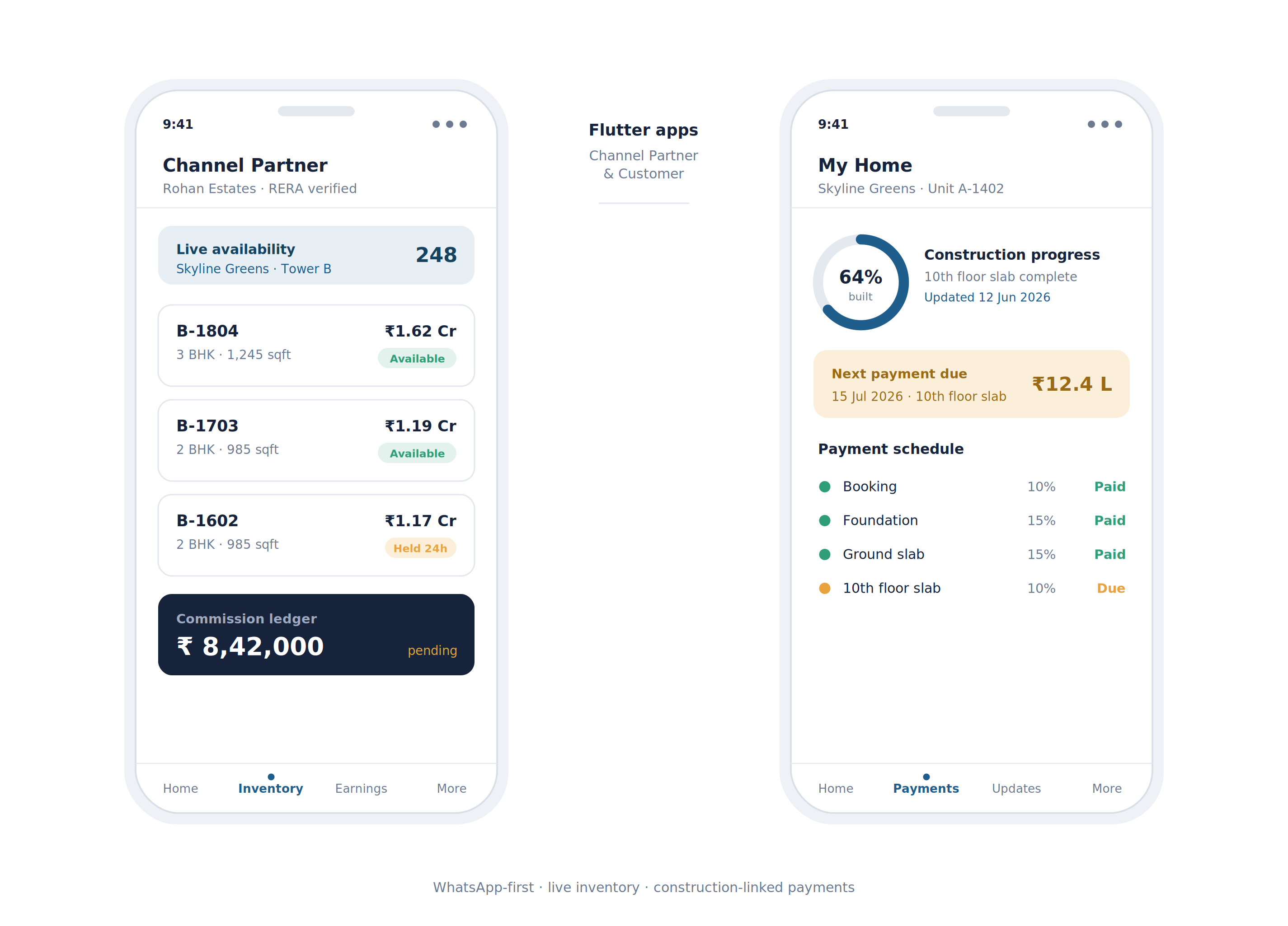
- Availability dashboard: real-time view of available units with instant status update on booking. When a CP logs in from Hyderabad to check availability on a Pune project, they see the live inventory without calling the sales team.
- Holding and blocking: a unit can be “held” for a prospect for a defined period (typically 24–48 hours) while the CP arranges documentation. Holds expire automatically if not converted to booking. A hold occupying a unit that could have been booked by another CP is a real cost, the system must enforce expiry.
2. Sales CRM with Site Visit Management
Real estate sales cycles are long, 3 to 18 months from first inquiry to registration. The CRM must manage the full journey:
- Multi-source lead capture: 99acres, MagicBricks, Housing.com, NoBroker, Facebook Lead Ads, the developer’s own website, and walk-in inquiry, all feeding one unified lead database with source attribution.
- Site visit scheduling and tracking: the critical moment in a real estate sale is the site visit. CRM tracks visit scheduled, confirmed, completed, and cancelled. Post-visit follow-up workflow triggered automatically. Field agent GPS check-in at site time-stamps the actual visit occurrence.
- Proposal generation: after site visit, the sales rep generates a proposal with unit-specific pricing, floor plan, payment plan options, and project details, automatically from the CRM, not manually assembled from multiple Excel files and PDFs.
- Negotiation tracking: offer made, counter-offer from customer, discount approved (with approval workflow, discounts above X% require sales manager approval), final price agreed.
- Conversion to booking: when deal is agreed, CRM triggers the booking workflow, payment link generation, token amount collection, booking form generation.
3. Construction-Linked Payment Plan Management
This is the module that generic CRMs universally get wrong. Indian real estate uses construction-linked payment plans where each payment demand is triggered by reaching a construction milestone:
- 10% on booking
- 15% on commencement of construction
- 15% on completion of foundation
- 15% on completion of ground floor slab
- 10% on completion of 5th floor slab
- 10% on completion of 10th floor slab
- 10% on completion of terrace slab
- 10% on possession
- 5% on registration
The platform must:
- Maintain the payment schedule per unit: Each buyer’s payment schedule is their specific booking price × the percentage at each milestone.
- Generate demand letters automatically: On milestone completion, when the site team marks “foundation complete” in the system, the platform automatically calculates the demand amount for every buyer linked to this project and generates a demand letter (PDF, formatted, legally compliant) sent via email and WhatsApp.
- Track collections: Which buyers have paid, which are delayed, what’s the outstanding amount per milestone per project. Automated follow-up messages for delayed collections.
- RERA escrow compliance: 70% of all customer receipts must be deposited in a RERA-designated escrow account. The platform must track every collection, calculate the 70% to be escrowed, and generate the monthly escrow statement.
4. Channel Partner (CP) Management
India’s channel partner ecosystem is where most real estate sales happen and where most real estate software completely fails developers.
- CP onboarding: GST registration, RERA broker registration (mandatory from 2023 for all real estate agents), Aadhaar KYC, bank details for commission payment. Digital onboarding with document upload and verification.
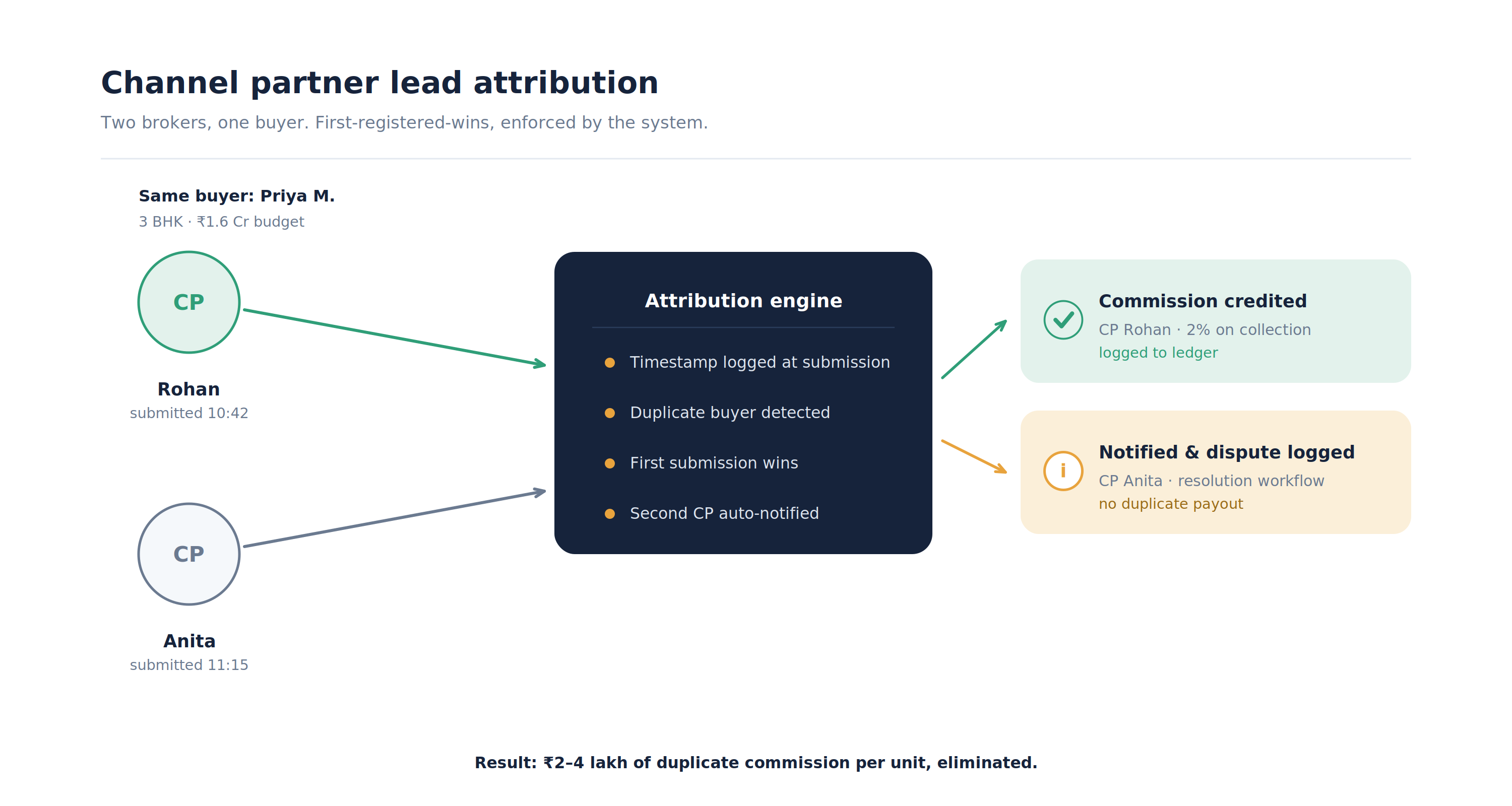
- Lead attribution: when two CPs submit the same buyer’s details (common when aggressive CPs overlap), the system applies first-registered-wins attribution and notifies the second CP. Dispute resolution workflow.
- CP commission structure: different commission rates for different project phases (pre-launch vs. possession), different rates for different unit types, spot incentives for volume. All configurable per project.
- Commission calculation on collection: commission typically calculated on actual collection (not booking value), when buyer pays a milestone demand, the CP’s commission on that payment is calculated and added to the CP’s commission ledger.
- CP portal: each CP gets their own login, live inventory, their bookings, their commission ledger (pending, confirmed, paid), project brochures, and floor plans. No more WhatsApp groups for sending brochures.
- GST on commission: CP commission is subject to 18% GST if the CP is GST-registered. The platform generates the commission TDS certificate and assists with GST-compliant commission invoicing.
5. Customer Portal
Post-booking, the buyer wants visibility:
- My unit: floor plan, technical specifications, change requests (for under-construction properties where buyers can select finishes).
- Payment schedule: upcoming demand dates, amounts due, payment history, receipts downloadable.
- Construction progress: monthly photo updates from site, milestone completion confirmations. The customer sees the same milestone their payment demand was linked to, confirmed as complete.
- Documents: allotment letter, agreement for sale (draft and executed), possession letter, registration documents. All in one place, downloadable.
- WhatsApp integration: all notifications, demand letters, payment confirmations, construction updates, possession notice sent via WhatsApp in addition to email. India’s default communication channel for 700M+ users.
6. RERA Compliance Module
RERA (Real Estate Regulatory Authority) compliance is non-optional for any project above 8 units or 500 sq. metres.
- Project registration data: RERA number, registration date, expiry, registered area, registered number of units. All visible on the developer’s public RERA portal listing.
- Quarterly progress report: RERA requires quarterly reports covering construction progress (% completion), sales status (units booked, registered, balance), and financial status (collections, escrow balance, project expenditure). The platform generates these reports directly from live project data, eliminating the 3-day manual compilation exercise per quarter.
- Fund utilisation certificate: RERA requires annual certification that funds collected from buyers have been utilised for the specific project. The platform maintains the collections-to-expenditure linkage at the project level.
- Complaint management: RERA mandates a grievance mechanism. The platform includes a buyer complaint system with defined response timelines and tracking.
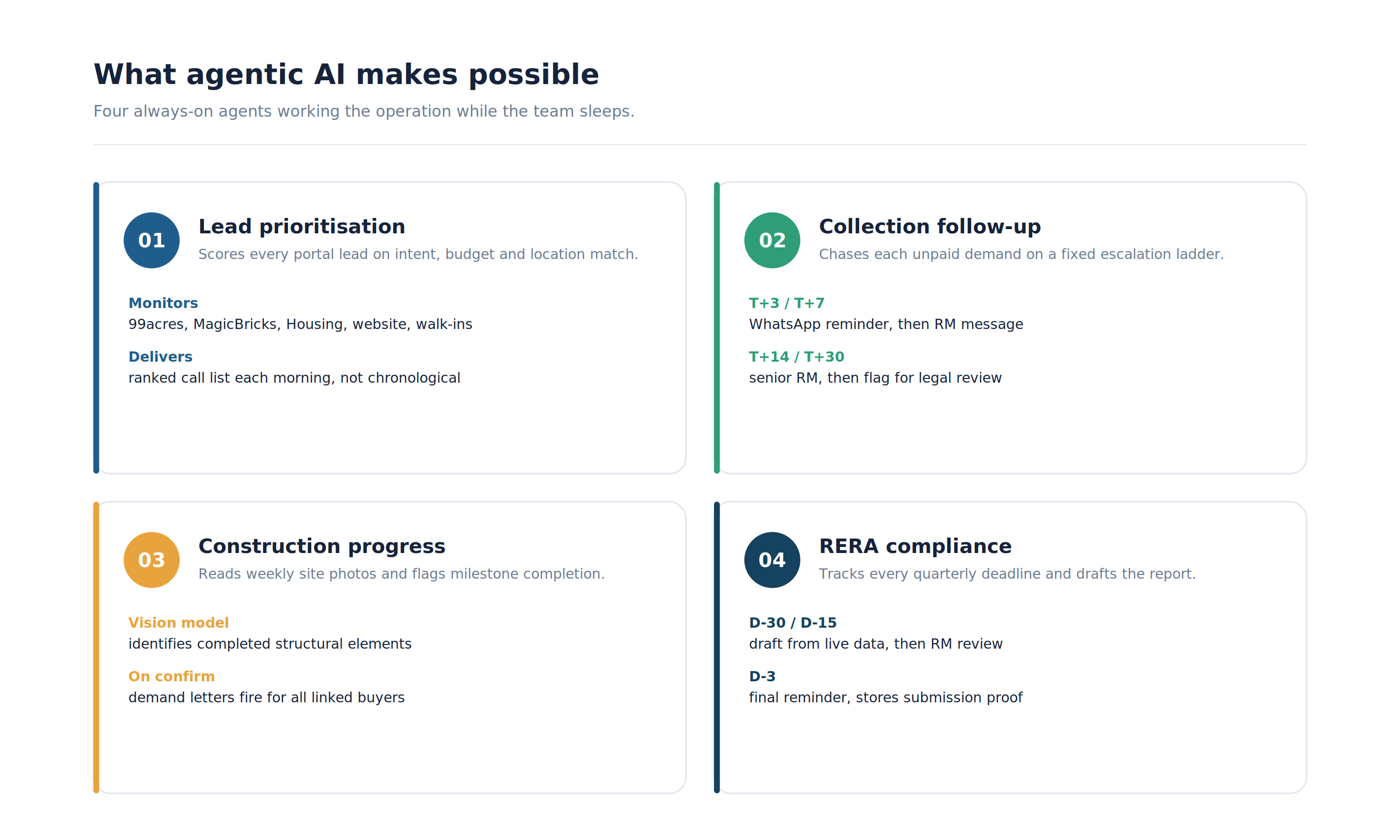
What Agentic AI Makes Possible in Real Estate
-
Agent 1 – Lead Prioritisation Agent:
Monitors all incoming leads across portals. Scores each lead on recency, inquiry specificity (1BHK enquiry for a 1BHK-heavy inventory = high intent), budget match (stated budget vs. available unit price), location preference match, and engagement depth. Prioritised lead list delivered to sales team every morning not chronological, prioritised by conversion probability.
-
Agent 2 – Collection Follow-Up Agent:
When a payment demand is raised, monitors payment status. At T+3 days unpaid: WhatsApp reminder with payment link. At T+7: personalised message from RM. At T+14: escalation to senior RM. At T+30: flags as collection risk for legal team review. Every action logged. Zero manual tracking.
-
Agent 3 – Construction Progress Agent:
Site engineer uploads weekly progress photos to the platform. AI vision model analyses photo content, identifies completed construction elements, and flags milestone completion for RM verification. When milestone confirmed: payment demand letters generated automatically for all buyers. Zero manual milestone-to-demand mapping.
-
Agent 4 – RERA Compliance Agent:
Monitors upcoming RERA quarterly report deadlines. 30 days before deadline: generates draft report from live data. 15 days before: sends for RM review. 3 days before: sends final reminder. Post-submission: stores submission confirmation.
Technology Stack
- Flutter (CP mobile app + customer mobile app) + Next.js (developer admin, inventory management, CRM, reporting, RERA compliance dashboard).
- Node.js NestJS (business logic, payment plan engine, RERA report generation, document generation) + Python FastAPI (AI lead scoring, construction photo analysis, demand forecasting).
- PostgreSQL (unit master, transaction ledger, payment schedule) + Redis (live inventory cache, session management).
- Integrations: PayU/Razorpay (collection payment links) · WhatsApp Business API (WATI) · 99acres/MagicBricks/Housing.com lead APIs · Aadhaar eKYC (CP onboarding) · DigiLocker (document verification) · GST e-invoice API (commission billing) · Tally API (accounting sync).
The Failure Framework
- Failure 1: The Flat EMI System, generic CRM treats all payments as flat monthly EMIs. When a construction milestone demand is raised, the system can’t handle the variable-amount demand. Sales team goes back to Excel. Fix: payment plan engine designed for milestone-based variable demands from day one.
- Failure 2: The CP Attribution Dispute, no first-registered attribution rule. Two CPs claim commission on the same sale. Developer pays both. ₹2–4 lakh duplicate commission on a single unit is a real loss. Fix: CP attribution timestamp logged at lead submission. Policy documented in CP agreement and enforced by the system.
- Failure 3: The RERA Escrow Gap, platform tracks collections but doesn’t calculate the 70% RERA escrow requirement. Developer inadvertently uses escrow funds for other purposes. RERA audit finds shortfall. Fix: RERA escrow calculation built as an automated check on every collection receipt.
- Failure 4: The Data Island, CRM, inventory, payment tracking, and RERA reporting are four separate Excel files maintained by four different teams. Data is inconsistent across all four. The RERA quarterly report takes 5 days to compile because data must be reconciled manually. Fix: single source of truth from day one. All modules read from the same database.
Cost and Timeline
Real estate software development starts from $20,000 for a production MVP development, unit inventory, sales CRM with lead management, construction-linked payment plan engine, and customer portal.
Full platform, CP management, RERA compliance module, construction progress tracking, WhatsApp automation, agentic follow-up: $55,000–$130,000 built in India.
Timeline: MVP in 10–14 weeks. Full platform: 5–8 months.
FAQ
-
What is RERA and what does it require from real estate software?
RERA (Real Estate Regulatory Authority) requires all projects above 500 sq. metres or 8 units to be registered, maintain 70% of buyer funds in a dedicated escrow account, and file quarterly progress reports covering construction progress, sales status, and financial utilisation. Software must generate these reports directly from live project data and track escrow compliance automatically.
-
What is a construction-linked payment plan?
A payment schedule where each instalment is linked to a construction milestone rather than a fixed date. When the developer completes the foundation, all buyers receive a demand for the foundation milestone payment. The platform must trigger demand letter generation automatically on milestone completion and track collection separately per milestone per buyer.
-
What is a Channel Partner (CP) in Indian real estate?
An independent real estate broker who sells units on behalf of developers in exchange for a commission (typically 1.5–3% of unit value). A major project may have 300–500 CPs simultaneously. Software must manage CP onboarding, lead attribution (first-registered-wins), commission calculation per collection, and CP portal access to live inventory.
-
How long does it take to build real estate software?
MVP with inventory, CRM, and payment plan engine: 10–14 weeks. Full platform with CP management, RERA compliance, and agentic automation: 5–8 months.