A textile manufacturer in Surat, 340 employees, ₹85 crore annual turnover, showed us their operation in 2024.
They were paying ₹8 lakh per year for SAP Business One. The system had been implemented 4 years earlier at a cost of ₹35 lakh.
Their production planner still sent raw material requirements to suppliers via WhatsApp. Their job work challan, the document required under GST rules when material is sent to an outsourced job worker for dyeing or processing was generated in Tally, not SAP, because SAP couldn’t handle the ITC-04 return format that the GST portal required.
Their PLI (Production Linked Incentive) scheme reporting for the government subsidy programme was done manually in Excel because SAP had no awareness of PLI incentive structures.
Three systems. Significant annual cost. And the production planner was still on WhatsApp.
This is India’s manufacturing technology problem in one picture. SAP and Oracle are built for Western manufacturing models, fixed BOMs, standardised job definitions, batch sizes that follow a predictable pattern.
Indian SME manufacturing is different: job work is fundamental, GST compliance is India-specific and changes frequently, the PLI scheme is India-specific and recent, and the supply chain is a network of small suppliers who communicate via WhatsApp rather than EDI.
I co-founded EngineerBabu 14 years ago. The team built AI inventory intelligence for Simba Beer, India’s No. 1 craft beer brand that reduced stockouts by 40% and wastage by 28%. Adani Group is a client. Google AI Accelerator 2024.
India’s manufacturing sector is on track to reach $1 trillion by 2026, fuelled by PLI schemes and the China+1 supply chain shift. Custom manufacturing software built for India’s specific compliance requirements is the gap in the market.
Email mayank@engineerbabu.com for your manufacturing software development conversation.
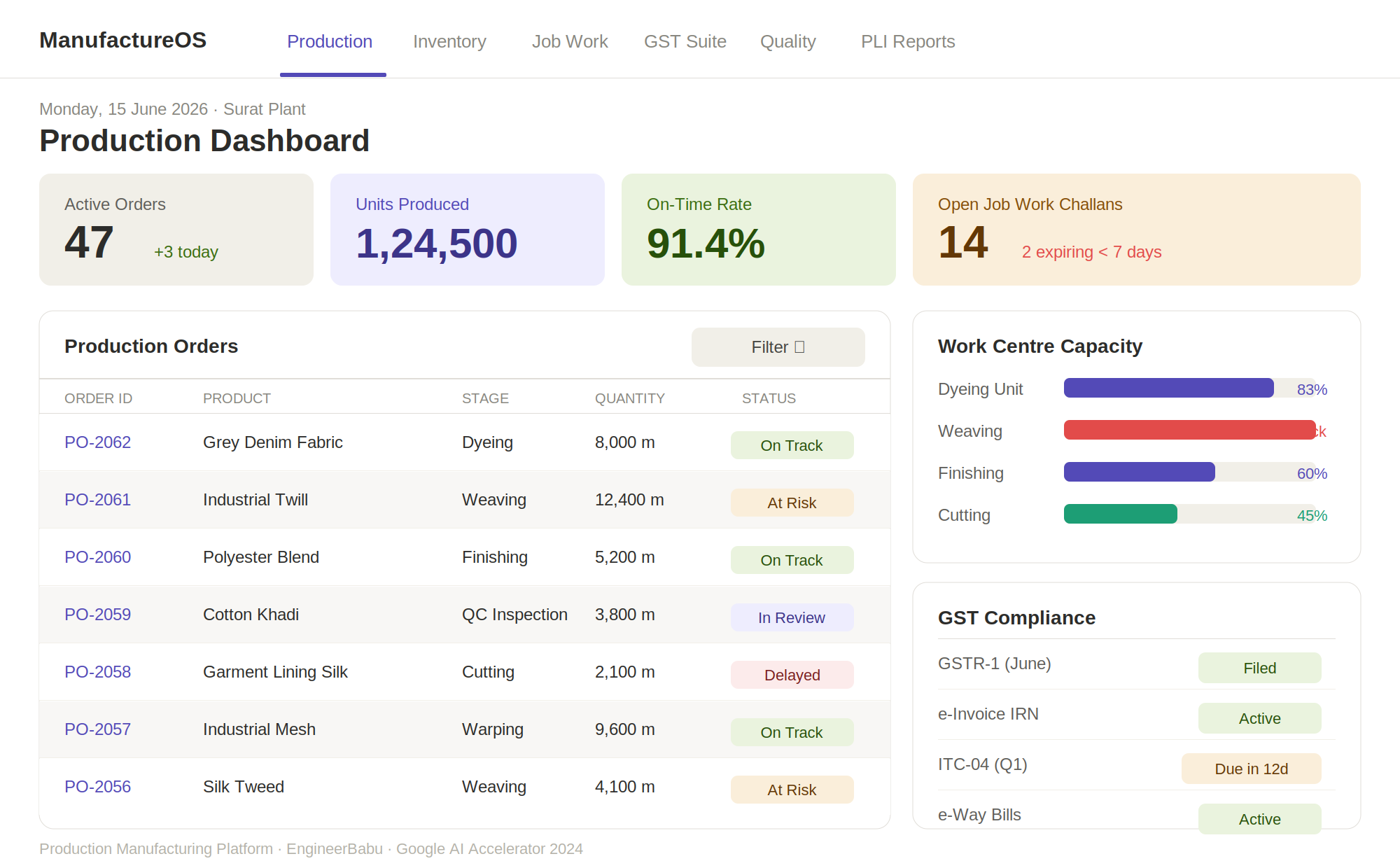
Why Generic ERP Fails Indian Manufacturers
India’s manufacturing compliance requirements are specific, frequent-changing, and poorly served by international ERP platforms:
- GST e-invoicing, from April 2025, mandatory for businesses above ₹5 crore turnover. The ERP must generate IRN (Invoice Reference Number) via the GST portal’s e-invoice API, embed the QR code in the invoice, and maintain the e-invoice record for audit. International ERP platforms require India-specific GST add-ons that are often poorly maintained.
- E-way bill generation, mandatory for movement of goods above ₹50,000. The ERP must generate e-way bills via the GST portal API at the time of despatch. E-way bill generation failures at despatch create production holdups.
- ITC-04 job work returns, when a manufacturer sends material to a job worker (an outsourced processor, dyer, heat treater, electroplater, sub-assembly contractor), they must file Form ITC-04 quarterly with the GST portal detailing all material sent to and received from job workers. Input Tax Credit on the material is at risk if the goods aren’t returned within 1 year. Generic ERPs don’t track job work challans in the format required for ITC-04.
- PLI scheme reporting, the Production Linked Incentive scheme offers manufacturers 4–6% incentive on incremental production above a base year. To claim the incentive, manufacturers must file production data with the nodal ministry portal in a specific format with supporting documentation. No off-the-shelf ERP supports PLI reporting as a standard module.
- Multi-rate GST on manufactured goods, a textile manufacturer producing both garments (5% GST) and industrial fabrics (12% GST) from the same factory must track GST on inputs, manage ITC reversal for exempt products, and file GSTR-1 and GSTR-3B correctly. The GST treatment of job work services (SAC 9988) further complicates this.
The 6 Core Modules of a Production Manufacturing Platform
1. Bill of Materials (BOM) and Production Planning
- BOM management: Every finished product has a BOM, the list of raw materials, semi-finished goods, and components required to produce one unit. For a garment manufacturer: fabric quantity (with cutting waste percentage), threads, zippers, labels, packaging. Multi-level BOMs for assembled products (finished product → sub-assembly → raw material).
- MRP (Material Requirements Planning): Given a production order for X units of product Y, MRP calculates the material quantities required, checks current inventory, and generates purchase requisitions for shortfall quantities. The basic logic is simple; production-grade MRP handles real-world complexity: lead times per supplier, minimum order quantities, safety stock levels, and concurrent production orders competing for the same raw material.
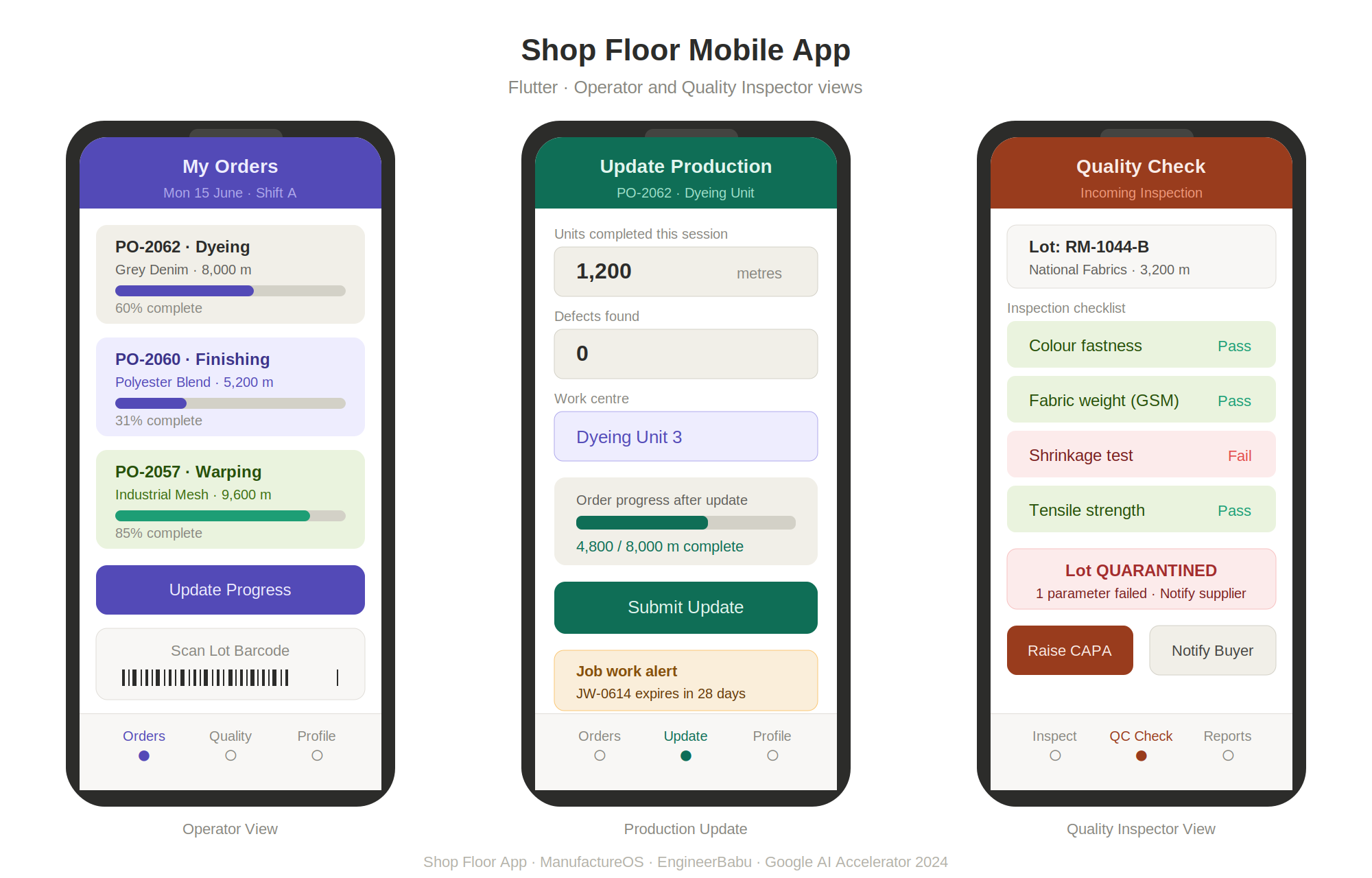
- Production order management: Shop floor tracking of which production order is being executed, which work centre, which operator, at what stage of the process. Shop floor data capture (via mobile app for operators who can’t be expected to use desktop ERP terminals) updates production order status in real time.
- Capacity planning: Which work centre is the bottleneck? If the dyeing unit can process 10,000 metres per day and the weaving unit produces 15,000 metres per day, the dye unit is the constraint. Capacity planning surfaces this and prevents production orders from being scheduled beyond actual capacity.
2. Job Work Management (India-Specific)
Job work, outsourcing a specific manufacturing process to a third-party job worker while the principal manufacturer retains ownership of the material is fundamental to India’s SME manufacturing ecosystem.
A textile manufacturer sends grey fabric to a dyer. The dyer processes it and returns coloured fabric. The principal remains the owner of the fabric throughout; the dyer provides a service. Under GST, this is a job work arrangement with specific compliance requirements.
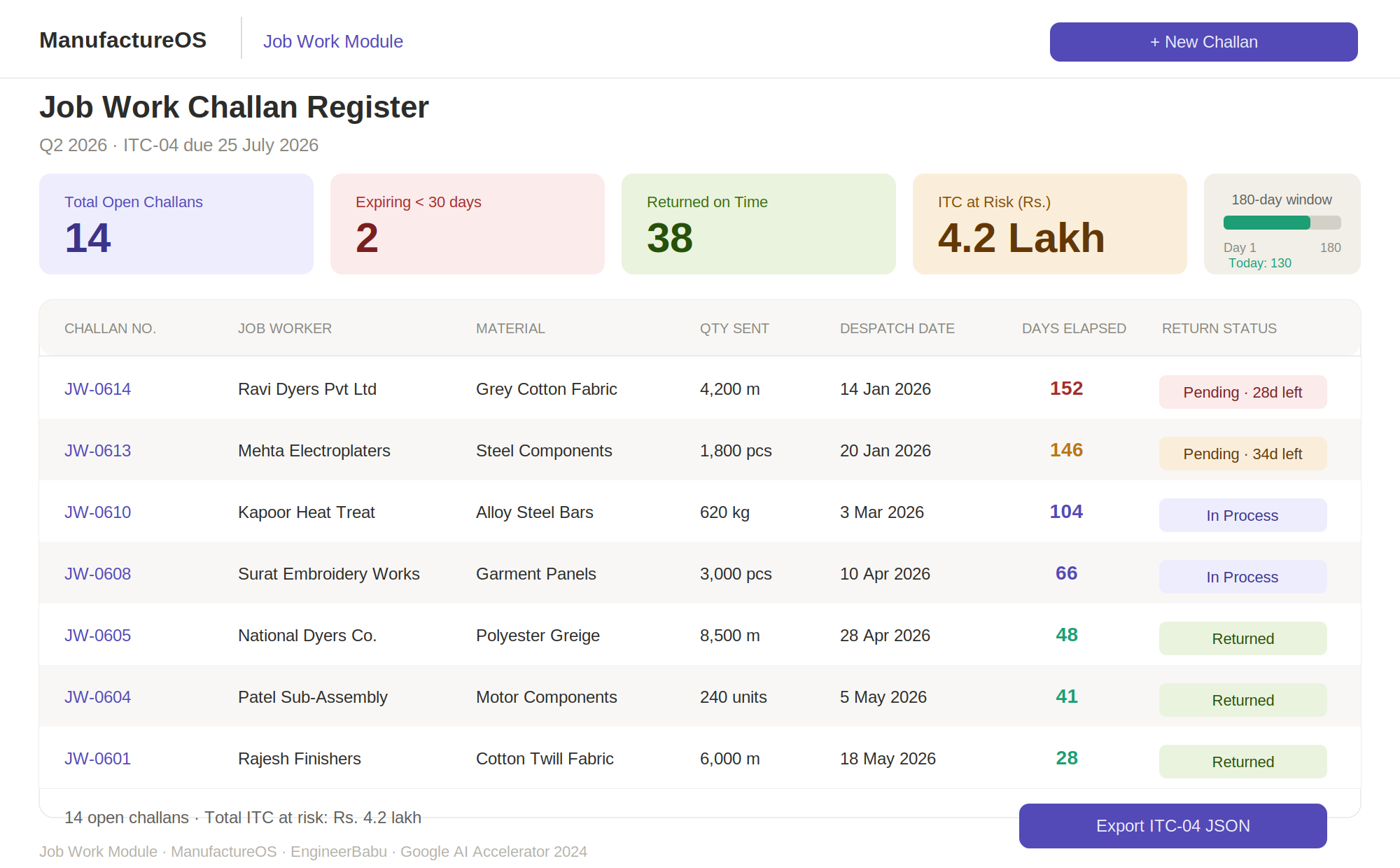
- Job work challan: Material sent to job worker must be accompanied by a GST job work challan (Form ITC-04 challan). The challan records: material description, HSN code, quantity sent, estimated value, job worker details, and date of despatch. The platform generates these challans automatically from the production order.
- Job work return: When processed material returns, the platform matches it against the original challan and records the return. ITC-04 quarterly return is generated from this data.
- 180-day rule for job work: If material is not returned within 180 days of despatch (or 1 year for specific cases), it is deemed a supply and GST becomes payable. The platform monitors all open job work challans and alerts the procurement team 30 days before each challan’s deadline.
- Job worker performance: Delivery timeliness, quality rejection rate, cost per process, tracked per job worker to inform vendor selection decisions.
3. Inventory Management with Lot/Batch Traceability
- Raw material inventory: Quantity by location (multiple godowns), lot-based tracking (each delivery from a supplier is a lot with a specific quality certificate). Minimum stock alert. Expiry tracking for perishable inputs.
- Work-in-progress (WIP) inventory: Material in production at various stages. WIP valuation for financial reporting requires job cost accumulation at each production stage.
- Finished goods inventory: By SKU, by batch, by location. FIFO (First In, First Out) dispatch logic for compliance and freshness management.
- Batch traceability (forward and backward): Critical for food and pharmaceutical manufacturing. Forward trace: which customers received which batch? Backward trace: which raw material lots went into which batch? Required for recall management and quality investigations.
The Simba Beer application: The inventory intelligence system built for Simba managed finished goods inventory at multiple warehouse locations across 15+ states, with SKU-level demand forecasting that drove production planning. The same platform architecture, multi-location inventory, demand-driven production triggers, SKU-level analytics, applies to any FMCG manufacturer.
4. Quality Management System (QMS)
- Incoming quality inspection: When raw material arrives from a supplier, the QMS triggers an inspection. Pass: material released to production. Fail: material quarantined, supplier notified, replacement requested.
- In-process quality checks: At defined production stages (after dyeing, after cutting, after stitching for garments), quality inspectors record measurements and defect counts. Statistical process control charts surface process drift before it produces defective output.
- Finished goods inspection: Pre-dispatch inspection against customer specification. Certificate of conformance generated for B2B shipments.
- CAPA (Corrective and Preventive Action): When a quality deviation is found, the QMS triggers a CAPA workflow, root cause analysis, corrective action definition, implementation tracking, and effectiveness verification.
Customer returns: when a customer returns defective goods, the system records the defect details, matches against the batch, and triggers a quality investigation.
5. PLI Scheme Reporting Module
The PLI (Production Linked Incentive) scheme is India-specific and directly valuable to manufacturers in textiles, steel, pharmaceuticals, electronics, food processing, and 11 other sectors.
- Base year production tracking: PLI incentives are calculated on production above the base year benchmark. The platform must track production by eligible product categories in the format required for PLI claim filing.
- Incremental production calculation: Current year production vs. base year by eligible SKU category. The incentive amount is calculated at the prescribed percentage of incremental value addition.
- Supporting documentation: GST invoices linked to PLI-eligible production, employee count verification, investment declarations, all maintained in the PLI documentation module for annual claim filing.
- Ministry portal data format: PLI claims are filed on the nodal ministry’s portal in a specific data format. The platform exports in the required format, eliminating manual data compilation.
6. GST Compliance Suite
- GSTR-1 generation: Monthly outward supply return. All B2B invoices (with buyer GST number), B2C invoices (aggregate), export invoices, and credit/debit notes. The platform generates GSTR-1 JSON directly uploadable to the GST portal.
- GSTR-3B generation: Monthly summary return. Output tax liability (by rate), ITC claimed (by category), and net tax payable. Platform auto-populates from transaction data.
- e-Invoice with IRN: For B2B invoices above ₹5 crore threshold, the platform generates IRN via the IRP (Invoice Registration Portal) API and embeds the QR code. E-invoice generation failures block despatch, zero-downtime integration required.
- e-Way bill: Generated at despatch for movement above ₹50,000. Platform integrates with the e-way bill portal API. Driver details, vehicle number, estimated distance, and consignment value auto-populated from the delivery order.
GST reconciliation: GSTR-2A/2B (what suppliers have uploaded) vs. GSTR-3B (what the manufacturer has claimed as ITC). Mismatches flagged for resolution with the supplier before filing.
What Agentic AI Makes Possible in Manufacturing
-
Agent 1 – Production Intelligence Agent
Monitors production order status, WIP inventory levels, and production target vs. actual daily. Generates the morning production manager briefing: which orders are on schedule, which are at risk, which work centres are creating bottlenecks. Surfaces insights the production manager would have taken 2 hours to compile manually, delivered in their inbox before the 8am shift meeting.
-
Agent 2 – Supply Chain Monitoring Agent:
Monitors all open purchase orders, expected delivery date vs. current status. Flags purchase orders at risk of delay (based on supplier performance history) 10 days before the delivery date. Sends supplier follow-up messages automatically. Escalates to procurement manager when supplier doesn’t respond within 48 hours.
-
Agent 3 – GST Compliance Agent:
Monitors monthly GST filing deadlines. 5 days before GSTR-1 due date: generates draft GSTR-1 from transaction data for CA review. 2 days before: sends reminder. After filing: stores acknowledgement. Monitors GSTR-2B match score and flags ITC mismatches above a threshold for supplier follow-up.
-
Agent 4 – Quality Alert Agent:
Monitors incoming quality inspection rejection rates per supplier. When a supplier’s rejection rate exceeds threshold (3 consecutive deliveries above 2% defect rate): generates a supplier performance alert, triggers a corrective action request, and notifies the procurement team to consider alternative suppliers.
Technology Stack for Manufacturing Software Development
- Flutter (shop floor mobile app for operators + quality inspection app + delivery app) + Next.js (production manager dashboard + procurement + QMS + GST compliance portal).
- Node.js NestJS (MRP engine, job work challan management, production order lifecycle, GST compliance suite) + Python FastAPI (AI demand forecasting, production optimisation, supplier risk scoring).
- PostgreSQL (BOM master, production order ledger, inventory lot tracking) + Redis (live production dashboard, inventory availability cache).
- India integrations: GST e-invoice IRP API · e-Way bill portal API · GSTN GSTR-1/3B API · TReDS (Trade Receivables Discounting System) for invoice discounting · MSME Samadhan portal (delayed payment portal) · PLI ministry portal data export.
Manufacturing Software Development : The Failure Framework
- Failure 1: The ITC-04 Blind Spot – Job work challans tracked in a separate register, not integrated with the ERP. When ITC-04 due date arrives, the GST team must manually compile job work data from a separate register. Errors result in incorrect ITC-04 filing, ITC claims at risk. Fix: job work challan module built as a first-class entity in the ERP, linked to both production orders and GST filing workflow.
- Failure 2: The e-Invoice Downtime – E-invoice IRN generation via IRP API goes down during peak billing hours at month-end. Platform has no offline fallback. Despatch delayed. Customers miss delivery windows. Fix: offline buffering for e-invoice generation with queue-based retry when IRP API is available. Alert when outstanding e-invoices exceed threshold.
- Failure 3: The PLI Data Gap – Manufacturer claims PLI incentive annually. Ministry audit asks for production data by eligible product category, cross-referenced with GST invoices. Data is in three different systems and takes 3 months to compile. Fix: PLI data structure designed before production tracking begins. Every production order tagged with PLI eligibility at the time of creation.
- Failure 4: The Batch Untraceable – Finished goods shipped to customers. Customer reports quality defect in a batch received 3 months ago. Manufacturer can’t trace which raw material lots were used in that batch. Investigation takes 3 weeks. Fix: batch/lot traceability built forward and backward from the first production order. Every raw material lot that goes into every batch is recorded at the time of material issue.
Cost and Timeline for Manufacturing Software Development
Manufacturing software development starts from $20,000 for a production MVP, BOM management, production order tracking, basic inventory management with GST e-invoicing.
Full platform, MRP, job work module, QMS, PLI reporting, full GST compliance suite, agentic production intelligence: $60,000–$150,000 built in India.
Timeline: MVP in 10–14 weeks. Full platform: 6–9 months.
Simba Beer AI inventory proof. Adani Group enterprise reference. Google AI Accelerator 2024. CMMI Level 5. 40–60% lower cost than US/UK equivalent.
FAQ
-
What is ITC-04 job work compliance?
Form ITC-04 is a quarterly GST return filed by manufacturers who send material to job workers for processing. It details material sent and received per job worker. If material is not returned within 180 days, ITC on that material is reversed. Manufacturing ERP must track job work challans natively for automatic ITC-04 generation.
-
What is the PLI scheme and how does software help?
Production Linked Incentive offers 4–6% incentive on production above a base year threshold across 13 sectors including textiles, steel, pharmaceuticals, and electronics. Software must track PLI-eligible production by category, calculate incremental value, maintain supporting documentation (GST invoices, employment records), and export data in the ministry portal format for annual claims.
-
Why do Indian manufacturers need custom ERP instead of SAP?
SAP and Oracle are designed for Western manufacturing models. They lack native support for India-specific requirements: ITC-04 job work returns, PLI scheme reporting, e-invoice IRN generation for Indian GST portal, e-way bill integration, and the informal supplier communication patterns (WhatsApp-based) common in Indian SME manufacturing ecosystems.
-
How long does it take to build manufacturing ERP software?
MVP with BOM, production tracking, inventory, and GST compliance: 10–14 weeks. Full platform with MRP, QMS, job work, PLI module: 6–9 months.