A wealth management firm in Mumbai came to us after 14 months of failed development with two previous vendors.
The platform looked clean. Dashboard was beautiful. Portfolio tracking worked for mutual funds. The problem surfaced the moment they tried to onboard their first PMS client.
SEBI’s Portfolio Management Services regulations (updated 2020) require specific reporting: a client-wise statement every month, a disclosure statement on portfolio composition, and a quarterly performance report with absolute and benchmark returns calculated using the TWRR (Time-Weighted Rate of Return) method. Not IRR. Not XIRR. Specifically TWRR under the SEBI (Portfolio Managers) Regulations, 2020.
The platform calculated returns using XIRR. Regulatory non-compliant from day one.
The second issue: the onboarding flow had no support for the ₹50 lakh minimum investment verification required by SEBI, no FATCA/CRS declaration for NRI clients, and no CKYC lookup. Three separate compliance gaps in the client onboarding workflow alone.
I co-founded EngineerBabu 14 years ago. The team has built fintech platforms that have processed over ₹10,000 crore, EarlySalary and multiple financial products for India’s regulated fintech market including Khatabook, Fibe, and TaptapSend.
The CTO spent 17 years at Wishfin, India’s largest credit marketplace, where financial regulatory compliance is not optional. Google AI Accelerator 2024, top 20 globally reflects the team’s production AI for financial decisioning.
India’s wealth management software market is growing rapidly as the HNI population expands. The number of SEBI-registered Portfolio Managers grew from 361 in FY21 to 493 by mid-2025. Total PMS AUM crossed ₹38.65 lakh crore as of May 2025. The global wealth management software market is projected to reach $12.7 billion by 2030 at 14% CAGR.
The opportunity is real. The compliance requirement is specific. This guide covers both.
Email mayank@engineerbabu.com for your wealth management platform conversation.
What Wealth Management Software Actually Needs to Do
Wealth management software in India is not one product. It serves different actors with different technology needs:
- SEBI-registered Portfolio Managers (PMS): Managing discretionary, non-discretionary, and advisory portfolios for HNI clients with ₹50 lakh+ minimum investments. Need: client onboarding with SEBI-compliant KYC, portfolio management with TWRR calculation, client reporting with regulatory disclosure compliance, and order management integrated with the broker and depository.
- SEBI-registered Investment Advisors (RIA): Providing fee-based financial advice to retail and HNI clients. Need: client risk profiling (SEBI mandated), goal-based financial planning tools, recommendation engine, compliance documentation, and a client portal for transparency.
- Alternative Investment Funds (AIF): Category I, II, and III AIFs managing pooled capital from sophisticated investors. Need: fund accounting, NAV calculation, investor reporting, SEBI filing, and complex waterfall distribution models.
- Family Offices: Managing multi-generational wealth across asset classes: listed equity, unlisted equity, real estate, gold, international assets, insurance, and fixed income. Need: consolidated net worth view, multi-asset portfolio tracking, estate planning support, and cross-border compliance (FEMA for NRI clients, FATCA/CRS for US persons).
- Robo-advisory platforms: Direct-to-investor digital platforms offering algorithm-driven portfolio allocation. Need: risk profiling, MF scheme selection, automated rebalancing, SIP management, and a frictionless investor onboarding experience.
Each category has different regulatory obligations, different client profiles, and different data complexity. A platform built for a PMS manager is not the same as one built for an RIA, and neither serves a family office adequately.
The 6 Core Modules of a Production Wealth Management Platform
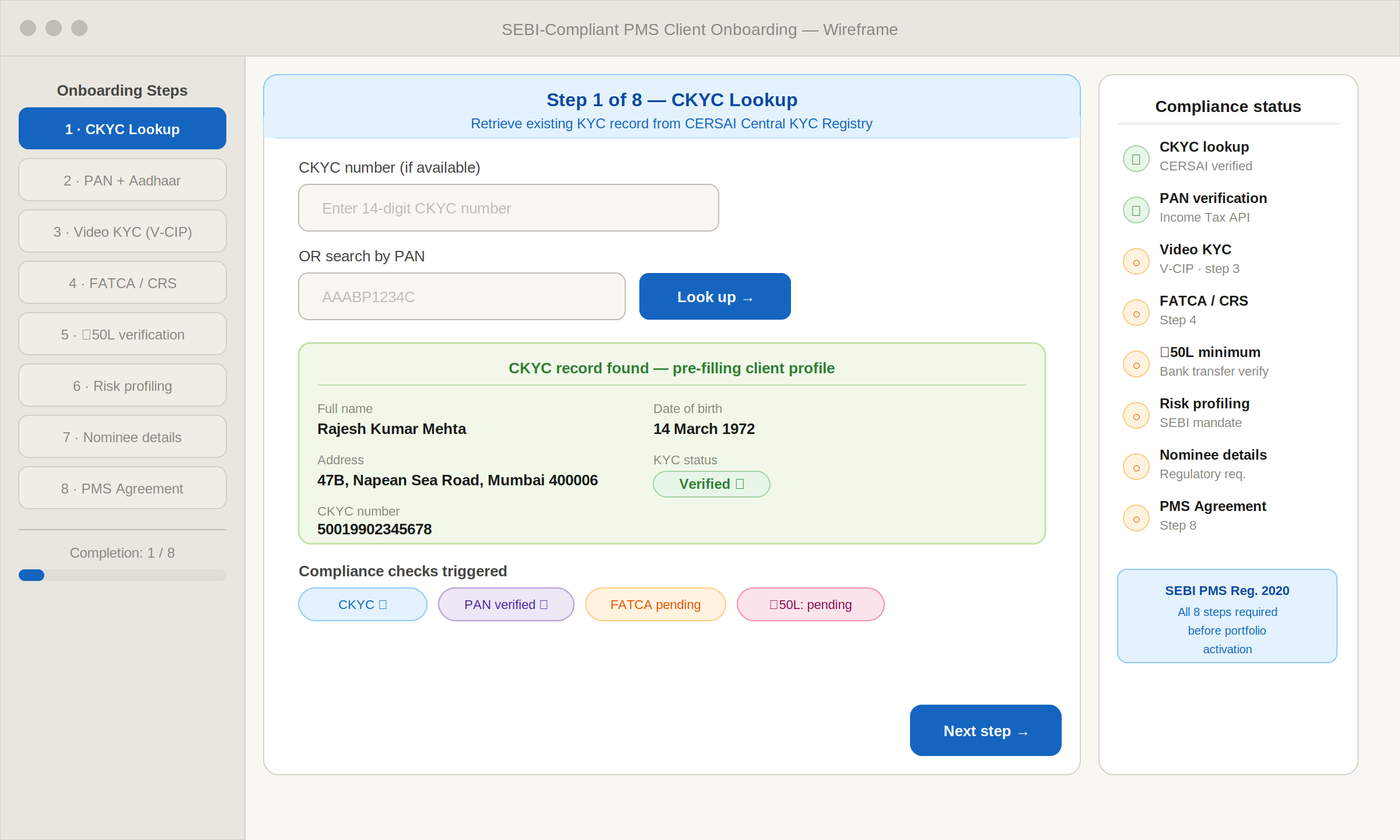
1. Regulatory-Compliant Client Onboarding
The WealthTech onboarding flow is more complex than a retail fintech onboarding. HNI clients require:
- CKYC (Central KYC): CERSAI’s CKYC registry lookup. If the client has an existing CKYC record (from a prior relationship with any financial institution), the CKYC number retrieves the full KYC record. Eliminates re-KYC paperwork for existing verified investors.
- In-person verification (IPV): SEBI requires in-person verification for PMS clients. Video KYC (V-CIP) is accepted. The platform must support a compliant V-CIP flow with recording, storage, and the prescribed video quality standards.
- FATCA/CRS declaration: All financial institutions must collect FATCA (Foreign Account Tax Compliance Act) and CRS (Common Reporting Standard) self-certification from clients. For US persons, additional disclosure obligations apply. The onboarding flow must collect and store these declarations.
- Minimum investment verification: PMS requires ₹50 lakh minimum. The platform must verify the client’s initial transfer against this threshold before activating portfolio management.
- Risk profiling: SEBI mandates a documented risk assessment for investment advisory clients. The platform must implement a structured risk profiling questionnaire, calculate a risk score, map it to an appropriate portfolio strategy, and store the documentation.
- Nominee registration: Regulated requirement. Nominee details with relationship proof stored and retrievable.
2. Multi-Asset Portfolio Management Engine
India’s HNI portfolio is not just stocks and mutual funds. A complete wealth management platform tracks:
- Listed equity: Demat holdings via NSDL/CDSL CDSL APIs. Real-time P&L, sector allocation, concentration risk alerts.
- Mutual funds: Units held via BSE StAR MF or MFU (Mutual Fund Utility). NAV-based valuation, fund category allocation, dividend reinvestment tracking.
- Bonds and fixed income: Corporate bonds, government securities, NCDs. Face value, accrued interest, yield to maturity calculations.
- PMS holdings: For clients invested in third-party PMS products, holdings at the portfolio manager level consolidated with direct holdings.
- Alternative Investment Funds (AIF): Unlisted, illiquid. Manual valuation or integration with fund administrator reporting.
- Real estate: Manual entry of property valuations with periodic update. For family offices, integrating with property management systems.
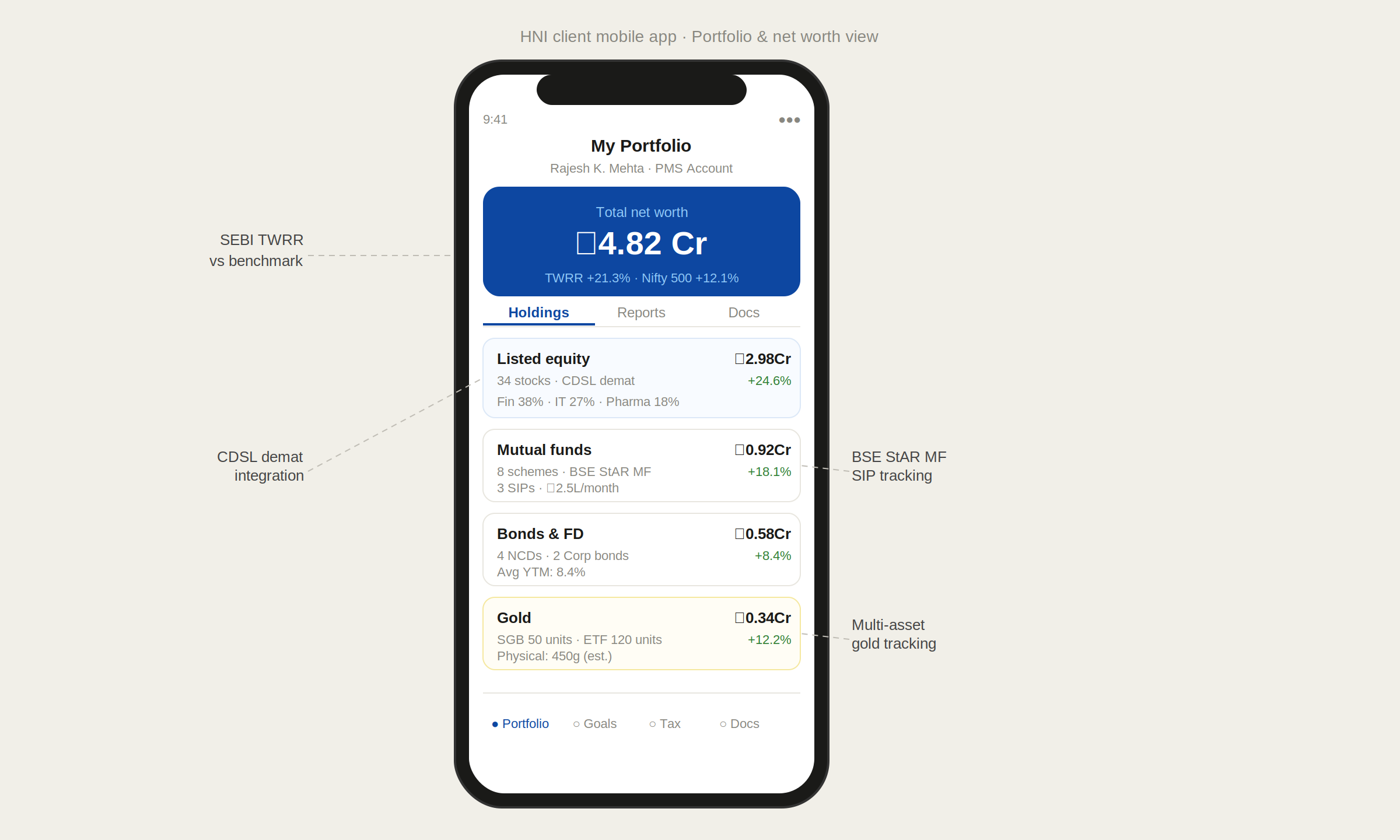
- Gold: Physical gold (estimated value), Sovereign Gold Bonds (exchange-traded, real-time price), Gold ETFs (demat), and digital gold (platform-specific APIs).
- International assets: LRS (Liberalised Remittance Scheme) investments. Integration with international brokers (Interactive Brokers, Charles Schwab) via API for US stocks, foreign mutual funds.
- Insurance: Policy summary integration for life, health, and term. Premium schedule, sum assured, maturity value.
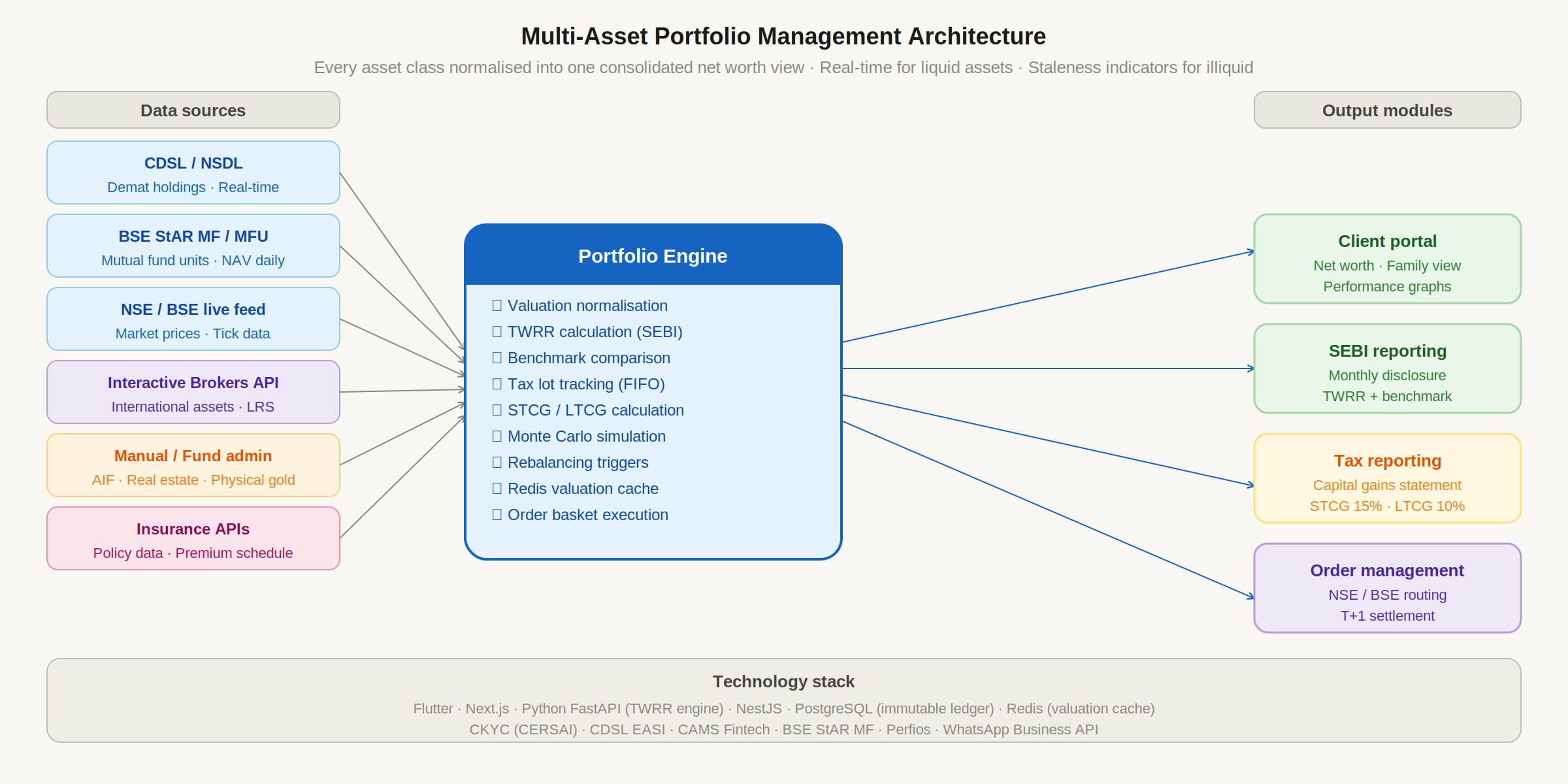
The consolidation challenge: each asset class has a different data source, a different update frequency, and a different valuation methodology. The portfolio management engine must normalise all of them into a single net worth view, updated in near-real-time for liquid assets and with appropriate staleness indicators for illiquid ones.
3. Performance Reporting – TWRR and Regulatory Disclosures
Performance reporting for a SEBI-registered PMS is not a dashboard feature. It is a regulatory obligation.
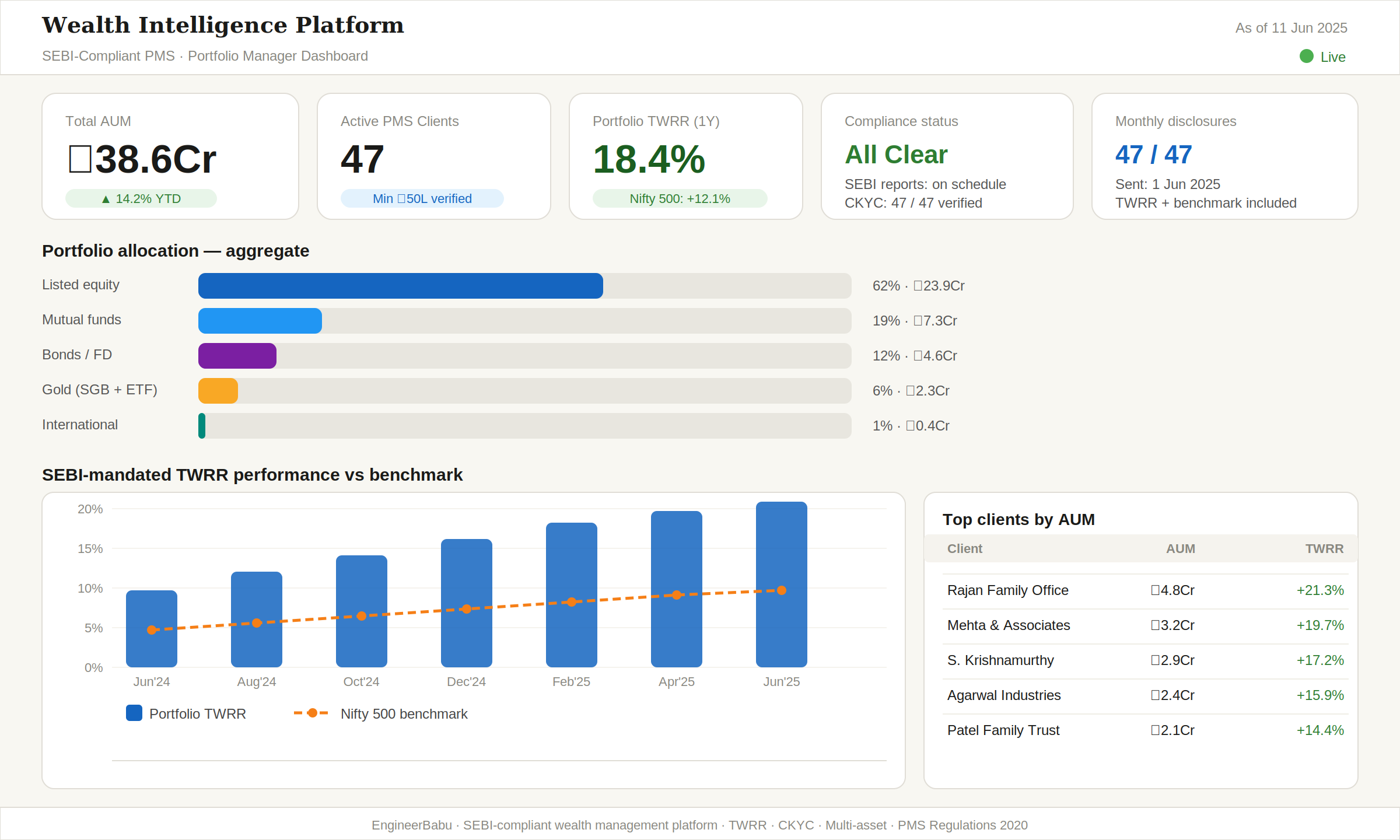
- TWRR (Time-Weighted Rate of Return): SEBI’s mandated return calculation methodology for PMS client reporting. TWRR eliminates the effect of cash flows (client additions and withdrawals) to measure the portfolio manager’s skill independently of client cash flow timing. The formula requires sub-period return calculation for every cash flow event. In a portfolio with daily transactions, this is a significant computational requirement.
- Benchmark comparison: SEBI requires performance reporting against a relevant benchmark index. The platform must maintain benchmark index data (Nifty 50, Nifty 500, BSE Sensex, etc.) and calculate benchmark TWRR for the same period as the portfolio return.
- Monthly disclosure statement: SEBI mandated. Must include portfolio composition (by security, sector, and asset class), total return for the period, benchmark comparison, and a complete transaction history.
- Annual report: SEBI mandated. Audited financials at the fund level.
- Taxation reporting: Capital gains calculations. Short-term capital gain (STCG: equity held less than 12 months, taxed at 15%) vs long-term capital gain (LTCG: equity held more than 12 months, taxed at 10% on gains above ₹1 lakh). Separate tracking for each lot (FIFO by default under Indian tax law). The platform must produce a capital gains statement suitable for IT return filing.
4. Robo-Advisory and Goal-Based Planning Engine
For platforms serving a broader retail or mass-affluent investor base alongside HNI PMS:
- Risk profiling to portfolio mapping: Questionnaire-driven risk score (conservative / moderate / aggressive) mapped to a model portfolio (asset allocation across large-cap equity, mid-cap, debt, gold, international). The mapping logic is the IP of the advisory firm and must be configurable without code changes.
- Goal-based planning: Retirement corpus, child education, home purchase, business succession. Each goal has a target amount, a time horizon, and a funding capacity. The planning engine calculates the required monthly SIP, the expected corpus at goal date under assumed returns, and the probability of achieving the goal under different market scenarios (Monte Carlo simulation).
- Automated rebalancing: When the portfolio drifts beyond a defined threshold from the target allocation (e.g., equity grows from 60% to 72% due to market appreciation), the platform flags rebalancing. For discretionary models, it executes the rebalancing order automatically. For advisory, it generates a recommendation for the client to execute.
- SIP management: Systematic investment plan registration and tracking across MF schemes. Integration with BSE StAR MF or MFU for SIP mandate creation and order execution.
5. Order Management and Broker Integration
For PMS platforms managing discretionary portfolios, the platform must execute trades:
- BSE/NSE order routing: Integration with a SEBI-registered broker (typically an existing broker empanelment for the PMS manager) via the broker’s API for order placement.
- Basket order execution: When the portfolio manager rebalances across multiple client portfolios simultaneously, the platform generates a basket of orders (one per client holding) and submits them for execution. Tracking of fills across the basket is required for P&L accuracy.
- CDSL/NSDL demat integration: Post-execution settlement confirmation via depository integration. Actual holdings updated after T+1 settlement, not at order execution.
- Pooled vs. segregated execution: Regulatory clarity required: PMS must maintain segregated client accounts. The platform must ensure there is no commingling of client assets across different portfolios.
6. Client Portal and Transparent Reporting
The HNI client portal is a trust product. It must show everything clearly:
- Net worth dashboard: Total across all asset classes with allocation pie chart, performance graph (absolute, TWRR, vs benchmark), and recent transaction feed.
- Document vault: All regulatory documents (account opening forms, FATCA declarations, portfolio manager agreement, monthly statements) stored, searchable, downloadable.
- WhatsApp and email notifications: Trade confirmation, monthly statement delivery, rebalancing recommendations, and market-event triggered alerts.
- Family consolidation: HNI families want a single view across multiple family members’ portfolios. The platform must support a family hierarchy: individual portfolios visible to each member, consolidated family view accessible to the family patriarch/authorised member.
Technology Stack
Flutter (client mobile app, portfolio dashboard, notifications, document vault) + Next.js (RM web portal, portfolio management, order management, compliance dashboard).
Python FastAPI (TWRR calculation engine, AI portfolio analytics, Monte Carlo simulation, tax calculation) + Node.js NestJS (workflow orchestration, broker integration, CDSL/NSDL integration, regulatory report generation).
PostgreSQL (immutable transaction ledger, every trade, every cash flow, every valuation event) + Redis (real-time portfolio valuation cache).
Key India integrations: CDSL EASI/CAMS Fintech APIs (MF holdings) · NSE/BSE order routing · BSE StAR MF / MFU (MF order execution) · CKYC registry (CERSAI) · NSDL/CDSL demat depository · Market data (NSE/BSE live feed) · Perfios/Finbox (bank statement for client income verification) · WhatsApp Business API.
The Failure Framework
- Failure 1: The XIRR PMS, returns calculated as XIRR. SEBI mandates TWRR for PMS client reporting. The platform generates non-compliant performance reports. First SEBI inspection finds the discrepancy. Fix: TWRR calculation engine built and validated before any portfolio data is populated. Test against SEBI’s published calculation examples before go-live.
- Failure 2: The Missing Benchmark, portfolio performance reported without benchmark comparison. SEBI requires benchmark comparison in PMS disclosure statements. Platform generates statements without benchmark data. Fix: benchmark data integration (NSE/BSE index feeds) and benchmark TWRR calculation are standard requirements, not optional features.
- Failure 3: The Consolidated View Gap, HNI clients with assets across equity, MF, bonds, and real estate see only the equity and MF portion. The portfolio appears incomplete. The client loses trust in the platform’s accuracy. Fix: multi-asset architecture from the data model design. Every asset class is a supported entity type, even if the valuation is manual for illiquid assets.
- Failure 4: The Tax Lot Chaos, trades executed without maintaining lot-level cost basis. Capital gains calculations at year-end require FIFO lot matching across years of transactions. Without proper lot accounting from the first trade, retrospective calculation is error-prone. Fix: every buy creates a lot record. Every sell matches against lots in FIFO order. Tax implications calculated at execution, not at year-end.
Cost and Timeline
Wealth management software development starts from $25,000 for a SEBI-compliant PMS platform MVP development, client onboarding with CKYC/KYC, multi-asset portfolio tracking for equity and MF, TWRR calculation, monthly disclosure statement generation, and client portal.
Full platform, multi-asset (including real estate, AIF, international), goal-based planning engine, robo-advisory with automated rebalancing, order management with broker integration, family office consolidation: $70,000–$180,000 built in India.
Timeline: MVP in 12–16 weeks. Full platform: 6–10 months.
40–60% lower cost than US/UK equivalent. CTO 17yr Wishfin financial compliance experience. Google AI Accelerator 2024. Full IP ownership.
FAQ
-
What is SEBI’s TWRR requirement for PMS?
SEBI mandates that Portfolio Managers use the Time-Weighted Rate of Return (TWRR) methodology for client performance reporting. TWRR eliminates the distortion of client cash flows to measure the portfolio manager’s performance independently. XIRR or simple returns are not compliant substitutes. The calculation requires sub-period return computation at every cash flow event.
-
What is the minimum investment for PMS in India?
₹50 lakh per client, as mandated by SEBI (Portfolio Managers) Regulations, 2020. The wealth management platform must verify this threshold during onboarding and restrict portfolio activation for accounts below the minimum.
-
What is CKYC in wealth management?
Central KYC, a centralised KYC registry maintained by CERSAI. If a client has completed KYC with any financial institution previously, their CKYC record is retrievable via CKYC number. Eliminates repeat KYC documentation for existing verified investors. Mandatory lookup in any regulated financial onboarding.
-
What is multi-asset portfolio tracking?
Consolidated view of a client’s wealth across all asset classes: listed equity, mutual funds, bonds, PMS holdings, AIFs, real estate, gold (physical, SGB, ETF), international assets, and insurance. Each asset class has a different data source and valuation methodology. The platform normalises all into a single net worth view.
-
How long does it take to build wealth management software?
MVP with SEBI-compliant PMS functionality: 12–16 weeks. Full multi-asset platform with robo-advisory and order management: 6–10 months.