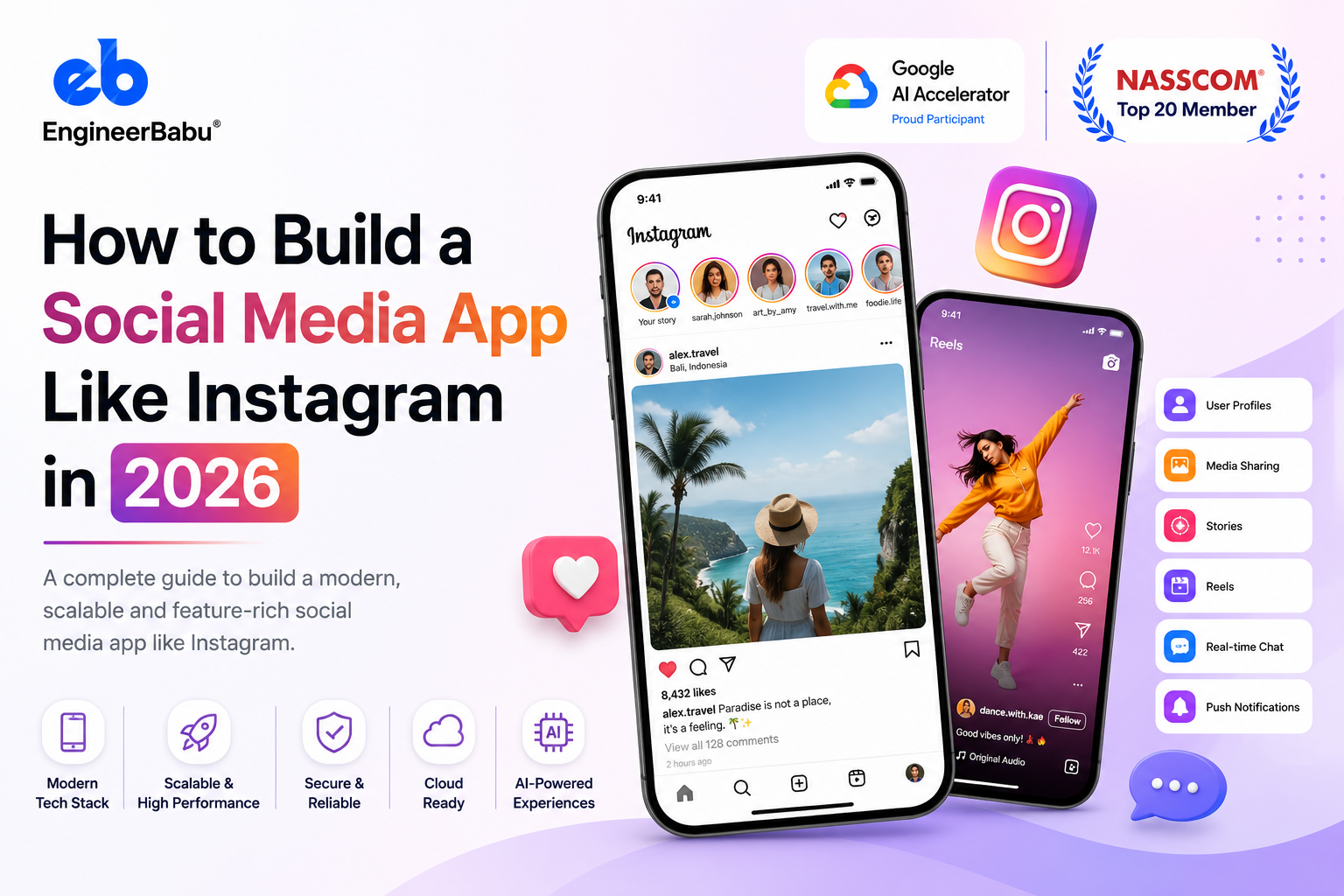
How to Build a Social Media App Like Instagram in 2026


Create engaging, high-performance mobile applications tailored to your business needs. We craft future-ready apps that offer smooth user experiences on all devices.
Build robust and scalable websites and CMS platforms that help you manage content effortlessly. Our development ensures a seamless digital presence.
Launch secure, feature-rich online stores with intuitive shopping experiences. We build tailored eCommerce platforms designed for growth.
Design captivating games with immersive gameplay and stunning graphics. From concept to launch, we build engaging experiences that players love.
Enhance your customer relationships with customized Salesforce implementations. Drive growth and efficiency with smarter CRM solutions.
Harness artificial intelligence and machine learning to automate workflows and gain actionable insights. Our AI transforms data into smart decisions.
Accelerate your software delivery lifecycle with continuous integration, delivery, and infrastructure automation to boost efficiency.
Hire app developers ready to turn your ideas into sleek, high-performing mobile apps for any platform.
Bring in frontend pros who craft smooth, beautiful, and user-friendly interfaces that your visitors will love.
Get backend developers who build fast, secure, and reliable systems to keep everything running behind the scenes.
Hire eCommerce developers who build secure, scalable online stores designed to offer seamless shopping and grow your sales.
Get dedicated developers committed to your projects, delivering consistent quality and speed as an extension of your team.
The pattern appears consistently.
A founder builds a social app. Community-focused. Clean UI. Good engagement in the first 3 months. Word spreads. They hit 8,000 users.
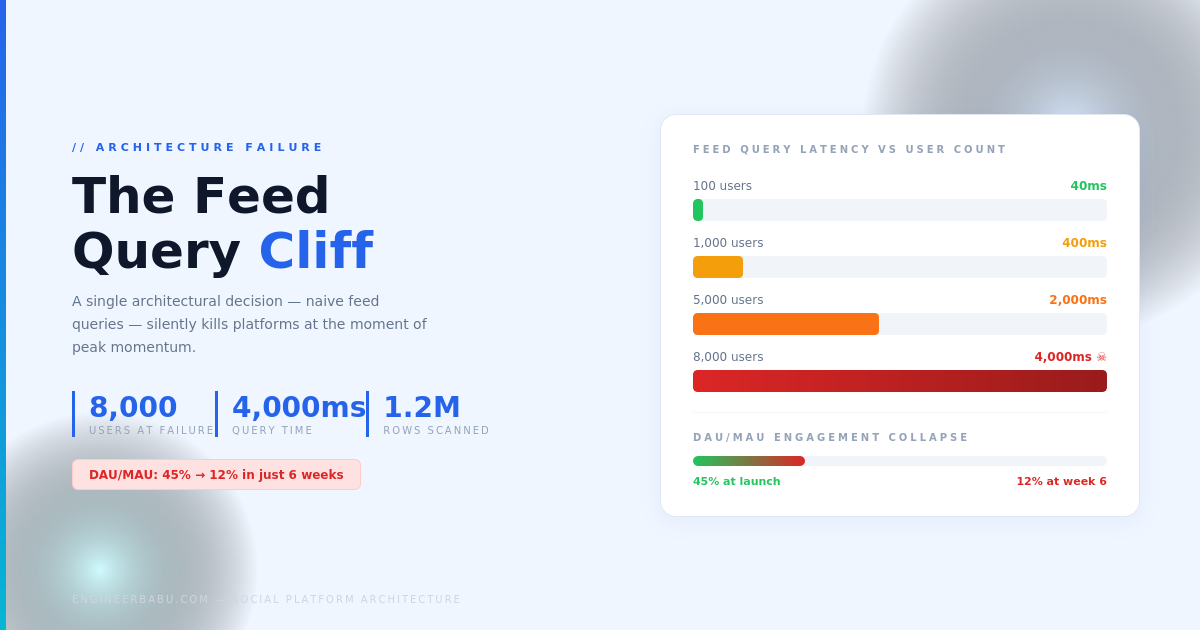
Then the feed slows down. Not dramatically – 800ms instead of 200ms. Then 2 seconds. Then 5 seconds on older Android devices. Users open the app, wait, and close it. The DAU/MAU ratio drops from 45% to 12% in 6 weeks.
The problem: the feed query. Every time a user opens the app, the system runs a database query that scans all posts from every account they follow, ranks them, and returns the top 20. At 100 users, this query takes 40ms. At 8,000 users with an average of 150 follows per user, it takes 4,000ms. The database is doing 1.2 million row evaluations per feed load.
This isn’t a bug. It’s an architecture decision made without the next scale level in mind.
I co-founded EngineerBabu 14 years ago. The team has built 75 YC-selected products – many of them social, community, and creator platforms. The Google AI Accelerator 2024 selection was specifically for production AI capabilities, directly applicable to the recommendation algorithms and content moderation systems that define modern social platforms.
The architecture mistakes that kill social apps at scale appear in nearly every first build. This guide exists to name them before you make them.
If you’re ready to build and want a team with 75 YC-product builds behind them – email mayank@engineerbabu.com.
The global social networking app market was valued at $385 billion in 2026, growing at a CAGR of 24%. 5.24 billion active social media users globally. The 25–34 cohort is 31% of users; the 13–24 segment is growing at 16% annually.
Here’s the reality for new builders: you’re not building the next Instagram.
Instagram has 3 billion monthly active users. TikTok has 1.5 billion. Facebook has 3 billion. These platforms have network effects so entrenched that a general social media platform competing directly with them is not a product strategy – it’s a funding exercise.
The new platforms that win in 2026 win by niche.
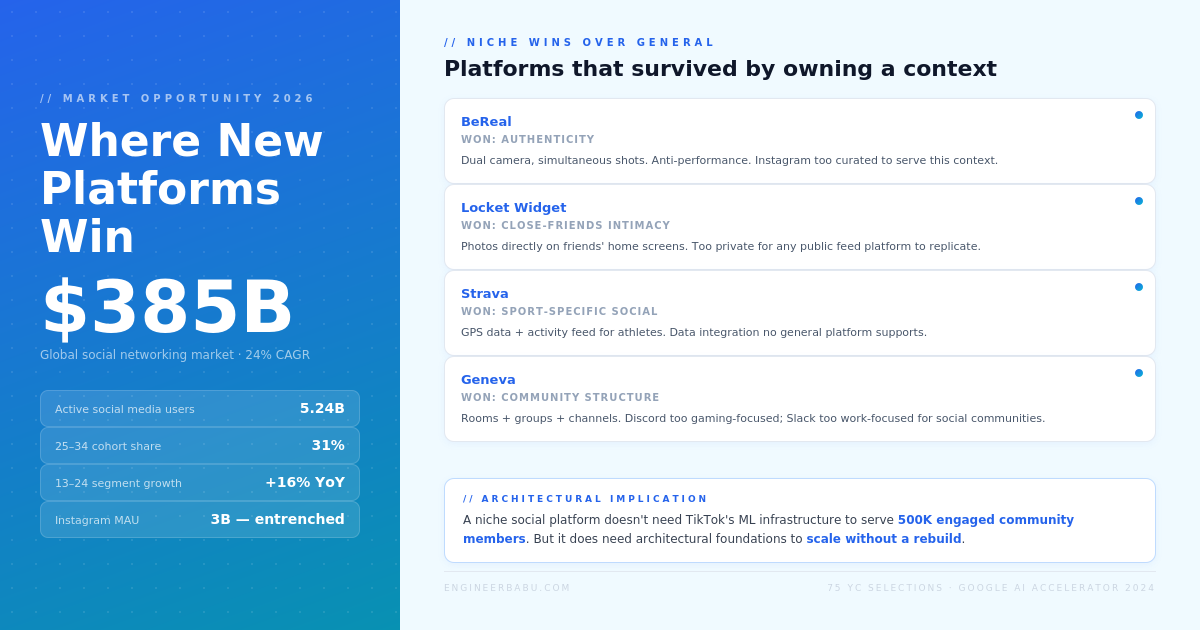
BeReal won by authenticity over performance. Locket won by close-friends intimacy. Geneva won by community structure. Strava won by sport-specific social graphs. Fourplay won by specific demographics. Each of these platforms won a specific social context that the general platforms serve poorly.
The opportunity in social media development isn’t building an Instagram clone. It’s identifying a community, a use case, or a social context that Instagram is too general to serve well – and building a platform that serves it better.
The architectural implication: a niche social platform can be built with significantly less infrastructure than a general one. You don’t need TikTok’s ML infrastructure to serve 500,000 engaged community members. But you do need the architectural foundations that allow the platform to scale to that level without a rebuild.
A social media app is a digital platform where users create, share, and interact with content – photos, videos, text, stories, live streams – within a community defined by social graphs, interest signals, and algorithmic or chronological feed curation. The distinguishing challenge from other software categories: unpredictable, concurrent, user-generated activity at scale, with zero tolerance for downtime or performance degradation.
The feed is the product. Not the profile. Not the messaging. The feed.
Every user’s decision to open the app a second time, a fifth time, a fiftieth time – is determined by what was in the feed the last time they opened it. If the feed showed them things they cared about, they came back. If it showed irrelevant content, they didn’t.
The feed architecture has two modes: chronological (show everything from followed accounts in time order) and algorithmic (rank content by predicted engagement). Both have trade-offs.
Chronological is easy to build and feels fair. At low user counts and high follow density, it works. It breaks when users follow more accounts than they can consume – the feed becomes noise.
Algorithmic is harder to build but dramatically better for retention. TikTok’s “For You” page is the most studied case: a user with zero follows gets a personalized feed within 3 minutes because the algorithm learns from every 0.1-second interaction. Building this is not a small engineering task.
The team’s recommendation for most social app builds in 2026: start chronological, architect for algorithmic. Build the behavioral event logging pipeline from day one – every view, every like, every share, every scroll past is an event. This data, accumulated from launch, is what trains the ranking model when you’re ready to deploy it. Building the data pipeline retroactively costs more than building it first.
The feed query problem – and how to solve it:
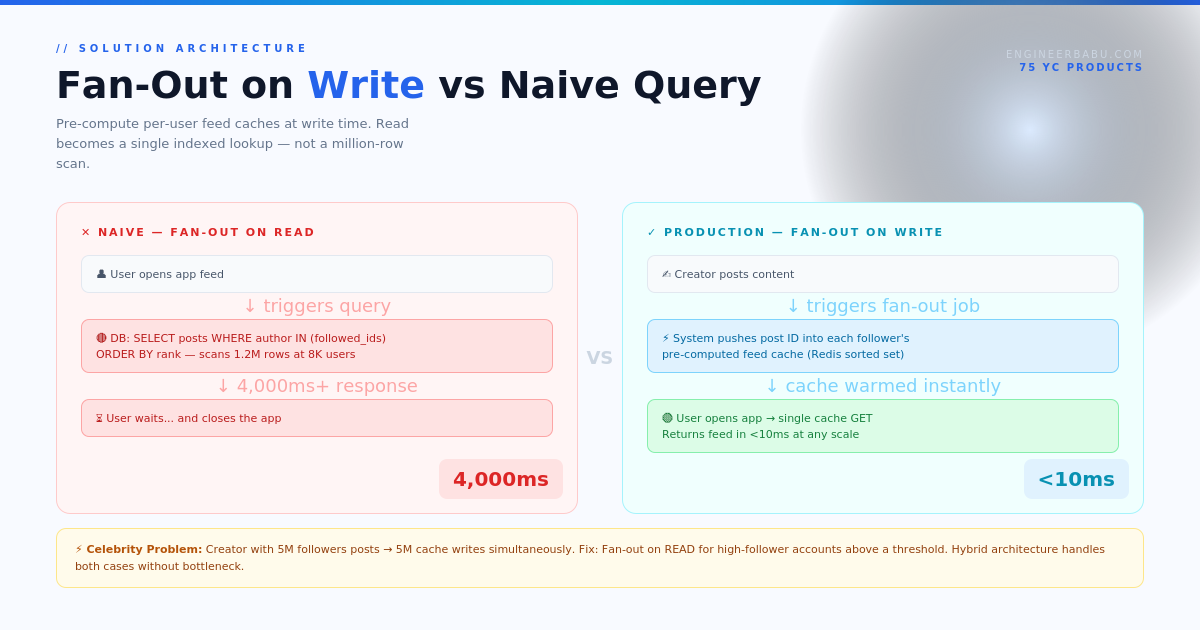
The naive implementation queries posts from followed accounts, scores them, and returns top N. This doesn’t scale.
The production approach is fan-out on write: when a user posts, the system immediately pushes that post into each follower’s feed cache. When a follower opens the app, their feed is read from cache – a single indexed lookup, not a complex query across millions of rows.
Fan-out has its own edge case: the celebrity problem. A creator with 5 million followers posts once. The system needs to push that post into 5 million feed caches simultaneously. The naive fan-out creates a write spike that can overwhelm the database.
The solution is fan-out on read for high-follower accounts – posts from accounts above a threshold are not pre-pushed but are fetched at read time and merged with the pre-pushed feed. This hybrid approach handles both normal accounts (fan-out on write) and high-follower accounts (fan-out on read) without either bottleneck.
Every photo and video a user uploads needs to be processed before it appears in feeds:
Images: resized for multiple display contexts (thumbnail, feed, full-screen), compressed for connection speed (WebP at different quality levels), stored on CDN edge nodes close to the end user.
Videos: transcoded to multiple resolutions (360p for 3G, 720p for 4G, 1080p for WiFi), adaptive bitrate streaming so playback quality adjusts to connection in real time, thumbnail generated at a specific frame (the first frame determines whether anyone taps), and if the platform has short-form video, the first 2 seconds need to auto-play without buffering even on slow connections.
All of this runs asynchronously. The user uploads a photo and sees it immediately in their feed (optimistic UI shows the original). Behind the scenes, the processing pipeline runs. When processing completes, the CDN-served version replaces the original.
The cost: media processing and CDN delivery is the largest infrastructure cost for any social platform that reaches meaningful scale. A viral video consumes terabytes of bandwidth daily. Getting the media processing right – efficient transcoding, smart CDN caching, WebP conversion for images – reduces infrastructure costs dramatically.
The team builds media processing pipelines using AWS Lambda (triggered on upload) for transcoding, CloudFront for CDN delivery, and S3 with intelligent tiering (hot content on standard storage, old content automatically tiered to cheaper storage). The architectural decision that matters most: media processing is always asynchronous, never blocking the user’s experience.
Users expect instant feedback. A like appears instantly. A comment posts instantly. A direct message arrives in under a second.
This requires WebSocket connections for persistent real-time communication. But WebSockets at scale have specific engineering requirements:
Connection management – each open WebSocket is a persistent connection consuming server resources. 100,000 concurrent users each with an open WebSocket connection requires a connection-aware infrastructure design. The team uses a message broker (Redis Pub/Sub or a dedicated WebSocket gateway service) to decouple connection management from application logic.
Live streaming – technically the most demanding social feature. Unlike on-demand video with a buffer, live streams have no buffer. Latency must be under 3 seconds for the interaction experience to feel real. This requires dedicated streaming servers (not the same CDN used for on-demand video), adaptive bitrate encoding on the input stream, and a real-time event processing system for comments and reactions that appear overlaid on the live video.
Notification infrastructure – push notifications are the highest-leverage retention feature in any social app. A well-timed “your post got 50 likes” notification brings users back at 3x the rate of no notification. Building the notification pipeline: event triggers (like, comment, follow, mention), notification preferences per user (some users turn them all off), delivery to APNs (iOS) and FCM (Android), and tracking of open rates per notification type.
In 2026, content moderation is not a Phase 2 feature. It’s a legal obligation in most markets.
The EU’s Digital Services Act, India’s IT Rules 2021, and US platform accountability frameworks all place obligations on platforms from the moment they’re live with user-generated content.
The production moderation architecture:
Pre-post automated screening – every image and video passes through AI classifiers before appearing on the platform: NSFW detection, hate speech detection (in text), copyright fingerprinting for video. False positive rate matters: if the classifier blocks too many legitimate posts, it damages creator trust.
Human review queue – flagged content surfaces to a human review interface. The queue is prioritized by confidence score (low-confidence AI decisions get reviewed first) and by report volume (content that many users have reported surfaces higher).
User reporting – every piece of content needs a report button. Reports feed into the human review queue. The team builds report workflows that capture the specific violation category and support appeal mechanisms for content that was incorrectly removed.
Proactive detection – reactive moderation (waiting for user reports) isn’t sufficient for CSAM, terrorism content, or coordinated inauthentic behavior. Proactive detection using hash-matching (PhotoDNA for CSAM) and ML-based behavior analysis is required.
The team’s Google AI Accelerator 2024 selection is directly applicable here: building production ML systems for content classification that work across multiple content categories, multiple languages, and that maintain acceptable precision-recall trade-offs at scale.
Every social platform has two sides: consumers and creators. Creator retention determines content supply. Without good content, consumers leave.
The creator tools that drive retention:
Analytics dashboard – views, reach, engagement rate, follower growth, top-performing posts. Creators need this data to understand what works. Building this requires aggregating behavioral events (views, likes, shares, saves, profile clicks) per post, per creator, per time window.
Content scheduling – creators plan content in advance. A scheduling system requires storing draft posts with metadata, triggering publish at a scheduled time, and notifying the creator on publish.
Creator monetisation – subscriptions, tips, paid content, brand partnership disclosures. Each monetisation mechanism requires different data schema and different payment processing. Building this into the architecture from launch (even if the features go live later) prevents expensive retrofits.
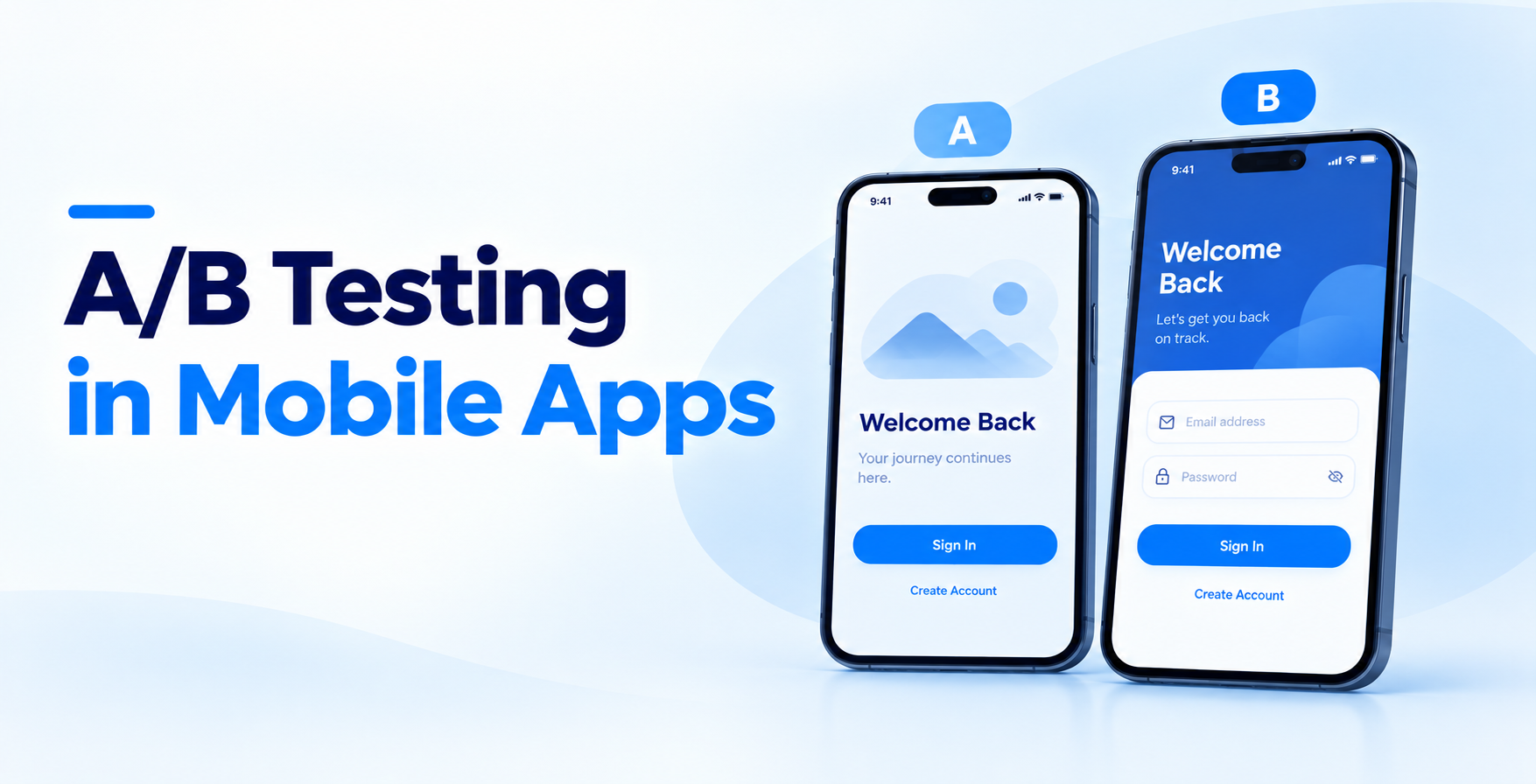
A/B testing for creators – some platforms allow creators to test different thumbnail images, different caption lengths, or different posting times. Building A/B infrastructure for creators requires a/b assignment at impression time and attribution of engagement back to the variant.
The social graph – who follows whom – is a fundamental data structure that most teams underestimate until they’ve hit the scale where naive implementations break.
The problem: most social graph queries are graph traversals. “Show me posts from people this user follows” is a JOIN across a potentially massive relationship table. “Show me friends of friends” is a 2-hop graph traversal. “Suggest people you might know” is a graph analysis operation across millions of nodes.
At 100,000 users with an average of 200 follows each, the follow table has 20 million rows. A naive “show posts from followed accounts” query across 20 million rows is not acceptable.
The solution: maintain materialized views of each user’s social graph – a pre-computed list of their follows, stored in a fast-access cache (Redis sorted set), refreshed when follows/unfollows happen. Feed generation reads from this cache, not from the follow table directly.
For “people you might know” suggestions: the team builds a lightweight social graph analysis job that runs nightly, computes 2-hop connections for each user, and stores the top 20 suggestions. This nightly job doesn’t block real-time operations.
Flutter (mobile) + Next.js (web)
Flutter for the primary consumer-facing apps – iOS and Android from one codebase. The scrolling performance, gesture handling, and media rendering that social feeds require are achievable in Flutter at native-comparable speeds. The 60fps infinite scroll that makes social feeds feel addictive is a Flutter strong suit.
Node.js NestJS (core API) + Python (ML/AI layer)
NestJS for the social graph management, post CRUD, notification delivery, and real-time WebSocket handling. Python FastAPI for the feed ranking model, content moderation ML inference, and creator analytics aggregation.
PostgreSQL + Redis + Elasticsearch
PostgreSQL for the social graph, user profiles, post metadata, and engagement records (likes, comments, shares). Redis for feed caches (pre-computed per-user feeds), session management, real-time like counts, and WebSocket session routing. Elasticsearch for content search (hashtag search, user search, keyword search).
Media: AWS S3 + CloudFront + Lambda for transcoding
S3 for media storage. Lambda triggered on upload runs the transcoding pipeline: image resize + WebP conversion, video transcoding to multiple bitrates, thumbnail generation. CloudFront delivers from edge locations close to the end user.
Real-time: Socket.io (WebSockets) + Firebase Cloud Messaging
Socket.io for real-time comments, DMs, and live stream event delivery. Firebase Cloud Messaging for push notifications to iOS (via APNs) and Android (via FCM).
Content moderation: AWS Rekognition + custom ML models (Google AI Accelerator-grade)
AWS Rekognition for NSFW image and video detection. Custom ML text classifiers for hate speech and harassment. PhotoDNA for CSAM hash matching. The team’s production AI capabilities from the Google AI Accelerator program are deployed in the moderation pipeline.
The 75 YC-selected products the team has built include multiple social and community platforms. The patterns repeat.
The founder who asked the team to build a community platform for professional creators in a specific niche – the architecture decision that saved the project was building fan-out on write from day one, with the hybrid approach for high-follower accounts built in before launch. When a creator with 200,000 followers joined the platform in month 3, the feed infrastructure handled it without degradation.
The platform that built the behavioral event pipeline from day one had enough training data to deploy a basic feed ranking model in month 4. The platform that skipped the event pipeline spent 3 months retroactively building it and then discovered the historical data was insufficiently structured for model training.
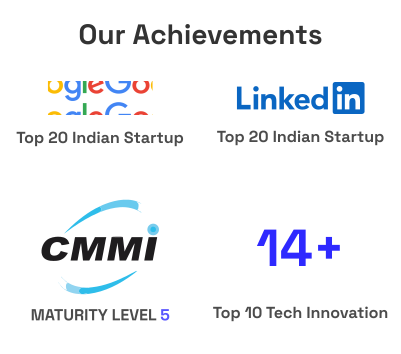
The CMMI Level 5 process means quality gates at every sprint: load testing against the next scale tier, not the current one. Performance benchmarking before deployment. Security review on every new API endpoint. These gates caught the feed query performance issue in a test environment, not in production.
The team can scope your social platform architecture and have a proposal within a week. mayank@engineerbabu.com.
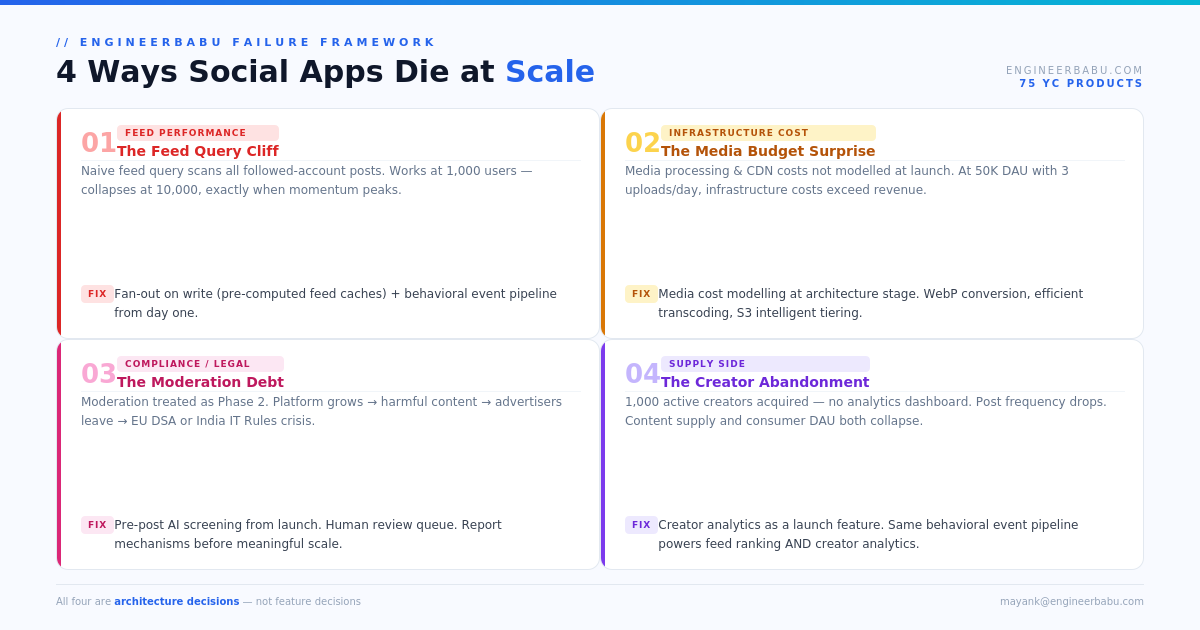
Naive feed query – scan all posts from followed accounts, rank, return top N. Works at 1,000 users. Falls apart at 10,000. The platform slows down precisely when momentum is highest.
The fix: Fan-out on write (pre-computed per-user feed caches) with hybrid fan-out on read for high-follower accounts. Behavioral event pipeline from day one.
Media processing and CDN costs are not modelled at launch. At 50,000 DAU with 3 uploads per user per day, media infrastructure costs exceed revenue. The platform’s unit economics never work.
The fix: Media cost modelling at architecture stage. Efficient transcoding pipeline, WebP conversion, intelligent CDN tiering. S3 intelligent tiering moves cold media to cheaper storage automatically.
Content moderation treated as Phase 2. Platform launches, grows, and then faces brand-damaging user-generated content. Advertiser pulls out. Platform loses creator trust. EU DSA or India IT Rules compliance becomes a crisis, not a feature.
The fix: Pre-post AI screening from launch. Human review queue before DAU reaches meaningful scale. Report mechanisms from day one.
Platform acquires 1,000 active creators. Creator analytics dashboard is not built. Creators can’t see what’s performing. They post less. Community content supply declines. Consumer DAU follows.
The fix: Creator analytics as a launch feature, not a post-launch addition. The behavioral event pipeline that drives the feed ranking model is the same data source that powers creator analytics.
No-code (Bubble, Wix, Mighty Networks): Right for closed community platforms with limited scale expectations. Cannot support the feed architecture, media processing pipelines, or real-time infrastructure that a consumer social app requires at scale.
Custom build: Required for any social platform targeting meaningful scale. The feed architecture, the media pipeline, the real-time infrastructure, and the content moderation system are all custom engineering investments that no-code platforms cannot accommodate.
Social media app development starts from $15K for a production MVP – user profiles, follow graph, basic feed (chronological), photo/video upload, likes, comments, push notifications.
Full platforms – algorithmic feed ranking, short-form video with transcoding, live streaming, creator analytics, AI content moderation – scoped based on platform type, feature set, and target scale.
Timeline: MVP with core social loop in 12–16 weeks. Full platforms in 5–9 months.
40–60% cost savings vs US/UK equivalent quality. Google AI Accelerator 2024 production ML capabilities. Full IP ownership.
75 YC-selected product builds. Many of them social platforms, creator tools, and community apps.
Google AI Accelerator 2024 – production ML for feed ranking, content moderation, and creator analytics.
Mayank leads personally. CMMI Level 5. 4 unicorn clients. 200+ VC-funded products. Full IP ownership.
A founder came to the team after their social platform died at 8,000 users from feed query performance. The rebuild took 10 weeks. The platform relaunched with fan-out architecture. It reached 80,000 DAU without a single feed-related complaint.
Every week a social platform operates with weak architecture is a week of user churn that network effects can’t recover from. The platforms that survive their first growth spike are the ones whose architecture was designed for it.
30 minutes. Honest assessment of your platform type, your niche, and what a social platform that survives scale actually requires.
Mayank Pratap | Co-founder, EngineerBabu
Social media app development is building a digital platform where users create, share, and interact with content – photos, videos, stories, live streams – within a community defined by social graphs and feed algorithms. The defining challenge: unpredictable, concurrent, user-generated activity at scale, with zero tolerance for performance degradation.
MVP with core social loop (profiles, follow graph, feed, media upload, likes, comments, push notifications): 12–16 weeks. Full platforms with algorithmic feed, short-form video, live streaming, creator analytics, and AI moderation: 5–9 months.
The feed architecture. A naive database query for feed generation – scan all posts from followed accounts – fails at 5,000–10,000 users. Fan-out on write (pre-computed per-user feed caches) is the production architecture. The behavioral event logging pipeline that feeds the ranking model must also be built from day one, not retrofitted.
Fan-out on write means when a user posts, the system immediately pushes that post into each follower’s pre-computed feed cache. When a follower opens the app, their feed is a fast cache lookup rather than a complex database query. The hybrid approach (fan-out on read for high-follower accounts) handles the celebrity problem – posts from accounts with millions of followers that would create write spikes.
In 2026, yes – in most major markets. The EU’s Digital Services Act, India’s IT Rules 2021, and US platform accountability frameworks place obligations on platforms from launch. Pre-post AI screening for NSFW and harmful content, human review queues for flagged content, and user reporting mechanisms are all required.
Flutter for mobile, Next.js for web, Node.js NestJS for core API and real-time (WebSockets), Python for ML/AI (feed ranking, content moderation), PostgreSQL for social graph and post data, Redis for feed caches and real-time state, Elasticsearch for search, AWS S3 + CloudFront for media storage and delivery.
Primary: advertising (impression-based, targeting requires behavioral data infrastructure built from day one). Secondary: creator subscriptions, tips, paid content, platform subscriptions. The data architecture for advertising (impression events, targeting attributes) must be in the schema from launch.
The creator economy refers to users who create content professionally or semi-professionally on platforms. Creator retention determines content supply. Creator analytics (views, engagement, follower growth), content scheduling, and monetisation tools are the features that retain creators. Building the behavioral event pipeline that drives creator analytics also drives feed ranking – the same investment serves both.