AI Product Development Company for Startups


Create engaging, high-performance mobile applications tailored to your business needs. We craft future-ready apps that offer smooth user experiences on all devices.
Build robust and scalable websites and CMS platforms that help you manage content effortlessly. Our development ensures a seamless digital presence.
Launch secure, feature-rich online stores with intuitive shopping experiences. We build tailored eCommerce platforms designed for growth.
Design captivating games with immersive gameplay and stunning graphics. From concept to launch, we build engaging experiences that players love.
Enhance your customer relationships with customized Salesforce implementations. Drive growth and efficiency with smarter CRM solutions.
Harness artificial intelligence and machine learning to automate workflows and gain actionable insights. Our AI transforms data into smart decisions.
Accelerate your software delivery lifecycle with continuous integration, delivery, and infrastructure automation to boost efficiency.
Hire app developers ready to turn your ideas into sleek, high-performing mobile apps for any platform.
Bring in frontend pros who craft smooth, beautiful, and user-friendly interfaces that your visitors will love.
Get backend developers who build fast, secure, and reliable systems to keep everything running behind the scenes.
Hire eCommerce developers who build secure, scalable online stores designed to offer seamless shopping and grow your sales.
Get dedicated developers committed to your projects, delivering consistent quality and speed as an extension of your team.
Last month, a Series A founder flew into Indore with a working AI product. His team had spent eight months and roughly $310,000 building a customer support copilot.
The demo looked clean. Investors liked it. Two enterprise pilots were signed.
Then he opened the cloud bill.
His inference costs were eating 71% of revenue per customer. The “AI” was a thin GPT-4 wrapper with no caching, no fallback model, no observability.
His architecture would not survive 500 concurrent users, let alone 5,000. He was not building a product. He was building a very expensive demo.
This is the part nobody tells founders when they hire an AI product development company. The hard part is not the model. It is everything around the model.
I have spent 14 years building products. I co-founded EngineerBabu, a CMMI Level 5 certified product engineering company, and I run it personally.
No sales team. No account managers. Every client comes through referral, and we take 20 projects a year. That constraint forces me to be on every architecture call myself.
In Q1 2026, AI startups captured $242 billion, roughly 80% of global venture funding. That is the upside. The downside is that only 5% of generative AI pilots reach meaningful revenue. 95% stall.
I have seen why. From the inside of 200+ VC-funded builds, four unicorn clients, and 75 YC-selected products, the failures rarely come from the model choice.
They come from architecture decisions made in week two that nobody questioned in month seven.
This guide is what I tell founders on the first 30-minute call. It is not a feature list. It is the conversation you should be having before you sign a statement of work with any AI product development company for startups.
Most founders walk in saying, “We want to build an AI product.” That is not a brief. That is a wish.
The real problem is almost always one of three things. You are bolting AI onto an existing workflow and need to keep latency under 800ms. You are building an AI-native product where the model is the moat.
Or you are wrapping a foundation model and need to do it in a way that survives the next price cut from OpenAI or Anthropic.
These three problems have nothing in common architecturally. A vendor who treats them the same will burn your runway.
Most CTOs I talk to underestimate inference cost by 3-4x. They look at the OpenAI pricing page, do napkin math on 10,000 monthly active users, and arrive at a comfortable number. Then production hits.
Retries, long contexts, agent loops, tool calls, and embedding refreshes all stack. The bill triples. Sometimes it quadruples.
The second underestimation is data. 85% of AI integration fails because of poor or insufficient data. The model is not the bottleneck. The pipeline feeding it is.
If your AI product development company is not asking about your data sources, retention policy, labeling strategy, and feedback loops in the first call, they are going to ship you a demo. Not a product.
An AI product development company for startups in 2026 is responsible for delivering a production system, not a model. That distinction matters. Here is what the actual scope looks like for the work the EngineerBabu team delivers.
Which is everything your user touches. Web app, mobile app, dashboard, admin panel. Standard product engineering. Reactjs, Next.js, Flutter, native iOS and Android when latency demands it.
Which is where most teams underinvest. This is the prompt router, model fallback logic, tool calling, agent state, memory store, and the evaluation harness. Frameworks like LangGraph, LlamaIndex, and increasingly custom orchestration in TypeScript or Python.
Which is the model itself, plus the wrappers around it. Foundation model APIs from OpenAI, Anthropic, and Google. Open-source models hosted on Bedrock, Together, Modal, or self-hosted on a GPU. Embedding models. Reranking. Vector stores like Pinecone, Weaviate, pgvector.
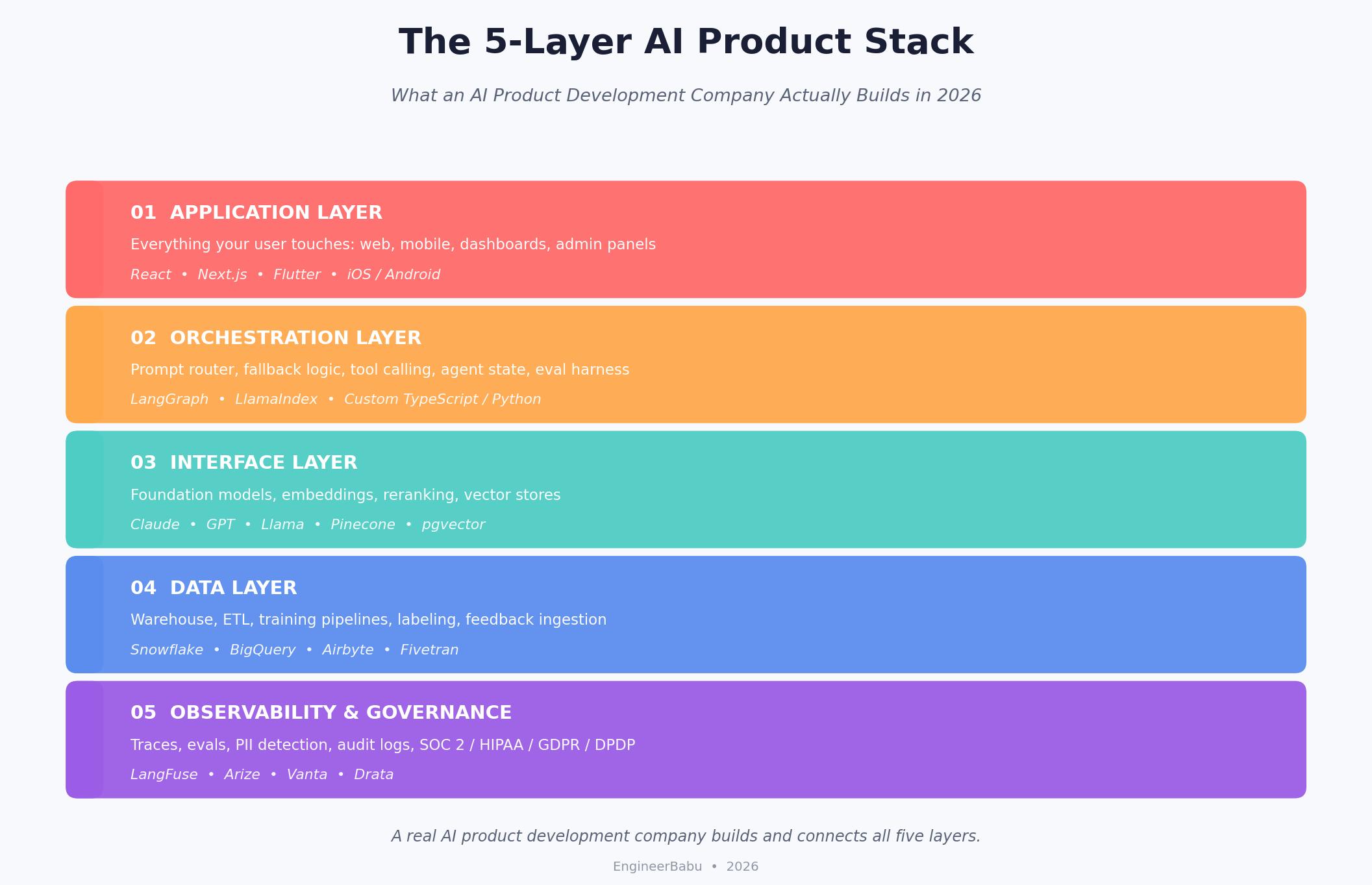
Which is your warehouse, ETL, training data pipeline, labeling workflow, and feedback ingestion? Snowflake or BigQuery. Airbyte or Fivetran. A labeling tool that fits your domain.
Which is what separates products from prototypes. LangFuse or Arize for traces. Custom evals. PII detection. Audit logs. Compliance artifacts for SOC 2, HIPAA, GDPR, DPDP.
A real AI product development company for startups builds and connects all five. A vendor who only talks about the first three is selling you a science project.
An AI MVP in 2026 runs between $140,000 and $300,000+, while a traditional MVP comes in at $30,000 to $55,000.
That gap is not arbitrary. The AI MVP is a different product.
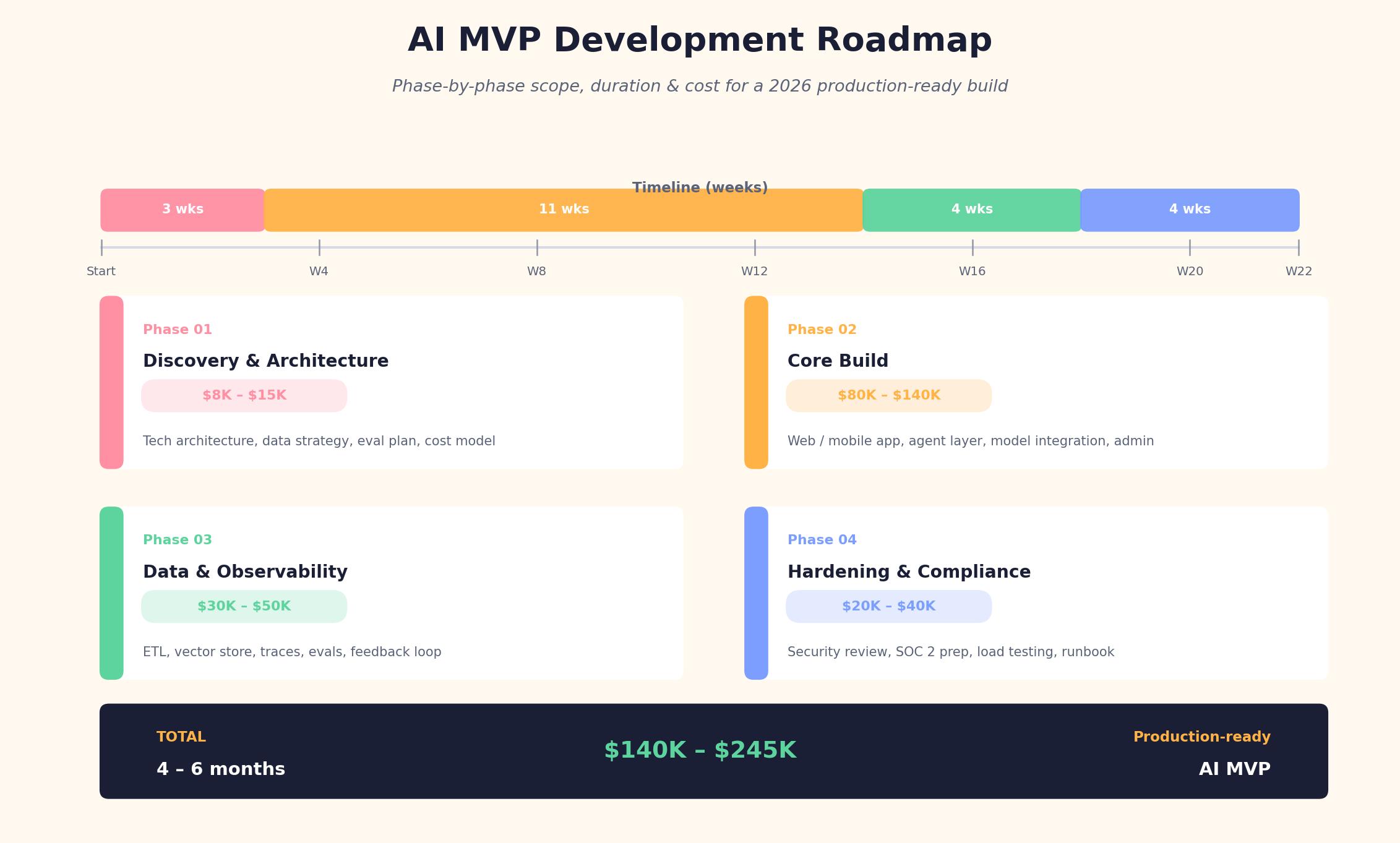
Here is roughly how the EngineerBabu team scopes a typical AI-native MVP for a seed or Series A startup.
| Phase | Duration | Cost Range (USD) | What You Get |
| Discovery and architecture | 2-3 weeks | $8,000-$15,000 | Tech architecture, data strategy, eval plan, cost model |
| Core build (application + orchestration) | 10-14 weeks | $80,000-$140,000 | Web/mobile app, agent layer, model integration, basic admin |
| Data pipeline and observability | 4-6 weeks | $30,000-$50,000 | ETL, vector store, traces, evals, feedback loop |
| Hardening and compliance | 3-4 weeks | $20,000-$40,000 | Security review, SOC 2 prep, load testing, runbook |
| Total | 4-6 months | $140,000-$245,000 | Production-ready AI MVP |
A simple AI MVP can ship in 6-10 weeks. A complex compliance-heavy build takes 16-24 weeks
AI-assisted development has compressed timelines by 40-60% for teams that know how to use it. Most teams do not.
The trap is the $40,000 quote. There is always a vendor willing to give you one. What they are quoting is the application layer.
You will spend the difference yourself, twice, when you rebuild the orchestration and observability layers after your first incident.
You can also go through MVP app development company on USA for further information.
Founders ask me which model to use. I do not give them a default. I give them a filter.
if you have a technical co-founder with shipped ML development or LLM experience, a 12-month runway after the hire, and your AI is a permanent moat (not a feature). At seed stage with less than $3M raised, this is almost never the right answer.
The opportunity cost of your co-founder doing recruiting and hiring for six months is higher than the cost of a senior team that ships in week one.
if your AI is core to the product but not your only differentiator, your timeline to revenue is under 12 months, and you need senior architecture from day one. This is the path for 80% of the founders I talk to.
If you already have a small team and need a specific gap filled. Vector search expertise. A fine-tuning specialist. Compliance prep. Useful for series A and beyond, rarely useful at seed.
The framework collapses to this question: where is your team’s compounding learning? If it is in the AI work itself, build. If it is in distribution, domain, or design, partner.
I have lost count of how many times I have been hired to rebuild what a previous vendor delivered. The pattern is predictable.
The previous team optimized for the demo. They picked the most impressive model, wrote prompts that worked on their five test cases, and shipped a dashboard with charts.
When the founder showed it to a real user, the user asked a question outside the prompt’s training and the system hallucinated a refund policy that did not exist.
When the EngineerBabu team built EarlySalary’s lending stack, which now processes ₹10,000 crore in disbursements, the first technical decision was not about credit scoring models.
It was about how the system would fail safely.
Every AI decision had a human review path. Every score had an audit trail. The model was the last thing we picked.
When we built Simba Beer’s AI inventory and field intelligence platform, the surprise was not the computer vision accuracy. It was that the salespeople refused to use the original UI.
We rebuilt the mobile experience three times before the model results actually changed business behavior. The AI was 90% of the impressive demo and 10% of the impact.
When we worked on OpenMoney’s neobank with mutual fund integration, the lesson was about regulated data.
You can have the best AI in the country and lose your license because someone logged a PAN number in a prompt trace. Observability done wrong is a compliance violation waiting to happen.
These are the lessons you do not get from a portfolio page. You get them from running the calls.
The industry pattern I see most often is overfitting to the model and underfitting to the product.
Vendors love to talk about RAG architectures, fine-tuning approaches, and benchmark scores. Founders love to listen, because it sounds technical and reassuring. Both miss the point.
A product is not a model with a UI. A product is a workflow that compresses time, removes friction, or unlocks a decision the user could not make before. The AI is a means. The workflow is the thing.
The second pattern is treating evaluations as an afterthought. 79% of enterprises have adopted AI agents in 2026 but in any business function no more than 10% are scaling them state by McKinsey State of AI 2025.
The gap is evals. Teams ship without a measurement system, then have no way to compare model A to model B, or prompt v1 to prompt v2. They are flying blind.
The third pattern is single-model dependency. Building your entire product on one foundation model in 2026 is a unforced error.
Model prices and capabilities shift quarterly. The architecture has to assume the underlying model will be swapped within 12 months. If it cannot, your unit economics are not yours.
They belong to OpenAI’s pricing committee.
The fourth pattern, and this is the contrarian one, is hiring too senior too early on the AI side and too junior too early on the product side.
Founders pay $400/hour for a PhD on the model and $40/hour for a frontend developer.
The PhD will deliver a model that works. The $40/hour frontend developer will deliver an app users abandon. Invest in product surface. The model is a commodity.
Here is the checklist I would use if I were on the other side of the table.
First, ask them to walk you through a failure. Not a case study. A project that did not work, what went wrong, and what they learned.
Vendors who cannot answer this have not been honest with themselves long enough to be useful to you.
Second, ask who is actually on the call when decisions get made. If the salesperson cannot tell you the name of the architect, the architect is not on the project.
You will get a junior team with an account manager translating between you and them. That model fails for AI work.
Third, ask about their evaluation methodology. If they cannot describe how they measure model output quality, regression test prompts, and track drift over time, they have never shipped a serious AI product to production.
Fourth, ask about cost modeling. A vendor who cannot tell you the unit economics of a typical user interaction, including model calls, embedding refreshes, and storage, has not thought about your business.
Fifth, ask for references from clients in your stage and your domain. A vendor with five enterprise clients and zero seed-stage shipments will not understand your pace.
Sixth, ask what they say no to. Vendors who take every project are not selecting for fit. They are selecting for cash flow. You want a partner whose constraints look like yours.
The technology choices that matter for an AI product development company for startups in 2026 are not the obvious ones.
For the foundation model, default to a multi-model strategy. Anthropic Claude for reasoning-heavy work and long context. OpenAI GPT for cost-optimized routing.
Open-source like Llama, Mistral, or Qwen for inference cost reduction on high-volume paths. Build the router on day one, even if you only use one model on day one.
For the vector store, pgvector, if you are already on Postgres and your collection is under 10M vectors. Pinecone or Weaviate when you cross that line.
The default for most seed-stage products is pgvector. Avoid premature optimization.
For the orchestration framework, do not pick a framework before you understand the workflow. LangGraph for state-heavy agent flows. LlamaIndex for retrieval-heavy work.
Custom TypeScript or Python developers orchestration when you need maximum control. I have seen too many products built on a framework that did not match the problem.
For observability, LangFuse, Arize, or Helicone. Pick one in week one. Wiring it in week 14 means you fly blind for three months.
For the application stack, Next.js plus a Python FastAPI service for AI workloads is the boring, correct answer for 80% of startup builds. Boring is good. Boring ships.
For compliance, SOC 2 Type 1 in months 4-6, Type 2 starts the audit clock when you have customer revenue. Vanta, Drata, or Secureframe handle the paperwork. The hard work is the underlying controls.
The single architecture decision that most often separates startups that scale from startups that stall is the prompt and model abstraction layer.
Most teams call the model directly from their application code. That works on day one. It does not work on day 180, when you need to swap models, run A/B tests, capture every input and output, redact PII before logging, version prompts, and roll back changes.
The teams that ship long-term build a thin model gateway in week one. Every call to a foundation model goes through it.
The gateway handles routing, retries, logging, redaction, and rate limiting. The application code does not know which model it is talking to.
This is the kind of decision an experienced AI product development company makes without being asked. A junior team does not know it needs to.
The trend lines for 2026 and 2027 are clear from the data and from what I am seeing on calls.
Agentic AI is moving from experiment to production. 23% of organizations are now scaling agentic systems somewhere in their business.
Most startups will need to design for agents in their architecture even if they ship a single-turn product first.
Inference cost is going to keep falling. The teams that win are the ones that design their unit economics for the cost structure 18 months from now, not today’s.
Compliance is becoming a moat. With the EU AI Act, India’s DPDP rollout, and sector-specific regulations in lending and healthcare, compliance-ready architecture is a sales asset, not overhead.
Vertical AI is winning. Horizontal copilots are crowded. The startups closing enterprise contracts in 2026 are domain-specific, integrated deeply into existing workflows, and built by teams with domain experts on the architecture call.
A simple AI MVP ships in 6-10 weeks. A standard SaaS AI MVP takes 10-16 weeks. A complex or compliance-heavy AI MVP, including fintech, healthtech, or anything with strict data residency, takes 16-24 weeks. AI-assisted development can compress these timelines by 40-60% for experienced teams.
Ask them to describe a project that failed and what they learned. Ask who is on the call when architecture decisions get made.
Ask how they measure model quality and drift. Ask for unit economics on a typical user interaction. Ask for references from your stage and domain. If they cannot answer any of these clearly, they are not the right partner.
The right partner can. Senior teams have seen investor diligence checklists and know how to document architecture, data lineage, model evaluations, and compliance posture in a way that holds up in a technical due diligence call.
This is one of the highest-leverage uses of a senior partner during a seed or Series A round.
Avoid fixed-bid projects on AI work. Scope changes are inevitable because the model behavior reveals product requirements you did not know existed. Insist on weekly demos with real data, not curated examples.
Build observability in week one, not week fourteen. Pick a partner who will say no to your bad ideas, not one who will build whatever you ask for.
For most seed and Series A startups, yes. A senior India-based team like EngineerBabu costs 40-60% less than a comparable US team and ships at equal or higher quality.
The risk is picking a vendor who treats you like an outsourcing client. Pick a partner who works in your timezone overlap, communicates founder-to-founder, and treats your product as their portfolio.
If you are evaluating AI development services companies for your startup and want to talk through the architecture decisions before you commit to a vendor, I am usually the one on those calls.
I take about 20 projects a year and I am on every one of them personally.
Send me a note at mayank@engineerbabu.com with what you are building and where you are in the process. If we are not the right fit, I will tell you, and I will usually know someone who is.
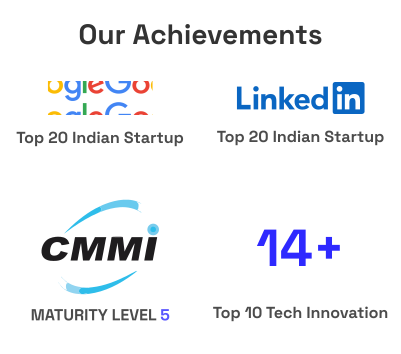
Mayank Pratap is the co-founder of EngineerBabu, a CMMI Level 5 product engineering company that has delivered 500+ projects across 20+ countries, including 200+ VC-funded products, 75 YC-selected builds, and four unicorn clients.
EngineerBabu is a Google AI Accelerator Top 20 company globally (2024), a NASSCOM member, LinkedIn Top 20 Startups India, and is backed by Vijay Shekhar Sharma. Mayank has been building technology products for 14 years and leads every engagement personally, from architecture reviews to scope trade-offs.
Reach Mayank: mayank@engineerbabu.com