India vs Ukraine Software Outsourcing: The Real Comparison (2026)


Create engaging, high-performance mobile applications tailored to your business needs. We craft future-ready apps that offer smooth user experiences on all devices.
Build robust and scalable websites and CMS platforms that help you manage content effortlessly. Our development ensures a seamless digital presence.
Launch secure, feature-rich online stores with intuitive shopping experiences. We build tailored eCommerce platforms designed for growth.
Design captivating games with immersive gameplay and stunning graphics. From concept to launch, we build engaging experiences that players love.
Enhance your customer relationships with customized Salesforce implementations. Drive growth and efficiency with smarter CRM solutions.
Harness artificial intelligence and machine learning to automate workflows and gain actionable insights. Our AI transforms data into smart decisions.
Accelerate your software delivery lifecycle with continuous integration, delivery, and infrastructure automation to boost efficiency.
Hire app developers ready to turn your ideas into sleek, high-performing mobile apps for any platform.
Bring in frontend pros who craft smooth, beautiful, and user-friendly interfaces that your visitors will love.
Get backend developers who build fast, secure, and reliable systems to keep everything running behind the scenes.
Hire eCommerce developers who build secure, scalable online stores designed to offer seamless shopping and grow your sales.
Get dedicated developers committed to your projects, delivering consistent quality and speed as an extension of your team.
The Question That Comes Up on Almost Every Sales Call
I get asked the same question at least twice a month: “We’re deciding between India and Ukraine — what would you do?”
Last quarter, I was on a call with a Berlin-based fintech founder building a lending origination platform. Smart guy. Had already spoken to 3 agencies in Kyiv and 2 in Bangalore. He’d built a comparison spreadsheet. Hourly rates. Time zones. English proficiency scores he’d pulled from some blog.
I asked him one thing: “What happens to your project if a geopolitical event grounds operations for 6 weeks?”
He went quiet.
That one question — not the hourly rate, not the NLP score, not which city has more JavaScript developers — is what separates a vendor decision from an engineering strategy. I’ve delivered 500+ projects across 20+ countries through EngineerBabu, a CMMI Level 5 certified product engineering company. I’ve worked with teams in both geographies.
Here’s what I actually know.
India vs Ukraine software outsourcing comes down to this: both are legitimate, high-quality outsourcing destinations with strong engineering talent pools, but they differ fundamentally in scale, cost stability, risk profile, and the types of product complexity they’re best suited to handle.
India offers depth, redundancy, and a wider specialization range. Ukraine offers tight team culture and strong frontend and low-level systems expertise — when operational continuity is not a concern.
This isn’t a “Ukraine bad, India good” argument. It’s a risk-adjusted value argument.
Let’s start with a number most comparison blogs skip: scale.
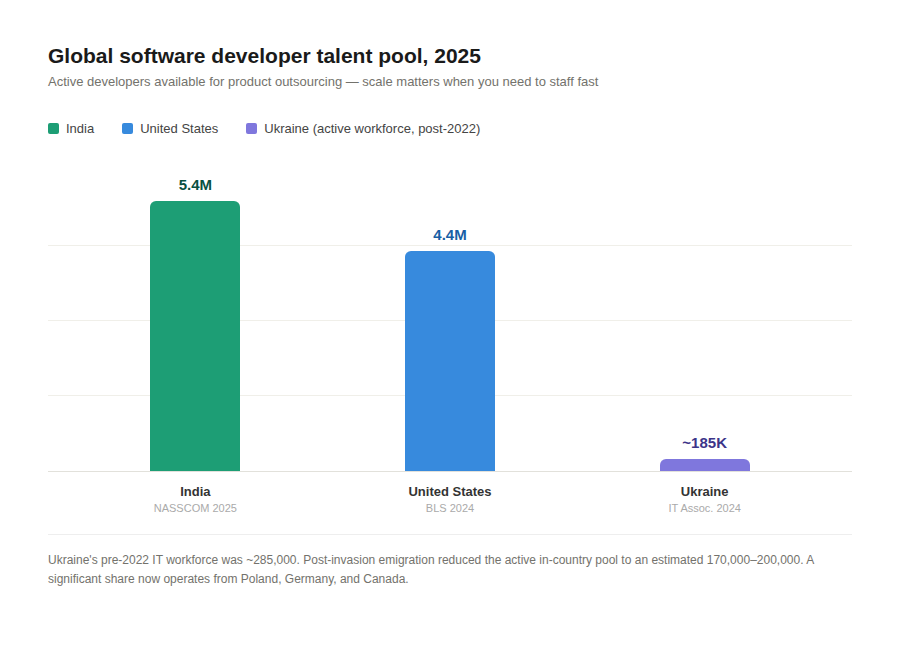
India has approximately 5.4 million software developers as of 2025, making it the largest tech talent pool globally. Ukraine, pre-2022, had roughly 285,000 IT professionals.
Post-invasion estimates put the active, in-country workforce at around 170,000-200,000, with significant talent diaspora in Poland, Germany, and Canada.
(Source: NASSCOM, 2025 Tech Talent Report; Ukraine IT Association, 2024)
That’s not a judgment on Ukrainian developers, many of the best engineers I know came out of Kyiv and Kharkiv. It’s arithmetic. When you need to scale a team from 8 to 30 in 90 days, the math matters.
When you need a specialized team with, say, 4 fintech compliance engineers, 2 ML engineers familiar with lending models, and a solutions architect with BFSI experience — the probability of finding that combination in India versus Ukraine is very different.
For the EngineerBabu team, our hiring funnel draws from Pune, Bangalore, Hyderabad, and Indore. For a mid-size product build, we can staff with the right seniority mix in 3-4 weeks. That’s not exceptional for India — that’s table stakes.
Here’s the comparison most blogs give you:
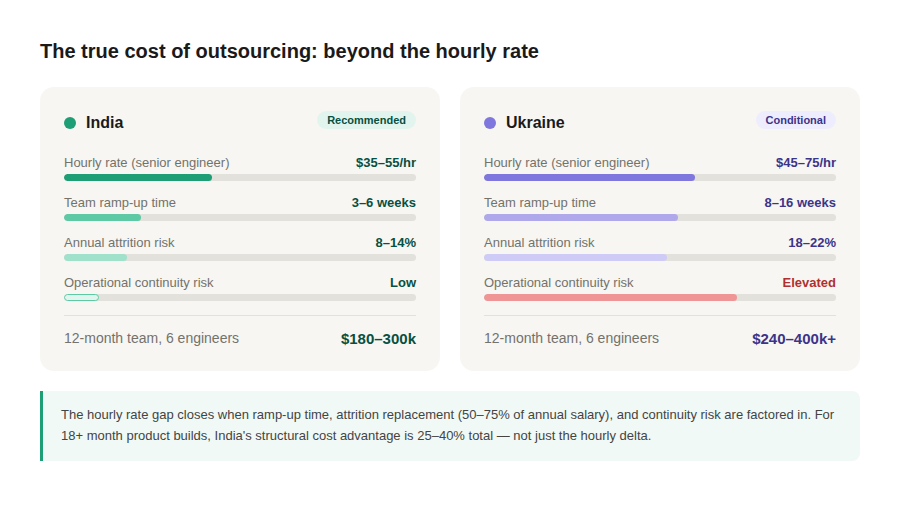
These numbers are roughly accurate. But they’re only useful if you’re hiring individual freelancers on Upwork. For product teams, the hourly rate is the least important cost variable.
What actually determines your outsourcing cost:
The project economics I run on EngineerBabu’s fixed-price builds are built around total delivery cost, not hourly rate. When I quote a product, the rate is rarely what changes the outcome, it’s the assumptions underneath it.
I want to be direct here because most comparison content treats this like a footnote.
Russia’s full-scale invasion of Ukraine began in February 2022. By Q2 2022, multiple international companies building products with Ukrainian development teams were mid-sprint with teams that were physically relocating, joining territorial defense units, or operating on intermittent power and internet. The disruption was real and measurable.
A 2023 survey by Clutch found that 34% of companies using Ukrainian software development vendors experienced project delays exceeding 4 weeks in 2022, and 12% reported complete project abandonment due to team unavailability. (Source: Clutch, “State of Global Outsourcing 2023”)
I’m not saying this to dismiss Ukrainian developers. I’m saying it because any CTO building on a 12-18 month timeline needs to price this risk honestly.
The question isn’t “will something happen?” The question is: “If it does, is my product architecture resilient enough to survive a 6-week team disruption, and is my vendor structured for that?”
Most vendors aren’t. Most clients don’t ask.
The risk conversation sometimes makes people think I’m dismissing Ukraine entirely. I’m not. There are specific product types where Ukrainian developers have historically delivered exceptional work:
Kyiv and Lviv have produced some of the strongest React and Vue.js engineering communities in Eastern Europe. The product culture there for UI/UX-heavy applications is genuinely strong.
Ukraine has a tradition of strong computer science education — particularly in Kharkiv and Kyiv universities — that shows up in systems-level code quality.
Ukraine has a notable game dev ecosystem (4A Games, GSC Game World) that has cross-pollinated skills into the broader developer community.
If you need 3 exceptional engineers for a 4-month product sprint with clear scope and no scaling requirement, Ukrainian developers can be excellent value — particularly the diaspora talent now based in Poland or Germany that combines European time zones with competitive rates.
The profile that should NOT be building primarily on a Ukraine-based team: a funded startup raising Series A, building a complex SaaS or fintech product, expecting to scale from MVP to production in 18 months, with a product roadmap that will require team expansion.
India’s software outsourcing industry isn’t great because of cheap labor. That framing is 15 years out of date. It’s great because of institutional depth.
CMMI Level 5 certification exists as a quality framework precisely because Indian software companies needed to demonstrate process maturity to global clients. It’s not a stamp — it’s an operational discipline.
The EngineerBabu team maintains CMMI Level 5 certification and NASSCOM membership not for the logos, but because the processes they represent genuinely change how projects are managed.
What that means in practice:
Repeatable delivery processes. After 500+ projects, patterns emerge. We know where projects fail. We’ve built process checkpoints specifically around those failure modes.
Regulatory familiarity for complex products. If you’re building a fintech product for an Indian market — a lending platform, a neobank, a mutual fund integration — the regulatory landscape is deeply understood locally.
When we built EarlySalary’s lending stack, which now processes over ₹10,000 crore in disbursements, the architecture decisions weren’t just technical — they were compliance decisions built into the system from day one. That kind of domain overlap is hard to replicate remotely.
Distributed risk within geography. India’s tech talent sits in at least 8 major cities. A disruption in one city doesn’t ground the whole project.
English-medium education at scale. India has one of the world’s largest English-medium engineering education systems. Communication quality at the mid-senior level is consistently strong.
Here’s the standard argument: Ukraine is UTC+2/+3, India is UTC+5:30. For European clients, Ukraine is more convenient. For US clients, India still works but requires schedule discipline.
I’ve built products for clients in San Francisco, New York, London, Berlin, and Singapore. The time zone question matters less than the communication infrastructure.
What matters more:
A team that gives you a clear 2-3 hour overlap window and actually shows up to it is worth more than a same-time-zone team that takes 6 hours to respond to a Slack message.
A team that over-documents decisions in writing — so an async review cycle at 11pm your time still moves the project — beats any time zone advantage.
At EngineerBabu, almost all client communication happens through structured async systems. Our clients in London get same-day responses before their morning standup. Our clients in Austin get updates before they leave the office. The 5.5-hour offset is real, but it’s a solved problem with process.
That said: if you’re building a product where your primary interaction is with a single non-technical founder who needs to be on calls daily, Ukraine’s time zone alignment with Europe is a genuine advantage worth pricing in.
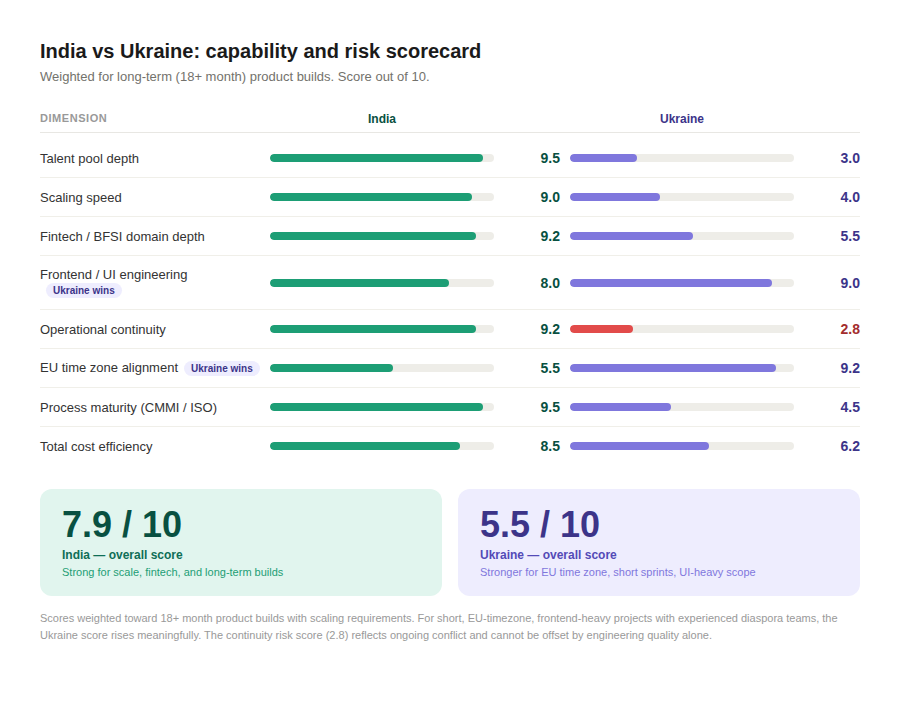
Use this to structure your vendor evaluation, not as a substitute for it.
| Factor | India | Ukraine |
| Talent pool size | 5.4M+ developers | ~170-200K active (post-2022) |
| Average senior engineer rate | $35-55/hr | $45-75/hr |
| Scaling speed (8 to 30 engineers) | 3-6 weeks | 8-16 weeks (current market) |
| Operational continuity risk | Low | Elevated (ongoing conflict) |
| Frontend/UI specialization | Strong | Very strong |
| Fintech/BFSI domain depth | Very strong | Moderate |
| European time zone fit | Moderate | Excellent |
| US time zone fit | Workable | Moderate |
| CMMI/ISO certified vendors | Abundant | Limited |
| English communication (B2+ level) | Very strong | Strong |
| Long-term (18+ month) project fit | Excellent | Conditional |
The biggest mistake I see companies make: they treat this as a talent quality decision when it’s actually a risk architecture decision.
Both India and Ukraine have excellent engineers. The 10x developer exists in both places. The question isn’t “where are the better developers?” The question is: “What kind of risk am I embedding into my product’s development infrastructure?”
A funded startup with 18 months of runway and a Series A target cannot afford a 6-week development disruption. It’s not a political statement — it’s a financial one.
The second mistake: evaluating based on demos and proposals, not delivery history. Every agency can show you a beautiful proposal. Ask for 3 client references for projects similar in complexity to yours, and actually call them.
Ask specifically: “Did they deliver on time, on scope, on budget — and how did they handle the first major scope change?” The answer to the last question is the most informative.
The third mistake: not thinking about what comes after launch. A product doesn’t end at go-live. You need bug fixes, feature releases, infrastructure scaling, security patches. The vendor you choose is a 3-5 year relationship, not a 6-month project. Evaluate them accordingly.
When the EngineerBabu team built OpenMoney’s neobank platform — a product that combined banking, mutual fund investments, and insurance in a single app — the architecture decisions were interdependent with the team structure.
The product needed 7 engineers across backend, frontend, compliance integration, and DevOps. The timeline was 14 months to production. The regulatory touchpoints included SEBI, RBI, and 3 insurance API integrations.
A distributed team with high replacement risk wasn’t viable. The compliance architecture alone required an engineer who understood India’s financial regulatory stack deeply enough to make real-time decisions about API development. That’s not a skill you can onboard mid-project.
We staffed from Pune and Bangalore. The team hit zero attrition over 14 months. The product launched on schedule.
I’m not saying every project needs that setup. I’m saying: know what your project actually requires before you optimize for hourly rate.
If you’re at the stage where you’re seriously comparing India versus Ukraine for your product build, you’re probably also trying to figure out whether to go fixed-price or time-and-material, how to structure IP ownership, and what “agile” actually means in practice with a remote vendor.
Those questions matter more than the geography decision.
I’m usually the one on these early-stage calls at EngineerBabu. We take 20 projects a year, every client is a referral, and there’s no sales team between you and me.
If you want to talk through your architecture decisions before you commit to a vendor, reach out directly: mayank@engineerbabu.com
Not a pitch. Just a conversation.
Mayank Pratap is the co-founder of EngineerBabu, a CMMI Level 5 product engineering company that has delivered 500+ products across 20+ countries. EngineerBabu is a Google AI Accelerator Top 20 company (2024), NASSCOM member, and LinkedIn Top 20 Startup in India.
Mayank has led product builds for 4 unicorn clients, 75 YC-selected companies, and 200+ VC-funded products. He is personally involved in every project the company takes on.
Connect on LinkedIn | mayank@engineerbabu.com
It depends on your risk tolerance and project type. Many Ukrainian developers have relocated to Poland, Germany, and other EU countries, and continue to deliver strong work from those locations. Pure in-Ukraine operations carry elevated continuity risk. If you’re considering a Ukrainian agency, ask specifically where your team will be physically located and what their contingency plan is for escalation events.
Fintech products, large-scale SaaS platforms, mobile apps requiring rapid team scaling, and any project with 18+ month timelines or regulatory complexity benefit most from India-based outsourcing. India’s engineering depth in BFSI, enterprise software, and API-heavy backend systems is particularly strong.
Ask for 3 references for projects of comparable scope and complexity — and call them. Specifically ask how the vendor handled the first major scope change mid-project. Review their process for handling technical debt. Ask what percentage of their projects are delivered on the original timeline. CMMI Level 5 certification is a meaningful signal of process maturity.
For a team of 6 mid-to-senior engineers including a tech lead, full-stack developers, and a QA engineer, expect $180,000-$300,000 for 12 months on a fixed-price project basis with an established vendor. Hourly-rate team augmentation from a staffing agency will run lower but comes with higher management overhead and attrition risk.
For most clients, no. The 5.5-hour offset with Europe and 9-12 hour offset with the US is manageable with structured communication protocols. The bigger risk is a vendor that uses time zone as an excuse for poor async communication.
The best India-based teams have solved this — look for vendors who over-document decisions and provide written daily updates, not just call-heavy workflows.