Outsource Software Development to India from Canada: A Founder's Honest Guide (2026)


Create engaging, high-performance mobile applications tailored to your business needs. We craft future-ready apps that offer smooth user experiences on all devices.
Build robust and scalable websites and CMS platforms that help you manage content effortlessly. Our development ensures a seamless digital presence.
Launch secure, feature-rich online stores with intuitive shopping experiences. We build tailored eCommerce platforms designed for growth.
Design captivating games with immersive gameplay and stunning graphics. From concept to launch, we build engaging experiences that players love.
Enhance your customer relationships with customized Salesforce implementations. Drive growth and efficiency with smarter CRM solutions.
Harness artificial intelligence and machine learning to automate workflows and gain actionable insights. Our AI transforms data into smart decisions.
Accelerate your software delivery lifecycle with continuous integration, delivery, and infrastructure automation to boost efficiency.
Hire app developers ready to turn your ideas into sleek, high-performing mobile apps for any platform.
Bring in frontend pros who craft smooth, beautiful, and user-friendly interfaces that your visitors will love.
Get backend developers who build fast, secure, and reliable systems to keep everything running behind the scenes.
Hire eCommerce developers who build secure, scalable online stores designed to offer seamless shopping and grow your sales.
Get dedicated developers committed to your projects, delivering consistent quality and speed as an extension of your team.
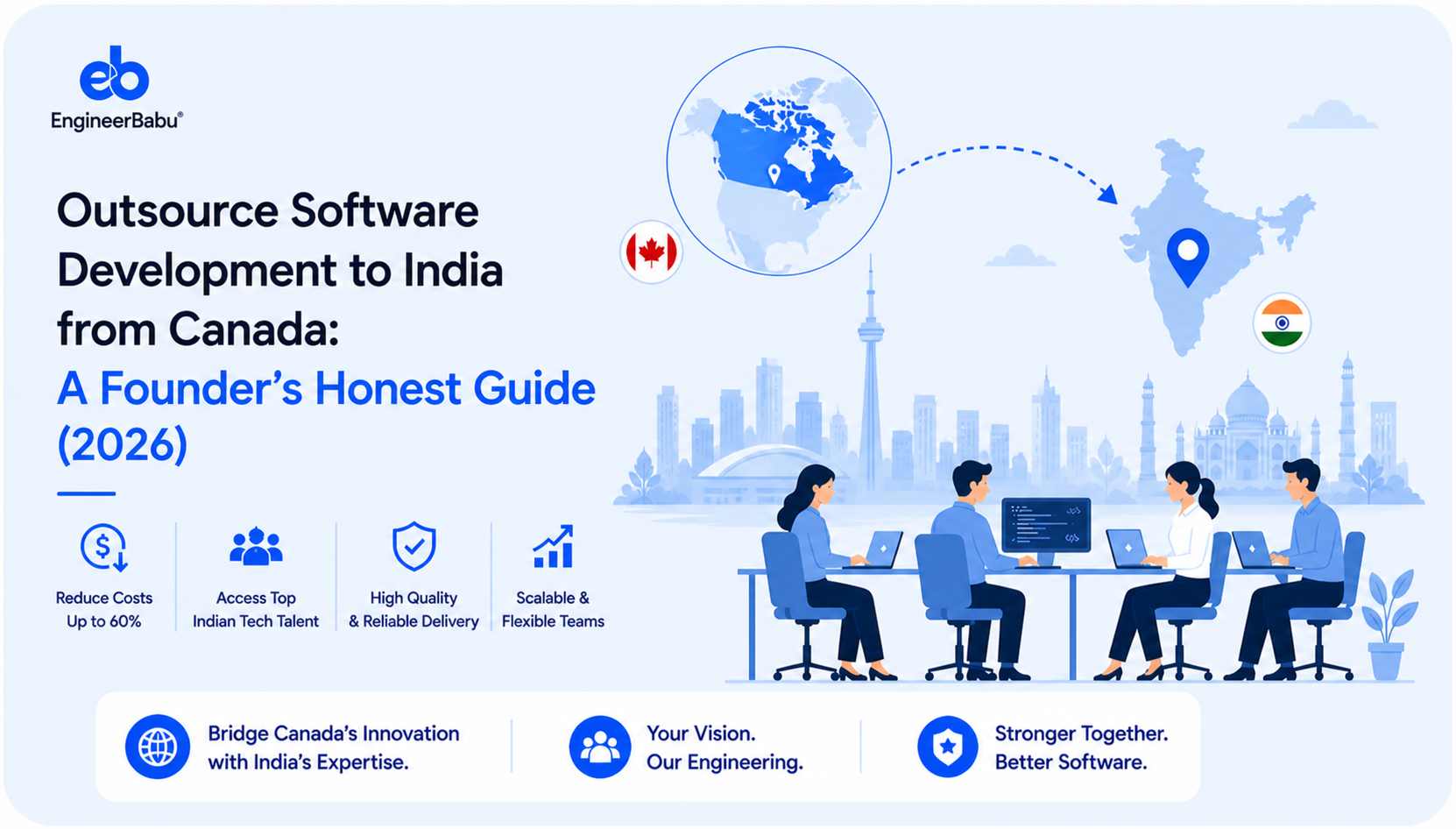
A Canadian SaaS founder I spoke to recently had already burned through $340,000 CAD with two local agencies—eighteen months of work, and still no product they could ship. The third agency they approached was charging $180/hour for senior engineering.
On a $2M runway, that math didn’t work. They found EngineerBabu through a referral, rebuilt the entire platform in 7 months, and launched to paying customers. That story isn’t unusual.
It’s actually the median path I see from Canadian companies who decide to outsource software development to India from Canada and eventually find the right partner.
The question isn’t whether you should outsource software development to India from Canada. For most product-stage startups and growth-stage companies, the answer is obvious once you do the math.
The real question is how to do it without losing 12-18 months to a bad engagement. This guide is the answer I give founders when they ask me on a call—before they’ve committed to anyone.
EngineerBabu, a CMMI Level 5 certified product engineering company based in India, has built over 500 products across 20+ countries, including 75 YC-selected companies and 4 unicorn clients.
I’ve personally been on the architecture calls, the sales conversations, the post-mortem reviews when things went sideways with previous vendors. I know what goes wrong. I also know what works.
Outsourcing software development to India from Canada means engaging Indian engineering teams—either agencies or dedicated developers—to build, scale, or maintain your software product, typically at 40-70% lower total cost than equivalent Canadian talent.
But cost is the wrong lens to start with. The more important truth is talent density. India graduates over 1.5 million engineering students annually. The top 10% of that pool—the engineers working at CMMI Level 5 certified companies, the developers with fintech and SaaS product backgrounds—are genuinely world-class.
They’re not cheaper because they’re worse. They’re cheaper because of the currency differential and a lower cost of living.
The work is comparable. In many cases, especially in complex domains like lending technology, neobanking, or AI-powered inventory systems, the Indian product engineering ecosystem has built more at scale than most Canadian teams have had the chance to.
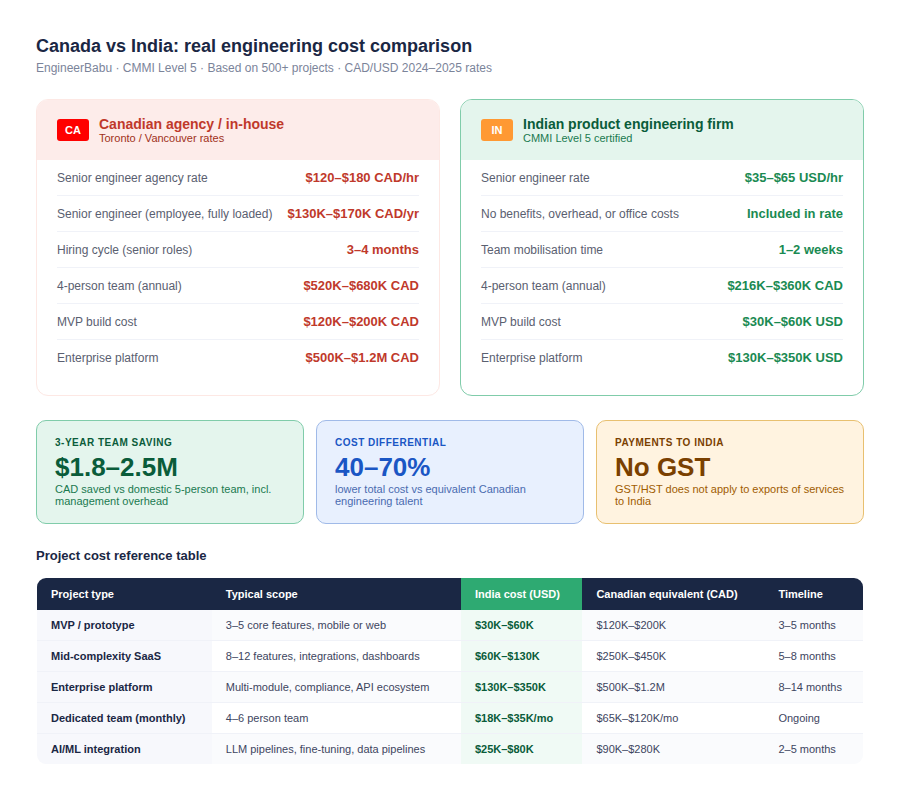
The cost reality is this: senior full-stack engineers in Toronto or Vancouver bill at $120-180 CAD/hour through agencies, or cost $130,000-170,000 CAD annually as employees once you factor in benefits, office, and overhead. The equivalent senior engineer in India, working through a quality-assured firm, runs $35-65 USD/hour.
For a 4-person product team over 12 months, that’s a saving of $600,000-800,000 CAD—money that goes back into product, marketing, or runway extension.
Canadian startups in particular feel this acutely. The talent market in Toronto, Vancouver, and Montreal is intensely competitive. Engineering salaries have escalated sharply since 2020. Hiring cycles stretch to 3-4 months for senior roles.
When companies choose to outsource software development to India from Canada, they solve three problems at once: cost, speed-to-hire, and timezone-adjusted availability.
I’ve seen roughly 500 project starts. The ones that succeed share a specific structure.
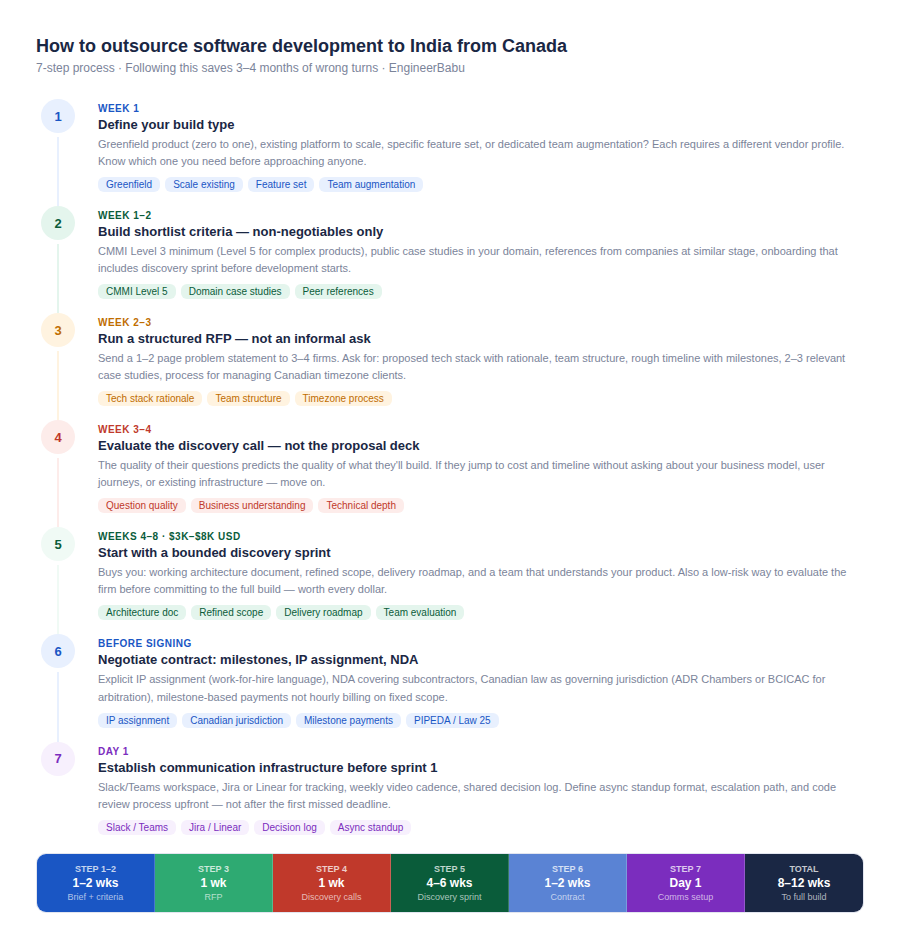
The EngineerBabu team structures every engagement around 2-3 week sprint cycles with defined deliverables. Before a single line of code is written, we do a discovery sprint: architecture review, tech stack decision, team structure, and a delivery roadmap the client can hold us to.
Following this process will save you 3-4 months of wrong turns.
Is this a greenfield product (zero to one), an existing platform you need to scale, a specific feature set, or a dedicated team augmentation? Each requires a different vendor profile.
Non-negotiable for serious work: CMMI certification (Level 3 minimum, Level 5 for complex products), public case studies in your domain, references from companies at a similar stage, and an onboarding process that includes a discovery sprint before development starts.
Send a 1-2 page problem statement to 3-4 firms. Ask for: proposed tech stack with rationale, team structure, rough timeline with milestones, 2-3 relevant case studies, and their process for managing Canadian timezone clients.
The quality of the questions they ask you predicts the quality of what they’ll build. If they immediately jump to cost and timeline without asking about your business model, user journeys, or existing infrastructure, move on.
This buys you a working architecture document, a refined scope, a delivery roadmap, and a team that now understands your product. It also gives you a low-risk way to evaluate the firm before committing to the full build.
More on the legal structure below.
Slack or Teams workspace, Jira or Linear for project tracking, weekly video call cadence, and a shared document for decisions and context.
The numbers most articles give you are vague. Here’s what things actually cost.
| Project Type | Typical Scope | India Cost (USD) | Canadian Equivalent (CAD) | Time |
| MVP / Prototype | 3-5 core features, mobile or web | $30,000–60,000 | $120,000–200,000 | 3–5 months |
| Mid-complexity SaaS product | 8-12 features, integrations, dashboards | $60,000–130,000 | $250,000–450,000 | 5–8 months |
| Enterprise platform | Multi-module, compliance-heavy, API ecosystem | $130,000–350,000 | $500,000–1,200,000 | 8–14 months |
| Dedicated team (monthly) | 4-6 person team | $18,000–35,000/month | $65,000–120,000/month | Ongoing |
| AI/ML feature integration | LLM pipelines, model fine-tuning, data pipelines | $25,000–80,000 | $90,000–280,000 | 2–5 months |
These are honest ranges from actual projects, not marketing numbers. The lower end assumes you have clear specs, fast feedback loops, and no major pivots mid-build.
Add 20-30% buffer for anything involving regulatory compliance, complex third-party integrations, or a client team that hasn’t done outsourced development before.
One thing most articles won’t tell you: the cost difference compounds significantly over time. A Canadian company that builds a 5-person engineering function in India instead of domestically typically saves $1.8-2.5M CAD over three years, even accounting for management overhead and occasional misses.
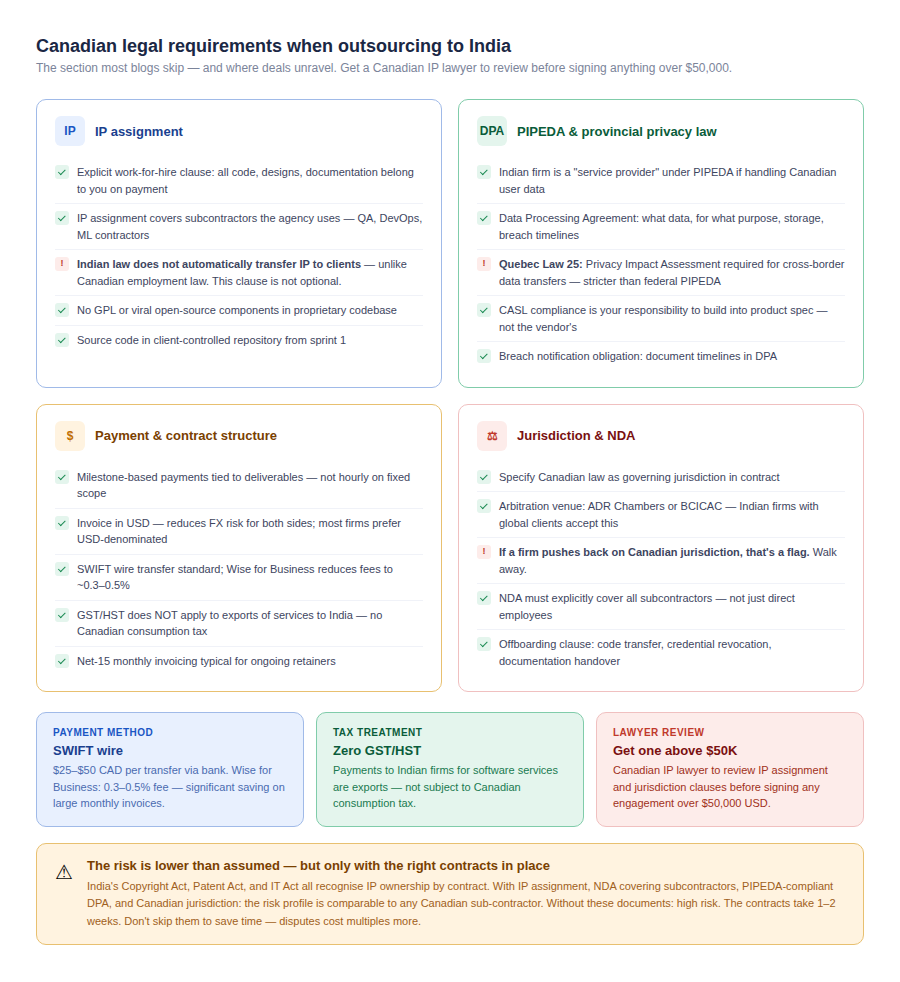
When you outsource software development to India from Canada, you take on specific legal obligations that most agencies—and many blogs—won’t spell out. This is the section most skip, and it’s where deals unravel.
Every contract must have explicit IP assignment language confirming that all code, design assets, and documentation created during the engagement become your property upon payment. Indian law does not automatically transfer IP to the client the way Canadian employment law does for employees. If this clause isn’t in your contract, you don’t own what’s been built.
Standard, but check that the NDA covers subcontractors the agency might use. Many firms use specialized contractors for QA, DevOps, or ML development work. If those aren’t bound by the same confidentiality terms, your data and architecture could be exposed.
If your product handles Canadian user data, the offshore team is a “service provider” under PIPEDA. You need a Data Processing Agreement (DPA) that specifies: what data is accessed, for what purpose, how it’s stored, and breach notification timelines. Quebec’s Law 25 has stricter requirements including a privacy impact assessment for cross-border data transfers.
If your product involves any email or electronic communication to Canadian users, CASL rules apply to you, not your Indian vendor. This is your responsibility to build into the product spec.
Wire transfers to Indian companies are straightforward from Canadian banks. Use SWIFT transfers to Indian bank accounts; typical fees are $25-50 CAD per transfer. For ongoing engagements, some teams use Wise for Business to reduce transfer costs. GST/HST does not apply to exports of services to India—your payments are not subject to Canadian consumption tax.
Specify Canadian law as the governing jurisdiction and a Canadian arbitration venue (usually ADR Chambers or the BCICAC). Indian firms with global clients are used to this request. If a firm pushes back on Canadian jurisdiction, that’s a flag.
The most common question I get from companies that want to outsource software development to India from Canada isn’t about cost—it’s about capability. Indian product engineering firms have deep expertise across the modern stack.
Here’s where the density of experience is highest, based on what the EngineerBabu team encounters:
Node.js or Java backends, React or React Native frontends, PostgreSQL or MySQL for transactional data, Redis for session and caching layers. Cloud-native architecture on AWS or GCP.
Microservices with Kubernetes orchestration for anything at scale. KYC/AML pipeline integration with providers like Jumio, Onfido, or Persona. Credit bureau API integration. Regulatory reporting modules.
When EarlySalary (now Fibe) needed to build a full lending stack capable of handling ₹10,000 crore in disbursements, the architecture decisions were: event-driven microservices, separate origination and underwriting services, a configurable rule engine for credit policy, and a distributed collections module.
The stack has processed millions of loan applications. Those architecture decisions—made at the start—are why it scaled.
Saas Products such as React or Next.js frontends, Python or Node.js APIs, multi-tenant database architecture with row-level security, Stripe or Chargebee for billing, Segment or Amplitude for analytics, CI/CD pipelines on GitHub Actions or CircleCI.
LLM integration via OpenAI, Anthropic, or Google Gemini APIs. RAG (Retrieval-Augmented Generation) pipelines with vector databases like Pinecone or Weaviate. Fine-tuning workflows for domain-specific models. Real-time AI inference with latency optimization. MLOps pipelines for model versioning and monitoring.
The Simba Beer engagement is a good example of AI applied to a non-obvious domain. The challenge was field intelligence—distributors needed real-time inventory visibility and sales optimization.
The team built an AI inventory management layer that ingested field data, predicted on demand by SKU and region, and surfaced actionable restocking recommendations. No off-the-shelf tool did this. It had to be built from scratch with the business logic embedded in the ML pipeline.
React Native for cross-platform (iOS + Android from one codebase), Swift/SwiftUI for iOS-specific builds where performance is critical, Kotlin for Android-specific work. Firebase or Supabase for real-time features and auth.
After 500+ projects, these are the patterns I see repeatedly when companies outsource software development to India from Canada. Not one-off mistakes—systematic failures that happen across companies of different sizes and industries.
The cheapest firm isn’t just cheap—it’s cheap for a reason. Under-resourced teams cut corners on architecture, skip documentation, and disappear when bugs emerge post-launch.
The right question isn’t “who is cheapest” but “who has built something structurally similar to what I’m building, and can they prove it.”
A 10-page functional spec that takes 2 weeks to write will save you 3 months of rework. I’ve seen companies hand over a Figma file and a one-paragraph description and expect a production-grade product.
The offshore team will build something—it just won’t be what the client had in their head.
Daily commits and weekly demos feel like velocity. But if the architecture is wrong—a monolith where microservices were needed, a relational database where a time-series database was required, no caching layer on a high-read API—those commits are building toward a rebuild.
Technical oversight at the architecture layer is non-negotiable. Either your CTO reviews it, or you need a firm that does discovery properly.
A 30-minute daily standup is fine for Eastern time companies. For Pacific time companies, it means a 6:30-7:00 AM call.
Most Canadian companies underestimate this friction until it causes them to skip calls, which causes drift, which causes misalignment, which causes rework. Build the communication protocol before you start, not after the first missed deadline.
Fixed price only works with a fixed scope. If you know you’ll change your mind—and most product founders do—a time-and-materials contract with a defined team composition and sprint cadence is more honest.
Change requests on fixed-price contracts are where most disputes originate.
One of the hardest parts of choosing to outsource software development to India from Canada is evaluating firms before you’ve worked with them. Use this framework before signing anything.
Technical Due Diligence Checklist:
Process Signals:
Cultural Fit Signals:
Credential Signals (non-negotiable for serious work):
The engagement doesn’t end at launch. This is something most offshore vendors don’t discuss, and it’s where a lot of post-launch pain originates.
If you’re building an in-house team eventually, the offshore team needs to document everything—architecture decisions, API contracts, environment setup, deployment procedures, known technical debt. This documentation should be a contractual deliverable, not an afterthought.
For most SaaS products, you’ll need ongoing engineering support post-launch: bug fixes, performance optimization, new features, dependency updates. A monthly retainer (typically $5,000-15,000 USD depending on team size) with a defined support SLA is more predictable than ad-hoc project work.
Before the offshore team hands over the codebase, establish performance benchmarks: p95 API response times, error rates, uptime SLA, database query performance. These become your baseline for the post-launch retainer agreement and prevent disputes about what’s a bug versus what’s a new feature request.
The companies that get the most value from outsourcing to India are the ones who treat it like a real engineering partnership—not a transaction. They invest in the relationship, document their decisions, provide fast feedback, and trust the team to make technical calls within agreed parameters.
The companies that struggle are the ones who hire the cheapest option, hand over a vague brief, and expect the offshore team to read their minds. That failure pattern transcends geography. It happens with Canadian agencies and Indian agencies alike.
The structural advantage India offers—deep talent, genuine cost savings, a maturing ecosystem of product engineering firms with CMMI certification and domain specialization—is real. But it only materializes when you engage it properly.
Companies that outsource software development to India from Canada and treat it as a commodity purchase almost always regret it. Companies that treat it as a strategic hire almost always succeed.
Canada-India is one of the more natural pairings in the global outsourcing map. Strong English, cultural familiarity with Western product norms, and a 14-year-old offshore ecosystem that has built real products at real scale.
For a Canadian founder evaluating this path, the question is less “should I” and more “how do I find the right partner and structure the engagement to succeed.”
If you’re evaluating whether to outsource software development to India from Canada—and you want to think through the technical architecture, team structure, or engagement model before signing anything—I’m usually the one on those calls at EngineerBabu.
We take 20 projects a year. Every engagement involves me personally on the discovery sprint and architecture review. No account managers, no sales hand-offs.
Mayank Pratap Co-founder, EngineerBabu 14 years building technology products Google AI Accelerator, CMMI Level 5 | NASSCOM Member | LinkedIn Top 20 Startups India 500+ projects | 20+ countries | 75 YC-selected products built
From first conversation to code-in-production on a discovery sprint: 2-3 weeks. From signed contract to full team start on a product build: 1-2 weeks. The bottleneck is almost always on the client side—getting the spec finalized, IP assignment agreed, and the team’s questions answered.
A well-run Indian firm can mobilize quickly. A client who takes 4 weeks to respond to questions creates a 4-week delay.
Yes, with the right contracts. India’s Copyright Act, Patent Act, and IT Act all recognize IP ownership by contract.
The key elements: explicit IP assignment clause (work-for-hire language), NDA covering subcontractors, no open-source components with viral licenses (GPL) in your proprietary codebase, and proper offboarding procedures including code repository transfer and credential revocation.
I’d recommend a Canadian IP lawyer review the contract before you sign anything over $50,000.
For a dedicated project: $25,000-30,000 USD minimum. Below that, the overhead of context-switching, onboarding, and communication coordination eats into the cost advantage.
Most companies that successfully outsource software development to India from Canada start with either a bounded discovery sprint or a 3-month minimum commitment—not a one-off task.
Build your process around asynchronous-first communication. Document decisions in writing. Use Loom or similar for complex async explanations. Reserve the 1-2 hour daily overlap window for decisions that genuinely require real-time conversation.
For Toronto-based companies, a 7:30-8:30 AM EST standup covers the India working day’s end. For Vancouver, this shifts to 5:30-6:30 AM PST—some teams do it, most prefer fully async with twice-weekly video check-ins instead.
Wire transfer via SWIFT is the standard. Wise for Business reduces transfer fees significantly (typically 0.3-0.5% vs. 1-3% at banks). Invoice in USD—most Indian firms prefer USD-denominated contracts because it removes FX risk for both sides.
For ongoing engagements, monthly invoicing with Net-15 terms is common. Budget for $25-50 CAD in bank transfer fees per wire. Payments to Indian companies for software services are not subject to Canadian GST/HST.