How to Build an Online Doctor Consultation App - From the Team That Built for India's Largest Hospitals


Create engaging, high-performance mobile applications tailored to your business needs. We craft future-ready apps that offer smooth user experiences on all devices.
Build robust and scalable websites and CMS platforms that help you manage content effortlessly. Our development ensures a seamless digital presence.
Launch secure, feature-rich online stores with intuitive shopping experiences. We build tailored eCommerce platforms designed for growth.
Design captivating games with immersive gameplay and stunning graphics. From concept to launch, we build engaging experiences that players love.
Enhance your customer relationships with customized Salesforce implementations. Drive growth and efficiency with smarter CRM solutions.
Harness artificial intelligence and machine learning to automate workflows and gain actionable insights. Our AI transforms data into smart decisions.
Accelerate your software delivery lifecycle with continuous integration, delivery, and infrastructure automation to boost efficiency.
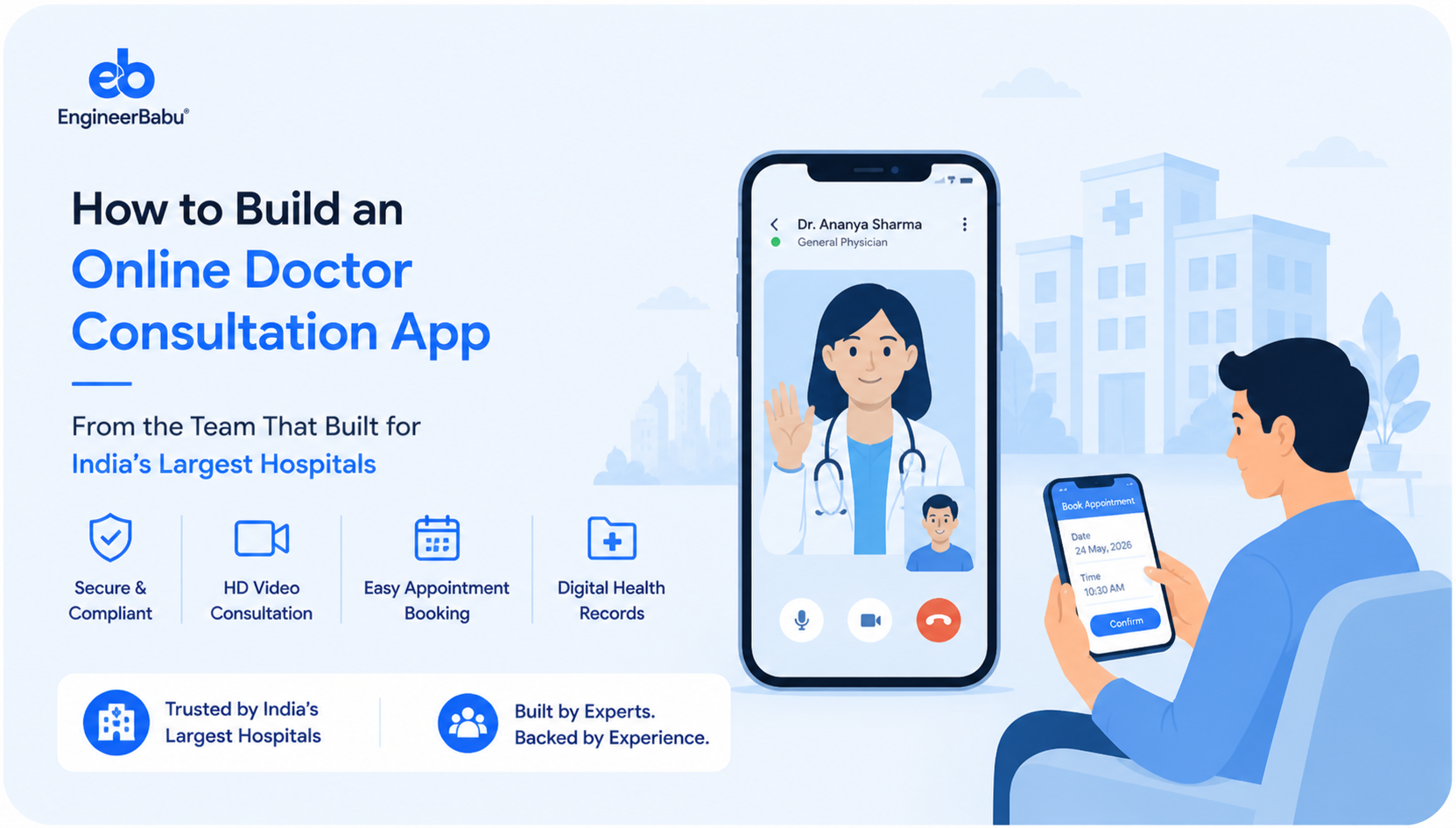
Let me tell you what a Zoom call with a doctor is not.
It’s not telemedicine. It’s not a consultation. It’s not healthcare delivery. It’s a video call. With a person who happens to have a medical degree. On a platform that was designed for corporate meetings, not clinical encounters.
A real online doctor consultation — the kind that actually improves healthcare outcomes — requires something fundamentally different from video conferencing. It requires clinical workflow built into every screen. An e-prescription system that checks drug interactions before the doctor hits send.
Patient history available during the call — not on a separate system the doctor has to alt-tab to. Lab ordering that flows from the consultation to the diagnostic lab and back. Follow-up scheduling that doesn’t depend on the patient remembering to call. Insurance integration that handles the payment without the patient navigating a claims process.
That’s not a video calling feature. That’s a clinical product.
The global telemedicine market is projected to reach $380 billion by 2030. COVID accelerated adoption by a decade. But here’s the part that matters: the market is shifting from “any video call will do” to “we need a proper clinical platform.” Hospitals, health systems, and healthtech startups are replacing their makeshift telehealth setups with purpose-built consultation platforms.
I know this because the EngineerBabu team has built healthcare technology for 400+ clients. Not websites for doctors. Clinical software that touches patient data, prescription workflows, diagnostic integration, and regulatory compliance.
If you already know you need an online doctor consultation app built by a team with real hospital experience — skip the blog and email mayank@engineerbabu.com. Assessed, scoped, and started within days. Not weeks.
For everyone else — let me tell you what it actually takes.
The team has built for India’s largest hospital chain — where doctors see 80+ patients per day and needed telemedicine that matched the speed and clinical rigour of their in-person OPD. For multi-location hospital groups that needed virtual consultations to extend specialist access to Tier 2 and Tier 3 cities without building physical infrastructure. For a global Australian medical device company where remote patient monitoring and virtual consultations intersect.
For India’s leading pharmacy and healthcare platform — where online consultation connects directly to medicine delivery. For one of India’s largest diagnostics chains — where virtual consultations link to lab test ordering and result review. For telemedicine platforms operating across multiple countries and regulatory frameworks.
My name is Mayank Pratap. I co-founded EngineerBabu 14 years ago. The team has shipped 500+ products. 400+ in healthcare alone. Google selected us for the AI Accelerator 2024. CMMI certified us at Level 5. Vijay Shekhar Sharma backs us personally. 24 of our clients became unicorns. 75 were Y Combinator-selected. LinkedIn named us a Top Startup in India — twice.
This blog is for the hospital CIO, the healthtech founder, or the health system executive who wants to build a real online doctor consultation platform — not a glorified video call.
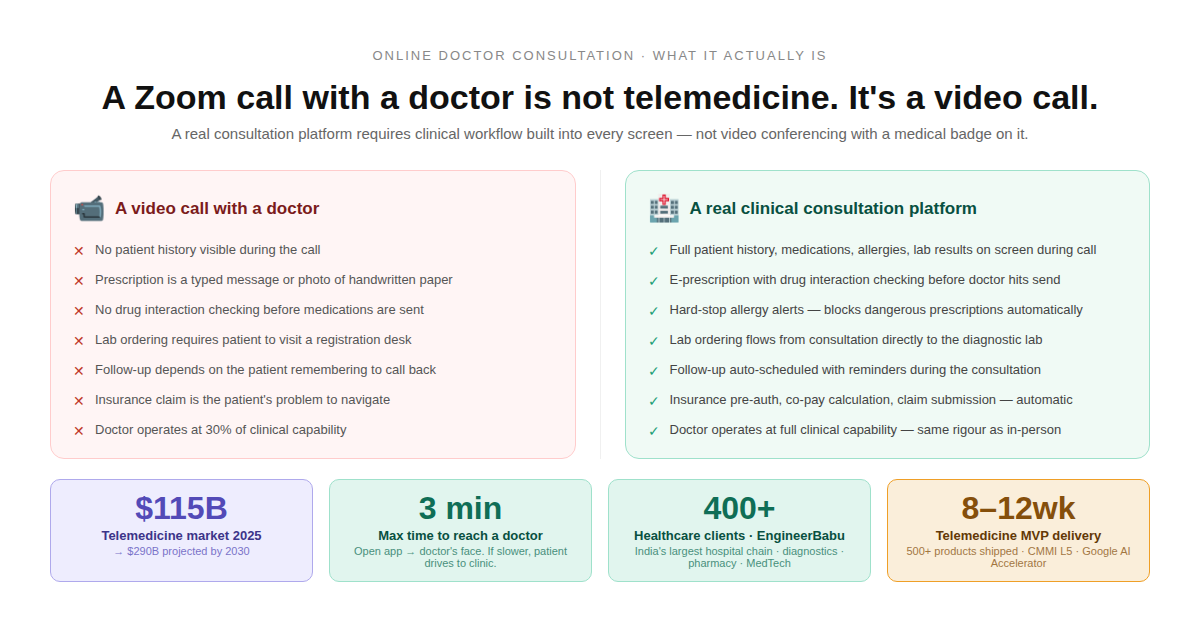
Every telemedicine blog starts with “video consultation” as feature #1. That’s like saying a hospital is “a building with beds.” Technically true. Completely useless.
An online doctor appointment & consultation app is a clinical delivery system that happens to use video as one of its communication channels. The video is the least interesting part. Everything around the video is what determines whether the platform delivers healthcare or delivers a video call.
Let me walk you through what actually matters.
A patient opens the app. They’re sick. They’re anxious. They’re possibly in pain. They don’t want to navigate a beautiful UI. They want a doctor. Now.
The time from opening the app to seeing a doctor’s face should be under 3 minutes for on-demand consultations. Under 30 seconds for scheduled appointments that are about to start.
That 3-minute window includes: login (biometric — no typing passwords when you’re sick), symptom input (guided, not free-text — pre-structured symptom questionnaires that collect clinically useful information while being fast for the patient), doctor matching (the right specialty based on symptoms), payment (pre-saved cards or insurance — zero friction), and video connection (instant, reliable, no “please install this plugin”).
When the team built telemedicine for India’s largest hospital chain, the 3-minute benchmark was the north star. Every screen was measured. Every unnecessary tap was eliminated. The team had learned from building a product that scaled to tens of millions of users — the same UX discipline of making complex workflows feel effortless on any device, any connection, any user skill level.
If the patient can’t reach a doctor in 3 minutes, they close the app and drive to the nearest clinic. The platform failed its most basic job.
While the patient sees a simple, calm interface, the doctor needs a clinical command center.
On one side: the video feed. On the other: the patient’s complete history — previous consultations (virtual and in-person), current medications, allergies, chronic conditions, recent lab results, imaging reports. All available without clicking away from the video.
Below the video: the prescription pad — with drug auto-suggest, dosage defaults for the patient’s age and weight, drug interaction checking that happens in real-time as medications are added, allergy alerts that surface automatically. When the doctor writes a prescription, the system checks it against the patient’s allergy list, their current medications, and standard dosage ranges before allowing the send.
Adjacent: the lab order interface — the doctor can order blood tests, imaging, or diagnostics during the consultation, and the order flows directly to the lab or radiology center. The patient doesn’t need to visit a registration desk. The order is already in the system.
At the bottom: follow-up scheduling — the doctor sets a follow-up date, and the system automatically schedules it, sends reminders, and pre-populates the follow-up consultation with the current encounter’s notes.
This clinical workspace is what separates a doctor consultation app from a video calling app. It’s not a video with a chat sidebar. It’s an integrated clinical tool that makes the virtual consultation as clinically rigorous as an in-person visit.
When the team built this for hospital chains with 80-patients-per-day OPDs, the clinical workspace was designed for speed. Doctors don’t have 5 minutes to navigate software between patients — virtual or physical. The workspace was built to match the speed of an in-person encounter.
One-tap prescription templates for common conditions. Pre-loaded lab order panels for standard workups. Voice note integration for doctors who can’t type between consultations.
The CTO’s 17 years building production systems that process thousands of real-time decisions adds a specific dimension here. The clinical workspace handles concurrent data — video stream, patient records, prescription checking, lab ordering — simultaneously. The architecture must be as responsive with 500 concurrent consultations as it is with 5. The team builds for this from day one.
Before the patient reaches a doctor, AI can do useful work. Not diagnosis — triage.
A structured symptom questionnaire powered by clinical logic. The patient describes symptoms. The AI classifies urgency (emergency — redirect to ER, urgent — next-available doctor, routine — scheduled appointment). The AI suggests the right specialty (the patient says “chest pain” — the system routes to cardiology, not general medicine). The AI pre-populates the doctor’s view with a structured symptom summary so the doctor doesn’t spend the first 2 minutes asking “so what brings you in today?”
Google AI Accelerator 2024 means the team builds production AI — not demo AI. The triage system requires clinical validation, edge case handling (what if the patient has atypical symptoms that don’t map neatly to one specialty?), and fail-safe defaults (when in doubt, route to a general physician, not a dead end).
The AI doesn’t replace clinical judgment. It removes administrative friction from the pre-consultation process. The doctor starts the consultation already informed. The patient reaches the right specialist faster. Everybody wins.
This is the feature that most telemedicine platforms get dangerously wrong. An e-prescription system isn’t a text field where the doctor types medication names. It’s a clinical safety system with multiple layers of validation.
Drug interaction checking — when the doctor adds Medication B, the system checks it against the patient’s existing Medication A and alerts if there’s a dangerous interaction. This check must happen in real-time, during the consultation, before the prescription is finalized.
Allergy alerts — the patient’s allergy list is checked against every prescribed medication. If the doctor prescribes penicillin and the patient is allergic to penicillin, the system blocks it with a hard stop, not a dismissable warning.
Dosage validation — for pediatric patients, dosages are calculated based on body weight. For renal patients, dosages are adjusted for kidney function. The system flags when a prescribed dose exceeds safe limits.
Drug-drug-disease interaction — some medications are contraindicated for certain conditions. Metformin and severe renal impairment. NSAIDs and active GI bleeding. The system checks prescriptions against the patient’s active diagnoses.
When the team built prescription systems for India’s largest hospital chain and for India’s leading pharmacy platform, these safety layers weren’t optional features — they were the core of the system. The difference between an e-prescription that’s a convenience feature and one that’s a clinical safety system is the difference between an app and a medical product.
The pharmacy integration adds another dimension. The prescription flows from the doctor’s screen to the pharmacy — either the hospital’s in-house pharmacy, a partner pharmacy chain, or a home delivery service. The patient doesn’t need to take a photo of the prescription and upload it somewhere. The medication is ordered before the consultation ends. For follow-up prescriptions, the system supports refills without a full consultation — the doctor reviews and approves remotely.
The video call looks simple to the user. Behind it is one of the most technically demanding components of the platform.
Medical-grade video requires: end-to-end encryption (HIPAA mandates this for any system carrying PHI — and a video of a medical consultation is PHI), adaptive bitrate streaming (the video quality adjusts automatically based on the patient’s network — because a patient in a Tier 3 Indian town on a 3G connection still needs a usable consultation), low latency (the doctor needs to see the patient’s skin condition, rash, or surgical wound in real-time — 2-second delays make clinical observation impossible), recording capability (for medical-legal documentation, with appropriate consent), and multi-party support (for consultations that include a specialist, the primary physician, and the patient simultaneously).
The team doesn’t build video infrastructure from scratch. The smart approach: integrate with specialized providers — Twilio, Agora, Vonage — and build the clinical workflow around them. Building your own WebRTC infrastructure for telemedicine is like building your own payment gateway for e-commerce. Technically possible. Financially insane when battle-tested alternatives exist.
But the integration isn’t trivial. The video SDK must be wrapped in encryption that meets healthcare compliance standards. The video session must be linked to the patient record — so the consultation is documented in the EHR, not floating in a separate video platform.
Recording storage must be compliant (encrypted, access-controlled, retention-policy-managed).
The team has integrated video into healthcare platforms for hospital chains and telemedicine operators. The integration patterns — SDK selection, encryption wrapping, EHR linking, recording management — are proven across multiple deployments.
A consultation without payment integration isn’t a business. It’s a charity.
For direct-pay models: the patient pays per consultation. Payment captured before or during the consultation via saved cards, UPI (India), Apple Pay, or local payment methods. Split payment between the platform and the doctor calculated automatically. Tax invoice generated.
For insurance models: the patient’s insurance is verified at the time of booking.
Pre-authorization obtained in real-time from the insurer. Co-pay calculated and collected from the patient. Claim submitted to the insurer automatically after the consultation. Denial management for rejected claims.
For hospital models: the consultation fee is part of the hospital’s billing system. The telemedicine module integrates with the hospital’s revenue cycle — the consultation charge flows to the patient’s account, gets included in the discharge bill or outpatient bill, and follows the same insurance claim process as an in-person visit.
The team has built payment and billing systems for financial platforms that have sustained over ₹10,000 crore in transactions. Hospital billing integration for 400+ healthcare clients. Insurance claims processing for hospital chains. The financial engineering of making money flow correctly through a healthcare consultation platform — where the payer could be the patient, the insurer, the government scheme, or a combination — is a solved problem for the team. Not a learning exercise.
If this sounds like the assessment rigour and clinical depth your online consultation platform needs — the team can have a scoped proposal in your inbox within a week. mayank@engineerbabu.com.
Flutter for the patient app. Cross-platform — iOS and Android app from one codebase. The team has shipped multiple Flutter-based healthcare applications. For a telemedicine app that patients use while sick, on unpredictable network connections, on every kind of device — Flutter’s native performance and offline-first capability matter.
React for the doctor’s clinical workspace. Web-based — doctors use laptops and desktops for consultations, not mobile phones. React’s component architecture matches the modular nature of the workspace — video panel, patient history panel, prescription panel, lab ordering panel — each a separate component that updates independently.
React also for the admin dashboard — appointment management, doctor scheduling, analytics, revenue reporting.
Node.js for the real-time API layer. Consultations generate real-time events: patient joins, doctor joins, prescription added, lab ordered, consultation ended. Node.js’s event-driven architecture handles these concurrent events efficiently. WebSocket connections for real-time chat alongside the video consultation.
Python for AI modules — symptom triage, drug interaction checking, clinical documentation AI. Python’s healthcare NLP libraries (MedSpaCy, clinical-BERT) and general ML ecosystem (scikit-learn, TensorFlow) are unmatched.
PostgreSQL for the clinical database. ACID compliance is non-negotiable for medical records. Patient data, consultation records, prescriptions, lab orders — all must be transactionally consistent.
Redis for session management and caching. Doctor availability status, consultation queue position, payment status — these need sub-millisecond read times.
Twilio or Agora for video infrastructure. Pre-built, battle-tested, HIPAA-compliant video SDKs. Wrapped with application-level encryption and linked to the clinical record.
AWS or GCP with healthcare-specific compliance. HIPAA-eligible services. Data encryption at rest (AES-256) and in transit (TLS 1.2+). Regional deployment for data residency. HIPAA BAA with the cloud provider.
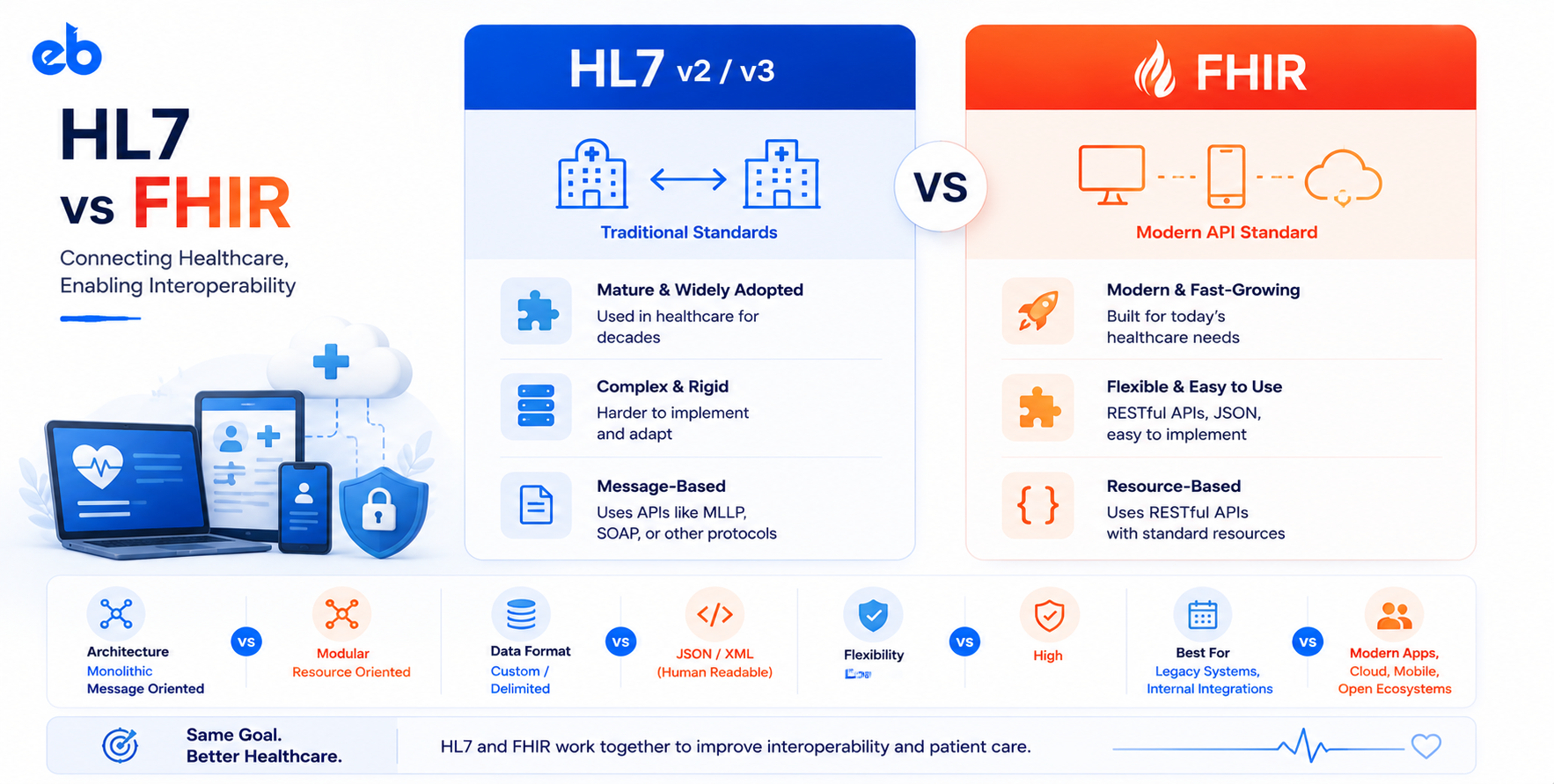
HL7/FHIR for EHR integration. If the consultation platform connects to an existing hospital EHR — and for hospital-deployed telemedicine, it must — FHIR APIs handle the data exchange. Patient demographics, clinical encounters, medications, and results flow between the consultation platform and the hospital system.
When the team built neobank architecture for a company that became a unicorn — multiple services running independently, communicating seamlessly, scaling to millions of users — the pattern applies directly to telemedicine. The video service, the prescription service, the payment service, the notification service — each runs independently. The video service crashing doesn’t take down the prescription service. The payment service scaling for peak appointment hours doesn’t affect the clinical database. Microservices designed for healthcare reliability.
Video consultation without clinical workflow integration is telehealth theatre. A doctor seeing a patient on video but unable to view their medical history, write a checked prescription, or order labs during the call is performing at 30% of their clinical capability. The consultation quality drops. The doctor loses trust in the platform. The patients stop coming back.
The team builds clinical workflow first, video second. The video is a communication channel within a clinical system. Not a clinical skin on top of a video app.
Most telemedicine platforms are designed for the patient. Beautiful patient app. Smooth booking flow. Easy video join. And a doctor experience that’s an afterthought — clunky interfaces, no access to patient history during the call, prescription entry that takes longer than writing on paper.
Doctors are the supply side. If doctors hate the platform, they stop using it. If they stop using it, patients have no one to consult. The platform dies.
The team builds doctor-first. When the EngineerBabu team built for India’s largest hospital chain — where doctors see 80+ patients per day — the doctor’s experience was the primary design constraint. The prescription interface had to be faster than paper. The patient history had to load before the video connected. The lab ordering had to be one tap.
“We’ll add HIPAA before launch.” This sentence has killed more telemedicine platforms than bad video quality. HIPAA compliance isn’t a feature. It’s an architectural principle that determines how video is encrypted, how records are stored, how access is controlled, and how audits are conducted.
CMMI Level 5 means the team builds compliance into the architecture from sprint one. PHI encryption before the first video call is coded. Access controls before the first patient record is created. Audit logging before the first consultation is conducted. 400+ healthcare clients across HIPAA, DHA, ABDM, and UK GDPR environments — compliance isn’t new territory. It’s home ground.
India has 800+ million internet users. Most of them on variable 4G connections. Many in Tier 2 and Tier 3 cities where bandwidth drops unpredictably. A telemedicine platform that requires stable 5 Mbps for video consultation excludes 40% of the patient population.
Adaptive bitrate streaming. Automatic fallback from video to audio when bandwidth drops. Offline-capable patient intake (fill symptoms offline, sync when connected). Compressed image sharing for doctors who need to see a wound or rash when video quality is insufficient.
The team learned this at scale. When a product built by the EngineerBabu team scaled to tens of millions of Indian users — many on ₹8,000 phones on 3G connections — every feature had to work in the worst possible conditions. That network resilience discipline applies directly to telemedicine. A patient in a village in Madhya Pradesh deserves the same consultation quality as a patient in Mumbai. The platform must deliver it.
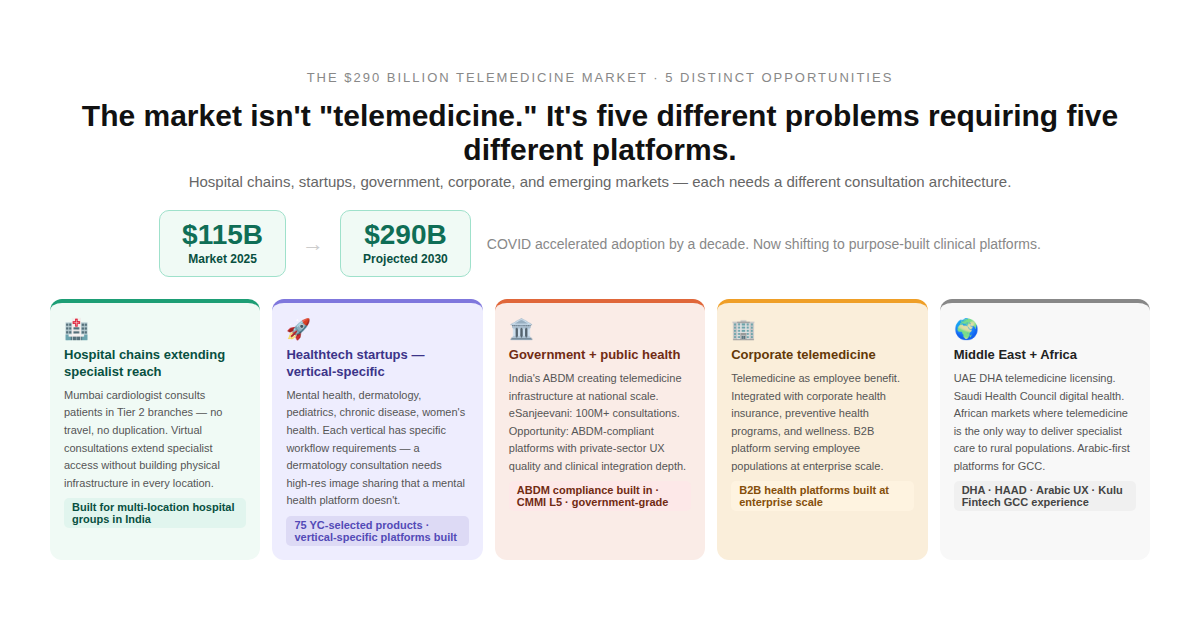
The $290 billion telemedicine market by 2030 isn’t one market. It’s several distinct opportunities.
A hospital group with cardiologists in its Mumbai flagship but no cardiologists in its Tier 2 city branches. Telemedicine lets the Mumbai cardiologist consult patients across every branch — without travel, without duplication, without building cardiology departments in every location. The team has built exactly this for multi-location hospital groups in India.
The next version of India’s leading doctor consultation platforms. Focused on specific verticals — mental health, dermatology, pediatrics, chronic disease management, women’s health. Each vertical has specific consultation workflow requirements. A mental health consultation is structurally different from a dermatology consultation (which needs high-resolution image sharing). The team has built vertical-specific healthcare platforms across multiple specialties.
India’s ABDM (Ayushman Bharat Digital Mission) is creating infrastructure for telemedicine at national scale. eSanjeevani — India’s government telemedicine platform — has conducted 100+ million consultations. But government platforms often lack the UX polish and clinical integration depth that private platforms provide. The opportunity is building platforms that comply with ABDM standards while delivering a clinical experience that matches private healthcare quality.
Companies providing telemedicine as an employee benefit. Consultation platforms integrated with corporate health insurance, preventive health programs, and wellness initiatives. The team has built B2B health platforms that serve employee populations at enterprise scale.
The UAE, Saudi Arabia, and multiple African countries are investing heavily in telemedicine infrastructure. DHA telemedicine licensing in Dubai. Saudi Health Council digital health initiatives. African markets where telemedicine is the only way to deliver specialist care to rural populations. The team has built healthcare technology for clients across the Middle East and Africa — understanding the regulatory requirements and infrastructure constraints specific to these markets.
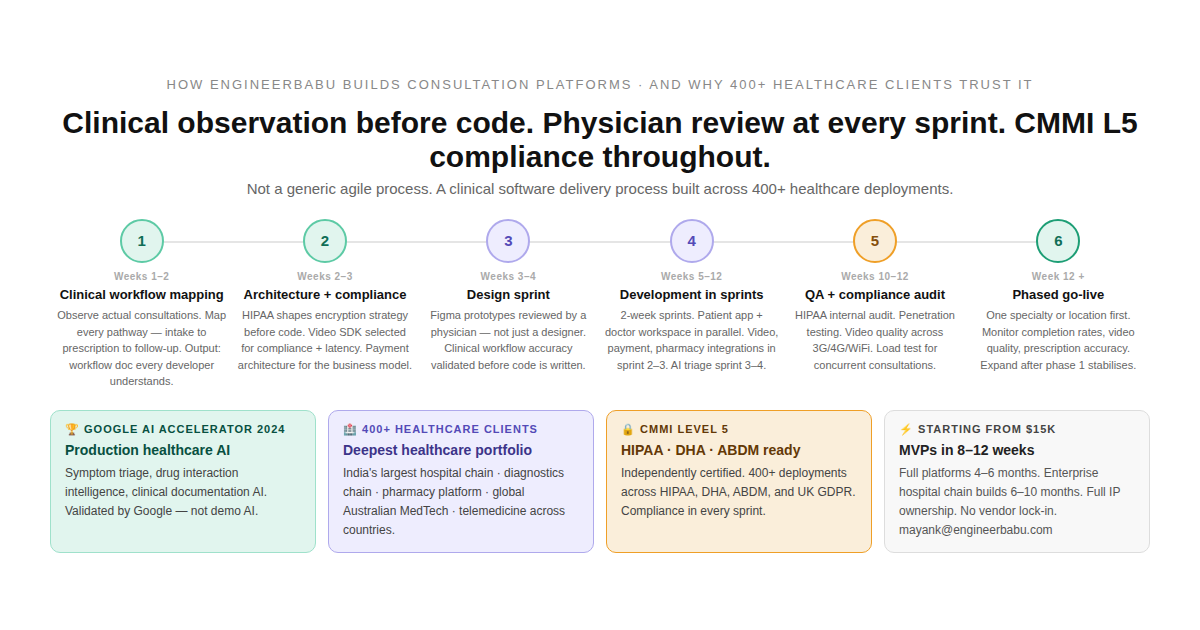
Not a methodology. What actually happens.
Week 1-2: Clinical workflow mapping. The team maps every consultation pathway — patient intake to doctor consultation to prescription to follow-up. For hospital clients, this means observing actual telemedicine consultations (or OPD consultations that will move to telemedicine). For startup clients, this means defining the consultation workflow with the founding team’s clinical advisors. The output: a workflow document that every developer on the project understands — not just “video call” but the complete clinical journey.
Week 2-3: Architecture and compliance. The data model, the service architecture, the compliance framework — all designed before code. HIPAA requirements (if applicable) shape the encryption strategy, access control design, and audit logging architecture. Video SDK selection based on compliance requirements, latency needs, and cost. Payment integration architecture based on the business model (direct pay, insurance, hospital billing).
Week 3-4: Design sprint. Figma prototypes for the patient app, the doctor workspace, and the admin dashboard. Reviewed by a physician — not just a product designer. The physician validates that the clinical workflow is accurate, the prescription interface is fast enough, and the patient history display is clinically useful. This physician review catches design errors that would cost weeks of development time to fix later.
Week 5-12: Development in sprints. Two-week sprints. Demo every two weeks. Patient app and doctor workspace built in parallel. Integration with video SDK, payment, and pharmacy in sprint 2-3. AI triage module in sprint 3-4. EHR integration (if connecting to existing hospital systems) in sprint 4-5.
Week 10-12: QA, security testing, compliance validation. HIPAA compliance audit (internal). Penetration testing. Video quality testing across network conditions (3G, 4G, WiFi, transitioning between networks mid-consultation). Load testing for concurrent consultations.
Week 12: Go-live + 2 months support. Phased rollout. Start with one specialty or one hospital location. Monitor consultation completion rates, video quality metrics, prescription accuracy, and payment success rates. Expand after the first phase stabilizes.
The team ships telemedicine MVP development in 8-12 weeks. Full platforms in 4-6 months. Enterprise platforms for hospital chains in 6-10 months.
Mayank Pratap leads every engagement personally. The hospital CIO, the healthtech founder, the health system executive — they talk to the founder from discovery through go-live.
400+ healthcare clients. India’s largest hospital chain. Multi-location hospital groups. A global Australian medical device company. India’s leading pharmacy platform. One of India’s largest diagnostics chains. Telemedicine platforms across multiple countries. The breadth is unmatched.
The CTO’s 17 years building production systems — infrastructure that processes thousands of real-time decisions daily — provides the architectural foundation. The same engineering that makes a financial platform reliable at massive scale makes a telemedicine platform reliable when a patient needs a doctor at 2 AM.
Google AI Accelerator 2024 for healthcare AI — symptom triage, clinical documentation, drug interaction intelligence. Production AI validated by Google.
CMMI Level 5 for healthcare compliance — HIPAA, DHA, ABDM, UK GDPR. Independently audited process maturity that healthcare regulators require.
Custom builds. Full code and IP ownership. The hospital’s platform. The hospital’s data. No vendor lock-in.
Starting from $15K for focused telemedicine MVPs. Full platforms scoped after understanding the clinical context — because a single-specialty teledermatology app and a multi-hospital omni-specialty telemedicine platform are fundamentally different projects.
If you’re a hospital, health system, or healthtech founder building an healthcare application — and you want it built by a team that’s deployed clinical software in 400+ healthcare settings — email me. mayank@engineerbabu.com. The founder. Not a form.
Tell me about the clinical context. The specialties. The patient population. The regulatory environment. The existing systems it needs to connect to. I’ll spend 30 minutes understanding the healthcare challenge and giving an honest assessment of what it takes to build a consultation platform that physicians actually use and patients actually trust.
Every week your telemedicine initiative stays in planning is a week of specialist reach you’re not extending, patients you’re not serving, and revenue you’re not generating. The team can have a scoped architecture proposal in your inbox within days.
Mayank Pratap Co-founder, EngineerBabu mayank@engineerbabu.com | engineerbabu.com
Google AI Accelerator 2024 · CMMI Level 5 · 400+ Healthcare Clients · 24 Unicorn Clients · 75 YC Selections · Backed by Vijay Shekhar Sharma · LinkedIn Top Startup India (Twice) · NASSCOM Member
EngineerBabu | Doctor Consultation Platforms That Deliver Healthcare, Not Just Video Calls