Outsourcing Software Development to India from UAE - Why Dubai's Smartest Companies Already Do It


Create engaging, high-performance mobile applications tailored to your business needs. We craft future-ready apps that offer smooth user experiences on all devices.
Build robust and scalable websites and CMS platforms that help you manage content effortlessly. Our development ensures a seamless digital presence.
Launch secure, feature-rich online stores with intuitive shopping experiences. We build tailored eCommerce platforms designed for growth.
Design captivating games with immersive gameplay and stunning graphics. From concept to launch, we build engaging experiences that players love.
Enhance your customer relationships with customized Salesforce implementations. Drive growth and efficiency with smarter CRM solutions.
Harness artificial intelligence and machine learning to automate workflows and gain actionable insights. Our AI transforms data into smart decisions.
Accelerate your software delivery lifecycle with continuous integration, delivery, and infrastructure automation to boost efficiency.
Hire app developers ready to turn your ideas into sleek, high-performing mobile apps for any platform.
Bring in frontend pros who craft smooth, beautiful, and user-friendly interfaces that your visitors will love.
Get backend developers who build fast, secure, and reliable systems to keep everything running behind the scenes.
Hire eCommerce developers who build secure, scalable online stores designed to offer seamless shopping and grow your sales.
Get dedicated developers committed to your projects, delivering consistent quality and speed as an extension of your team.
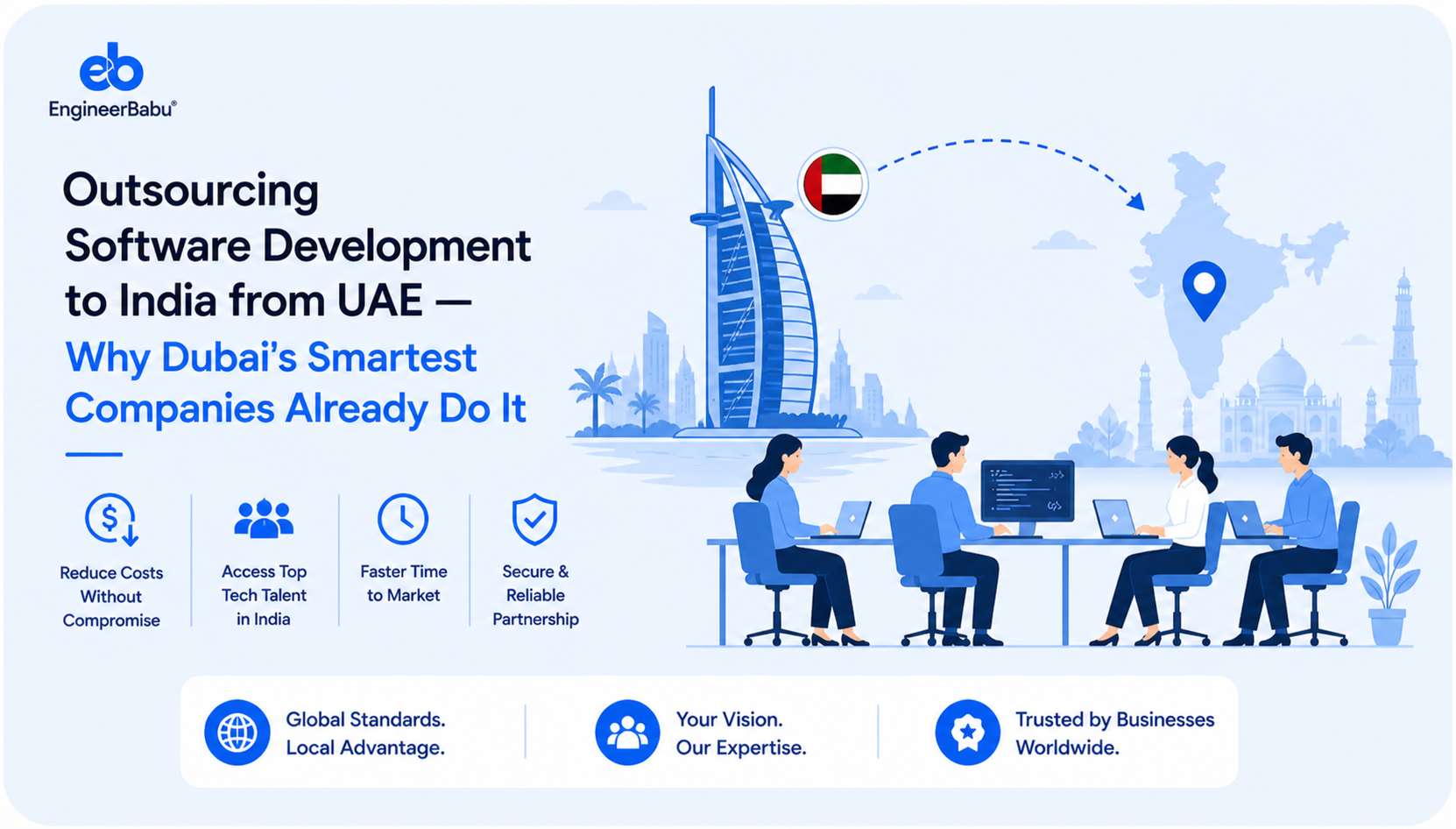
There’s an outsourcing corridor that nobody writes about.
Every blog on the internet covers US-to-India outsourcing. Thousands of articles. UK-to-India gets decent coverage. Australia-to-India, some.
UAE-to-India? Almost nothing.
Which is absurd. Because the UAE-India technology corridor is arguably the most natural outsourcing relationship on the planet. And I’m going to tell you exactly why.
The timezone difference between Dubai and India is 1 hour and 30 minutes.
Read that again. One hour. Thirty minutes.
A development team in Indore starts work at 9:30 AM IST. That’s 8:00 AM in Dubai. The teams operate on essentially the same business day. Same morning standup. Same lunch break.
Same afternoon sprint review. Real-time Slack conversations without anyone staying up late. Code reviews that happen in minutes, not overnight.
No other outsourcing destination offers this to the UAE. Philippines is 4 hours ahead. Vietnam is 3 hours ahead. Eastern Europe is 2-3 hours behind. Only India sits in that magical 1.5-hour window where the timezone difference is functionally invisible.
I know this because the EngineerBabu team works with UAE clients as if they’re in the same city. Not as a claim — as a daily operational reality.
My name is Mayank Pratap. I co-founded EngineerBabu 14 years ago. The team has shipped 500+ products. 200+ for VC-funded companies. 24 clients that became unicorns. The team built Kulu Fintech’s GCC financial infrastructure — technology built specifically for the Gulf market. Built TaptapSend’s multi-continent remittance platform with compliance across five regulatory jurisdictions including Middle Eastern corridors. I also co-founded Supersourcing — a B2B IT staffing platform that serves GCC clients directly.
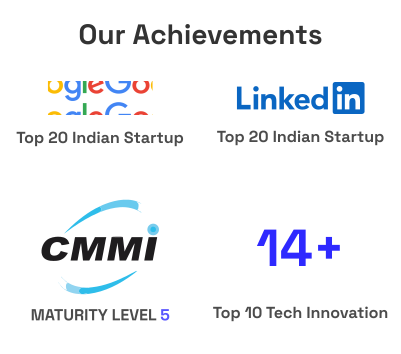
Google selected EngineerBabu for the AI Accelerator 2024. CMMI certified us at Level 5. Vijay Shekhar Sharma backs us personally.
When I tell you that outsourcing from the UAE to India isn’t just viable but is the smartest technology decision a Dubai company can make — I’m speaking from the specific experience of having done it. For companies operating in this exact market.
The UAE has one of the most ambitious technology visions in the world. Dubai’s D33 strategy targets $8.7 trillion in trade over the next decade. Abu Dhabi’s Falcon Economy is pumping billions into AI, fintech, and digital infrastructure. Saudi Arabia’s Vision 2030 — which UAE companies increasingly serve as a market — is $3.3 trillion in planned economic transformation.
The demand for software development in the UAE has never been higher. Every bank wants a digital platform. Every retailer wants an app. Every government service is going digital. Every logistics company wants AI optimization.
The supply? That’s the problem.
The UAE has a population of 10 million. The local developer workforce is small. Companies compete fiercely for the same pool of engineers. Senior developer salaries in Dubai have crossed AED 40,000-60,000/month ($11,000-$16,000). A four-person development team costs AED 200,000+/month ($55,000+) before office space, visa processing, insurance, and equipment.
And turnover is brutal. Developers in Dubai switch jobs every 18-24 months. By the time you’ve hired, onboarded, and integrated a team, half of them are already interviewing elsewhere.
This is why Dubai’s smartest technology leaders — the ones who’ve actually shipped products, not the ones who talk about digital transformation at conferences — outsource their development to India.
Not because India is cheap. Because India has 5.8 million developers, deep domain specialization, English fluency, process maturity (CMMI, ISO, NASSCOM standards), and a timezone that makes collaboration frictionless.
The cost savings are real — 40-60% lower than Dubai-based development. But the strategic advantage is deeper. It’s access to talent that simply doesn’t exist in sufficient depth within the UAE.
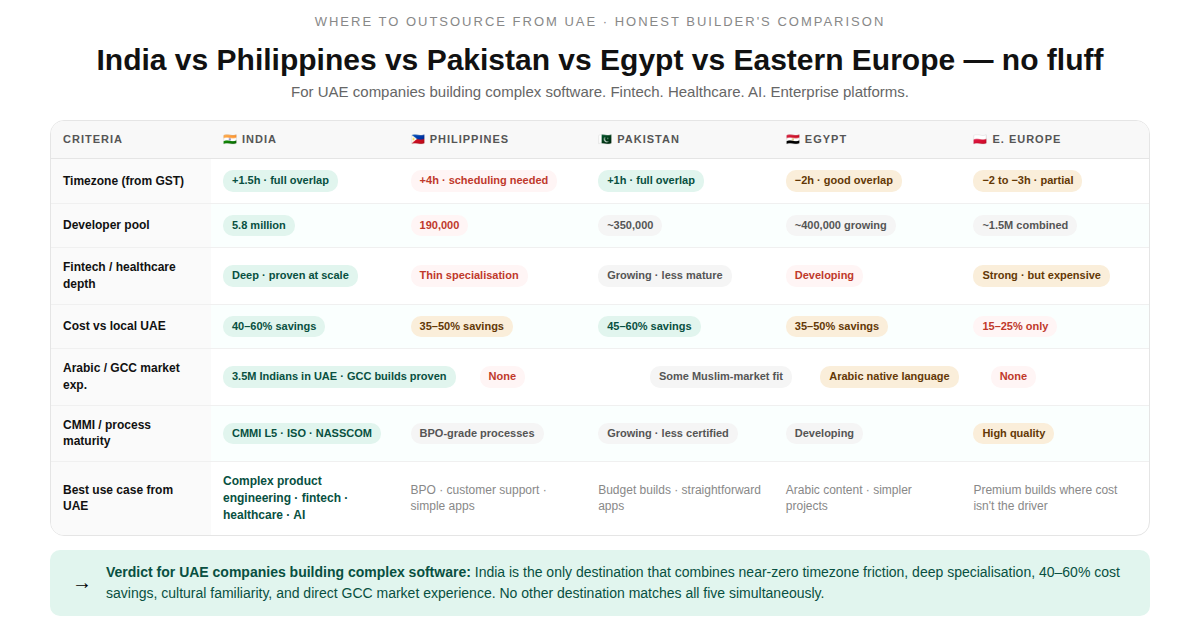
A Dubai CTO evaluating outsourcing options has several choices. India. Philippines. Pakistan. Egypt. Eastern Europe. Let me be honest about each.
1.5 hours timezone difference. English is a business language. 5.8 million developers with deep specialization across fintech, healthcare, AI, and enterprise. Established compliance expertise — PCI-DSS, HIPAA, CBUAE, SAMA. Cultural familiarity — the UAE has 3.5 million Indian residents. Travel time from Dubai to Indian tech hubs: 3-4 hours.
The EngineerBabu team has direct GCC experience. Kulu Fintech’s financial infrastructure was built specifically for Gulf market requirements — Arabic language support, regional payment methods, local regulatory compliance. That’s not theoretical “we can learn your market” capability. It’s “we’ve already built for your market” proof.
When TaptapSend needed remittance corridors serving Middle Eastern demographics, the team understood the compliance and cultural context — because they’d already operated in the GCC fintech ecosystem through Kulu Fintech.
Philippines has excellent English — better than India on average. But the developer pool is 190,000 versus India’s 5.8 million. Domain specialization in fintech, healthcare, and AI is thin. The timezone difference from Dubai is 4 hours — manageable but not the near-zero friction that India offers. Philippines excels at customer support and business process outsourcing.
For complex software development, the talent depth isn’t comparable.
Pakistan’s IT sector is growing rapidly. Rates are 10-20% lower than India. English proficiency is good. Timezone is identical to India. But the ecosystem is younger — fewer CMMI-certified companies, fewer enterprise-grade references, less regulatory compliance experience. For straightforward applications, Pakistan is a viable option. For complex, regulated products — fintech, healthcare, enterprise — India’s ecosystem maturity creates a significant advantage.
Egypt has a growing developer community, competitive rates, and Arabic as a native language (useful for Arabic-first products). Timezone difference from UAE is 2 hours. But the software engineering ecosystem is still developing. Finding specialized fintech or healthcare engineers in Egypt is challenging. For Arabic content work and simpler development projects, Egypt adds value. For complex product engineering, India leads.
Eastern European developers are excellent. Process maturity is high. But rates are $50-$100/hour — approaching the level where the UAE company might as well build locally.
Timezone difference from Dubai is 1-3 hours, which is good. But the cost advantage over local UAE development is only 15-25%, compared to India’s 40-60%. For UAE companies where cost optimization matters alongside quality — which is most companies — India offers a better value equation.
The verdict: For UAE companies building complex software — fintech, healthcare, AI, enterprise platforms — India is the natural choice. The timezone is unmatched. The talent depth is unmatched. The cost advantage is significant. And companies like EngineerBabu bring direct GCC market experience that eliminates the learning curve.
Let me tell you what’s being built right now. Not theoretical use cases. Real patterns the team sees across UAE client engagements.
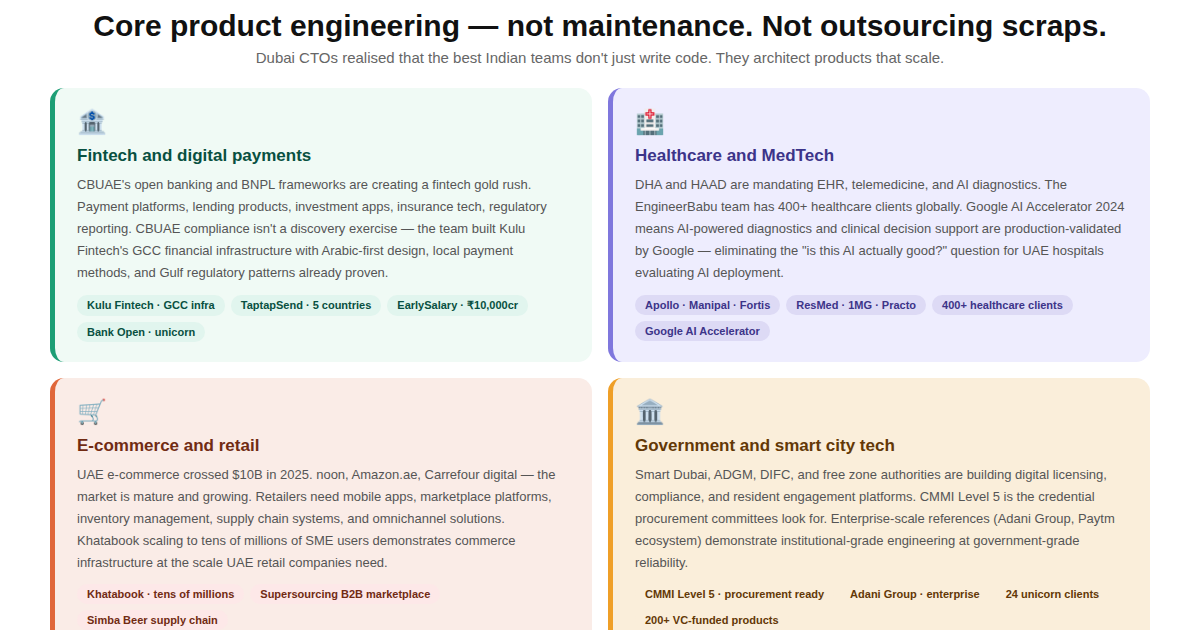
The UAE fintech market is one of the most dynamic in the world. CBUAE is actively creating regulatory frameworks for digital payments, BNPL, open banking, and cryptocurrency. Tabby, Tamara, e& money, Mashreq Neo, Liv by Emirates NBD — the market is exploding.
UAE companies are building payment platforms, lending products, investment apps, insurance technology, and regulatory reporting systems — with Indian development teams.
The EngineerBabu team brings fintech app development depth that’s hard to find anywhere. EarlySalary’s ₹10,000 crore lending platform. Bank Open’s unicorn neobank. OpenMoney’s multi-product financial architecture. Razorpay ecosystem payment orchestration. TaptapSend’s 5-country regulated remittance. Kulu Fintech’s GCC financial infrastructure — built specifically for the Gulf market.
The CTO’s 17 years at Wishfin — one of India’s largest credit marketplaces — means the fintech expertise isn’t surface-level. It’s deep. Credit decisioning engines, bureau integrations, risk modeling, payment settlement, reconciliation — the team has built every component a UAE fintech needs.
CBUAE compliance isn’t a discovery exercise for the team. Through Kulu Fintech’s GCC work, the team already understands the UAE regulatory landscape, local payment methods, and Arabic UX requirements.
The UAE healthcare market is undergoing massive digitalization. DHA (Dubai Health Authority) and HAAD (Health Authority Abu Dhabi) are pushing electronic health records, telemedicine, AI diagnostics, and patient engagement platforms.
Indian teams — and the EngineerBabu team specifically — have deep healthcare IT expertise.
400+ healthcare clients. Apollo Hospitals, Manipal, Shalby, CHL, ResMed, 1MG, Fortis, Practo, Thyrocare, Tata Health, Somnoware. HIPAA-compliant builds proven across US and UK healthcare markets.
Google AI Accelerator 2024 means the AI capabilities — AI-powered diagnostics, predictive analytics, intelligent scheduling, clinical decision support — are validated by Google. For UAE hospitals and health systems looking to deploy AI safely, working with a Google-validated AI team eliminates the “is this AI actually good?” question.
UAE e-commerce crossed $10 billion in 2025. noon, Amazon.ae, Carrefour digital, Namshi — the market is mature and growing. Retailers need mobile apps, marketplace platforms, inventory management, supply chain optimization, and omnichannel solutions.
The EngineerBabu team has built e-commerce and supply chain technology across multiple projects. Simba Beer’s supply chain platform — which recovered millions in blocked capital through custom technology — demonstrates the team’s ability to build systems where money flow, inventory tracking, and operational efficiency intersect.
Khatabook’s scaling to tens of millions of SMEs demonstrates consumer and small business commerce at massive scale. Supersourcing — the B2B marketplace platform Mayank co-founded — demonstrates that the team doesn’t just build marketplaces for clients. They build and operate their own.
UAE government entities are among the most digitally advanced in the world. Smart Dubai, ADGM (Abu Dhabi Global Market), and various free zone authorities are building digital platforms for licensing, compliance, public services, and resident engagement.
CMMI Level 5 is the credential that matters most for government work. It’s the process maturity signal that procurement committees look for. The EngineerBabu team’s CMMI Level 5 certification, combined with enterprise-scale references (Adani Group, Paytm ecosystem), positions them for government and quasi-government technology projects that require institutional-grade engineering.
This is the concern I hear most often from UAE clients. “Can an Indian team build Arabic interfaces?”
Honest answer: most Indian teams can’t do it well. They’ll use Google Translate, flip the layout from left-to-right to right-to-left, and call it done. The result looks wrong. It feels wrong. Arabic-speaking users immediately sense that the product wasn’t designed for them.
The EngineerBabu team approaches Arabic differently — because they’ve done it before.
When Kulu Fintech’s GCC financial infrastructure was built, Arabic wasn’t a localization layer. It was a primary design consideration. Right-to-left layouts designed from scratch — not mirrored from English. Arabic typography that looks beautiful, not just functional. Number formatting, date conventions, and form layouts that match Arabic user expectations. Cultural UI patterns that GCC users recognize and trust.
The experience with Khatabook taught the team something fundamental about building for non-English markets. Khatabook scaled to tens of millions of Indian users across multiple languages — Hindi, Marathi, Gujarati, Tamil, and more. The team learned that localization isn’t translation. It’s redesign. Every language has its own visual hierarchy, scanning patterns, and cultural expectations. Building for Arabic requires the same respect — treating it as a primary experience, not an afterthought.
For UAE products, the team builds bilingual — English and Arabic — from the first wireframe. Not English-first with Arabic added later. Bilingual from the start. Toggle between languages seamlessly. Both experiences feel native.
UAE has a complex regulatory landscape. Federal regulations through CBUAE. Financial free zone regulations through DIFC (Dubai International Financial Centre) and ADGM (Abu Dhabi Global Market). Free zone-specific technology requirements for DMCC, DAFZA, JAFZA, and others. Data protection under UAE Federal Law. Sector-specific regulations from DHA, HAAD, SCA (Securities and Commodities Authority).
Most development teams — Indian or otherwise — discover these requirements mid-project. The discovery causes delays, architecture changes, and cost overruns.
The EngineerBabu team has navigated UAE-adjacent regulatory frameworks through Kulu Fintech’s GCC work. Through TaptapSend’s multi-jurisdiction compliance — which included Middle Eastern regulatory corridors. Through HIPAA, PCI-DSS, SAMA, and RBI compliance across other projects.
CMMI Level 5 processes mean compliance isn’t bolted on as an afterthought. It’s woven into the architecture from sprint one. Security decisions, data residency choices, access control designs, audit logging implementations — all shaped by regulatory requirements from the beginning.
The team won’t pretend to be UAE regulatory experts. That’s the client’s legal counsel’s job. But the team knows how to translate regulatory requirements into compliant software architecture — quickly and correctly — because they’ve done it across multiple jurisdictions.
Let me put the numbers in terms that make sense for a Dubai-based company.
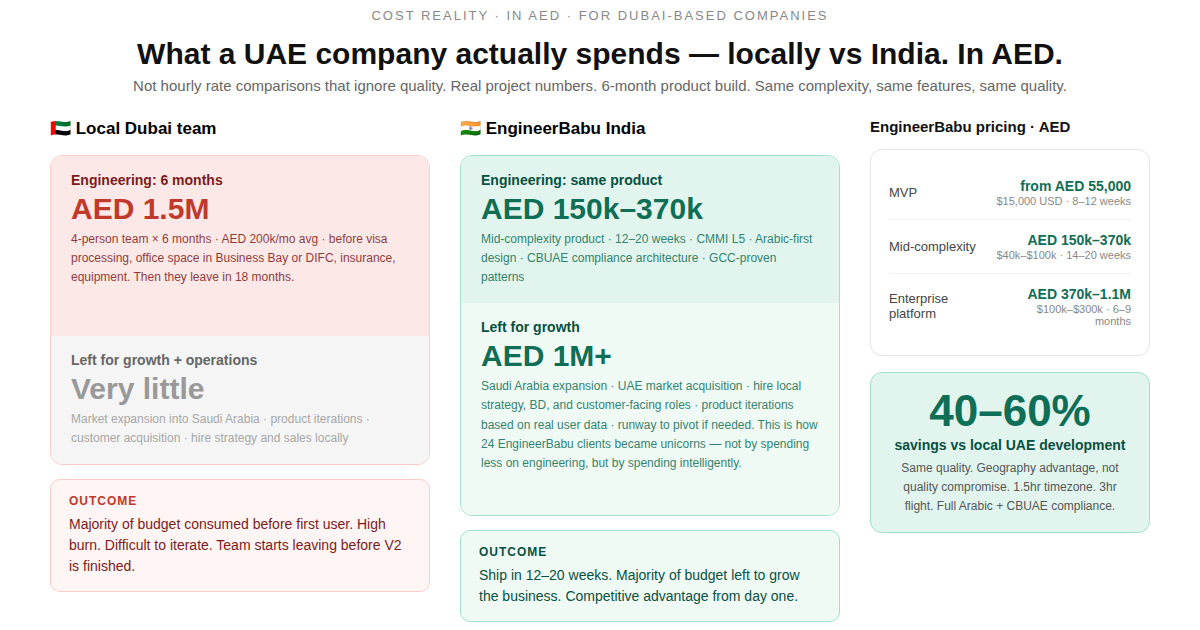
Local UAE development: A senior developer in Dubai costs AED 35,000-60,000/month ($9,500-$16,000). A four-person team (2 developers + 1 QA + 1 PM) costs AED 160,000-240,000/month ($43,000-$65,000). That’s before office space in Business Bay or DIFC, visa processing, insurance, and equipment. A 6-month product build costs AED 1.2M-1.8M ($325,000-$490,000) — for a mid-complexity product.
India (quality Tier 1 team like EngineerBabu): The same product — same complexity, same features, same quality — starts from AED 55,000 ($15,000) for MVP development. Mid-complexity products: AED 150,000-370,000 ($40,000-$100,000). Enterprise platforms: AED 370,000-1,100,000 ($100,000-$300,000). The savings are 40-60%. Not because the quality is lower. Because the cost of living in Indore — where EngineerBabu is headquartered — is a fraction of Dubai. Engineering talent is equally skilled. The cost of operating is structurally lower.
What does a UAE company do with the 40-60% savings? Invest in growth. Marketing. Market expansion into Saudi Arabia (where Vision 2030 is creating enormous opportunities). Product iterations based on real user data. Hire locally for strategy and customer-facing roles while leveraging India for engineering.
This is exactly the model that 24 of the EngineerBabu team’s clients used to become unicorns. Not by spending less on engineering. By spending intelligently — world-class Indian engineering at India pricing, and investing the savings where they compound: growth.
Let me walk through how a UAE client engagement actually operates.
A Dubai CTO starts work at 9 AM Gulf Standard Time. The EngineerBabu team in Indore has been working since 9:30 AM IST — which is 8 AM GST. By the time the Dubai CTO opens Slack, the team has already been working for an hour. The daily standup happens at 10 AM GST (11:30 AM IST). Both teams are in their productive morning hours. Not one team at midnight. Not one team barely awake. Both teams, peak energy, full overlap.
Sprint reviews happen at 2 PM GST (3:30 PM IST). Both teams are still in their work day. Feedback is given, discussed, and incorporated — same day. Not “we’ll address it tomorrow.” Same day. This near-identical timezone creates a collaboration rhythm that US-to-India outsourcing can never match. The UAE client doesn’t need structured “overlap hours.” The entire business day is an overlap.
Dubai to Indore is a 3-hour flight (via Mumbai or direct to Indore airport).
Same-day travel for kickoff meetings, milestone reviews, or relationship building. Multiple EngineerBabu clients have visited the Indore office. The physical proximity reinforces the relationship — something that Eastern European or Latin American outsourcing can’t offer UAE companies.
3.5 million Indians live in the UAE. Indian culture, work ethic, and business practices are deeply understood in the Emirates. There’s no cultural translation needed. No surprise about communication norms. No adjustment period for working styles. Indian teams and UAE companies start collaborating effectively from day one.
Same three killers. Different context.
The UAE procurement team runs a tender. Ten Indian companies respond. The cheapest bid wins. The cheapest company sends junior developers. The product is late, buggy, and needs to be rebuilt. The UAE company swears off Indian outsourcing forever.
The EngineerBabu team isn’t found through tenders. Every client comes through referral. The team takes 20 projects a year. The selection works both ways — the team evaluates whether the project is a fit for their expertise, and the client evaluates whether the team is a fit for their needs. This mutual selection is why the relationship works.
The UAE company signs the contract and expects the Indian team to operate independently. No regular calls. No shared context. No cultural investment. The teams become strangers working on the same codebase. Misalignment compounds. Six months later, the product doesn’t match the vision.
Mayank leads every engagement personally. The founder-to-CTO relationship creates a communication channel that survives project complexity. When things get hard — and they always do in complex software — the relationship is strong enough to navigate disagreements constructively.
Arabic UX. CBUAE compliance. UAE data residency. Local payment methods. These aren’t global requirements with a UAE flavor. They’re UAE-specific requirements that must shape the architecture from day one. The team has GCC experience through Kulu Fintech. These aren’t discovery items. They’re known variables.
Mayank Pratap leads the company personally. The Dubai client talks to the founder from the first call through launch. 1.5 hours of timezone difference means real-time collaboration, not overnight communication cycles.
Custom builds from scratch. Full code and IP ownership. No white-label. No shared infrastructure. Everything belongs to the client.
Direct GCC fintech experience through Kulu Fintech. Multi-jurisdiction compliance expertise through TaptapSend. Arabic UX capability proven in Gulf market builds. CTO with 17 years of financial infrastructure experience. Google AI Accelerator 2024. CMMI Level 5.
24 unicorn clients. 75 Y Combinator selections. 200+ VC-funded products. 500+ total products shipped. EarlySalary. Khatabook. OpenMoney. Bank Open. Razorpay. TaptapSend. Kulu Fintech. Simba Beer. Adani Group. Apollo Hospitals. Manipal. ResMed. 1MG.
Every client came through referral. Fourteen years. Zero marketing budget.
Starting from $15K (AED 55,000) depending on scope and complexity. Exact numbers after understanding the specific project.
If you’re a Dubai, Abu Dhabi, or UAE-based company evaluating technology partners — email me directly. mayank@engineerbabu.com. Not a form. Not a chatbot. The founder.
Tell me about the product, the market, the regulatory requirements. I’ll spend 30 minutes understanding the business and giving an honest assessment. If EngineerBabu is the right fit — great. If not — if the project needs something different — I’ll tell you that too.
We’re 1.5 hours away by timezone. 3 hours away by flight. And as close as Slack for everything in between.
Mayank Pratap Co-founder, EngineerBabu mayank@engineerbabu.com | engineerbabu.com
Google AI Accelerator 2024 · CMMI Level 5 · Backed by Vijay Shekhar Sharma · 24 Unicorn Clients · 75 YC Selections · 200+ VC-funded Products · LinkedIn Top 20 Startups India · NASSCOM Member
India offers the best combination of timezone alignment (only 1.5 hours difference from UAE), talent depth (5.8 million developers), domain specialization (fintech, healthcare, AI), process maturity (CMMI-certified companies), and cost advantage (40-60% savings vs local UAE development). EngineerBabu has direct GCC experience through Kulu Fintech and serves UAE clients with near-identical timezone collaboration — both teams work the same business day.
Projects with quality Indian teams start from AED 55,000 ($15K) for MVPs. Mid-complexity products (fintech, healthcare, e-commerce) range AED 150,000-370,000 ($40K-$100K). Enterprise platforms range AED 370,000-1,100,000 ($100K-$300K+). Compared to local UAE development — where a 4-person team costs AED 160,000-240,000/month — the savings are substantial. EngineerBabu provides exact estimates after understanding the specific project.
Most Indian teams handle Arabic poorly — they translate and mirror English layouts. EngineerBabu builds Arabic as a primary design experience, not a localization layer. The team built Kulu Fintech’s GCC financial infrastructure with Arabic-first design — right-to-left layouts designed from scratch, proper
Arabic typography, cultural UI patterns, bilingual toggle from day one. Experience scaling Khatabook across 10+ Indian languages reinforced that localization is redesign, not translation.
India is 1.5 hours ahead of UAE (IST is UTC+5:30, GST is UTC+4). This is functionally identical — both teams work the same business day with full overlap. A Dubai CTO and an Indore development team hold standup at 10 AM GST / 11:30 AM IST and sprint review at 2 PM GST / 3:30 PM IST. No late nights, no early mornings. This near-zero timezone friction is India’s unique advantage over every other outsourcing destination for UAE companies.
EngineerBabu has GCC regulatory experience through Kulu Fintech (GCC financial infrastructure) and multi-jurisdiction compliance through TaptapSend (5 countries including Middle Eastern corridors). The team has built PCI-DSS compliant payment systems, HIPAA-compliant healthcare platforms, and SAMA-adjacent fintech products. CMMI Level 5 processes ensure compliance is architected from sprint one, not retrofitted before launch. The team translates regulatory requirements into compliant software architecture — the client’s legal counsel defines requirements, the team implements them correctly.
EngineerBabu | Product Engineering for Companies That Build for the World