Insurance Agency Management System Development Guide


Create engaging, high-performance mobile applications tailored to your business needs. We craft future-ready apps that offer smooth user experiences on all devices.
Build robust and scalable websites and CMS platforms that help you manage content effortlessly. Our development ensures a seamless digital presence.
Launch secure, feature-rich online stores with intuitive shopping experiences. We build tailored eCommerce platforms designed for growth.
Design captivating games with immersive gameplay and stunning graphics. From concept to launch, we build engaging experiences that players love.
Enhance your customer relationships with customized Salesforce implementations. Drive growth and efficiency with smarter CRM solutions.
Harness artificial intelligence and machine learning to automate workflows and gain actionable insights. Our AI transforms data into smart decisions.
Accelerate your software delivery lifecycle with continuous integration, delivery, and infrastructure automation to boost efficiency.

TL;DR
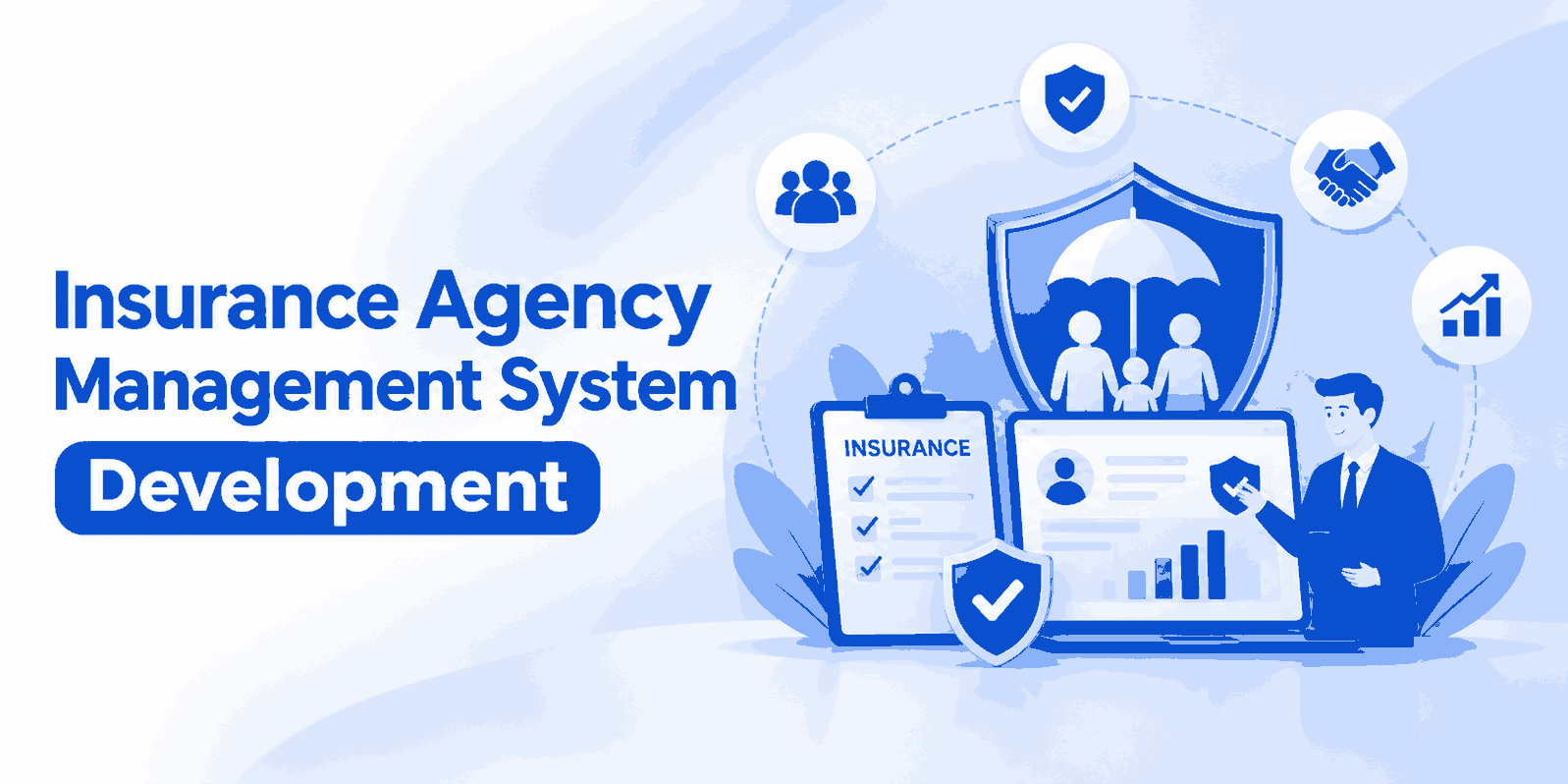
An agency management system is the software an insurance agency runs its daily business on. It stores client and policy records, tracks quotes through binding, calculates producer commissions, flags renewals, and feeds management reporting.
Insurance agency management system development is the work of building that platform around one agency’s actual workflow instead of a generic template.
The pressure to move is real. According to First Connect’s 2026 State of the Industry Report, 53% of independent agents feel optimistic about technology but only 35% actively use it in daily operations. That gap is rarely about willingness. It is about tools that do not match how the agency sells and services business.
Spreadsheets reappearing next to the system is the clearest signal. When producers keep a side sheet for split commissions or renewal notes, the platform has stopped being the source of truth.
Other signals show up in month-end. Reconciliation takes days, carrier statements get checked by hand, and no one can answer retention questions without exporting to Excel. Agencies with a specialty book feel it first, because niche products rarely fit standard rating and commission fields.
Scale changes the math too. At 15 producers the workarounds are annoying. At 60 they cost real revenue.
One client record tied to every policy, document, endorsement, and note. This is the foundation of any insurance agency management system development project, and getting the data model wrong here gets expensive later.
Producers need to raise a submission once and push it to multiple carriers without retyping. The workflow should track status, deadlines, and declinations so nothing sits silently.
Split commissions, overrides, tiered schedules, and house percentages all live here. Most custom builds happen because this module failed somewhere else.
Automated renewal timelines, assigned owners, and escalation rules. Renewals are the quietest revenue leak in an agency.
First notice of loss, carrier claim numbers, and service ticket history attached to the policy record, not to someone’s inbox.
Book of business by carrier, producer performance, loss ratios, and pipeline. Agencies increasingly want this delivered as a live business intelligence dashboard rather than static exports.
| Factor | Off-the-shelf platform | Custom build |
| Time to live | Weeks | 4 to 9 months |
| Upfront cost | Low | High |
| Cost at scale | Per-seat, rises with headcount | Fixed, plus maintenance |
| Fit to niche products | Limited | Exact |
| Data ownership | Vendor-hosted | Yours |
| Carrier integrations | Pre-built, fixed set | Built to your carrier panel |
Buy when your book looks like everyone else’s. Build when your commission structure, carrier panel, or compliance process is the thing that makes you money. The middle path works too, and this custom vs off-the-shelf apps comparison covers how teams decide.
Before a single screen gets designed, sit with producers, CSRs, and accounting separately. Each group describes a different agency. Document how a submission really travels, where it stalls, and which spreadsheets exist outside the system. Count the carriers, the product lines, and the commission variations.
This discovery phase typically takes three to four weeks and prevents the most expensive category of rework. Agencies that skip it end up rebuilding the commission module twice.
Policies, clients, carriers, producers, and transactions all relate to each other in ways that are hard to change later. Decide early how endorsements, cancellations, and reinstatements affect a policy record.
Decide how a policy moving between producers affects historical commission. Model multi-location agencies and shared accounts if they exist. A clean schema here is what lets reporting stay fast at a hundred thousand policies instead of degrading at ten thousand.
Ship client records, policy management, and the quote workflow as a usable release. Let a small producer group run live business through it while the commission and reporting modules are still in build.
Real usage surfaces gaps that no requirements document catches. This staged approach also keeps the project funded, because leadership sees working software early instead of a status report. Most teams reach this first usable release around month three.
Legacy systems hold years of policy history, documents, and commission records of uneven quality. Run migration in test cycles, reconcile totals against the old system, and keep the old platform readable for a full renewal cycle.
Expect duplicate clients, orphaned policies, and attachments with broken links. Budget real weeks for cleanup, not a weekend cutover. Migration is where most insurance agency management system development timelines slip, and it is almost always underestimated.
Carrier connectivity is the make-or-break piece. Real-time rating, policy download, and document retrieval each work differently per carrier, and a few still run on file-based exchange.
The integration layer needs to normalize all of it, which is why solid API development work carries more weight than the UI budget.
Beyond carriers, the usual list includes accounting software, e-signature, payment processing, email and calendar sync, and document storage. Add compliance logging early rather than retrofitting it, since compliance automation software development patterns are easier to build in than bolt on.
A focused system for a single-line agency with a handful of carriers lands around $60,000 to $110,000. A multi-line agency platform with commission automation, carrier download, and reporting runs $120,000 to $250,000.
Enterprise builds with multi-entity accounting and deep carrier connectivity go past $300,000.
Timelines follow the same curve, from roughly four months to over a year. Maintenance after launch typically runs 15 to 20 percent of build cost annually. Rates vary widely by region, and the outsourced software development cost breakdown is useful if you are comparing quotes across markets.
EngineerBabu builds custom platforms for insurance businesses, from broker-facing systems to carrier-side tools. Work spans data modeling, carrier integration, commission engines, and reporting, delivered through a CMMI Level 5 process with senior engineers staying on the project.
Teams that need a working version in front of producers quickly often start with MVP development and expand once the core workflow proves out. Broader insurance software development capability covers the rest of the stack as the platform grows.
Planning insurance agency management system development this year? Talk to the EngineerBabu team about scoping your build.
No. A CRM manages prospects and sales activity. An agency management system is the system of record for bound policies, carrier data, commissions, and servicing after the sale closes.
Yes. Custom platforms can consume AL3 files and IVANS feeds, though each carrier formats data slightly differently. Expect per-carrier mapping work rather than one universal connector handling everything.
Typically six to twelve weeks for a mid-sized agency, including test cycles and reconciliation. Document volume and historical data quality drive the timeline more than policy count does.
Rarely. Under roughly ten producers, off-the-shelf platforms usually win on cost and speed. Custom work makes sense when niche products or unusual commission structures break standard software.
The agency does, including the database and hosting environment. Confirm source code ownership and export rights in the contract before development starts, not after launch.