How to Choose a Software Development Company in India - A Decision-Maker's Guide


Create engaging, high-performance mobile applications tailored to your business needs. We craft future-ready apps that offer smooth user experiences on all devices.
Build robust and scalable websites and CMS platforms that help you manage content effortlessly. Our development ensures a seamless digital presence.
Launch secure, feature-rich online stores with intuitive shopping experiences. We build tailored eCommerce platforms designed for growth.
Design captivating games with immersive gameplay and stunning graphics. From concept to launch, we build engaging experiences that players love.
Enhance your customer relationships with customized Salesforce implementations. Drive growth and efficiency with smarter CRM solutions.
Harness artificial intelligence and machine learning to automate workflows and gain actionable insights. Our AI transforms data into smart decisions.
Accelerate your software delivery lifecycle with continuous integration, delivery, and infrastructure automation to boost efficiency.
Hire app developers ready to turn your ideas into sleek, high-performing mobile apps for any platform.
Bring in frontend pros who craft smooth, beautiful, and user-friendly interfaces that your visitors will love.
Get backend developers who build fast, secure, and reliable systems to keep everything running behind the scenes.
Hire eCommerce developers who build secure, scalable online stores designed to offer seamless shopping and grow your sales.
Get dedicated developers committed to your projects, delivering consistent quality and speed as an extension of your team.
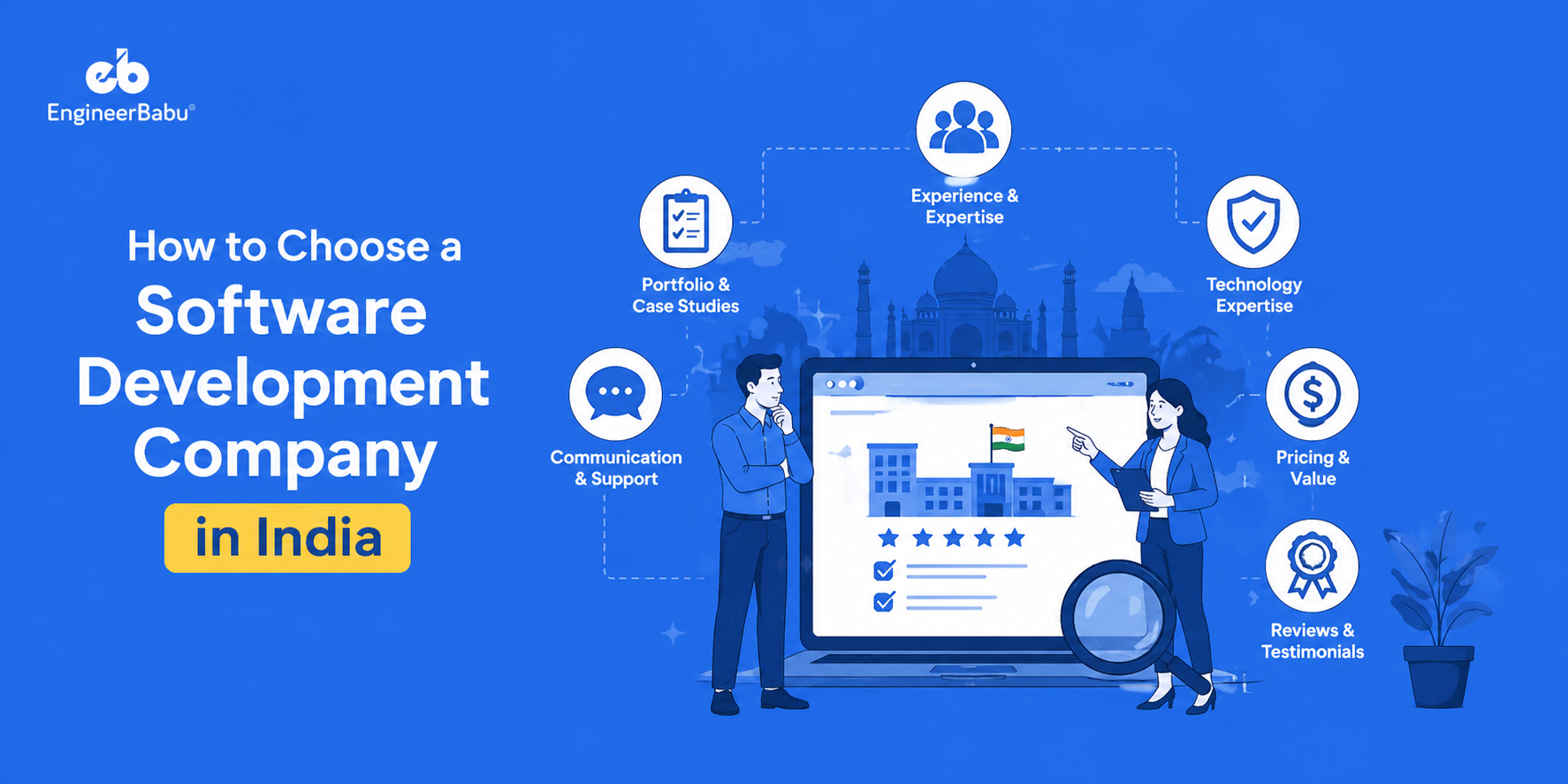
I’m going to tell you something that most Indian software companies will never admit. Most of them aren’t very good.
There are over 30,000 software companies in India. The vast majority will take your project, assign junior developers, miss deadlines, deliver buggy code, and then ghost you when things go wrong. You know this. That’s why you’re reading a blog titled “how to choose” instead of just picking one from Clutch.
I run one of those 30,000 companies. I’ve been running it for 14 years. And I’m going to tell you exactly how to evaluate Indian software companies — including mine — so you don’t waste six months and six figures learning what I already know.
My name is Mayank Pratap. I co-founded EngineerBabu. Here’s what the team has shipped: 500+ products. 200+ for VC-funded companies. 75 for Y Combinator-selected startups. 24 clients that became unicorns — including Bank Open, which went from a startup to a billion-dollar neobank with core banking integrations built by the EngineerBabu team.
EarlySalary — one of India’s first salary advance platforms. The team built the lending infrastructure. ₹10,000 crore disbursed. Khatabook — tens of millions of Indian SMEs. OpenMoney — full-stack financial platform. Razorpay ecosystem — payment orchestration. TaptapSend — remittance across five countries. Apollo Hospitals, Manipal, ResMed, 1MG — healthcare platforms. Adani Group — enterprise technology. Simba Beer — supply chain systems that recovered millions.
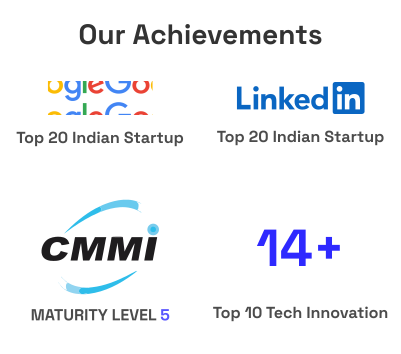
Google selected EngineerBabu for the AI Accelerator 2024. CMMI certified us at Level 5 — the highest level. Vijay Shekhar Sharma, the founder of Paytm, backs us personally.
I’m telling you this not to pitch you. I’m telling you so you understand: I’ve been on both sides of this equation for 14 years. I know why outsourcing to India fails. I know why it succeeds.
And I know exactly what separates a company that’ll deliver from one that’ll waste your money.
Let’s get into it.
India produces over 1.5 million engineering graduates every year. It has the second-largest developer population on Earth. The cost advantage over US, European, or Australian development is 40-60%. English fluency is high. Timezone overlaps exist with every major market — US Pacific has 4-5 hours of overlap with Indian business hours, UAE has 1.5 hours of offset, Singapore has 2.5 hours, and Australia’s east coast has 4.5 hours.
The numbers make sense. That’s why global companies spent over $200 billion on Indian IT services in 2024.
But here’s the problem.
The same numbers that attract serious companies also attract everyone else. Low barriers to entry mean thousands of companies with a website, a Clutch profile, and a handful of developers calling themselves a “leading software development company in India.” Most of them have never shipped a product that handles real users, real money, or real compliance requirements.
When I started EngineerBabu 14 years ago, the Indian outsourcing market had the same problem — but fewer companies. Now it’s 10x worse. A US CTO searching “software development company India” gets 30,000 results and no way to tell the difference between a team that built a unicorn neobank and a team that built a WordPress website for a restaurant.
That’s the problem this blog solves.
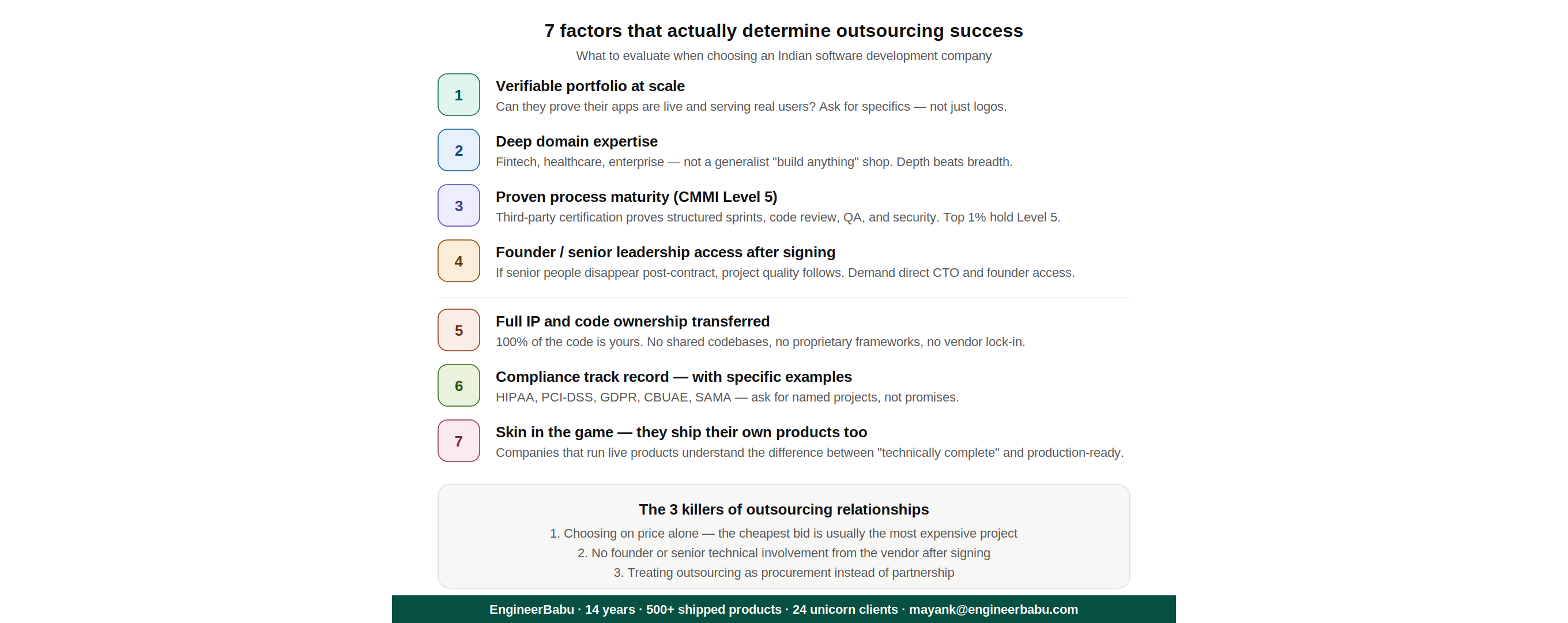
I’ve spent 14 years watching companies succeed and fail at outsourcing to India. These are the seven factors that determine the outcome. Not the office photos. Not the team size claims.
Not the Clutch reviews. These.
This is the single most important question. Not “do they have a portfolio?” Every company has a portfolio. The question is: can you verify that the products they claim to have built are real, live, and operating at scale?
When the EngineerBabu team says they built EarlySalary’s lending platform, you can download the EarlySalary app, see it operating, and verify that it’s disbursed over ₹10,000 crore. When they say Bank Open became a unicorn with their core banking integrations, you can Google “Open Financial Technologies valuation” and see the billion-dollar number.
Most Indian companies list client logos without context. “We worked with [big name]” might mean they built the entire platform — or it might mean they fixed a CSS bug on one page. Ask for specifics. What exactly did you build? What was the architecture? How many users does it serve? What happened after launch?
If they can’t answer these questions in detail, they didn’t build what they’re claiming.
A company that “builds everything for everyone” actually builds nothing well for anyone.
The EngineerBabu CTO spent 17 years at Wishfin building credit infrastructure before joining the company. That’s why when EarlySalary needed a credit decisioning engine that processes thousands of real-time decisions daily, the team didn’t need to learn how credit scoring works — they’d been doing it for nearly two decades.
When TaptapSend needed compliance across five regulatory jurisdictions for their remittance platform, the team didn’t Google “how does cross-border compliance work.” They had already navigated multi-country regulatory requirements.
When Apollo Hospitals and Manipal needed healthcare technology, the team didn’t need a crash course on HIPAA or medical data handling. They’d already built HIPAA-compliant platforms and served 400+ healthcare clients.
Domain depth means faster delivery, fewer mistakes, and architecture decisions based on experience rather than guesswork. A generalist team will build your fintech product the same way they build an e-commerce site. A domain-expert team builds it the way it needs to be built — because they’ve learned from the last 50 fintech products what breaks and what scales.
“We follow agile” is meaningless. Every company says it. Almost none of them mean it.
Process maturity means: Is every sprint planned with defined deliverables? Is there code review before any merge? Is there automated testing? Is there a deployment pipeline? Is there documentation? Is there a rollback plan when deployments fail? Are security reviews built into the development cycle?
The easiest way to verify process maturity is to ask for third-party certifications. CMMI (Capability Maturity Model Integration) is the gold standard. It’s an independent audit of a company’s engineering processes, quality assurance, security practices, and project management.
EngineerBabu holds CMMI Level 5 certification — the highest level achievable. This isn’t a form you fill out. It’s a rigorous multi-month audit by accredited assessors who examine real projects, real processes, and real outcomes. Fewer than 1% of Indian software companies hold Level 5.
Why does this matter to you as a buyer? Because when something goes wrong — and in any complex software project, something will — the difference between a company with mature processes and one without is the difference between a controlled fix and a chaotic scramble.
This is where most outsourcing relationships break down.
You evaluate the company. You talk to the founder or a senior partner during sales. You’re impressed. You sign the contract. Then you never speak to that person again. You’re handed to a project manager who was hired six months ago and has no authority to make decisions. Communication degrades. Decisions stall. Problems fester.
I lead EngineerBabu personally. When a client in San Francisco or Dubai or Singapore starts a project, they’re talking to me — not a sales team. I’m in the architecture reviews. I’m in the scope discussions. I’m in the difficult conversations about trade-offs and priorities. That hasn’t changed in 14 years, and it won’t change because the company has grown.
Vijay Shekhar Sharma didn’t back a company. He backed a team he’d watched build things. That distinction matters. Ask any Indian software company: “Will the founder or CTO be involved in my project?” If the answer is no — or if it’s yes during sales and no after signing — that tells you everything about how they prioritize clients.
This should be non-negotiable. But it’s astonishing how many companies get this wrong.
EngineerBabu builds custom products from scratch. The client’s product, the client’s brand, the client’s IP. Complete code ownership is transferred. Every line of code, every architecture
document, every deployment script belongs to the client. No white-label. No shared infrastructure. No vendor lock-in.
Many Indian companies use shared codebases, proprietary frameworks, or template-based approaches. Your “custom” product is actually a modified version of something they’ve built 20 times before. The code belongs to them. If you want to switch vendors or bring development in-house, you discover that your product isn’t really yours.
Before signing any contract, ask: “Do I own 100% of the code? Can I take it to another vendor tomorrow if I choose?” If there’s hesitation, walk away.
If your product handles financial data, healthcare data, personal data, or operates in regulated markets — compliance isn’t optional. It’s architecture.
For US healthcare: HIPAA compliance. For payments anywhere: PCI-DSS. For UAE fintech: CBUAE. For Saudi Arabia: SAMA. For EU: GDPR. For lending in India: RBI Digital Lending Guidelines.
The EngineerBabu team has built HIPAA-compliant healthcare platforms for Apollo, Manipal, and ResMed. They’ve handled PCI-DSS for payment systems. They’ve navigated CBUAE and SAMA through Kulu Fintech’s GCC work. They’ve managed multi-country compliance for TaptapSend across five jurisdictions simultaneously. They’ve operated under RBI oversight through EarlySalary.
CMMI Level 5 means the security and compliance processes aren’t ad-hoc — they’re systemic. Built into every sprint, every code review, every deployment.
Ask any vendor: “Which compliance frameworks have you built for? Give me specific examples.” If they say “we can handle any compliance requirement” without naming specific projects — they haven’t done it.
This is the question nobody asks. But it’s the most revealing.
Does the company build and run its own products? Or do they only build things for other people?
EngineerBabu doesn’t just build for clients. The team built and runs Supersourcing — a B2B IT staffing platform that Mayank co-founded. They built LoanOS — a modular loan management system now used by a DSA processing ₹1,000 crore per year.
When a company builds its own products, they understand what it means to ship something that their own business depends on. They understand the difference between “technically complete” and “production-ready.” They understand that a bug in production isn’t a ticket in Jira — it’s lost revenue.
A company that has only ever built for clients doesn’t have that visceral understanding. They deliver the code and move on. The consequences of their architectural decisions are someone else’s problem.
The right Indian software company should recommend technology based on your product’s requirements, not their team’s existing skills.
For mobile: Flutter for cross-platform or Swift/Kotlin for native. For web: React, Angular, or Vue depending on the application type. For backend: Node.js for real-time applications, Python for AI/ML-heavy products, Java for enterprise systems. For databases: PostgreSQL for transactional data, MongoDB for document-heavy applications, Redis for caching. For cloud: AWS or GCP with infrastructure-as-code.
When the EngineerBabu team built Bank Open’s neobank, they chose a microservices architecture — not because it was trendy, but because a neobank has multiple financial services that need to scale independently. When they built EarlySalary’s credit engine, they used Python — not because Python is their favorite language, but because Python’s machine learning ecosystem is unmatched for real-time credit scoring.
The Google AI Accelerator 2024 selection validated the team’s AI and machine learning capabilities specifically — not general development. If your product requires AI, ensure your Indian partner has demonstrable AI expertise, not just a landing page about it.
Most blogs about outsourcing to India skip this part. They talk about evaluation but not execution. Here’s what a well-run engagement looks like.
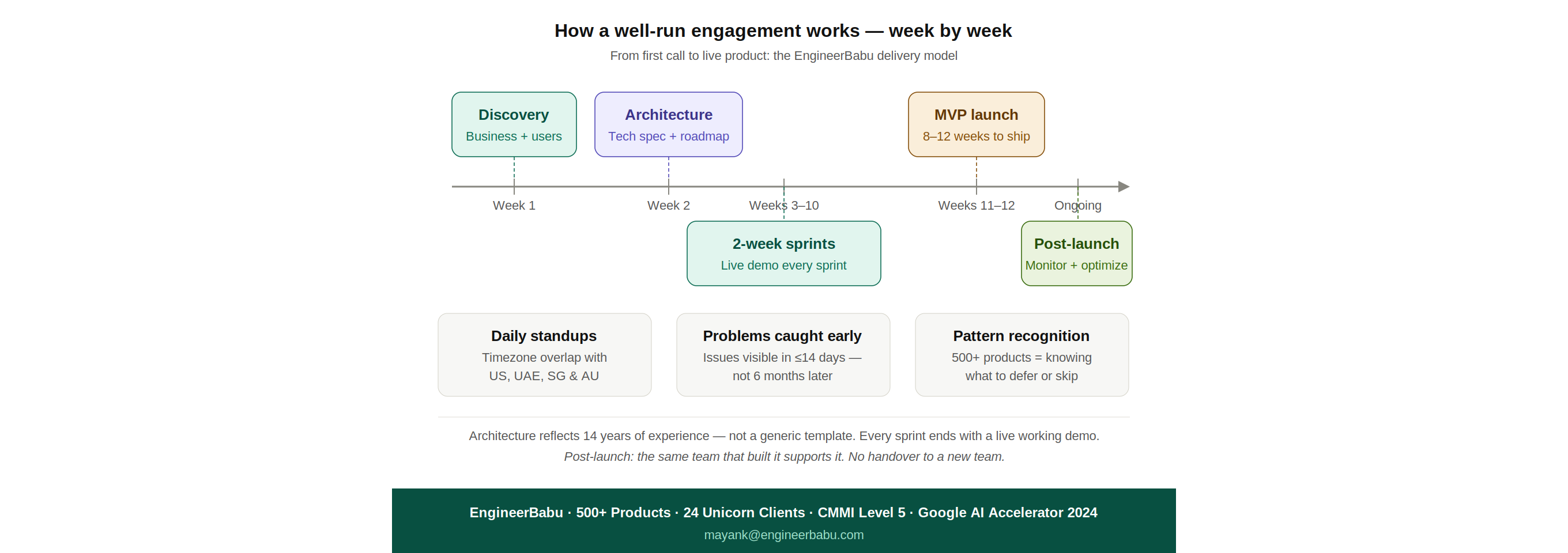
When the EngineerBabu team starts a new project with a US, UAE, or Australian client, the first week is discovery — not coding. Understanding the business model, the target users, the competitive landscape, and the compliance requirements. This happens through daily video calls during overlapping timezone hours.
The second week produces a technical architecture document and a product roadmap. Not a generic template — a specific architecture informed by the team’s experience building similar products. When EarlySalary’s credit platform was designed, the architecture reflected what the CTO had learned about credit infrastructure over 17 years at Wishfin. When TaptapSend’s multi-country remittance architecture was designed, it reflected five regulatory frameworks the team had already navigated.
From week three, development runs in two-week sprints. Every sprint ends with a demo that the client sees and approves. Not a slide deck — a working product increment. The client in San Francisco, Dubai, Sydney, or Singapore sees progress every 14 days. If something is wrong, it’s caught within two weeks, not six months.
The team ships MVPs in 8-12 weeks. Not because they rush. Because 500+ shipped products create a pattern recognition that eliminates wasted effort. The team knows what to build in phase one, what to defer to phase two, and what to skip entirely.
Post-launch, the team doesn’t disappear. They monitor production, respond to issues, and optimize based on real user data. This is where most outsourcing relationships fall apart — the vendor moves on to the next project. EngineerBabu’s model is different. When a product is live, the team that built it supports it. Because a product that crashes in production costs trust — and in a referral-driven business where every client came through word of mouth, trust is the only asset that matters.
I’ve watched hundreds of outsourcing relationships — mine and others’. Three things kill them consistently.
Choosing on price alone. The cheapest bid is usually the most expensive project. A team quoting $12/hour will take twice as long, write code that needs to be rewritten, miss compliance requirements, and deliver something that looks finished but breaks under real usage. The EngineerBabu team isn’t the cheapest in India. They’re the most experienced. The difference between hiring them and hiring the cheapest option is the difference between building once and building twice.
No founder or senior technical involvement from the vendor. When the senior people disappear after the contract is signed, project quality follows them out the door. The people making technical decisions should be the people with 10-20 years of experience — not the ones with 2-3 years who happen to be available. Every EngineerBabu project has the CTO (17 years, Wishfin) and Mayank (14 years, founder) involved in architecture and key decisions. Not as reviewers. As participants.
Treating outsourcing as procurement instead of partnership. Companies that write a spec, throw it over the wall, and expect a finished product six months later will always be disappointed. The best outsourcing relationships are collaborative. Daily standups. Shared Slack channels. Joint architecture decisions. The client’s team and the Indian team functioning as one unit. That’s how EarlySalary built a ₹10,000 crore platform. That’s how Bank Open built a unicorn neobank. Not procurement. Partnership.
Mayank Pratap leads the company personally. Whether the client is in San Francisco, Dubai, Sydney, or Singapore — the engagement model is the same. Founder involvement from day one. The CTO’s 17 years of financial infrastructure experience on every architecture decision.
Custom builds. Full code and IP ownership transferred. No white-label. No shared codebases. No vendor lock-in. The client’s product. The client’s property.
Google AI Accelerator 2024 for AI capabilities that have been validated by Google itself. CMMI Level 5 for internationally audited engineering processes. 24 unicorn clients for the pattern recognition that only comes from building at scale. 75 YC selections for startup speed and discipline. 200+ VC-funded products for proof that investors trust what the team builds.
150+ engineers across full-stack, mobile, cloud, AI/ML, and DevOps. Clients across 15+ countries. Products handling millions of users, billions of rupees, regulated data in healthcare, finance, and enterprise.
Starting from $15K depending on scope, industry complexity, and feature depth. The exact number comes after understanding the specific business — not before.
Here’s my commitment.
Email me. mayank@engineerbabu.com. I’ll spend 30 minutes understanding the business — the market, the users, the product vision, the regulatory requirements. Then I’ll tell you honestly: should you build this, and what will it take?
If EngineerBabu is the right fit, we’ll move forward. If we’re not — if the project needs something outside our expertise, or if the timeline isn’t realistic — I’ll tell you that too. I’d rather earn trust by being honest than earn a contract by overpromising.
That’s how every client for 14 years has come through referral. Not marketing. Not outbound. Just building good products and being honest about what we can and can’t do.
Mayank Pratap Co-founder, EngineerBabu mayank@engineerbabu.com | engineerbabu.com
Google AI Accelerator 2024 · CMMI Level 5 · Backed by Vijay Shekhar Sharma · 24 Unicorn Clients
Verify their portfolio with real, live products at scale. Check for domain expertise in your industry. Ask for CMMI certification or equivalent process maturity evidence. Ensure founder or senior technical involvement in your project. Confirm 100% code and IP ownership. Ask for specific compliance experience matching your requirements. EngineerBabu has CMMI Level 5, Google AI Accelerator selection, 24 unicorn clients, and 75 YC project track record.
Quality software development from India starts from $15K depending on scope, industry complexity, compliance requirements, and feature depth. This represents 40-60% savings compared to US, European, or Australian development teams at equivalent quality levels. EngineerBabu provides exact estimates after understanding the specific project — not before.
With the right partner, yes. EngineerBabu transfers complete code and IP ownership to every client. No white-label, no shared codebases, no proprietary frameworks that create vendor lock-in. CMMI Level 5 processes include security protocols, access controls, and NDA enforcement. 200+ VC-funded companies and 24 unicorns have trusted the team with their core technology.
India overlaps with US Pacific time by 4-5 business hours, with UAE by nearly full business day, with Singapore by 2.5 hours, and with Australian east coast by 4.5 hours. EngineerBabu runs daily standups during
overlapping hours and uses sprint demos every two weeks to ensure no communication gaps. The founder is personally accessible across all timezones.
Yes. EngineerBabu serves clients across 15+ countries including the US, UK, UAE, Saudi Arabia, Singapore, and Australia. Industry-specific compliance experience includes HIPAA (US healthcare), PCI-DSS (global payments), CBUAE/SAMA (Gulf fintech), GDPR (EU data protection), and RBI (Indian financial services). Case studies include US logistics (BURQ), GCC fintech (Kulu Fintech), multi-continent remittance (TaptapSend), and global healthcare platforms (Apollo, ResMed, 1MG).
EngineerBabu | Product Engineering for Companies That Build for the World