Future of Mobile App Development in 2027: 8 Key Shifts


Create engaging, high-performance mobile applications tailored to your business needs. We craft future-ready apps that offer smooth user experiences on all devices.
Build robust and scalable websites and CMS platforms that help you manage content effortlessly. Our development ensures a seamless digital presence.
Launch secure, feature-rich online stores with intuitive shopping experiences. We build tailored eCommerce platforms designed for growth.
Design captivating games with immersive gameplay and stunning graphics. From concept to launch, we build engaging experiences that players love.
Enhance your customer relationships with customized Salesforce implementations. Drive growth and efficiency with smarter CRM solutions.
Harness artificial intelligence and machine learning to automate workflows and gain actionable insights. Our AI transforms data into smart decisions.
Accelerate your software delivery lifecycle with continuous integration, delivery, and infrastructure automation to boost efficiency.

TL;DR
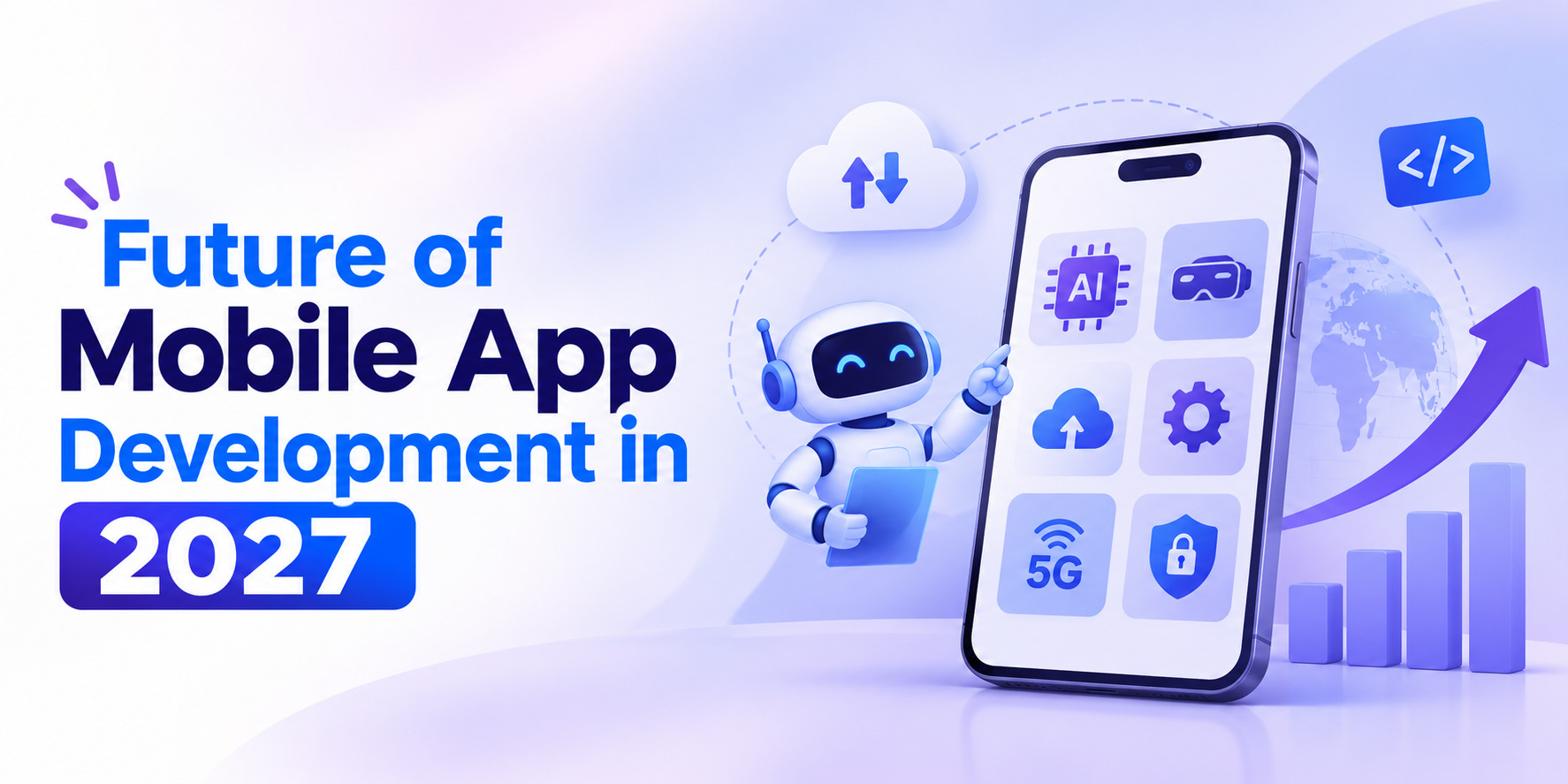
Here is the prediction that should be on every product roadmap right now: Gartner forecasts that mobile app usage will decrease by 25% by 2027 as AI assistants take over tasks people currently open apps to do (Gartner).
Fewer app opens does not mean fewer apps. It means the app stops being the destination and becomes the engine behind one.
The future of mobile app development in 2027 looks less like a new framework cycle and more like a change in who the user actually is. Increasingly, the first consumer of your app is a machine acting for a person.
That reframes your API surface as the primary product, your UI as one of several front ends, and your data quality as the thing that decides whether you get called at all.
Three forces are arriving at once. Assistants are becoming the entry point to digital tasks. Models small enough to run on phones are getting genuinely capable. And development itself is being compressed by AI tooling, which changes team shape and cost structure.
None of these are speculative any more. All three are shipping. What makes the future of mobile app development hard to plan for is the combination, since each one invalidates assumptions the other two depended on.
When an assistant books your flight, it does not tap your buttons. It calls your endpoints. Apps that expose clean, well-documented, permissioned APIs get invoked. Apps that bury functionality in UI flows get skipped entirely.
What it means: Treat your public interface contract as a product with versioning, docs, and an owner. AI in mobile app development now starts at the integration layer, not the feature layer.
Shipping models that run locally removes latency, cuts inference cost, and sidesteps the hardest privacy conversations. Apple and Google have both pushed silicon and frameworks hard in this direction, and flagship devices now handle meaningful workloads offline.
What it means: Plan a hybrid inference strategy. Sensitive and latency-critical work runs locally, heavy reasoning goes to the cloud, and the handoff is invisible to users.
Static screens assume every user needs the same layout. Generative interfaces assemble components dynamically based on intent, history, and context, so a frequent user and a new one see genuinely different surfaces for the same task.
What it means: Design systems matter more than screens. You are specifying components and rules, then letting the runtime compose. This is one of the clearest AI trends in mobile apps moving from demos into shipped products.
Instead of guiding a user through seven taps, the app completes the sequence and reports back. That requires orchestration, retries, permissions, and audit trails, which is closer to backend engineering than mobile work.
What it means: Invest in orchestration early. Teams building a multi-agent AI system learn fast that the difficulty is state management and failure handling, not the model call.
Apps increasingly act on predicted intent rather than reporting it after the fact. Prefetching content, surfacing the next likely action, and flagging churn risk inside the session all become standard behavior.
What it means: Event instrumentation stops being an analytics chore. Predictive analytics in mobile apps only works when your event schema was designed for it from the start.
Flutter and React Native have closed most of the performance gap, and AI-assisted code generation favors a single codebase because there is one surface to maintain. Native remains the right call for heavy graphics, deep hardware access, and some AR work.
What it means: Default to shared code and justify native per module, not per project. Comparing cross-platform app frameworks is now a question of ecosystem fit rather than raw speed.
AI pair programming has compressed implementation time dramatically. What it has not compressed is deciding what to build, how systems fit together, and which tradeoffs to accept. Teams flatten toward fewer, more senior engineers.
What it means: Expect smaller teams shipping faster, with more review pressure on design decisions. The mobile app development cost curve bends down on implementation and up on architecture and QA.
With AI features touching more personal context, users and enterprise buyers are asking where data goes and who trains on it. Clear answers are becoming a sales advantage rather than a compliance checkbox.
What it means: Document your data flows publicly. Build deletion, export, and model opt-out paths into the product rather than into a support queue.
Teams adding conversational surfaces should also look at how AI chatbot development patterns have matured, since most of the early mistakes have already been made and documented.
The future of mobile app development is not a story about one technology replacing another. It is about the app losing its monopoly on how people reach software, and the work shifting toward being reachable, reliable, and fast wherever that request originates.
Teams that spend 2027 making their product callable, measurable, and privacy-clear will be fine. Teams still optimizing a home screen nobody visits will not.
EngineerBabu builds in exactly this direction, combining agent-ready backends with cross-platform clients through its mobile app development services for US and global product teams.
No. Gartner expects usage to drop, not apps to disappear. Assistants become an additional entry point, while apps keep handling complex interactions, rich media, offline work, and anything needing a dedicated interface.
No. Native remains the right choice for games, AR, heavy graphics, and deep hardware access. Cross-platform now covers most business, commerce, and content apps without a meaningful performance penalty.
System design, API architecture, AI integration, on-device model deployment, and data privacy engineering. Raw UI implementation is increasingly handled by AI tooling, which raises the value of judgment over syntax.
Typically 20% to 40% above a comparable build, covering model integration, evaluation, prompt and output testing, and inference costs. On-device deployment lowers running costs but raises initial engineering effort.
No. Waiting costs market position, and the underlying shift toward API-first, agent-reachable products is stable. Build for that architecture now and swap models as better ones become available.