How to Build a Distributor Management System, Order Management, Scheme Automation, Claims Processing, and Channel Intelligence 2026


Create engaging, high-performance mobile applications tailored to your business needs. We craft future-ready apps that offer smooth user experiences on all devices.
Build robust and scalable websites and CMS platforms that help you manage content effortlessly. Our development ensures a seamless digital presence.
Launch secure, feature-rich online stores with intuitive shopping experiences. We build tailored eCommerce platforms designed for growth.
Design captivating games with immersive gameplay and stunning graphics. From concept to launch, we build engaging experiences that players love.
Enhance your customer relationships with customized Salesforce implementations. Drive growth and efficiency with smarter CRM solutions.
Harness artificial intelligence and machine learning to automate workflows and gain actionable insights. Our AI transforms data into smart decisions.
Accelerate your software delivery lifecycle with continuous integration, delivery, and infrastructure automation to boost efficiency.
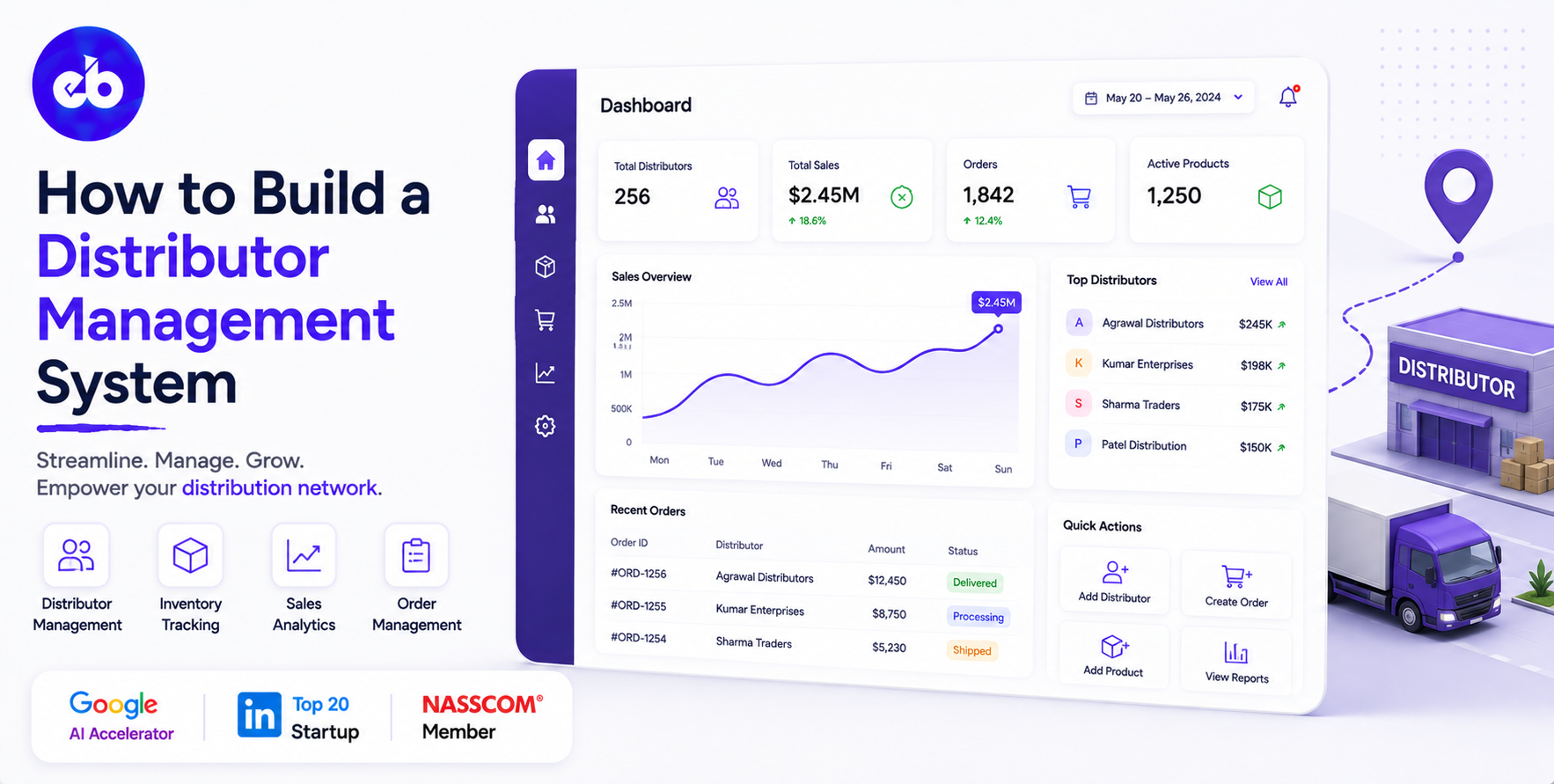
Most FMCG companies know their primary sales numbers, what they shipped to distributors. Very few know their secondary sales numbers, what distributors actually sold to retailers. The gap between primary and secondary is where inventory builds up, schemes go unclaimed, distributors go unhappy, and market share gets lost to competitors who are closer to the action.
A Distributor Management System (DMS) closes this gap. It gives the manufacturer real-time visibility into distributor inventory, secondary sales, scheme performance, and claims, and gives distributors the tools to run their operations professionally rather than through a combination of Tally, WhatsApp, and manual ledgers.
India’s FMCG distribution market is one of the most complex in the world, 10 million retail outlets, 100,000+ distributors, and product journeys that cross multiple levels of the trade before reaching the consumer.
The company that builds a DMS that distributors actually adopt, because it makes their business easier, not just the manufacturer’s reporting better, wins market intelligence that their competitors cannot match.
EngineerBabu built supply chain and distribution intelligence for Simba Beer and enterprise operations for Adani Group. CMMI Level 5. Google AI Accelerator 2024 Top 20. Contact: mayank@engineerbabu.com
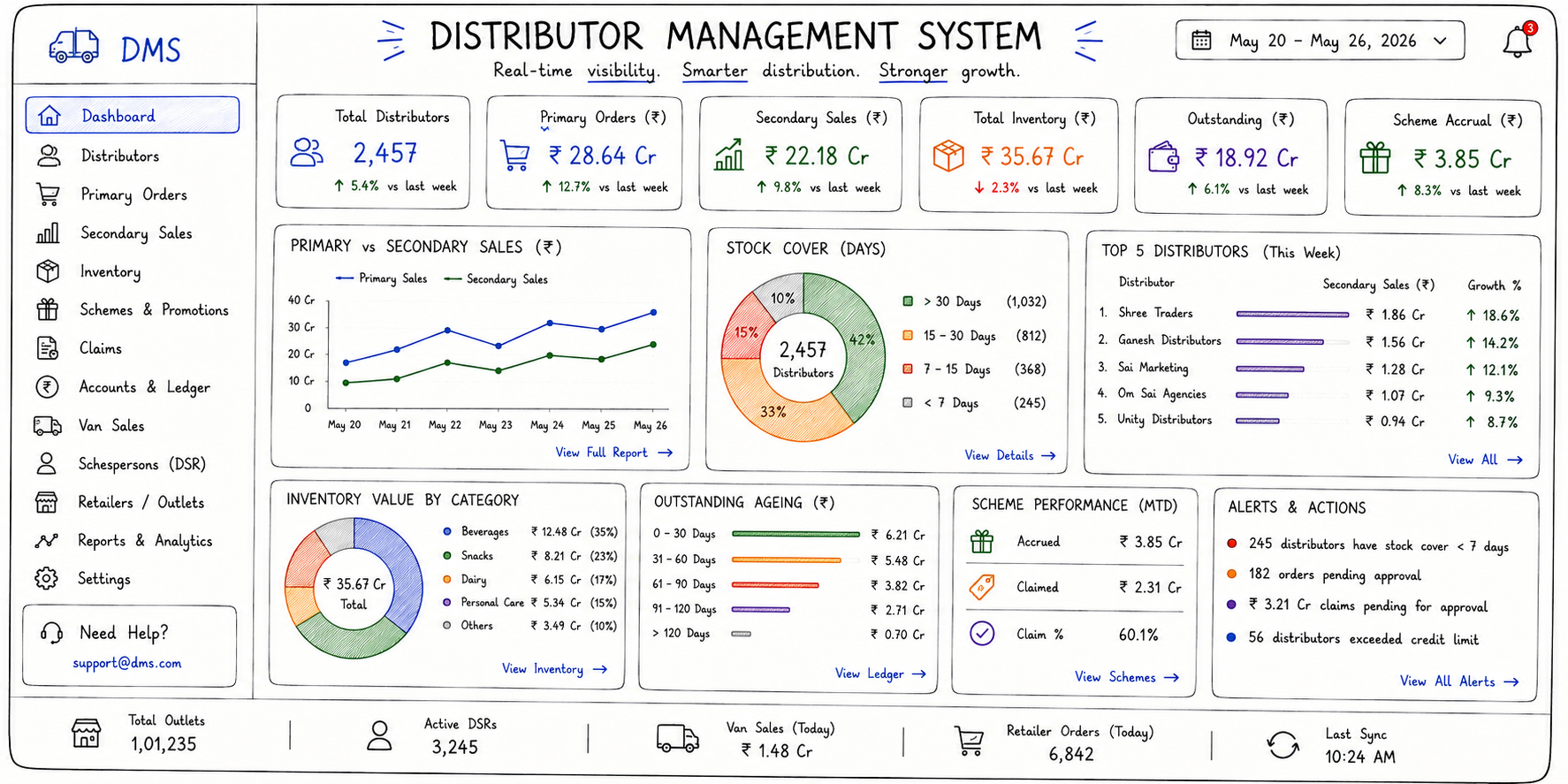
| Function | Module |
| Distributor onboarding and master data | Distributor profile, territory, beat, outlet universe |
| Primary order management | Distributor orders to the company |
| Secondary order management | Retailer orders to the distributor |
| Inventory management | Stock at distributor warehouse, by SKU, by lot, by expiry |
| Scheme and promotion management | Active schemes, accrual tracking, claim processing |
| Claims management | Credit notes, damage claims, returns claims |
| Accounts and ledger | Distributor outstanding, credit limit, ageing |
| Van sales and beat management | Driver app for van sales operations |
| Salesperson management | DSR (Distributor Sales Representative) performance |
| Retailer management | Outlet master, visit frequency, order history |
| Analytics and reporting | Secondary sales, stock cover, scheme ROI |
| Integration | ERP, field force app, financial systems |
The distributor profile:
| Category | Fields |
| Identity | Legal name, trade name, GST number, PAN |
| Contact | Owner name, phone, email, address |
| Territory | Districts, towns, and localities served |
| Outlet universe | All retailers this distributor serves |
| Credit terms | Credit limit, credit days, outstanding |
| Primary beat | Which company salesperson covers this distributor |
| Bank details | For payment settlement |
| Active schemes | Which schemes this distributor is enrolled in |
| Performance tier | Gold / Silver / Standard, based on volume |
| KYC documents | GST certificate, trade licence, cancelled cheque |
The outlet master under each distributor:
Every retailer that the distributor supplies is mapped in the outlet master, outlet name, address, GPS coordinates, license number (for regulated categories), owner contact, outlet category, and visit frequency. This outlet master is the foundation of secondary sales reporting and retailer-level analytics.
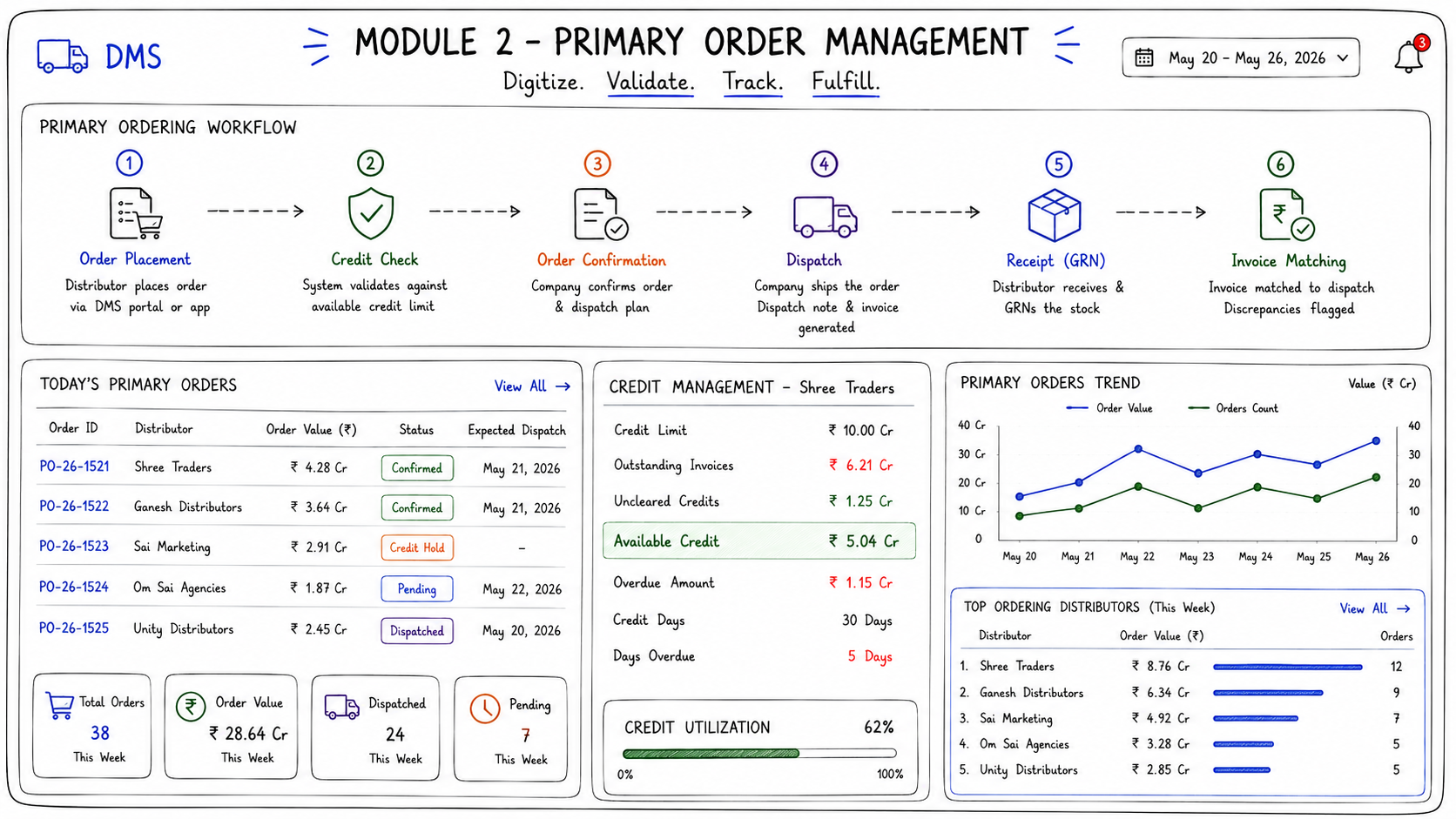
Primary orders are orders placed by the distributor to the manufacturing company. Historically managed through phone calls, email, or company salesperson visits, a DMS digitises this process entirely.
The primary ordering workflow:
| Step | Action | System |
| Order placement | Distributor places order through DMS portal or app | Order captured with SKUs and quantities |
| Credit check | System validates against available credit limit | Real-time credit check, order blocked if limit exceeded |
| Order confirmation | Company acknowledges and confirms dispatch plan | Confirmation with expected dispatch date |
| Dispatch | Company ships the order | Dispatch note, invoice generated |
| Receipt | Distributor receives and GRNs the stock | Stock added to distributor inventory in DMS |
| Invoice matching | Distributor invoice matched to DMS dispatch | Discrepancies flagged for resolution |
The credit management module:
Every distributor has a credit limit, the maximum outstanding they can carry before new orders are blocked. The DMS tracks the credit position in real time:
| Component | Calculation |
| Credit limit | Negotiated maximum, set by finance and sales |
| Outstanding invoices | Total invoiced but unpaid |
| Uncleared credits | Scheme credits and claims pending application |
| Available credit | Credit limit − outstanding + uncleared credits |
| Overdue amount | Outstanding beyond credit days, triggers order hold |
Secondary sales capture methods:
| Method | How It Works | Data Quality |
| DMS portal entry | Distributor enters daily secondary sales in the DMS | Medium, dependent on distributor discipline |
| Integrated billing software | Distributor’s Tally or Busy accounting integrated with DMS via API | High, from actual billing system |
| Van sales app | DSR captures each sale at the outlet during the visit | Very high, real-time, location-verified |
| Photo-based entry | Distributor photographs sales register, OCR extracts data | Medium, OCR accuracy dependent |
The secondary sales data model:
| Field | Details |
| Date | Sale date |
| Outlet | Retailer who purchased |
| SKU | Product sold |
| Quantity | Units sold |
| Rate | Price at which sold |
| DSR | Which salesperson made the sale |
| Beat | Which beat this outlet belongs to |
| Invoice number | Distributor’s billing reference |
Inventory management at the distributor level:
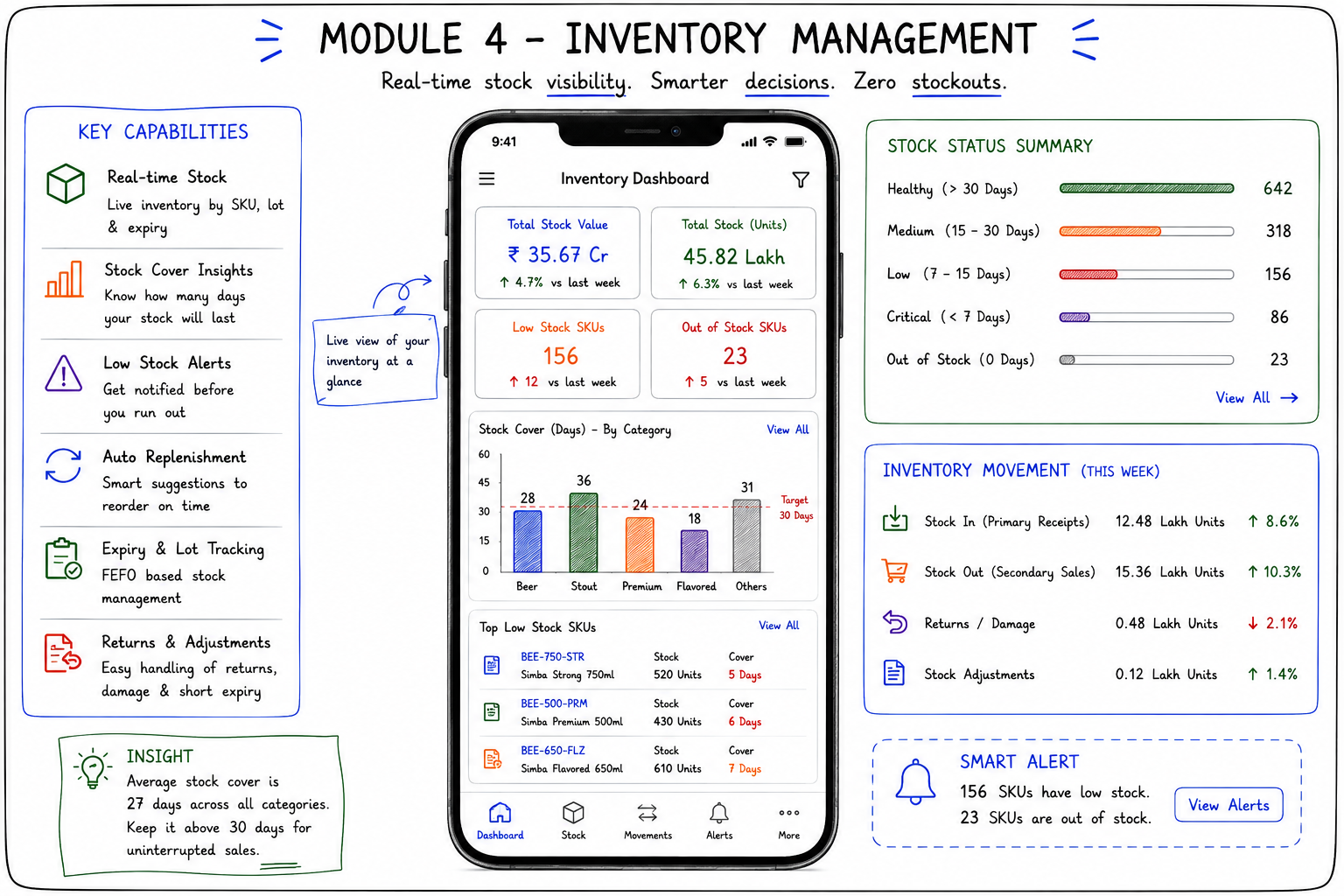
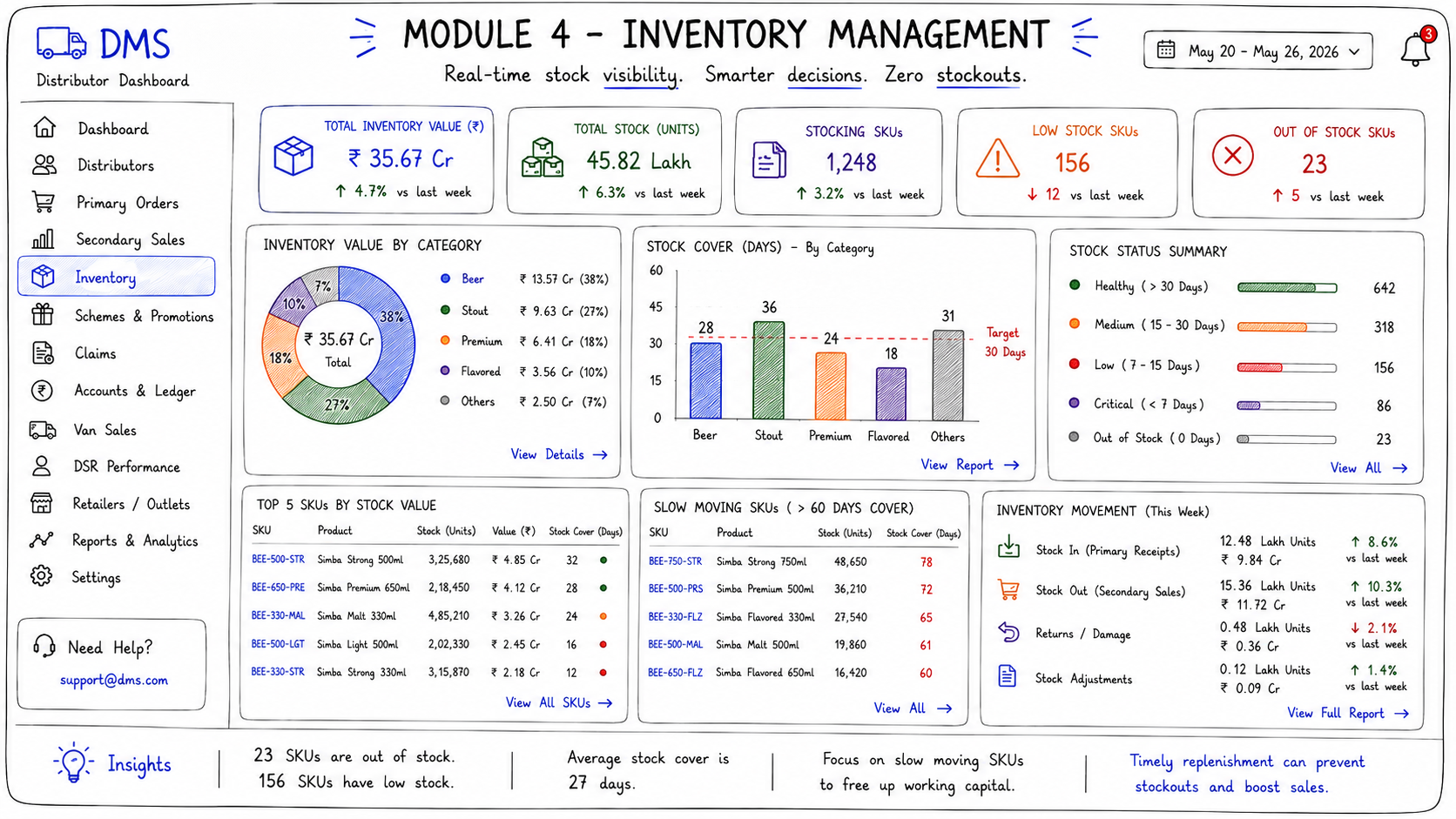
The DMS maintains a real-time inventory position for each distributor, every primary receipt adds stock, every secondary sale decrements stock, every damage or return adjusts accordingly.
| View | Business Use |
| Current stock by SKU | What does this distributor currently hold? |
| Stock cover (days) | At current secondary sales rate, how many days of stock remain? |
| Slow-moving stock | SKUs with > 60 days cover, needs push or redistribution |
| Expiry alert | Stock approaching best-before date, needs priority liquidation |
| Stock vs norm | Is the distributor holding the right level of stock per SKU? |
Schemes are one of the most powerful sales tools in FMCG distribution, and one of the most administratively expensive to manage. A quarterly scheme involving 50 distributors and 200 SKUs generates thousands of scheme calculation transactions, hundreds of credit notes, and a significant volume of distributor queries and disputes if managed manually.
Scheme types the DMS manages:
| Scheme Type | Description | Calculation |
| Purchase scheme | Distributor buys X cases, gets Y% credit | Monthly purchase total × credit % |
| Secondary scheme | Distributor sells X cases, gets Y credit | Monthly secondary volume × credit rate |
| Scheme on scheme | Tiered slabs, higher volume, higher credit | Slab-wise calculation |
| Free goods scheme | Buy X, get Y units free | Physical free goods issued at dispatch |
| Season scheme | Additional credit for buying during a defined period | Date-flagged scheme |
| POSM scheme | Distributor installs display material, earns credit | Verified via field app photo |
The automated scheme calculation engine:
At the end of each scheme period, weekly, monthly, or quarterly, the engine:
The distributor sees a WhatsApp message: “Your April scheme credit has been calculated. You earned ₹28,400 on 284 cases of Brand X. Credit note CN-2024-0892 has been applied to your account.”
No query. No dispute. Because the calculation is transparent and the supporting data is accessible.
Claims are one of the most operationally painful aspects of distributor management. A distributor receiving damaged goods from the company expects a credit note.
A distributor who ran a promotion that damaged product in the market expects a market damage claim credit. A distributor who received a product that has gone past its expiry date expects replacement or credit.
Without a structured claims system, these claims are submitted via email or phone, processed manually, occasionally lost, and frequently disputed. Every unresolved claim represents a relationship problem and a cash flow problem for the distributor.
Claims types managed:
| Claim Type | Trigger | Resolution |
| Transit damage | Goods received in damaged condition | Credit note or replacement |
| Market damage | Product damaged at market, packaging, spillage | Credit after field verification |
| Expiry return | Stock approaching or past expiry | Credit or replacement per policy |
| Scheme non-credit | Distributor claims scheme credit was missed | Audit and correction |
| Price difference | Distributor billed at wrong price | Credit note for difference |
| Short supply | Received fewer units than invoiced | Credit note for shortage |
The claims workflow:
Claims aging dashboard:
All open claims listed with age, days since submission. Claims above 7 days without action flagged for manager review. The claims aging dashboard gives the sales team visibility into which distributors have unresolved claims, a distributor with ₹50,000 in unresolved claims is a relationship risk that needs proactive resolution.
The analytics layer answers the questions that matter:
| Question | Analytics View |
| Which distributors are growing and which are declining? | Secondary volume trend per distributor |
| Which SKUs are moving through the channel and which are stagnant? | SKU-wise secondary velocity |
| Which distributors are sitting on excess inventory? | Stock cover per distributor per SKU |
| Which scheme is generating the best return? | Scheme ROI, secondary volume lift vs credit cost |
| Which distributors are consistently late on payments? | Payment behaviour analysis |
| Which districts are underperforming relative to market potential? | District-wise volume vs potential |
| Which outlet categories drive the most volume? | Volume by outlet segment |
The distributor scorecard:
Every distributor receives a monthly performance scorecard, not just to the company’s internal team but visible to the distributor themselves through the DMS portal. The scorecard covers: secondary volume achievement vs target, payment discipline, claim resolution time, and scheme utilisation rate. Distributors whose scores qualify them for tier upgrade receive the notification in the portal, creating positive competitive motivation across the channel.
| Module | Cost Range (USD) | Notes |
| Distributor master + territory management | $5K – $10K | |
| Primary order management + credit check | $8K – $15K | Real-time credit validation |
| Secondary sales capture (multi-method) | $8K – $15K | Portal, API, van app integration |
| Distributor inventory management | $6K – $12K | Real-time stock, expiry alerts |
| Scheme management engine + auto-calculation | $10K – $18K | All scheme types, rule builder |
| Claims management workflow | $8K – $15K | Submission, verification, credit note |
| Distributor portal (web dev + mobile app) | $8K – $15K | Self-service access |
| Accounts and ledger management | $6K – $12K | Outstanding, ageing, credit limit |
| DSR management + van sales app | $8K – $15K | |
| Analytics and channel intelligence | $6K – $12K | |
| ERP integration (SAP/Oracle) | $6K – $12K | Bidirectional |
| AWS + VAPT + Year 1 ops | $5K – $10K | |
| Total | $84K – $161K | Full DMS platform |
EngineerBabu built distribution and supply chain intelligence for Simba Beer and enterprise operations for Adani Group. CMMI Level 5. Google AI Accelerator 2024 Top 20. Contact: mayank@engineerbabu.com
Primary sales is the volume that the manufacturing company sells to its distributors, what left the company’s factory or warehouse. Secondary sales is the volume that distributors sell to retailers and outlets. The difference matters enormously for market understanding. A company that tracks only primary sales knows how much product it dispatched to the channel but not how much of that product is actually moving to retail shelves. Distributors who are forward-buying, stocking up before a price increase or to claim a volume scheme, inflate primary sales without creating real consumer demand. A company that tracks secondary sales knows what is actually selling through the channel, where inventory is building up, and which markets have real velocity versus which are showing inflated primary numbers. Secondary sales visibility is the difference between managing inventory and managing demand.
A scheme calculation engine eliminates disputes by making the calculation transparent and automatic. When a scheme is active, the engine records every qualifying transaction in real time, every case of a qualifying SKU that a distributor purchases or sells. At scheme period end, the engine calculates earned credit by applying the scheme rules to the recorded transactions and generates an itemised statement showing every qualifying transaction, the scheme rate applied, and the total earned credit. This statement is sent to the distributor via WhatsApp with enough detail that they can verify the calculation themselves. In a manual scheme calculation process, the distributor receives a credit note with a total amount and no supporting detail, they have no way to verify it and frequently dispute it. When the calculation is transparent and supported by transaction-level data that both parties can access, disputes drop to near zero.
The most common reason DMS deployments fail is that the system makes the distributor’s life harder rather than easier, it creates data entry burden without giving the distributor any direct benefit. The right adoption strategy has three components. First, give distributors something valuable for their own operations before asking them to enter data for the manufacturer, a claims tracking tool that shows them exactly where their claims are in the resolution process, a scheme statement they can access anytime rather than waiting for the company to send it, and a secondary sales tool that replaces their manual record-keeping. Second, start with the largest distributors who have the most to gain from digitisation and whose adoption creates a reference point for smaller distributors. Third, integrate with the accounting software distributors already use, Tally, Busy, so that secondary sales data flows automatically without separate manual entry. When the DMS reduces the distributor’s own administrative burden, adoption follows.