How to Build an App Like Jar (India): Architecture, Cost, and the Onboarding


Create engaging, high-performance mobile applications tailored to your business needs. We craft future-ready apps that offer smooth user experiences on all devices.
Build robust and scalable websites and CMS platforms that help you manage content effortlessly. Our development ensures a seamless digital presence.
Launch secure, feature-rich online stores with intuitive shopping experiences. We build tailored eCommerce platforms designed for growth.
Design captivating games with immersive gameplay and stunning graphics. From concept to launch, we build engaging experiences that players love.
Enhance your customer relationships with customized Salesforce implementations. Drive growth and efficiency with smarter CRM solutions.
Harness artificial intelligence and machine learning to automate workflows and gain actionable insights. Our AI transforms data into smart decisions.
Accelerate your software delivery lifecycle with continuous integration, delivery, and infrastructure automation to boost efficiency.
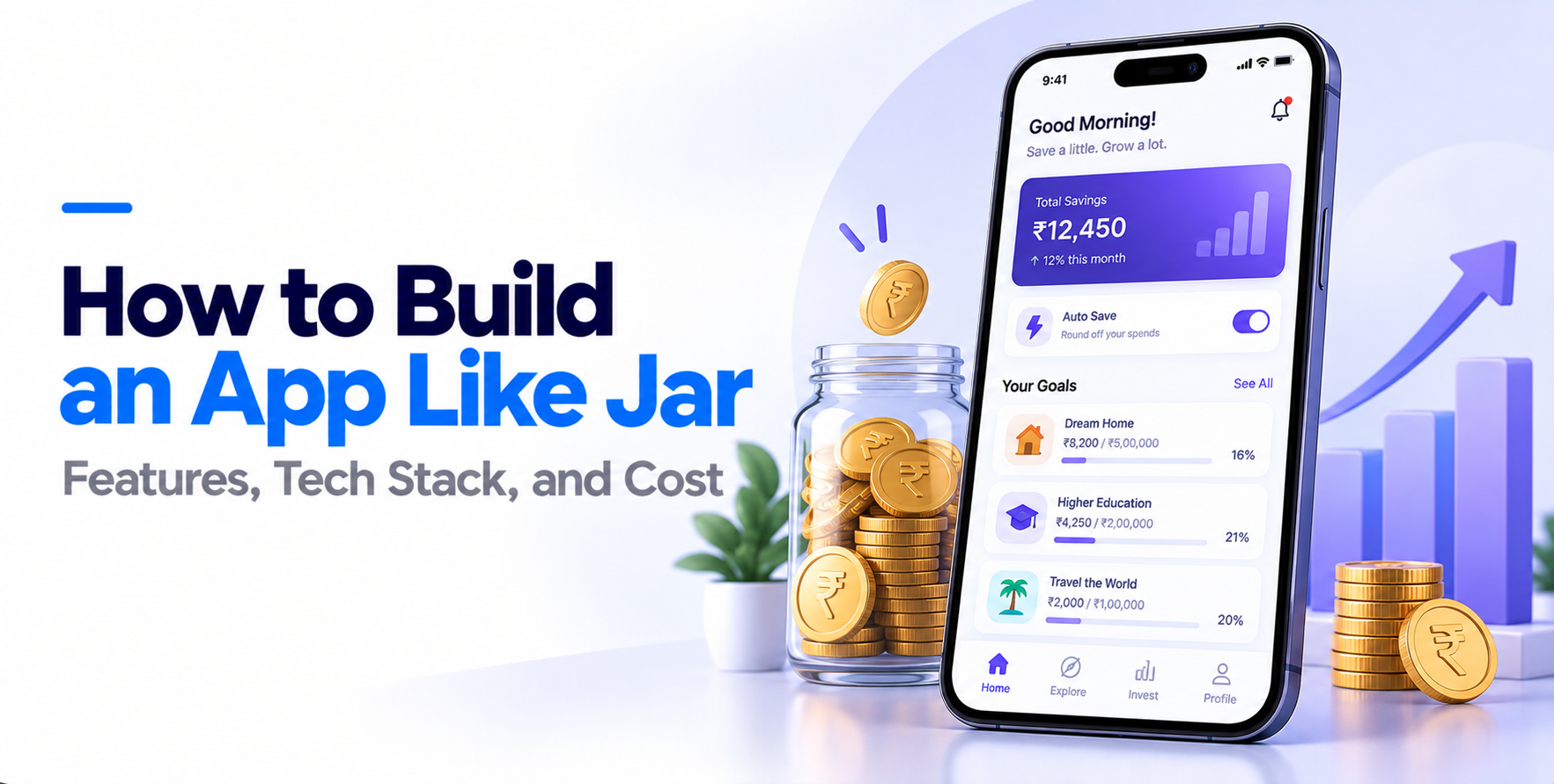
Someone spends ₹27 on a cup of chai. Three rupees gets rounded off, and by the time they have opened their banking app to check the debit, that ₹3 has already become a fraction of a gram of 24K gold sitting in an insured vault under their name.
That gap, the seconds between a transaction and owning the asset, is the entire product. If the ledger behind it is wrong, the seconds stop mattering, because the user’s app balance no longer matches what the vault actually holds.
For founders who want to build an app like Jar, this guide covers what actually matters: the onboarding decision, the custody integration, the reconciliation layer, real cost ranges, and the mistakes that quietly sink clone attempts.
The demand side is not in question. India’s Digital Gold and WealthTech Platforms market is valued at roughly ₹155 billion as of a February 2026 Research and Markets report. Jar itself grew operating revenue ninefold to about ₹2.08 billion, according to TechCrunch’s September 2025 reporting on its filings.
The opening is on the onboarding side. Most gold-savings apps still ask for a full KYC form before a user’s first rupee moves, which kills activation before it starts. Jar’s early growth came from delaying full verification until after the first small transaction. This lets a new user go from download to owning gold in under a minute.
That is the wedge. A product that gets the first sixty seconds right beats a feature-complete clone that makes users fill out a form before they feel anything happen.
Users see a round-off notification and a gold balance. Underneath, three systems run in parallel, and each one can break the other two.
This layer reads UPI transaction data, or uses a scheduled daily debit, to work out the save amount. Jar’s original design relied on reading transaction SMS to detect spending. That is a fragile integration point as Android’s permission model gets stricter, so it needs a manual or bank-statement-based fallback when SMS access is denied.
Live pricing, purity guarantees and insured vault storage come from a licensed provider, not from anything the team builds itself. Jar’s own partner is SafeGold. Becoming a bullion custodian is a different regulated business from the one most founders are actually starting.
Every round-off transaction has to match a confirmed gold purchase from the provider, in near real time, with a full audit trail. This is the system an auditor actually inspects, not the round-off math. It is also the layer most clone attempts treat as an afterthought.
Teams should ship these three surfaces and then stop. A credit line, insurance and a second asset class belong in version two. A clear look at MVP versus full-scale development can save a quarter of the runway.
The team must decide how delayed KYC will work at each transaction threshold, since this single decision shapes the entire account model. Compliance counsel should be consulted before any code is written, not after a build is scoped around an assumption.
Every transaction should be modeled as its own entity with a strict state: captured, pending provider confirmation, confirmed, or failed. The reconciliation job should be written early. Teams that skip this ship a clean dashboard in week six and rebuild the entire backend in week twenty. This pattern shows up constantly in fintech-grade transaction systems.
The app connects to SafeGold, Augmont or MMTC-PAMP for pricing, custody and purity guarantees. The settlement file format and confirmation delay should be tested before a launch date is fixed. Vendors tend to undersell this part in sales calls.
SMS-based detection alone does not hold up across Android OS versions. A bank-statement or manual-entry fallback should be built from day one, not added as a patch after users complain that round-offs stopped working.
The app needs logic that upgrades a user from delayed to full KYC once they cross a transaction or balance threshold, with PAN validation and AML monitoring behind it. This overlaps heavily with the reconciliation discipline in loan management software development, where similar threshold-based compliance logic applies.
Physical redemption involves minimum weight limits, minting charges and courier insurance. A user’s first bad redemption experience is the fastest way to lose trust that took months to build.
| Layer | Practical choice | Why |
| Mobile | Flutter or React Native | One codebase, fast iteration for a consumer product |
| Backend | Node.js or Java microservices | Handles many small-value transactions at once |
| Database | PostgreSQL with a separate ledger service | Transactional integrity for reconciliation |
| Cache and queue | Redis | Round-off calculation and retry queues |
| Payments | UPI-linked rails via a licensed PA/PG | Required for round-off detection and recharge |
| Gold custody | SafeGold, Augmont or MMTC-PAMP API | Licensed pricing, purity and vault storage |
Digital gold is not directly regulated by SEBI or RBI the way a Gold ETF or Sovereign Gold Bond is, as Inc42’s report on digital gold regulation explains. That does not make compliance optional.
Reduced verification applies below a small-value transaction threshold under RBI’s rules for prepaid instruments, but full KYC is required past it. The current threshold should be confirmed with compliance counsel before the onboarding flow is designed around a specific number.
Transaction monitoring in line with PMLA obligations is expected regardless of the KYC tier, since round-off patterns can still be used to split larger flows into small ones.
A 3% GST applies to every digital gold purchase. It should be shown clearly in pricing, not buried in a settlement statement.
A complete, exportable transaction history for each user is the baseline evidence a regulator or auditor will ask for first.
| Scope | Range | What it includes |
| Focused MVP | ₹18-28 lakhs | Delayed KYC onboarding, round-off capture, single gold provider, holdings dashboard |
| Production platform | ₹45-65 lakhs | Recurring savings, physical redemption, UPI payment layer, dual-provider failover |
| Scaled platform | ₹1-1.5 crore+ | Credit line or insurance add-ons, multi-asset wealth features |
Reconciliation and compliance design usually take more engineering hours than the round-off feature itself. This is the opposite of what most founders budget for.
Discovery and the onboarding-model decision take two to three weeks. The core build for a focused MVP runs eight to ten weeks. Gold provider integration testing, compliance review and a redemption-flow pilot add another two to four weeks. That is three to four months to a real first launch, not a demo.
Jar did not win because round-off math is clever. It won by making the first sixty seconds after download feel like the user was already saving money, and by having a reconciliation system solid enough to survive that speed at scale.
Teams that treat the onboarding decision and the ledger as the actual product, not the round-off feature, are the ones still standing after their first audit.
For teams scoping a gold-savings platform for the Indian market, EngineerBabu works across fintech-grade custody, ledger and compliance systems, from first MVP to production scale.
A focused MVP with delayed KYC onboarding, round-off capture and one gold provider integration costs ₹18-28 lakhs. A fuller product with UPI payments, physical redemption and dual-provider failover costs ₹45-65 lakhs.
No. A licensed provider like SafeGold, Augmont or MMTC-PAMP supplies pricing, purity and insured vault storage. Jar itself partners with SafeGold. The team should build the ledger and reconciliation layer on top of that integration instead.
Reduced verification applies below a small-value threshold under RBI’s rules for prepaid instruments. This is part of what lets Jar activate new users within a minute of download. The current threshold and its conditions should be confirmed with compliance counsel before onboarding is designed around it.
Reconciliation, not the round-off calculation. Every transaction has to match a confirmed gold purchase from the provider in near real time. A mismatch left unresolved means the app balance no longer reflects what the vault actually holds.
Through the spread between buy and sell price on every gold transaction, and through minting and delivery fees on physical redemption. Later, they cross-sell products like a credit line or insurance once the core savings loop is proven.
Not on brand recognition, but it can compete on onboarding speed and on a specific underserved segment. Jar itself expanded from a single gold-savings product into UPI payments through bank partnerships only after its core loop proved out. This is the order a new entrant should copy.